
Lecture
The AI effect occurs when observers disregard the behavior of an artificial intelligence program, claiming that it is not real intelligence.
Writer Pamela McCorduck writes: «Part of the history of the field of artificial intelligence is that every time someone figured out how to make a computer do something — play a decent game of checkers, solve simple but relatively informal problems — a chorus of critics would say, «that's not thinking». Researcher Rodney Brooks complains: «Every time we figure out a piece of it, it stops being magical; we say, «Oh, that's just a computation».
The AI effect is the observation that when artificial intelligence (AI) systems achieve some level of success at a task, that task ceases to be considered artificial and becomes simply "computation". This is because people tend to discount AI's achievements in the field of AI, and are inclined to treat AI as a mere tool that simply runs a program.
For example, the game of chess was one of the first tasks that AI successfully solved, but when AI began beating the best chess players in the world, the game stopped being considered an intellectual task. Over time, AI also succeeded in other fields, such as speech recognition, natural language processing, and automated transportation control. Each time AI reaches a new level in these fields, the task ceases to be regarded as artificially intelligent and becomes "ordinary".
The AI effect is the reason behind the underestimation of AI's potential and its future capabilities. It also shows that people often fail to realize how AI can be used to solve more complex problems and tasks, such as education, research, and the creation of new technologies.
Overall, the AI effect indicates that we must take into account AI's achievements in various fields, and not underestimate its potential for solving complex problems and improving people's quality of life.
«The AI effect» is a way of thinking, a tendency to redefine AI in the sense that «AI is whatever hasn't been done yet». It is a widespread public misconception that once AI successfully solves a problem, that solution method is no longer considered part of AI. Geist believes that John McCarthy gave this phenomenon the name «the AI effect».
McCorduck calls it a «curious paradox» that «practical AI successes, computational programs that actually achieved intelligent behavior, were soon assimilated into whatever application domain they were found to be useful in, and became silent partners alongside other problem-solving approaches, leaving AI researchers to deal only with the «failures», the tough nuts that couldn't yet be cracked».
Tesler's Theorem:
«AI is whatever hasn't been done yet».
— Larry Tesler
Douglas Hofstadter quotes this, as do many other commentators.
When problems have not yet been formalized, they can still be characterized using a model of computation that includes human computation. The computational load of the task is divided between the computer and the human: one part is solved by the computer, and the other by the human. This formalization is called a human-assisted Turing machine.
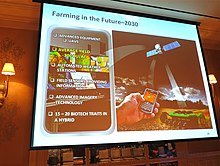
Software and algorithms developed by AI researchers are now integrated into many applications worldwide, although they are not called AI. This underappreciation is known from such diverse fields as computer chess, marketing, agricultural automation and the hospitality industry.
Michael Swaine reports: «These days, advances in artificial intelligence are not as often lauded as artificial intelligence, but are often regarded as advances in some other field». «Artificial intelligence has become more important as it has become less conspicuous», says Patrick Winston. «These days it's hard to find a large system that doesn't work in part because of ideas developed or matured in the AI world».
According to Stottler Henke, «the great practical benefits of AI applications, and even the very presence of AI in many software products, remain largely unnoticed by many, despite the already widespread use of AI techniques in software. This is the AI effect. do not use the term «artificial intelligence», even if their company's products are based on some artificial intelligence techniques. Why not?»
Marvin Minsky writes: «This paradox arose because whenever an AI research project made a new useful discovery, that product would usually quickly turn into a new scientific or commercial specialty with its own distinctive name. These changes in name led outsiders to ask, «Why do we see so little progress in the core field of artificial intelligence?»
Nick Bostrom notes that «a lot of cutting-edge AI has filtered into general applications, often without being called AI, because once something becomes useful enough and common enough, it's not labeled AI anymore».
The influence of AI on supply-chain risk-management decision-making is a severely understudied area.
To avoid the problem of the AI effect, the editors of a special issue of IEEE Software, devoted to AI and software engineering, recommend, to begin with, not overstating — not exaggerating — the results that are actually achievable.
The Bulletin of the Atomic Scientists views the AI effect as a global strategic military threat. As they note, this obscures the fact that AI applications had already found use in both the American and Soviet armed forces during the Cold War. Artificial intelligence tools for advising people on weapons deployment were even developed by both sides and were used only to a very limited extent at the time. They believe that this constantly shifting failure to recognize AI continues to undermine human awareness of security threats today.
Many AI researchers find that they can get more funding and sell more software if they avoid the bad reputation of «artificial intelligence» and instead pretend that their work has nothing to do with intelligence at all. This was especially true in the early 1990s, during the second « AI winter ».
Patty Tascarella writes: «Some believe that the word «robotics» actually carries a stigma that reduces a company's chances of getting funding».
Michael Kearns suggests that «people subconsciously try to preserve some special role for themselves in the universe». By dismissing artificial intelligence, people can continue to feel unique and special. Kearns argues that this shift in perception, known as the AI effect, can be traced to the moment the mystery was removed from the system. The ability to trace the cause of an event implies that it is a form of automation rather than intelligence.
A related effect has been noted in the history of animal cognition and in consciousness studies, where every time an ability previously thought to be exclusively human is discovered in animals (for example, the ability to make tools or pass the mirror test), the overall importance of that capacity becomes obsolete.
Herbert A. Simon, when asked about the lack of press coverage of AI at the time, said: «What distinguished AI was that the very idea of it provokes real fear and hostility in some people. So you get very strong emotional reactions. But that's fine. We'll live with it».
Mueller 1987 proposed comparing AI to human intelligence by devising a standard for human-level machine intelligence. Nevertheless, this suffers from the AI effect when different people are used as the standard.
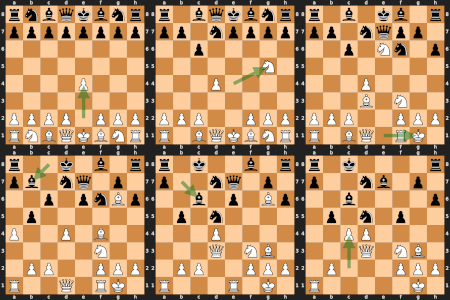
When IBM's chess computer Deep Blue managed to defeat Garry Kasparov in 1997, people complained that it had only used «brute force methods» and was not truly intelligent. Society's perception of chess shifted from a complex mental challenge to a routine operation. Fred A. Reed writes:
«The problem AI advocates regularly run into is this: once we know how a machine does something «intelligent», it stops being considered intelligent. If I beat the world chess champion, I'll be considered very smart».
On the contrary, John McCarthy was disappointed with Deep Blue. He argued that it was merely a brute-force machine, and had no deep understanding of the game. However, this does not mean that McCarthy rejected AI altogether. He was one of the founders of the field and coined the term «artificial intelligence». McCarthy lamented the widespread prevalence of the AI effect,
As soon as it works, no one will call it AI anymore
but simply didn't consider Deep Blue a good example.
Experts agree that the AI effect definitely — or probably — will continue. Since technological development is a continuous and endless process, the AI effect will also continue indefinitely. Each advance in AI will provoke a new objection and a new redefinition of public expectations, one that keeps expanding. Without addressing the AI effect directly, some authors have suggested , that the indefinite persistence of this phenomenon may be linked to artificial intelligence itself, much like Moore's law.
The AI effect may grow into a rejection of all specialized artificial intelligences. Instead, public perception of «artificial intelligence» may shift to include only those that are networks or collectives of several specialized AIs.

Comments