
Lecture
The development of modern artificial intelligence (AI) systems is accompanied by a rapid increase in the demand for computing resources. Neural network models have grown tens and hundreds of times larger in terms of number of parameters, and their training and operation require substantial expenditures of electrical energy. Understanding the structure of AI energy consumption makes it possible to assess the ecological footprint of these technologies, optimize infrastructure, and forecast the further development of the industry.
Energy costs are divided into two main categories:
Training large models — is the most energy-intensive stage of the AI life cycle. It includes:
repeated passes of training data through the model (epochs);
the operation of dozens or hundreds of graphics accelerators;
data transfer between cluster nodes;
server cooling.
For example:
training large language models with tens of billions of parameters can require anywhere from several gigawatt-hours to tens of gigawatt-hours of energy;
a large GPU cluster consumes 3–15 MW depending on its size and load.
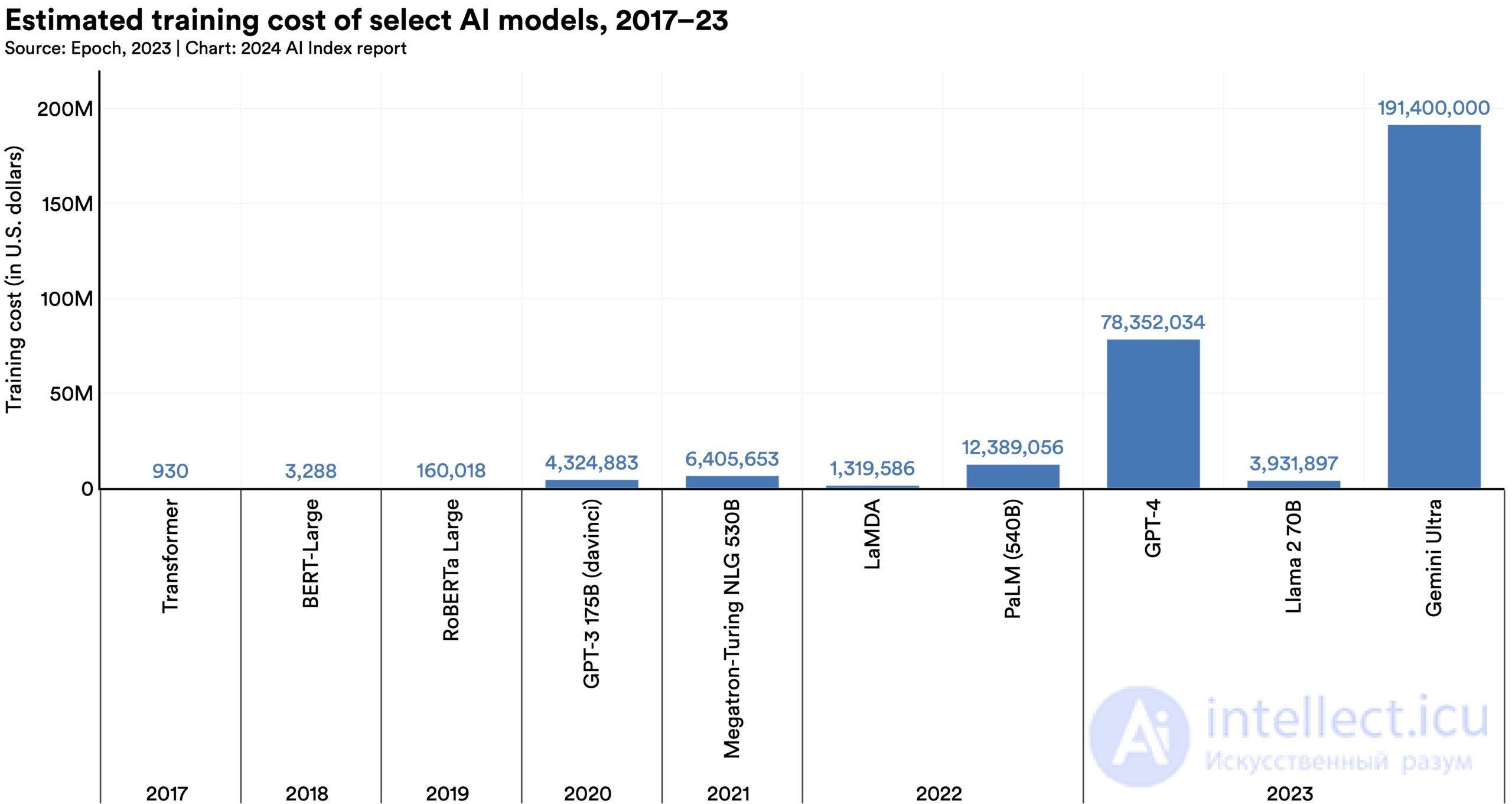
Training the largest models requires substantial infrastructure. The trend toward increasing model sizes is visible in the list of large language models. For example, training GPT-2 (that is, a model with 1.5 billion parameters) in 2019 cost $50,000, while training PaLM (that is, a model with 540 billion parameters) in 2022 cost $8 million, and Megatron-Turing NLG 530B (in 2021) — cost around $11 million. The definition of «large» in the expression «large language model» is inherently vague, since there is no defined threshold for the number of parameters needed for a model to be considered «large».
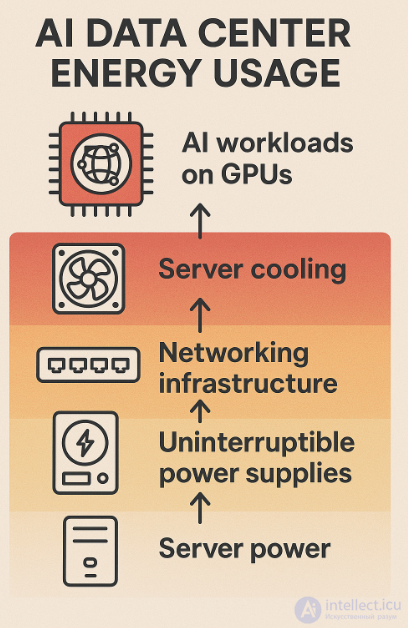
Using a model — answering queries, generating images, audio, and so on — also requires substantial resources, especially with high volumes of requests.
Typical figures:
a single request to a GPT-scale model can consume between 0.1 and 2 W·s, and generating a long text — tens of times more;
the continuous operation of data centers includes costs for:
powering servers,
cooling,
network infrastructure,
uninterruptible power supply systems.
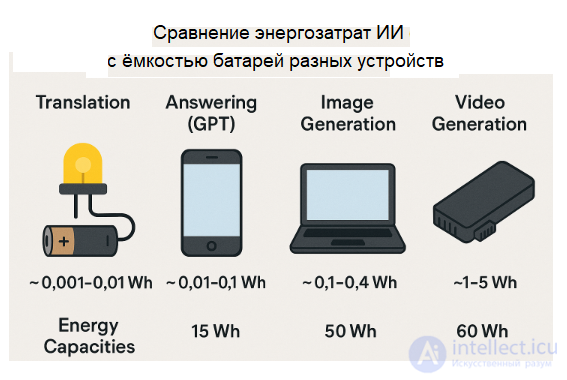
Below is a comparative table of the energy costs of various AI tasks — from text translation to image and video generation. It is based on recent research from MIT Technology Review, Nature, and academic publications.
Table of energy costs of AI systems
The data is approximate, since exact values depend on the model, data center, GPU, and optimizations.
| Task type | Example models | Workload description | Average energy consumption per request* | Comments |
|---|---|---|---|---|
| Classic machine translation (NMT) | Marian, OpusMT, mBART-small | Lightweight seq2seq models, short context | 0.001–0.01 Wh | Very low cost — the model is small, requests are short |
| Translation or short reply in chat models (small LLM) | GPT-3.5-tier, Llama-3 8B | Small LLMs, short request | 0.02–0.1 Wh | Depends on context length; fast and cheap models |
| Responses from large LLMs (GPT-4/5-class) | GPT-4, GPT-5, Claude-Opus | Large transformers, long context | 0.3–3 Wh | The main energy consumer — the number of parameters and the length of the response |
| Long-form reasoning (chain-of-thought) | GPT-5, DeepSeek-R1 | Very large LLMs, many internal steps | 1–10 Wh | Internal computations increase energy costs by ×3–10 |
| Image generation (Diffusion) | Stable Diffusion, DALL·E, Midjourney | Iterative denoising processes | 1–5 Wh per image | Depends on the number of steps (50–150) and resolution |
| 3D / depth / segmentation generation | ControlNet, SD-XL Depth | Additional networks + diffusion | 2–7 Wh | Several models operate simultaneously |
| Short video generation (1–5 sec) | Runway Gen-2, Sora-like | Diffusion + video transformer | 10–80 Wh | The most energy-intensive type of generation, proportional to the number of frames |
| Long video generation (10–60 sec) | Sora-class | Multi-frame models with a huge number of parameters | 150–600 Wh | Strongly dependent on FPS, resolution, and sampling |
| Rendering + AI simulations (physics, agents) | Google Imagen Video, Game-AI transformers | Complex computations + memory | 5–20 Wh | Heavy multi-component workload |
* Wh = watt-hour.
For reference: 1 Wh ≈ the energy consumed by a 1 W light bulb over 1 hour.
5000 mA·h at 3.85 V → ≈ 19.25 Wh
4000 mA·h at 3.7 V → ≈ 14.8 Wh
3000 mA·h at 3.7 V → ≈ 11.1 Wh
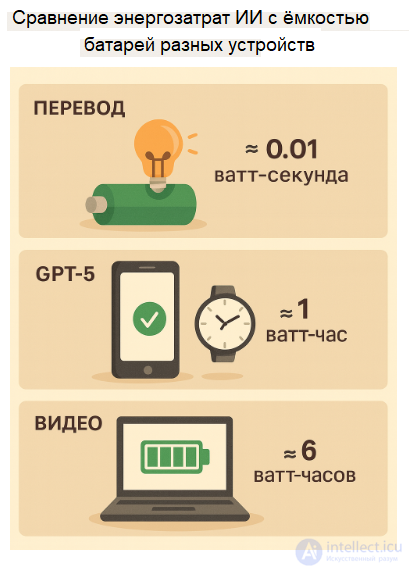
Text translation — is the most energy-efficient task, since the models are compact and optimized.
Chatbot responses (GPT) — higher energy costs, especially for large models (GPT-4).
Image generation — requires significantly more energy, especially at high resolution.
Video generation — the leader in energy consumption, since each frame is created separately and requires large computing resources.
Modern graphics processors — are the main working tool of AI:
they consume 300–700 W each under full load;
a server with 8–16 GPUs can consume up to 10 kW for computation alone.
Google TPU, NVIDIA Grace Hopper, Cerebras, and other accelerators make it possible to:
increase the energy efficiency of operations;
reduce training time;
reduce heat generation.
The PUE (Power Usage Effectiveness) metric:
1.0 — ideal (all energy goes only to computation),
top-tier data centers operate at a PUE level of 1.1–1.2,
older ones — 1.5–2.0.
This means that for every kilowatt of equipment operation, another 0.1–1 kW can be spent on cooling alone.
Model size — more parameters mean more energy.
Architecture type — transformers are energy-intensive; mixture-of-experts (MoE) models are more economical.
Computation optimization — int8, int4, sparsity reduce costs.
Quality of code and parallelization — delayed gradients, distributed training.
Data center topology — proximity of GPUs, interconnect speed.
Location — cold regions make it possible to reduce cooling costs.
Large models are comparable in energy consumption to:
air travel,
the operation of large industrial enterprises,
the data centers of global social networks.
At the same time, the energy footprint depends not only on the amount of energy consumed, but also on its source:
coal-based power → high CO₂ emissions,
renewable power → minimal impact.
Many companies are switching AI servers to solar, wind, and geothermal energy.
Mixture of Experts (MoE) — activate only part of the parameters.
Compact models (small/efficient AI).
Fine-tuning instead of full training.
quantization (int8, int4);
sparsity (zeroing out useless weights);
AI-graph compilers: TensorRT, XLA, DeepSpeed.
next-generation energy-efficient GPUs;
liquid cooling;
specialized accelerators.
optimizing equipment placement;
using natural cold (Scandinavia, Canada);
recycling heat for building heating.
Growing demand: by 2030, AI systems could consume up to 3–5% of the world's electricity.
New training paradigms:
training on simulated data,
bionic computing,
neuromorphic chips.
Algorithm optimization will become a key task in training models with billions of parameters.
Decentralized AI: moving inference to mobile devices will reduce the load on data centers.
Government regulation: efficiency standards, emission limits, transparency requirements.
Energy consumption — is a central problem of modern AI. The growth of computational models leads to a noticeable increase in energy costs, but progress in hardware, algorithms, and data center architecture makes it possible to gradually reduce the unit cost of computation. The future of AI depends on the industry's ability to find a balance between performance, efficiency, and environmental responsibility.

Comments