
Lecture
In today's world of artificial intelligence there are many models designed for various tasks. ChatGPT, AgentGPT and AutoGPT – three powerful tools that use GPT-4, but differ in their level of autonomy and area of application.
In this article we will examine in detail the differences between these models to help you choose the most suitable tool.
ChatGPT – is a chatbot optimized for conversational interaction. It answers questions, helps with code, writes texts, analyzes information, and performs other tasks related to natural language processing.
Features:
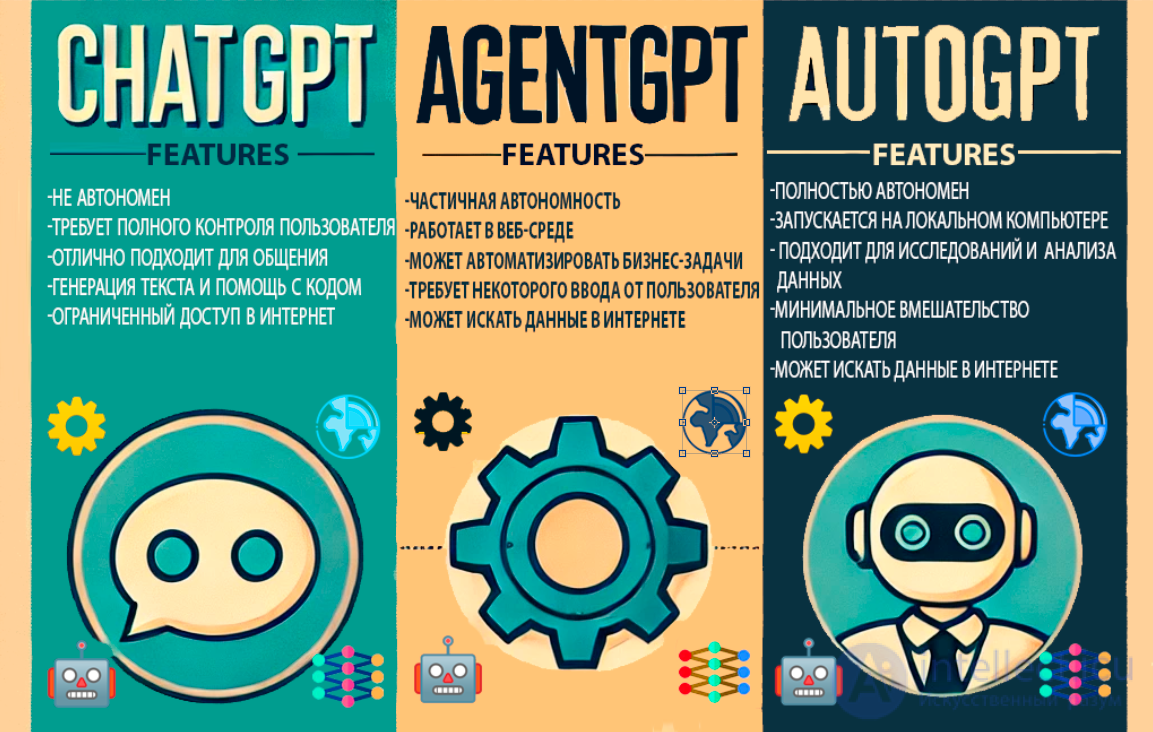
AgentGPT – is a system that creates autonomous AI agents capable of working without constant user oversight. It allows an agent to set goals, develop strategies, and adapt in the process of carrying out tasks.
Features:
AutoGPT is also an advanced NLP tool, created as an open-source autonomous AI application that uses GPT-4, as well as internet-browsing capabilities, to independently perform complex tasks. The main difference between AutoGPT and AgentGPT is that AgentGPT operates in a web environment, while AutoGPT runs on users' computers and performs its tasks there.
As already mentioned, AgentGPT requires input and interaction from the user. AutoGPT, on the other hand, is designed to work independently and to work out its own prompts to solve tasks.
AgentGPT is well suited for tasks such as sales or marketing automation, where human input initiates and directs how the agent carries them out. AutoGPT is better suited for tasks where the tool has full autonomy to act, such as creating new content, conducting research and analysis, and managing data.
AutoGPT is prone to frequent errors, primarily because it relies on its own feedback, which can compound mistakes. In contrast, non-autonomous models can be corrected by users who monitor their output. In addition, AutoGPT has a tendency to hallucinate, or to present false or misleading information as fact when responding.
AutoGPT can be limited by the costs associated with running it, since its recursive nature requires constantly calling the OpenAI API on which it is built. Each step required in one of AutoGPT's tasks requires a corresponding call to GPT-4 at a price of at least $0.03 per 1000 tokens used for input, and $0.06 per 1000 tokens for output, when choosing the cheapest option. For reference, 1000 tokens correspond to roughly 750 words.
Another limitation is AutoGPT's tendency to get stuck in infinite loops. Developers believe this is a result of AutoGPT's inability to remember, since it does not know what it has already done and repeatedly tries to perform the same subtask endlessly. Andrej Karpathy, co-founder of OpenAI, which created GPT-4, further explains that it is AutoGPT's «finite context window» that can limit its performance and cause it to «go off the rails». Like other autonomous agents, AutoGPT is prone to distraction and unable to stay focused on its goal due to a lack of long-term memory, which leads to unpredictable and unintended behavior
GodMode — is one of the newest solutions in the world of autonomous AI agents, which has already attracted attention for its advanced capabilities. Like AutoGPT and AgentGPT, it allows users to create AI agents to accomplish specified goals.
GodMode's main advantage — is simplicity of setup. Although it still lags behind AgentGPT in personalization capabilities, such as giving the agent a name, this shortcoming is offset by an intuitive and convenient interface.
GodMode clearly demonstrates the rapid development of technology in the field of AI agents. New tools offering ever more advanced features and improvements appear every day.
| Feature | ChatGPT | AgentGPT | AutoGPT | GodMode |
|---|---|---|---|---|
| Autonomy | No | Partial. has mouse movements and keystrokes | Full Partial. has mouse movements and keystrokes | Partial |
| User control | Full | Partial | Minimal | Minimal |
| Flexibility in performing tasks | Limited | High | Maximum | High |
| Dialogue support | Excellent | Medium | Minimal | Medium |
| Internet access | Limited | Can search for data | Can search for data | Can search for data |
| Operating environment | Web | Web | Local computer | Web/Local computer |
| Primary purpose | Conversation, help with tasks | Business process automation | Fully autonomous execution of complex tasks | Simple setup and management of AI agents |
| Requires user input | Yes | Partially | No | Partially |
| Examples of use | Chatbot, text generation, help with code | Marketing automation, sales, data processing | Research, data analysis, autonomous content creation | Simple creation and launching of AI agents without complex setup |
We are only beginning to unlock the potential of intelligent agents, and their development could radically change many spheres of life. The creation of autonomous systems capable of exploring, planning, and performing complex tasks promises a genuine technological revolution.
Imagine AI assistants capable of analyzing millions of scientific publications, finding hidden patterns and proposing new hypotheses. Or powerful AI-based strategic analysts that instantly adapt to market changes, offering optimal business solutions. The possibilities of these technologies are practically limitless: from automating routine tasks to creating fully autonomous management systems.
However, along with progress come challenges. The more advanced AI agents become, the more important it is to develop ethical norms and control mechanisms so that they work in the interests of society. This requires close cooperation among developers, ethics experts, lawmakers, and the public.
In addition, mass automation based on AI agents can significantly increase productivity, but at the same time will affect the labor market, changing the requirements for skills and professions. Managing these changes will become one of the key tasks of the near future.
AI agents open up a world of new possibilities for us, but their development requires a responsible approach, so that the technologies serve humanity rather than create new threats.

Comments