
Lecture
The ethics of artificial intelligence is a branch of the ethics of technology specific to artificially intelligent systems. It is sometimes divided into a concern with the moral behavior of humans as they design, manufacture, use, and treat artificially intelligent systems, and a concern with the behavior of machines, in machine ethics. It also includes the issue of a possible singularity due to superintelligent AI.
The term «robot ethics» (sometimes «roboethics») refers to the morality of how humans design, construct, use, and treat robots. Robot ethics intersects with AI ethics. Robots are physical machines, whereas AI can be only software. Not all robots operate through AI systems, and not all AI systems are robots. Robot ethics considers how machines may be used to harm or benefit humans, their impact on individual autonomy, and their impact on social justice.
Machine ethics (or machine morality) is a field of research concerned with developing artificial moral agents (AMAs), robots, or artificially intelligent computers that behave morally or as though morally. In order to account for the nature of these agents, it has been suggested that certain philosophical ideas be considered, such as the standard characterizations of agency, rational agency, moral agency, and artificial agency, which are related to the concept of AMAs.
Isaac Asimov considered the issue in the 1950s in his book «I, Robot». At the insistence of his editor John W. Campbell Jr., he proposed the Three Laws of Robotics to govern artificially intelligent systems. Much of his subsequent work was then spent testing the boundaries of his three laws, to see where they would break down or lead to paradoxical or unanticipated behavior. His work suggests that no set of fixed laws can sufficiently anticipate all possible circumstances. More recently, scholars and many governments have challenged the notion that AI itself can be held responsible. A panel convened by the United Kingdom in 2010 amended Asimov's laws to clarify that responsibility for AI lies either with its manufacturer or with its owner/operator.
In 2009, during an experiment at the Intelligent Systems Laboratory of the Ecole Polytechnique Fédérale de Lausanne in Switzerland, robots that had been programmed to cooperate with each other (in searching for a beneficial resource and avoiding a poisonous one) eventually learned to lie to one another in an attempt to hoard the beneficial resource.
Some experts and academics have questioned the use of robots for military combat, especially when such robots are given some degree of autonomous function. The US Navy funded a report that indicates that, as military robots become more complex, greater attention should be paid to the implications of their ability to make autonomous decisions. The president of the Association for the Advancement of Artificial Intelligence commissioned a study to examine this issue. They point to programs such as the Language Acquisition Device, which can emulate human interaction.
Vernor Vinge suggested that a moment may come when some computers are smarter than humans. He calls this «the singularity». He suggests that it may be somewhat or perhaps very dangerous for humans. This is discussed by a philosophy called Singularitarianism. The Machine Intelligence Research Institute has suggested a need to build «Friendly AI», meaning that the advances which are already occurring with AI should also include an effort to make AI intrinsically friendly and humane.
The creation of tests to see whether an AI is capable of making ethical decisions is being discussed. Alan Winfield concludes that the Turing test is flawed and the requirement for an AI to pass it is too low. A proposed alternative test is one called the Ethical Turing Test, which would improve on the current test by having multiple judges decide whether the AI's decision is ethical or unethical.
In 2009, academics and technical experts attended a conference organized by the Association for the Advancement of Artificial Intelligence to discuss the potential impact of robots and computers, and the impact of the hypothetical possibility that they could become self-sufficient and able to make their own decisions. They discussed the possibility and the extent to which computers and robots might be able to acquire any level of autonomy, and to what degree they could use such abilities to possibly pose any threat or hazard. They noted that some machines had acquired various forms of semi-autonomy, including the ability to find power sources on their own and the ability to independently choose targets to attack with weapons. They also noted that some computer viruses can evade elimination and have achieved «cockroach intelligence». They noted that self-awareness as depicted in science fiction is probably unlikely, but that there are other potential hazards and pitfalls.
However, there is in particular one technology that could truly bring about the possibility of robots with moral qualities. In an article on robots acquiring moral values, Nayef Al-Rodhan mentions the case of neuromorphic chips, which aim to process information similarly to humans, nonlinearly and via millions of interconnected artificial neurons. Robots embedded with neuromorphic technology could learn and develop knowledge in a uniquely humanlike way. Inevitably, this raises the question of the environment in which such robots would learn about the world and whose morality they would inherit — or if they end up also developing human «weaknesses»: selfishness, a pro-survival attitude, hesitation, and so on.
In Moral Machines: Teaching Robots Right from Wrong, Wendell Wallach and Colin Allen conclude that attempts to teach robots right from wrong will likely advance understanding of human ethics by motivating humans to address gaps in modern normative theory and by providing a platform for experimental investigation. As one example, it introduced normative ethicists to the controversial issue of which specific learning algorithms to use in machines. Nick Bostrom and Eliezer Yudkowsky argued for decision trees (such as ID3) over neural networks and genetic algorithms, on the grounds that decision trees obey modern social norms of transparency and predictability (e.g. stare decisis), while Chris Santos-Lang argued in favor of the opposite, on the grounds that the norms of any age must be allowed to change and that natural failure to fully satisfy these particular norms has been essential in making humans less vulnerable to criminal «hackers».
According to a 2019 report from the Center for the Governance of AI at Oxford University, 82% of Americans believe that robots and AI need to be carefully managed. Concerns cited ranged from how AI is used in surveillance and in spreading fake content online (known as deepfakes when they include fabricated video images and audio generated with AI), to cyberattacks, data privacy violations, hiring bias, autonomous vehicles, and drones that don't require a human controller.
In a survey of 84 ethics guidelines for AI, 11 clusters of principles were found: transparency, justice and fairness, non-maleficence, responsibility, privacy, beneficence, freedom and autonomy, trust, sustainability, dignity, solidarity.
Luciano Floridi and Josh Cowls created an ethical framework of AI principles set by four principles of bioethics (beneficence, non-maleficence, autonomy, and justice) and an additional AI-enabling principle of explicability.
Bill Hibbard argues that because AI will have such a profound effect on humanity, AI developers are representatives of future humanity and thus have an ethical obligation to be transparent in their efforts. Ben Goertzel and David Hart created OpenCog as an open-source framework for AI development. OpenAI is a nonprofit AI research company created by Elon Musk, Sam Altman, and others to develop open-source AI beneficial to humanity. There are numerous other open-source AI developments.
Unfortunately, making code open source does not make it comprehensible, which by many definitions means that the AI code is not transparent. The IEEE has a standardization effort on AI transparency. The IEEE defines several levels of transparency for different users. Furthermore, there is concern that releasing the full capacity of contemporary AI to certain organizations may be a societal harm, that is, may do more harm than good. For example, Microsoft has expressed concern about allowing universal access to its facial recognition software, even for those who can pay for it. Microsoft posted an unusual blog on this topic, asking for government regulation to help determine what to do.
Not only companies, but many other researchers and civil rights advocates recommend government regulation as a means of ensuring transparency, and through it, human accountability. This strategy has proven controversial, as some worry that it will slow the rate of innovation. Others argue that regulation leads to systemic stability more able to support innovation in the long term. The OECD, UN, EU, and many countries are presently working to devise strategies for regulating AI, and to find appropriate legal frameworks.
On June 26, 2019, the European Commission's High-Level Expert Group on Artificial Intelligence (AI HLEG) published its «Policy and investment recommendations for trustworthy artificial intelligence». This is the AI HLEG's second deliverable, after the April 2019 publication of the «Ethics Guidelines for Trustworthy AI». The June AI HLEG recommendations cover four principal subjects: humans and society at large, research and academia, the private sector, and the public sector. The European Commission claims that «HLEG's recommendations reflect an appreciation of both the opportunities for AI technologies to drive economic growth, prosperity, and innovation, as well as the potential risks involved» and states that the EU aims to lead on the framing of policies governing AI internationally.
AI is increasingly integral to facial and voice recognition systems. Some of these systems have real business applications and directly impact people. These systems are vulnerable to biases and errors introduced by their human creators. Additionally, the data used to train these AI systems can itself have biases. For instance, facial recognition algorithms developed by Microsoft, IBM, and Face++ all had biases when it came to detecting people's gender; these AI systems were able to detect the gender of white men more accurately than the gender of men with darker skin. Further, a 2020 study of voice recognition systems from Amazon, Apple, Google, IBM, and Microsoft found that they have higher error rates when transcribing Black people's voices than white people's. Furthermore, Amazon discontinued its use of AI hiring and recruitment because the algorithm favored male candidates over female ones. This was because Amazon's system was trained using data collected over a 10-year period that came mostly from male candidates.
Bias can creep into algorithms in many ways. For example, Friedman and Nissenbaum identify three categories of bias in computer systems: existing bias, technical bias, and emergent bias. In natural language processing, problems can arise from the text corpus — the source material the algorithm uses to learn about the relationships between different words.
Large companies such as IBM, Google, etc. have made efforts to research and address these biases. One solution for addressing bias is to create documentation for the data used to train AI systems.
The problem of bias in machine learning is likely to become more significant as the technology spreads to critical areas like medicine and law, and as more people without a deep technical understanding are tasked with deploying it. Some experts warn that algorithmic bias is already widespread in many industries and that almost no one is making an effort to identify or correct it. There are some open-source tools from civil society that are trying to raise awareness of biased AI.
«Robot rights» is the concept that people should have moral obligations towards their machines, similar to human rights or animal rights. It has been suggested that robot rights (such as a right to exist and perform its own mission) could be linked to robot duty to serve humanity, analogous to linking human rights with human duties before society. These could include the right to life and liberty, freedom of thought and expression, and equality before the law. This issue has been considered by the Institute for the Future and by the U.K. Department of Trade and Industry.
Experts disagree on how soon specific and detailed laws on this subject will be needed. Glenn McGee reported that sufficiently humanoid robots might appear by 2020, while Ray Kurzweil sets the date at 2029. Another group of scientists meeting in 2007 speculated that at least 50 years would have to pass before any sufficiently advanced system would exist.
The rules for the 2003 Loebner Prize competition envisioned the possibility of robots having their own rights:
61. If, in any given year, a publicly available open-source entry submitted by the University of Surrey or the Cambridge Center wins the Silver or Gold Medal, then the Medal and the cash award will be presented to the body responsible for the development of that entry. If no such body can be identified, or if there is disagreement among two or more claimants, the Medal and the cash award will be held in trust until such time as the entry may legally possess, either in the United States of America or in the venue of the contest, the cash award and the Gold Medal.
In October 2017, the android Sophia was granted «honorary» citizenship in Saudi Arabia, though some considered this to be more of a publicity stunt than a meaningful legal recognition. Some saw this gesture as openly denigrating human rights and the rule of law.
The philosophy of sentientism grants degrees of moral consideration to all sentient beings, primarily humans and most non-human animals. If artificial or alien intelligence show evidence of being sentient, this philosophy holds that they should be shown compassion and granted rights.
Joanna Bryson has argued that creating AI that requires rights is both avoidable, and would in itself be unethical, both as a burden to the AI agents and to human society.
Joseph Weizenbaum argued in 1976 that AI technology should not be used to replace people in positions that require respect and care, such as:
Weizenbaum explains that we require authentic feelings of empathy from people in these positions. If machines replace them, we will find ourselves alienated, devalued, and frustrated, for the artificially intelligent system would not be able to simulate empathy. Artificial intelligence, if used in this way, represents a threat to human dignity. Weizenbaum argues that the fact that we are entertaining the possibility of machines in these positions suggests that we have experienced «an atrophy of the human spirit that comes from thinking of ourselves as computers».
Pamela McCorduck counters that, speaking for women and minorities «I'd rather take my chances with an impartial computer», pointing out that there are conditions where we would prefer to have automated judges and police that have no personal agenda at all. However, Kaplan and Haenlein stress that AI systems are only as smart as the data used to train them, since they are, in their essence, nothing more than fancy curve-fitting machines; using AI to support a court ruling can be quite problematic if past rulings show bias toward certain groups, since those biases get formalized and entrenched, which makes them even harder to spot and counteract.
Weizenbaum was also bothered that AI researchers (and some philosophers) were willing to view the human mind as nothing more than a computer program (a position now known as computationalism). To Weizenbaum, these points suggest that AI research devalues human life.
AI founder John McCarthy objects to the moralizing tone of Weizenbaum's critique. «When moralizing is both vehement and vague, it invites authoritarian abuse», he writes. Bill Hibbard writes that «human dignity requires that we strive to remove our ignorance of the nature of existence, and AI is necessary for that striving».
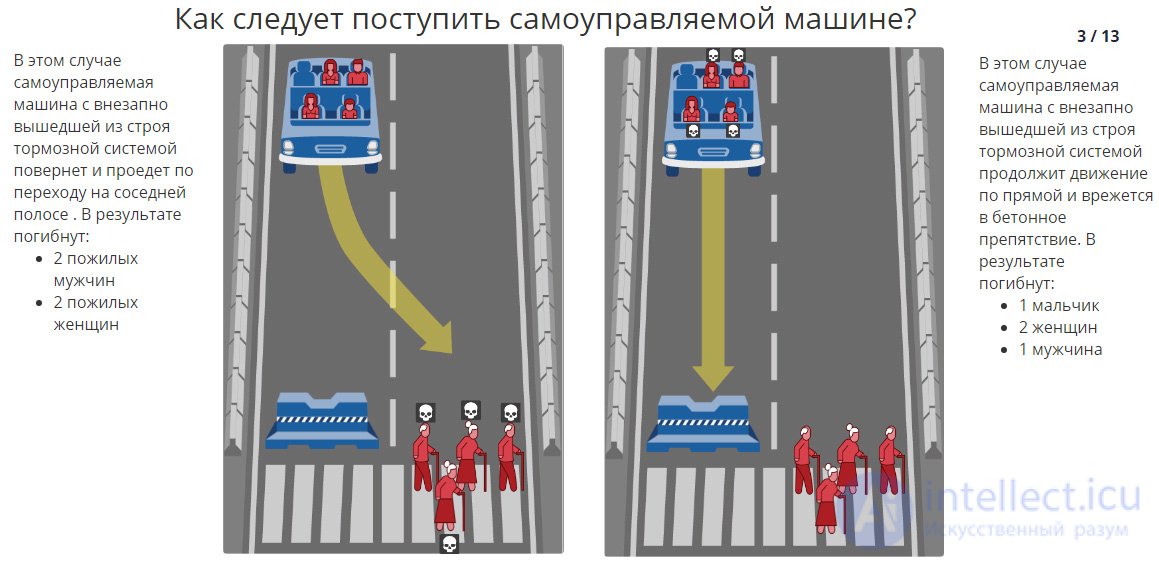
As the widespread use of autonomous cars becomes increasingly imminent, new challenges raised by fully autonomous vehicles must be addressed. There have recently been debates regarding legal liability of the responsible party if these cars get into accidents. In one report where a driverless car struck a pedestrian, the driver was inside the car, but the controls were completely in the hands of computers. This led to a dilemma over who was at fault for the accident.
In another incident on March 19, 2018, Elaine Herzberg was struck and killed by a self-driving Uber in Arizona. In this case, the automated car was capable of detecting cars and certain obstacles in order to autonomously navigate the roadway, but it could not anticipate a pedestrian in the middle of the road. This raised the question of who was to be held accountable for her death: the driver, the pedestrian, the car company, or the government.
Currently, self-driving cars are considered semi-autonomous, requiring the driver to pay attention and be prepared to take control if necessary. Thus, it falls to governments to regulate the driver who over-relies on autonomous features, as well as to explain to them that these are merely technologies that, while convenient, are not a complete substitute. Before autonomous vehicles become widely used, these issues need to be tackled through new policies.
Some experts and academics have questioned the use of robots in military combat, especially when such robots are given some degree of autonomous function. On October 31, 2019, the United States Department of Defense's Defense Innovation Board published a draft report outlining principles for the ethical use of artificial intelligence by the Department of Defense that would ensure a human operator would always be able to look into the «black box» and understand the kill-chain process. However, a major concern is how the report will be implemented. The US Navy funded a report which indicates that as military robots become more complex, there should be greater attention to implications of their ability to make autonomous decisions. Some researchers state that autonomous robots might be more humane, as they could make decisions more effectively.
Over the last decade, intensive research has been conducted into autonomous power with the ability to learn using assigned moral responsibilities. «The results may be used when designing future military robots, to control unwanted tendencies to assign responsibility to the robots». From a consequentialist view, there is a chance that robots will develop the ability to make their own logical decisions on who to kill, and that is why there should be a set moral framework that the AI cannot override.
There has been a recent outcry with regard to the engineering of artificial intelligence weapons that have included ideas of a robot takeover of humankind. AI weapons do present a type of danger different from that of human-controlled weapons. Many governments have begun to fund programs to develop AI weaponry. The United States Navy recently announced plans to develop autonomous drone weapons, paralleling similar announcements by Russia and Korea respectively. Due to the potential of AI weapons becoming more dangerous than human-operated weapons, Stephen Hawking and Max Tegmark signed a «Future of Life» petition to ban AI weapons. The message posted by Hawking and Tegmark states that AI weapons pose an immediate danger and that action is required to avoid catastrophic disasters in the near future.
«If any major military power pushes ahead with the development of AI weapons, a global arms race is virtually inevitable, and the endpoint of this technological trajectory is obvious: autonomous weapons will become the Kalashnikovs of tomorrow», says the petition, which includes Skype co-founder Jaan Tallinn and MIT professor of linguistics Noam Chomsky as additional supporters against AI weaponry.
Physicist and astronomer Sir Martin Rees has warned of catastrophic instances like «dumb robots going rogue or a network that develops a mind of its own». Huw Price, a colleague of Rees at Cambridge, has voiced a similar warning that humans might not survive when intelligence «escapes the constraints of biology». These two professors created the Centre for the Study of Existential Risk at Cambridge University in the hope of avoiding this threat to human existence.
Regarding the potential for smarter-than-human systems to be employed militarily, the Open Philanthropy Project writes that these scenarios «seem potentially as important as risks related to loss of control», but research investigating AI's long-run social impact has spent relatively little time on this concern: «this class of scenarios has not been a major focus for the organizations that have been most active in this space, such as the Machine Intelligence Research Institute (MIRI) and the Future of Humanity Institute (FHI), and there seems to have been less analysis and debate regarding them».
Approaches like machine learning with neural networks can result in computers making decisions that neither they nor their human programmers can explain. It is difficult for people to determine whether such decisions are fair and trustworthy, potentially leading to bias in AI systems going undetected, or to people rejecting the use of such systems. This has led to advocacy, and in some jurisdictions, legal requirements for explainable artificial intelligence.
Many researchers have argued that, through «an intelligence explosion», a self-improving AI could become so powerful that humans would not be able to stop it from achieving its goals. In his paper «Ethical Issues in Advanced Artificial Intelligence» and subsequent book «Superintelligence: Paths, Dangers, Strategies», philosopher Nick Bostrom argues that artificial intelligence has the capability to bring about human extinction. He claims that general superintelligence would be capable of independent initiative and of making its own plans, and may therefore be more appropriately thought of as an autonomous agent. Since artificial intellects need not share our human motivational tendencies, it would be up to the designers of the superintelligence to specify its original motivations. Because a superintelligent AI is able to bring about almost any possible outcome and to thwart any attempt to prevent the implementation of its goals, many uncontrolled unintended consequences could arise. It could kill off all other agents, persuade them to change their behavior, or block their attempts at interference.
However, instead of overwhelming the human race and leading to our destruction, Bostrom has also argued that superintelligence can help us solve many difficult problems such as disease, poverty, and environmental destruction, and could help us to «enhance» ourselves.
The sheer complexity of human values makes it very difficult to make AI's motivations human-friendly. Unless moral philosophy provides us with a flawless ethical theory, an AI's utility function could allow for many potentially harmful scenarios that conform to a given ethical framework but not to «common sense». According to Eliezer Yudkowsky, there is little reason to suppose that an artificially designed mind would have such an adaptation. AI researchers such as Stuart J. Russell, Bill Hibbard, Roman Yampolskiy, Shannon Vallor, Steven Umbrello, and Luciano Floridi have proposed design strategies for developing beneficial machines.
There are many organizations concerned with AI ethics and policy, public and governmental as well as corporate and civil society.
Amazon, Google, Facebook, IBM, and Microsoft have established a non-profit organization, the Partnership on AI to Benefit People and Society, to formulate best practices on artificial intelligence technologies, advance the public's understanding, and to serve as a platform on artificial intelligence. Apple joined in January 2017. The corporate members will make financial and research contributions to the group, while engaging with the scientific community to bring academics onto the board.
The IEEE put together a Global Initiative on Ethics of Autonomous and Intelligent Systems which has been creating and revising guidelines with the help of public input, and accepts as members many professionals from within and without its organization.
Traditionally, government has been used by societies to ensure ethics are observed through legislation and policing. There are now many efforts by national governments, as well as transnational government and non-government organizations to ensure AI is ethically applied.
Intergovernmental initiatives:
Governmental initiatives:
Academic initiatives:
Constitutional artificial intelligence is a method of AI development focused on aligning outputs with human values and ethical principles. Instead of relying entirely on human feedback, it draws on a predefined set of rules, or a "constitution", that helps the AI adjust its responses during training. This makes it possible to build safe, honest, and helpful AI systems, minimizing the likelihood of biased or harmful outputs.
This approach, first proposed by researchers at Anthropic, makes the process of AI alignment more scalable and less dependent on constant human oversight.
The key elements of the concept:
A constitution — not a legal document, but a set of ethical rules that the AI follows in its behavior. These principles can be based on international declarations, terms of service, or specially crafted guidelines.
AI self-assessment and self-criticism — a system in which the model analyzes its own responses, checks them against the constitution, and corrects shortcomings, reducing the need for external oversight.
AI alignment — a method that seeks to align the AI's goals and actions with human intentions and values, addressing safety concerns and potential risks.
Scalability — automating feedback through constitutional principles makes the method more efficient than RLHF, which requires substantial human resources and can introduce bias.
This approach makes it possible to develop AI systems that better adapt to complex ethical requirements and minimize undesirable consequences.
Reinforcement learning from human feedback (RLHF) is an AI alignment method in which humans evaluate the model's outputs and provide feedback, improving its behavior. In contrast, constitutional AI relies on a predefined set of rules, allowing models to adjust their own responses independently. This makes it potentially more scalable and consistent, but its effectiveness depends on the quality of those principles.
AI ethics and responsible AI are broad concepts covering the moral dimensions of technology. AI ethics studies the impact of AI on society, while responsible AI encompasses practices that ensure safety and transparency (for example, fairness, XAI, accountability, and data protection). Constitutional AI is one method that embeds ethical principles directly into the model training process, contributing to the development of more trustworthy and safer systems.
The role of fiction with regard to AI ethics has been complex. Three levels can be distinguished at which fiction has influenced the development of artificial intelligence and robotics: historically, fiction has been a prefiguration of general tropes that not only influenced the goals and vision for AI, but also outlined ethical questions and common fears associated with it. During the second half of the twentieth century and the early decades of the twenty-first, popular culture, in particular movies, TV series, and video games, has frequently echoed concerns and dystopian projections around ethical questions concerning AI and robotics. Recently, these themes have also increasingly been treated in literature going beyond the realm of science fiction. As Carme Torras, a research professor at the Institut de Robòtica i Informàtica Industrial (Institute of Robotics and Industrial Informatics) at the Technical University of Catalonia, notes,[118] in higher education, science fiction is also increasingly being used to teach technology-related ethical issues in technical degree programs.
History
Historically, the investigation of moral and ethical implications of «thinking machines» goes back at least to the Enlightenment: Leibniz already poses the question of whether we might attribute intelligence to a mechanism that behaves as though it were a sentient being, and so does Descartes, in describing what might be considered an early version of the Turing test.
The romantic period has several instances of artificial beings escaping their creator's control with dire consequences, most famously in Mary Shelley's «Frankenstein». However, the widespread concern with industrialization and mechanization in the 19th and early 20th centuries brought ethical implications of unchecked technical developments to the forefront of fiction: R.U.R. — Rossum's Universal Robots, Karel Čapek's play about sentient robots endowed with emotions used as slave labor, is not only credited with inventing the term «robot» (derived from the Czech word for forced labor, robota), but was also an international success after it premiered in 1921. George Bernard Shaw's play Back to Methuselah, published in 1921, questions at one point the validity of thinking machines that act like humans; Fritz Lang's 1927 film «Metropolis» shows an android leading the revolt of the exploited masses against the oppressive regime of a technocratic society.
Fiction's influence on technological development
While the anticipation of a future dominated by potentially unmanageable technology has long fueled the imagination of writers and filmmakers, one question has been analyzed less often, namely, to what extent fiction has played a role in providing inspiration for technological development. For example, it has been documented that a young Alan Turing saw and admired G. B. Shaw's play «Back to Methuselah» in 1933 (just three years before he published his first seminal paper, which laid the foundation for the digital computer), and he was probably at least aware of plays such as «R.U.R.», which enjoyed international success and were translated into many languages.
One might also ask what role science fiction has played in establishing the principles and ethical implications of AI development: Isaac Asimov conceptualized his «Three Laws of Robotics» in his 1942 short story «Runaround», part of the collection I, Robot; Arthur C. Clarke's short story «The Sentinel», on which Stanley Kubrick's film «2001: A Space Odyssey» is based, was written in 1948 and published in 1952. Another example, among many others, is the numerous short stories and novels of Philip K. Dick — particularly Do Androids Dream of Electric Sheep?, published in 1968 and featuring its own version of the Turing test, the Voight-Kampff test, to gauge the emotional responses of androids indistinguishable from humans. The novel later became the basis for the influential 1982 film «Blade Runner» by Ridley Scott.
Science fiction has grappled for decades with the ethical implications of AI developments and has thus provided a blueprint for ethical issues that may arise once something resembling artificial general intelligence is achieved: Spike Jonze's 2013 film «Her» shows what might happen if a user falls in love with the seductive voice of their smartphone's operating system; Ex Machina, on the other hand, poses a more difficult question: if confronted with a clearly recognizable machine, made only human through a face and an empathetic and sensual voice, could we still establish an emotional connection, still be seduced by it? (The film echoes a theme already present two centuries earlier, in the 1817 short story «The Sandman» by E.T.A. Hoffmann.)
The theme of coexisting with artificially sentient beings is also the subject of two recent novels: «Machines Like Me» by Ian McEwan, published in 2019, involves, among other things, a love triangle involving an artificial human as well as a human couple. Klara and the Sun by Nobel laureate Kazuo Ishiguro, published in 2021, is the first-person account of Klara, an «AF» (Artificial Friend), who tries, in her own way, to help the girl she lives with, who, after having been «lifted» (i.e. subjected to genetic enhancement), suffers from a strange illness.
Television series
While ethical questions related to AI have been featured in science fiction literature and feature films for decades, the emergence of the television series as a genre allowing for longer and more complex plotlines and character development has led to significant contributions treating the ethical implications of technology. The Swedish series «Real Humans» (2012–2013) addressed the complex ethical and social consequences tied to the integration of artificial sentient beings into society. The British dystopian science fiction anthology series «Black Mirror» (2013–2019) was particularly notable for experimenting with dystopian fictional developments related to a wide range of recent technological developments. Both the French series Osmosis (2020) and the British series The One deal with the question of what might happen if technology tried to find the ideal partner for a person.
Visions of the future in fiction and games
The film «The Thirteenth Floor» suggests a future where simulated worlds with sentient inhabitants are created by computer gaming consoles for the purpose of entertainment. The film «The Matrix» suggests a future where the dominant species on planet Earth are sentient machines, and humanity is treated with utmost speciesism. The short story «The Planck Dive» suggests a future where humanity has turned itself into software that can be duplicated and optimized, and the relevant distinction between types of software is sentient and non-sentient. The same idea can be found in the Emergency Medical Hologram of Starship Voyager, which is an apparently sentient copy of a reduced subset of the consciousness of its creator, Dr. Zimmerman, who created the system for medical emergency care. The films «Bicentennial Man» and «A.I.» deal with the possibility of sentient robots that could love. I, Robot explored some aspects of Asimov's three laws. All these scenarios try to foresee possibly unethical consequences of the creation of sentient computers.
The ethics of artificial intelligence is one of several core themes in BioWare's Mass Effect series of games. It explores the scenario of a civilization accidentally creating AI through a rapid increase in computational power via a globally networked neural net. This event caused an ethical schism between those who felt bestowing organic rights upon the newly sentient Geth was appropriate and those who continued to see them as disposable machinery and fought to destroy them. Beyond the initial conflict, the complexity of the relationship between the machines and their creators is another ongoing theme throughout the story.
Over time, debates have tended to focus less and less on possibility and more on desirability, as emphasized in the «Cosmist» and «Terran» debates initiated by Hugo de Garis and Kevin Warwick. A Cosmist, according to Hugo de Garis, is actually seeking to build more intelligent successors to the human species.
Experts at Cambridge University have argued that AI is depicted in fiction and non-fiction predominantly as racially White, which distorts perceptions of its risks and benefits.
AI ethics in Russia
If you think that this is so-called «strong AI» (AGI), you are mistaken.
AGI, in most cases, is not a scam at all, but simply a way of increasing the chances of obtaining funding for one's project by raising a hyped AGI flag over it. And although such projects quite often have little to do with AGI, their creators, nonetheless, at least want to develop something they consider useful.
But the largest scam in AI takes place in the field of «AI ethics».
This topic is going through a «Cambrian explosion» stage. A Google search for “artificial intelligence” returns 200 million links, while a search for “artificial intelligence ethics” returns more than 50% of the number of links of the previous search (107 million).
The scam is quite spectacular, like any magic trick.
And now, exposing this magic trick.
Luciano Floridi — the creator of the «Philosophy of Information» and the term «inforgs» — writes as follows in his essay «Why Information Matters».
«There is no ethics without choice, responsibility, and moral evaluation, i.e. all of which require a large amount of relevant and reliable information, as well as good management».
Consequently, if there is no management controlling the processes of choice, responsibility, and moral evaluation, such AI ethics turns into «ethics theater», in which «ethics washing» takes place.
As shown by the results of the first meta-study of 169 quite substantial works on AI risk audit and analysis, «The Use of AI Ethics in Practice: Are the Tools Fit for Purpose?», 77% of these works do not offer any means of practical control over their own recommendations at all.
That is, everything is limited to philosophical discussions and speculative assessments without any practical methods and management tools for controlling the operation of the AI systems being used.
And if one bothers to read this meta-study carefully, it becomes clear that the remaining 23% of the works are also quite primitive and superficial in their approach to controlling the ethics of AI system operation: the processes by which they make decisions, the assignment of responsibility for those decisions, and the rendering of moral evaluations of the consequences of such decisions.
The reason for the «big scam» in AI ethics seems obvious to me — a mistaken anthropomorphization of AI.
This fundamental error not only throws off the aim of researchers and developers. Worse still, it throws off the aim of society as a whole. Instead of studying the real risks of the widespread introduction of AI into people's lives (the chief of which, in my view, is their transformation into inforgs), a «big scam» is underway in the field of AI ethics — a concept that does not exist in nature.
Hence the «ethics theater», with its endless play about «ethics washing».
Researchers
Organizations

Comments