
Lecture
Neuroslob is content created by a neural network that:
looks real (grammar, style, structure),
but has no meaning, value or reliability. It can be long and convincing at first glance, but on inspection it turns out to be empty.
Artificial intelligence has made getting information almost instantaneous. Writing a text, coming up with an idea, solving a problem, explaining a complex topic, creating an image or drawing up a plan can now be done in a few seconds.
But along with the convenience comes a new phenomenon, which can conditionally be called Neuroslob or the "AI slob".
If AI slop is content that artificial intelligence produces in bulk, then Neuroslob can be understood as a person's habit of constantly handing their own intellectual work over to a neural network — from searching for information to formulating thoughts and making decisions.
In other words:
AI slop is a problem of the quality of AI content. Neuroslob is a problem of the quality of human thinking under excessive dependence on AI.
It is important that Neuroslob is more of a conceptual term than a generally accepted scientific concept. Even in research on AI slop itself there is not yet a single formal definition: researchers note the subjectivity of the assessment and link the phenomenon to characteristics such as superficial competence, disproportion between the effort spent and the result, and the possibility of mass production.
Name variants
Neuroslob — a combination of "neuro" (from "neural network") and "slob" (a slovenly person; rubbish).
AI slop — an English-language term that has become established in the media and dictionaries.
Synthetic junk — emphasizing the artificial origin.
Pseudo-content — pseudo-content that imitates real text or data.
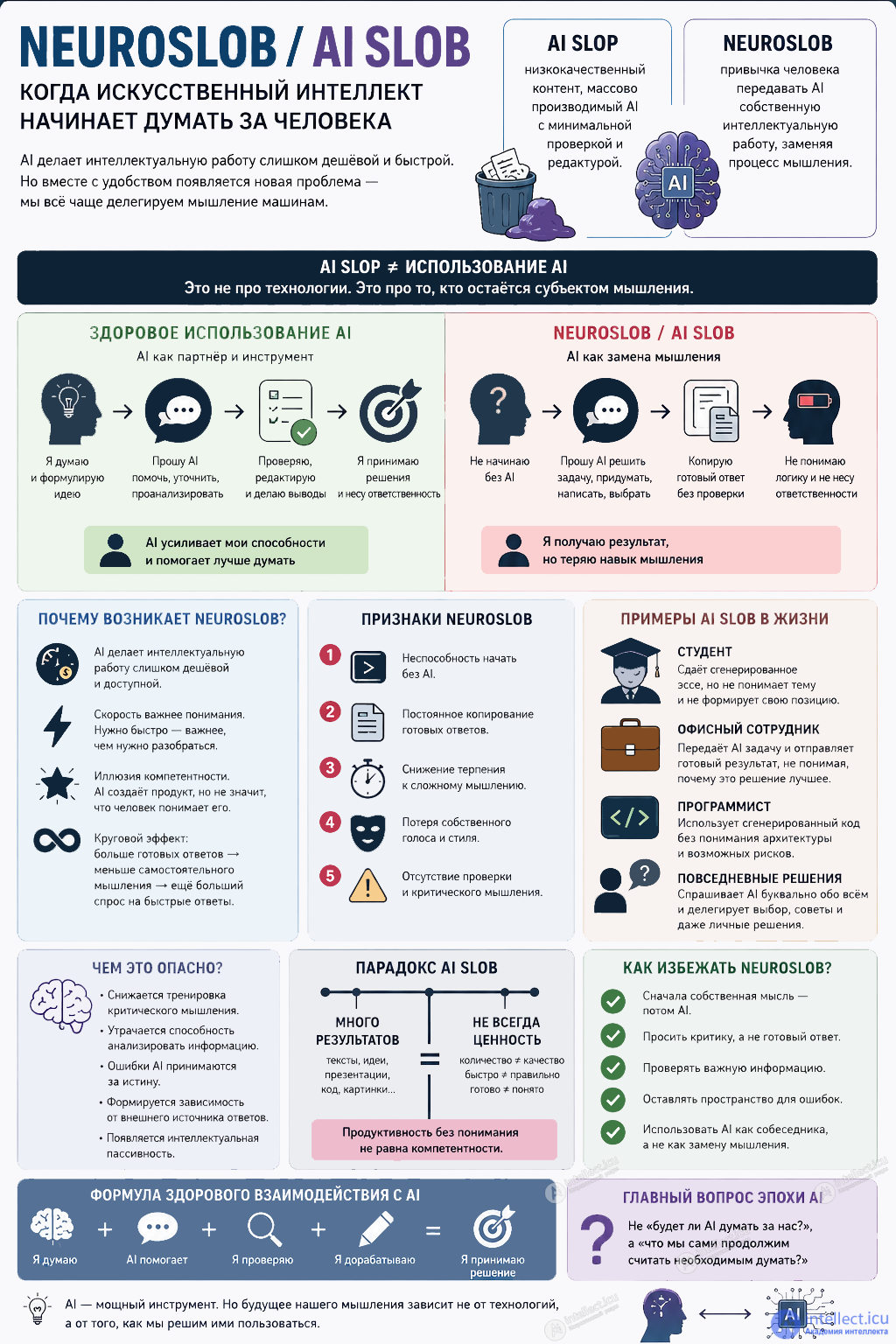
An AI slob can be understood as a person who uses artificial intelligence not so much as a tool for strengthening their own thinking as a replacement for it.
Features
Plausible form: the text resembles a scientific article, news item or essay.
Absence of facts: the data is invented or confused.
Mass scale: such materials are generated in enormous quantities.
Difficulty of filtering: it is hard for a person to tell rubbish from a useful text right away.
For example, instead of:
"First I'll think, and then I'll ask the AI to help me."
the following model emerges:
"AI, think for me."
The difference seems small, but the consequences can be significant.
The person stops going through the intellectual path on their own: formulating a question, looking for arguments, comparing options, making mistakes, correcting themselves and arriving at their own conclusion.
The result is a kind of intellectual home delivery.
Algorithmic limitations: models strive for plausibility, not for truth.
Commercial motivation: generating cheap content for advertising and SEO.
Lack of verification: many platforms publish AI texts without editorial filtering.
Training complexity: models are trained on huge corpora that contain errors and noise.
It used to take time, knowledge and skills to create a good text. Now it is enough to write a few sentences in a chat.
The same thing is happening with programming, design, translation, data analysis, information search and learning.
The cheaper an intellectual task becomes, the fewer incentives there are to do it yourself.
This is not necessarily bad. Delegating routine is one of the main advantages of technology.
The problem begins when, along with the routine, we delegate the very process of thinking.
The modern digital environment rewards speed.
Need to write a post quickly? AI.
Need to answer an email quickly? AI.
Need to get to grips with a topic quickly? AI.
Need to come up with ten ideas quickly? AI.
As a result, a habit develops of getting a ready-made result instead of one's own understanding.
A person may know the right answer without understanding why it is right.
One of the main features of the AI slob is the feeling that the person has become much smarter.
They can get a complex text, presentation, program or analytical memo within a minute.
But a question arises:
who actually did the intellectual work?
If a person cannot explain the result without the help of a neural network, their own competence may turn out to be much lower than it seems.
AI creates the product.
The person gets the feeling that they know how to create such a product.
These are two different things.
A person faces a task and the first thing they do is open a neural network.
Not because AI is necessary, but because starting the work on their own already feels unfamiliar.
The answer is hardly edited, checked or adapted.
The main thing is to get the result as quickly as possible.
If a good answer requires ten minutes of thought, and the neural network produces it in ten seconds, thinking for oneself begins to be perceived as a needless waste of time.
Texts become grammatically correct but similar to one another.
The same constructions, the same tone, the same arguments and the same conclusions gradually create a sense of a mass-produced intellectual product.
A person accepts the AI's answer only because it sounds confident.
But AI is capable of making mistakes, inventing facts and producing plausible but incorrect information.
A "scientific article" with terminology but no logic.
"News" in which dates and events are invented.
"Recipes" with non-existent ingredients.
"Books" or "essays" consisting of filler and repetition.
Videos of animals or people in strange, absurd poses.
A student receives an assignment:
"Write an essay on the influence of social networks on society."
Instead of studying the topic and forming their own position, they type a request into a neural network:
"Write a 1500-word essay."
They get a ready-made text and hand it in.
Formally, the work is done.
But the educational process has effectively not taken place.
A manager asks an employee to prepare a proposal for a new project.
The employee does not analyze the problem on their own. They give the AI a few sentences, get a ready-made document and send it to the manager.
If the boss asks:
"Why are you proposing this particular solution?"
the employee is no longer always able to answer with reasoned arguments.
A developer asks the AI to write a function.
The code works.
But the developer does not understand the architecture, the dependencies and the possible vulnerabilities.
This is already a form of the AI slob in programming: there is an external result, but the internal understanding is insufficient.
In the professional environment, the problem of AI-generated code is increasingly viewed precisely through the lens of additional review, technical debt and hidden risks, and not simply through the question of "was the code written by AI".
A person starts asking AI literally about everything:
AI becomes not an assistant but a kind of external center for decision-making.
It is especially important to draw a line here.
Using AI does not mean being an AI slob.
A person can actively use neural networks and still keep their own independent thinking.
For example:
"Here are my five ideas. Help me compare them."
This is the use of AI as an intellectual partner.
But this:
"Come up with an idea for me. Write everything. Decide which is better."
is already much closer to the AI slob model.
The difference lies not in the mere fact of using artificial intelligence, but in who remains the subject of the thinking.
These concepts can be seen as related phenomena.
AI slop arises when AI makes it possible to produce an enormous amount of cheap, low-quality content.
Neuroslob arises when a person gets used to consuming this content and hands more and more of their own intellectual work over to AI.
The result is a vicious circle:
AI produces more content → the person consumes more ready-made answers → the person thinks less for themselves → demand for quick ready-made answers grows → AI produces even more content.
That is why the problem of AI slop concerns not only the quality of individual texts or images. It is tied to a broader question: what the information space is becoming and how the role of the human changes within it.
The main risk of Neuroslob is not that a person will literally "become stupid".
The problem is subtler.
Some intellectual skills may simply get less exercise.
If a person constantly uses a calculator, they do less arithmetic in their head.
If they constantly use a navigator, they may get worse at finding their way on their own.
If they constantly assign AI to formulate thoughts, analyze arguments and make decisions, a similar question arises:
what will happen to the skill of thinking independently?
This does not mean that technology necessarily leads to intellectual degradation. It is rather a matter of a redistribution of skills: part of the cognitive work passes from the human to the tool.
And here it is especially important to preserve the ability to understand and verify the result.
The most interesting thing is that an AI slob can look very productive.
In one hour they can create:
But the quantity of output does not guarantee its value.
That is why the modern understanding of AI slop is tied not simply to the fact of using generative AI, but to low value, mass scale and a lack of human verification.
The solution is not a complete rejection of AI.
On the contrary, the most sensible strategy is to use the neural network so that it strengthens thinking rather than replaces it.
You can follow a few rules.
Before making a request to the neural network, formulate your own position.
Instead of:
"Write me an article."
it is better to say:
"Here is my article outline. Find the weak points and suggest improvements."
Especially when it concerns finance, medicine, law, research or professional decisions.
Mistakes are part of learning.
If AI constantly corrects every mistake before the person has even realized it, the educational value of the process decreases.
A good interaction model:
person → idea → AI → criticism → person → decision.
A bad one:
person → AI → ready-made result → copy.
Neuroslob is not a person who uses artificial intelligence.
It is a person who gradually stops using their own thinking wherever it can be replaced with a ready-made answer.
In this sense, the AI slob is not so much a technological problem as a cultural one.
AI can make a person incredibly productive. But the same tool can turn a person into a passive consumer of ready-made thoughts.
Therefore the main question of the age of artificial intelligence is not this:
"Will AI think for us?"
It is far more important to ask:
"What will we ourselves continue to consider necessary to think about?"
Perhaps the main skill of the future will be not the ability to work without AI, but the ability to understand when to use the machine and when to leave the work to one's own brain.

Comments