
Lecture 19 min.
An explosion is the rupture of a special shell or casing with great destructive force, an extremely rapid process in a confined volume that releases strongly heated gases; it also refers to the destruction resulting from it. The sound accompanying these processes is also called an explosion. The force produced by an explosion is capable of doing the work of hurling and crushing (destruction). The force arises from the action of the gases released in the explosion (near the site of the explosion) and from the action of shock waves (both near and far from the site of the explosion). An explosion can be part of complex technological processes that use its force (explosive welding, explosive forming, and so on) or its sound (hydroacoustics, seismic exploration). In nature, extremely large-scale processes take place: the explosions of stars (the shedding of shells during outbursts of novae and supernovae), accompanied by the formation of nebulae.
In English:
An explosion requires a rapid, powerful expansion of matter. There are many ways in which this can happen, both natural and artificial, for example volcanic eruptions or two objects striking each other at very high speed, as in an impact. Explosive volcanic eruptions occur when magma rises from below with dissolved gas in it. The decrease in pressure as the magma rises causes the gas to come out of solution as bubbles, which leads to a rapid increase in volume, while the size of the magma chamber remains the same. This raises the pressure, which eventually leads to an explosive eruption. Explosions can also occur beyond the Earth, in the Universe, in events such as supernovae or, more commonly, stellar flares. People can also create explosions by means of explosives or through nuclear fission or fusion, as in nuclear weapons. Explosions often occur during wildfires in eucalyptus forests, when the volatile oils in the treetops suddenly ignite.
Two types of explosions are distinguished: those involving the release of chemical or nuclear energy (explosives, explosions of gas mixtures), and those involving the release of energy obtained from an external source (lightning, the rupture of a shell containing compressed gas).
An explosive transformation is a rapid, self-propagating process that releases energy and forms strongly compressed gases capable of doing work; it arises from chemical and nuclear reactions. As a result of an explosive transformation, a compression wave arises in the surrounding medium. Such waves also accompany explosions that are not accompanied by an explosive transformation, namely the physical explosions of pressure vessels filled with non-flammable gases, steam, or multiphase compressible systems (dust, foam). A physico-chemical boiling liquid expanding vapor explosion (BLEVE) occurs as a result of external heating of a vessel filled with a flammable, low-boiling liquid. When the container ruptures and the vapors of the boiling liquid subsequently ignite, a fireball forms . Depending on the sources of energy, there are also electrical and volcanic explosions, explosions from collisions of cosmic bodies (for example, when meteorites strike the surface of a planet), and explosions caused by gravitational collapse (supernova explosions and others).
Point explosions are explosions of a substance occupying a small volume relative to the zone of impact, for example an explosive charge. A volumetric explosion is the explosion of a gas, vapor, or dust-air cloud occupying a significant volume of the zone of impact. When a cloud explodes, a fireball forms .
There is no consensus on exactly which chemical processes should be considered an explosion. This is because high-speed processes can proceed as detonation or deflagration (slow burning). Detonation differs from combustion in that the chemical reactions and the release of energy proceed with the formation of a shock wave in the reacting substance, and new portions of the explosive are drawn into the chemical reaction at the front of the shock wave, rather than by heat conduction and diffusion, as in slow burning. The difference in the mechanisms of energy and mass transfer affects the rate at which the processes proceed and the results of their action on the environment; in practice, however, the most varied combinations of these processes are observed, as well as transitions from combustion to detonation and back. For this reason, various fast-moving processes are usually classed as chemical explosions without specifying their nature.
A chemical explosion of non-condensed substances differs from combustion in that combustion occurs when the combustible mixture is formed in the course of the burning itself .
There is a stricter approach that defines a chemical explosion exclusively as a detonation. It necessarily follows from this condition that in a chemical explosion accompanied by an oxidation-reduction reaction (combustion), the burning substance and the oxidizer must be mixed; otherwise the reaction rate will be limited by the rate at which the oxidizer is delivered, and this process is, as a rule, diffusive in nature. For example, natural gas burns slowly in the burners of household kitchen stoves because oxygen reaches the combustion zone slowly by diffusion. However, if the gas is mixed with air, it will explode from a small spark, which is a volumetric explosion. There are very few examples of chemical explosions not caused by oxidation/reduction, for example the reaction of finely dispersed phosphorus(V) oxide with water, but it can also be regarded as a steam explosion.
Individual explosives, as a rule, contain oxygen within their own molecules. They are metastable substances that can be stored for a longer or shorter time under normal conditions. However, when an explosion is initiated, enough energy is imparted to the substance for a combustion or detonation wave to propagate spontaneously, sweeping through the whole mass of the substance. Nitroglycerin, trinitrotoluene, and other substances have such properties. Smokeless powders and black powder, which consists of a mechanical mixture of charcoal, sulfur, and saltpeter, are not capable of detonation under ordinary conditions, but they are traditionally also classed as explosives.

An exploded capacitor
A high-current electrical discharge can cause an "electrical explosion" through the formation of a high-energy electric arc, which rapidly vaporizes metal and insulating material. This arc flash is a hazard to people working with energized switching equipment. Excessive magnetic pressure inside a superpowerful electromagnet can cause a magnetic explosion .
Strictly speaking, this is a physical process, as opposed to a chemical or nuclear one; for example, the rupture of a sealed or partially sealed container under internal pressure is often called an explosion. Examples are an overheated boiler or a simple can of beans thrown into a fire.
A boiling liquid expanding vapor explosion is a type of mechanical explosion that can occur when a vessel containing a pressurized liquid ruptures, leading to a rapid increase in volume as the liquid vaporizes. It should be noted that the contents of the container may cause a subsequent chemical explosion, the consequences of which can be considerably more serious, for example the explosion of a propane cylinder in the seat of a fire. In this case, the consequences of the mechanical explosion from the destruction of the cylinder are compounded by the consequences of the explosion caused by the release of propane (first liquid, and then almost instantly turning into gas) in the presence of an ignition source. For this reason, rescuers often distinguish between these two events.
A nuclear explosion is an uncontrolled process that releases a large amount of thermal and radiant energy as a result of a nuclear chain reaction of atomic fission or a thermonuclear fusion reaction. Artificial nuclear explosions are mainly used as the most powerful weapon, designed to destroy large targets and concentrations of people or equipment.

The nebula M1-67 around the Wolf-Rayet star WR 124 is the remnant of a stellar explosion, currently observed to span six light-years across
Among the largest known explosions in the Universe are supernovae, which occur after the end of the life of certain types of stars. Solar flares are an example of ordinary, much less energetic explosions on the Sun and, presumably, on most other stars as well. The source of energy for solar flare activity is the tangling of magnetic field lines resulting from the rotation of the Sun's conducting plasma. Another type of large astronomical explosion occurs when a meteoroid or asteroid collides with the surface of another object, such as a planet, or explodes in its atmosphere. This happens because the two objects are moving at very high speed relative to each other (a minimum of 11.2 kilometers per second (7.0 miles/s) for a body falling to Earth). For example, the 1908 Tunguska event is believed to have been the result of a meteorite exploding in the air.
Mergers of black holes, probably involving binary black hole systems, are able to radiate many solar masses of energy into the Universe in a fraction of a second in the form of a gravitational wave. This is capable of transferring ordinary energy and destructive forces to nearby objects, but in the vastness of space, nearby objects are rare. The gravitational wave observed on May 21, 2019, known as GW190521, produced a merger signal lasting about 100 ms, during which it is estimated to have radiated nine solar masses in the form of gravitational energy.

Aftermath of a steam locomotive explosion, 1911
Many military, construction, scientific, and other technologies have been created on the basis of explosive processes . The use of explosions, first in military technology and then in the mining industry, began long before other sources of work: the steam engine, the internal combustion engine, and the electric motor .
In physics and engineering the term "explosion" is used in different senses: in the physics of explosions, the presence of a shock wave is a necessary condition, whereas in engineering, a shock wave is not required for a process to be classed as an explosion if there is a threat of destruction of equipment and buildings. In engineering the term "explosion" is largely associated with processes occurring inside closed vessels and rooms, which can be destroyed by an excessive rise in pressure even in the absence of shock waves . In engineering, for external explosions without the formation of shock waves, compression waves and the effect of the fireball are considered . In the absence of shock waves, the defining sign of an explosion is the sound effect of the pressure wave . In engineering, in addition to explosions and detonation, pops (deflagration bangs) are also distinguished .
In engineering, the term "explosive combustion" is used for chemical explosions not accompanied by the appearance of shock waves. This process differs from normal layer-by-layer combustion in its non-stationarity and a flame propagation speed that is several orders of magnitude greater. In a closed volume, explosive combustion causes compression waves. Such combustion is characteristic of explosions of black powder, pyrotechnic compositions, and industrial dust. Under certain conditions, explosive combustion can turn into detonation .
In explosions using chemical explosives in soils and rocks, shock waves practically never arise. Powerful shock waves are formed only in underground nuclear explosions at fairly short distances from the charge.
In slow combustion occurring in a closed tube, a shock wave always arises ahead of the combustion zone. At high combustion rates, the shock wave significantly affects the state of the gas mixture approaching the combustion zone. Slow combustion in a tube can turn into detonation through spontaneous acceleration of the flame, with a detonation wave arising ahead of the flame .
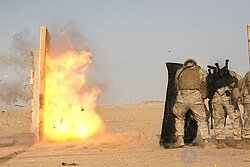
An explosive charge blowing up a test door during an exercise
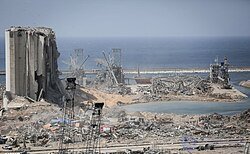
Aftermath of a large explosion.
Explosive force is released in the direction perpendicular to the surface of the explosive. If a grenade is in the air at the time of the explosion, the direction of the blast will be 360°. In contrast, in a shaped charge the explosive force is focused to create a more powerful localized blast; shaped charges are often used by the military to breach doors or walls.
The rate of reaction is what distinguishes an explosive reaction from an ordinary combustion reaction. If the reaction does not proceed very quickly, the thermally expanding gases will dissipate moderately into the surrounding medium without a large pressure difference and without an explosion. For example, when wood burns in a fireplace, heat is certainly released and gases are formed, but neither is released fast enough to create a sharp, significant pressure difference and then cause an explosion. This can be compared with the difference between the discharge of energy from a battery, which occurs slowly, and the discharge of a flash capacitor, such as in a camera flash, which releases all of its energy instantly.
The release of heat in large quantities accompanies most explosive chemical reactions. The exceptions are called entropic explosives and include organic peroxides such as acetone peroxide. It is the rapid release of heat that causes the gaseous products of most explosive reactions to expand and create high pressures. This rapid formation of high pressures of released gas constitutes the explosion. A release of heat at an insufficient rate will not cause an explosion. For example, although a unit mass of coal releases five times more heat than a unit mass of nitroglycerin, coal cannot be used as an explosive (except in the form of coal dust), because the rate at which it releases this heat is quite slow. In fact, a substance that burns less rapidly (i.e., slow combustion) may actually release more total heat than an explosive that detonates rapidly (i.e., fast combustion). In the former case, slow combustion converts most of the internal energy (i.e., chemical potential) of the burning substance into heat given off to the surroundings, whereas in the latter case, fast combustion (i.e., detonation) converts most of the internal energy into work done on the surroundings (i.e., converts a smaller part of the internal energy into heat); see: heat and work (thermodynamics), equivalent forms of energy. For a more detailed discussion of this topic, see the section "Heat of combustion."
When a chemical compound is formed from its components, heat may be either absorbed or released. The amount of heat absorbed or released during the transformation is called the heat of formation. The heats of formation of solids and gases found in explosive reactions have been determined for a temperature of 25 °C and atmospheric pressure, and are usually expressed in kilojoules per gram-molecule. A positive value indicates that heat is absorbed when the compound is formed from its elements; such a reaction is called endothermic. In explosives engineering, only materials that are exothermic are of interest, that is, those that release heat and have a negative heat of formation. The heat of reaction is measured either at constant pressure or at constant volume. It is this heat of reaction that can properly be expressed as the "heat of explosion."
A chemical explosive is a compound or mixture that, on the application of heat or shock, decomposes or rearranges with extreme rapidity, giving off a large amount of gas and heat. Many substances not normally classed as explosives may have one or even two of these properties.
The reaction must be capable of being initiated by shock, heat, or a catalyst (in the case of some explosive chemical reactions) in a small portion of the mass of the explosive. A material in which the first three factors are present cannot be recognized as an explosive unless the reaction can be brought about at the desired moment.
Fragmentation is the accumulation and scattering of particles as a result of the detonation of explosives. Fragments may originate from parts of structures (for example glass, or fragments of building or roofing material), exposed strata and/or various geological features on the surface (for example loose rocks, soil, or sand), the casing surrounding the explosive, and/or any other loose objects that have not been vaporized by the shock wave of the explosion. High-velocity fragments with a low angle of incidence can travel hundreds of meters, carrying enough energy to initiate the detonation of other explosives, injure or kill people, and/or damage vehicles or structures.
In aerospace engineering, the term "rapid unscheduled/unplanned disassembly" is used as a humorous euphemism for the explosion of an aircraft or spacecraft. Elon Musk used it in 2015 after the landing mechanism of the first stage of a Falcon 9 rocket failed and it lost control just before landing.
In legal literature, the term "criminal explosion" is widely used: an explosion that causes material damage, harm to the health and lives of people, or harm to the interests of society, as well as an explosion that may cause a person's death. Criminal explosions include both explosions carried out to commit an intentional crime and violations of special safety rules that led to explosions . To determine whether special explosion-safety rules must be observed in industry, explosion-hazardous zones and explosion-hazardous facilities are designated.
Blasting of rock mass in a quarry
The mechanical effect of an explosion is related to the work done as the gases expand. The effect is conventionally divided into brisant (local) and high-explosive (general) forms. The brisant effect appears directly in the vicinity of the charge (in a solid medium) or near the surface of a solid body, while the high-explosive effect appears at distances much greater than the size of the charge. The brisant effect is characterized by strong deformation and crushing of the medium, while its overall high-explosive effect is determined by the impulse, that is, by the initial pressure in the explosion cavity and its size. The high-explosive effect depends only on the energy of the charge. The shape of the explosive charge and its detonation characteristics significantly influence only the brisant effect of the explosion . The brisant effect of an explosion can be enhanced by shaped-charge effects.
The effect of a shock wave on objects depends on their characteristics. The destruction of permanent buildings depends on the impulse of the explosion. For example, when a shock wave acts on a brick wall, the wall will begin to tilt. During the action of the shock wave, the tilt will be insignificant. However, if the wall continues to tilt by inertia even after the shock wave has passed, it will collapse. If an object is rigid, firmly anchored, and of small mass, it will have time to change shape under the impulse of the explosion and will resist the shock wave as a force applied continuously. In this case the destruction will depend not on the impulse but on the pressure produced by the shock wave[ .
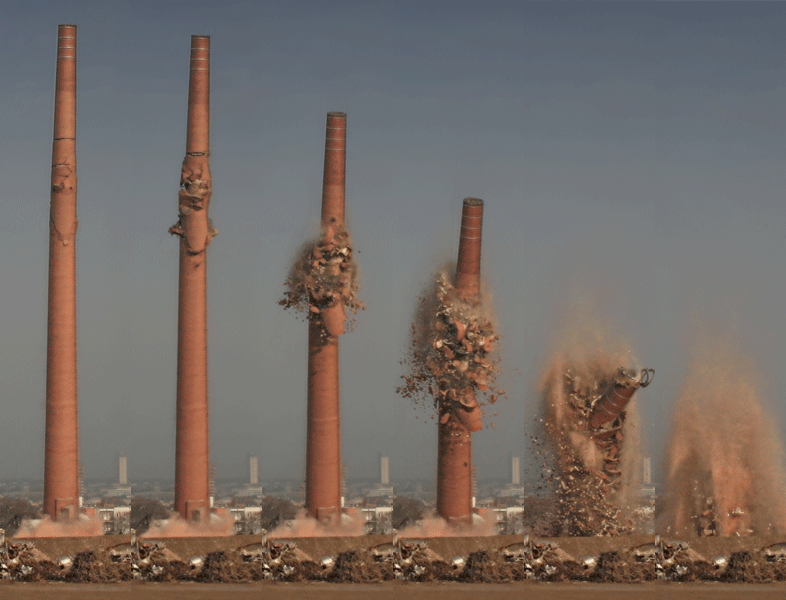
Animation of the demolition of a chimney by means of an explosion
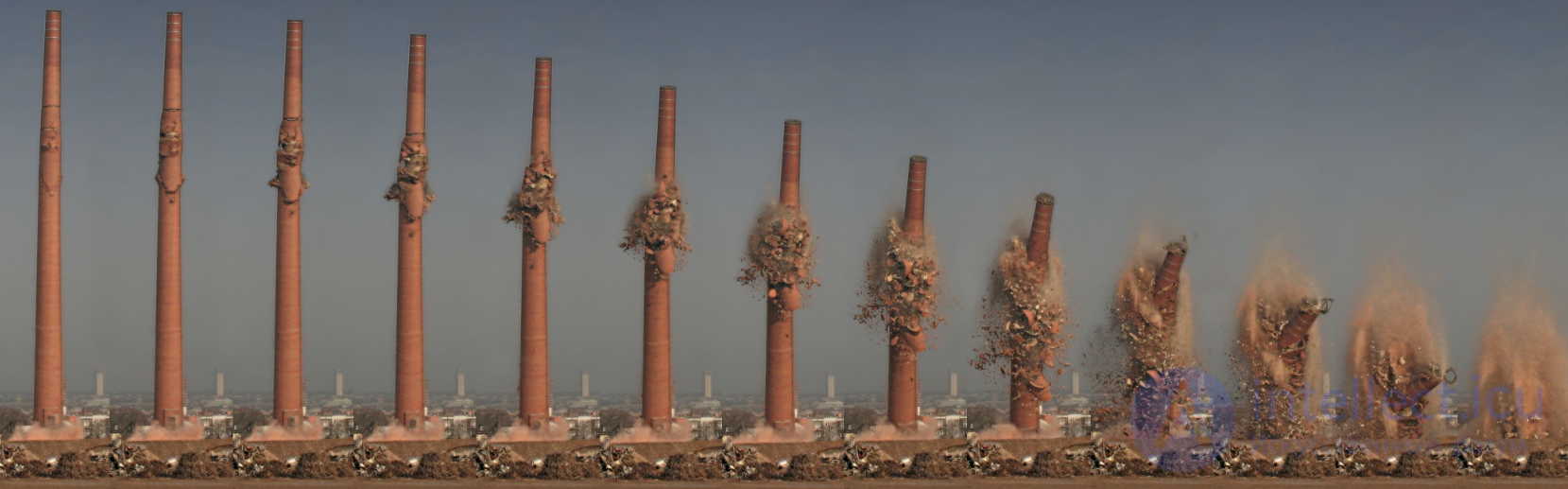
Demolition of a chimney by means of a directed explosion (freeze frame)

Comments