
Lecture 18 min.
The history of the theory of electrolytic dissociation is a characteristic
example of how scientific knowledge is built – from experimental data (empirical
material) to idealized images (a physical model) and a mathematical
description.
Experimental data:
When the solution parameters considered earlier were measured – the lowering of the
freezing point ΔTf of a solution relative to the pure solvent, the elevation of the
boiling point ΔTb, and the osmotic pressure π – it was found that substances whose
solutions conduct electric current give overestimated values, and the
factor by which the experimental value exceeds the one calculated from the
molecular mass is the same:
i = ΔTf(exp)/ΔTf(calc) = ΔTb(exp)/ΔTb(calc) = π(exp)/π(calc)
Van 't Hoff called the correction factor i the isotonic coefficient.
Explanation – dissociation of the dissolved particles.
Demonstrations:
a) electrical conductivity of an acetic acid solution as it is diluted;
b) electrical conductivity of alcoholic and aqueous solutions of cobalt chloride.
Substances that in solution or in the melt break down partially or completely
into ions and conduct electric current through the motion of ions are called
electrolytes.
Degree of dissociation:
α = (number of dissociated molecules)/(total number of molecules of the solute)
α = (i - 1)/(n - 1)
n – number of ions formed by the dissociation of one formula unit.
Explaining the effects by the presence of ions corresponds to building a physical model
of the phenomenon.
The very fact of dissociation was known earlier – back in 1834 M. Faraday (1791-1867)
formulated the laws of electrolysis and at the same time proposed the terms "ion", "cation",
"anion". However, until the work of Arrhenius (1887) it was believed that the dissociation of electrolytes
was possible only under the action of an electric field. D.I. Mendeleev objected to Arrhenius's theory
in 1889.
There were quite serious arguments for such objections. Here are some of
them. Suppose that 1 mole of table salt (about 58.5 g, or a tablespoon of
sodium chloride) has to be separated into positive and negative ions with an average
distance of 1 cm between them. By Coulomb's law:
F = 9.2*108 kg*m2*C-2*(q1*q2)/ r2
for q1 = q2 = 1.6*10–19 C we get F = 9.2*108 (1.6*10–19)2 /10–4 kg
But this is the calculation for two ions, whereas for a mole (6*1023)2 appears in the numerator, and then the
resulting attractive force is 8.5*1022 kg(!). As the average distance
between the ions decreases, this force increases. Consequently, "tearing" a mole of table salt into
ions is practically impossible. The idea of the interaction of ions with water dipoles,
thanks to which dissociation occurs, arose far from immediately.
The classification of electrolytes by strength is subjective
Strong α > 0.7; medium strength 0.7 > α > 0.3; weak α < 0.3
(according to the Moscow State University textbook edited by E.M. Sokolovskaya and L.S. Guzey).
Alternative:
for a 0.1 M solution strong α > 0.3; medium strength 0.3 > α > 0.03; weak α < 0.03
(according to the textbook of the 1st Medical Institute, Yu.A. Ershov, V.A. Popkov ...)
For weak electrolytes, reference tables usually give
dissociation constants or their negative decimal logarithms.
HA ↔ H+ + A– Ka = Kacid = [H+][ A–]/[HA]
pKacid = -lg (Kacid)
For acetic acid Kacid = 1.8*10-5; pKacid = 4.8
Dilution law (Ostwald)
For the equilibrium AK ↔ A– + K+
ion concentration Cion = C0α;
dissociation constant Kd = C0
2α2/(1 - α)C0 = α2C0/(1 - α)
For a weak electrolyte, when α << 1
Kd = α2C0 α ≅ (Kd/C0)1/2
Equilibria in solutions
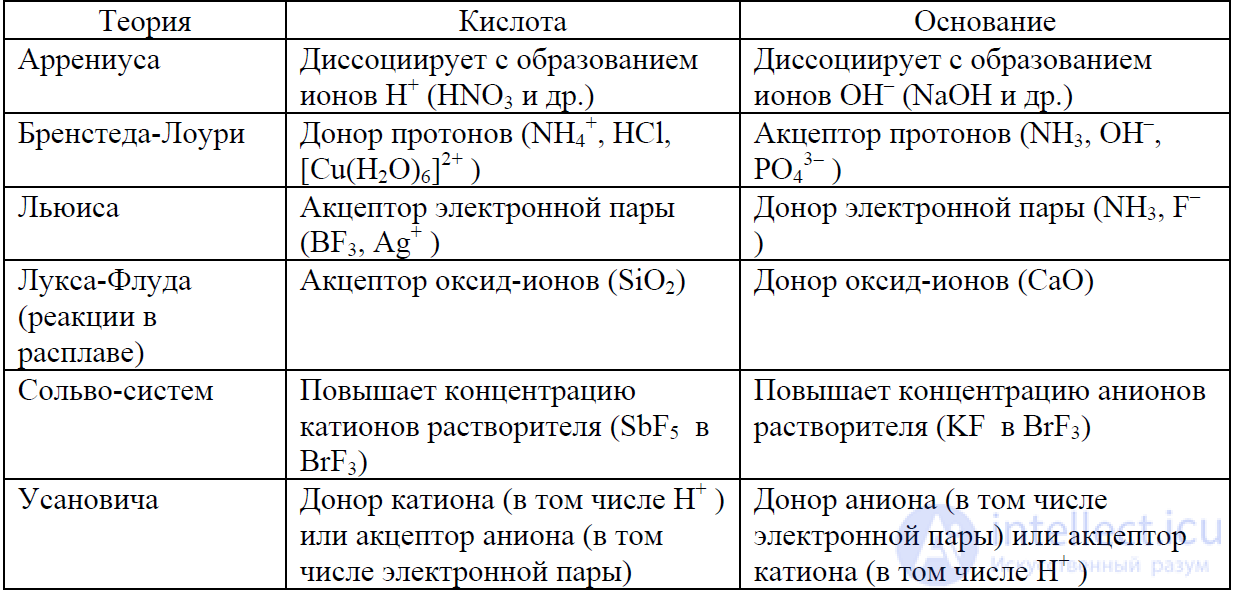
For describing acid-base equilibria in aqueous solutions the classical Arrhenius theory is quite
suitable:
An acid is an electrolyte that dissociates in solution to form
H+ ions; a base is an electrolyte that dissociates in water to form
hydroxide ions OH– . An ampholyte (amphoteric hydroxide) is an electrolyte that
dissociates in water to form both H+ ions and OH– ions.
Proton theory of acids and bases (J. Brønsted, T. Lowry, 1923 )
An acid is a substance whose molecular particles (including ions)
are able to donate a proton (proton donors); the molecular particles of a base
are able to accept protons (proton acceptors).
NH4
+ ↔ NH3 + H+
acid base
Protolytic equilibrium in water:
H2O ↔ H+ + OH–
Kc = [H+][OH–]
[H2O]
At constant temperature in dilute solutions the concentration of water in water [H2O]
is constant and equals 55.5 mol/L (1000 g/18 g*mol).
Kc[H2O] = Kw = [H+][OH–] = 10-14
In a rigorous thermodynamic treatment (concentrations replaced by activities)
we take the activity of the solvent (water) as equal to 1 (see lecture 3, table 1) and obtain
the same expression Kw = [H+][OH–] = 10-14 .
Then [H+] = 10-7. In practice, for convenience of measurement (see below) and of notation, the
quantity pH = -lg [H+] is used
For pure water under standard conditions pH = 7
At pH > 7 the solution is alkaline;
at pH < 7 the solution is acidic
Under normal conditions (0°C):
Kw = 1.14*10-15 , then [H+] = 3.37*10-7 and pH = -0.53 + 7 = 6.47
Buffer solutions
The pH of buffer solutions remains practically constant on dilution
or on adding small amounts of a strong acid or a strong base.
Buffer action is displayed by:
1. A weak acid – its salt with a strong base system, as well as a combination of an acid salt and a
normal salt of weak acids, or of two acid salts. Examples:
System Buffer range
CH3COOH/CH3COONa pH: 3.8 ÷ 5.8
H2CO3/NaHCO3 pH: 5.4 ÷ 7.4
NaHCO3/Na2CO3 pH: 9.3 ÷ 11.3
NaH2PO4/Na2HPO4 pH: 6.2 ÷ 8.2
2. A weak base – its salt with a strong acid system:
NH3*H2O/NH4Cl pH: 8.2 ÷ 10.2
3. Ions and molecules of ampholytes – amino acid and protein systems.
The pH value at which an amino acid exists only in the form of the internal
salt I is called the isoelectric point. When such an amino acid solution is electrolyzed,
the amino acid moves neither to the cathode nor to the anode. In more acidic media
amino acids move as the cation II toward the cathode, in less acidic ones – as the
anion III toward the anode.
II H+ I OH- III
H3N+-CHR-COOH ← H3N+-CHR-COO- → H2N-CHR-COO-
The concept of the isoelectric point also applies to the products of polycondensation of
amino acids – proteins. In the isoelectric state, amino acids and proteins do not
show buffer properties. Buffer action appears when a
small amount of strong acid or alkali is added to them.
Buffer capacity is measured by the amount of acid or alkali (mol or mmol of
equivalents) whose addition to 1 L of buffer solution changes the pH by one unit.
The mechanism of buffer action is well described in the recommended literature ,
so we give only the ready-made formulas for calculating pH:
For an acid buffer pH = pKacid + lg[salt]/[acid];
For a basic buffer pH = 14 - pKbase - lg [salt]/[base]
pKacid and pKbase – the negative decimal logarithms of the dissociation
constants of the weak acid and the weak base, respectively.
For sparingly soluble or "insoluble" substances, reference tables
give the Ksp values. It is assumed that sparingly soluble salts can pass into solution
only in the form of ions:
AKsolid ↔ A– + K+
Then Kc = [A–][ K+]/[AKsolid]; at constant temperature [AKsolid] is constant,
so Kc[AKsolid] = Ksp = [A–][ K+]
In a rigorous thermodynamic treatment (concentrations replaced by activities)
we take the activity of the pure solid substance as equal to 1 (see lecture 3, table 1) and
obtain the same expression Ksp = [A–][ K+].
For the salt Ca3(PO4)2 :
Ca3(PO4)2 ↔ 3 Ca2+ + 2 PO4
3-
Ksp = [Ca2+]3[PO4
3-]2
Since the Ksp value, constant at constant temperature, expresses an equilibrium, when
an excess of one of the ions in the formula is added, the concentration of the other ion must
decrease.
The measurable properties of solutions of strong electrolytes indicate a formally
incomplete dissociation of the latter. This is due to the electrostatic (Coulomb)
interaction between ions surrounded by solvation shells. Therefore, when writing all the formulas given above
rigorously, one must use not concentrations but
activities of the electrolytes a: a = fC, f – activity coefficient.
To determine f one must calculate the ionic strength of the solution I = 0.5ΣCmn2 ,
where Cm is the molal concentration of the ion and n is its charge.
-lgf = 0.502 n2(I)1/2 (Debye-Hückel equation)
Redox processes
Standard procedure: "balancing" redox reactions
(usually the electron balance or ion-electron balance method is used).
Demonstrations:
a) potassium permanganate in neutral, acidic and alkaline media
neutral medium (Mn+7 → Mn+4 )
2 KMnO4 + H2O + 3 Na2SO3 = 2 MnO2 + 2 KOH + 3 Na2SO4
acidic medium (Mn+7 → Mn+2 )
2 KMnO4 + 3 H2SO4 + 5 K2SO3 = 2 MnSO4 + 3 H2O + 6 K2SO4
2 KMnO4 + 5 SO2 + 2 H2O = 2 MnSO4 + K2SO4 + 2 H2SO4
alkaline medium (Mn+7 → Mn+6 )
2 KMnO4 + 2 KOH + Na2SO3 = 2 K2MnO4 + H2O + K2SO4
Electron transfer in redox reactions is real and is used for practical purposes.
Demonstrations:
a) energy of an exchange reaction (magnesium powder and copper chloride in the presence of water).
b) Daniell cell (Zn + CuSO4 = ZnSO4 + Cu)
When the reaction in which zinc displaces copper from solution is carried out on separate
electrodes:
Zn + CuSO4 = ZnSO4 + Cu or Zn + Cu2+ = Zn2+ + Cu
the electric current arising between the electrodes can be used
to do work.
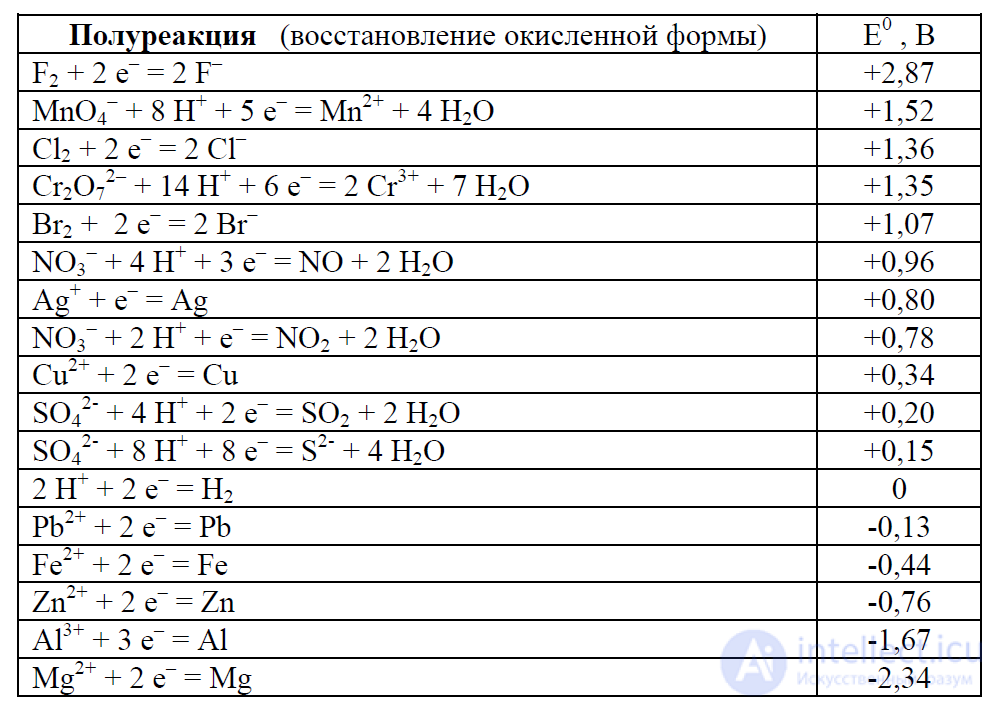
Reference tables give standard electrode potentials of a number of
metals, showing the possibility of electron transfer between them. These data are
obtained for systems containing an aqueous solution of metal ions at a concentration
(activity) of 1 M and an electrode made of that metal; the electric potential E is determined
relative to the standard – the hydrogen electrode. The values of standard potentials
are given for the reduction process (acceptance of electrons) per one
transferred electron.
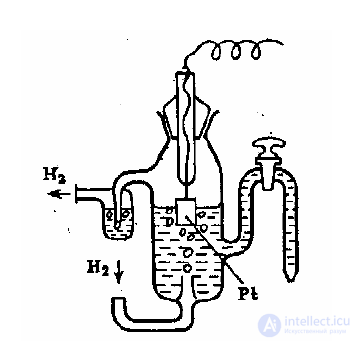
Fig. 1 Hydrogen electrode. The concentration of H+ in the solution is 1 M, the pressure of H2 is 1 atm.
The potential of a system of two metals is calculated from the tables.
For the system Zn + Cu2+ = Zn2+ + Cu
E0 = E0(oxidant) - E0(reductant) = +0.34 - (-0.76) = 1.1 V
To determine the direction of a redox reaction
extended tables of standard electrode potentials are used.
Half-reaction (reduction of the oxidized form) E0 , V

Example 1:
Which reaction will occur in an acidic medium at concentrations of 1 mol/L: the oxidation of Cl– to Cl2
by nitric acid, which is reduced to NO , or the oxidation of NO2 to nitric acid
by chlorine?
Solution: In the series of potentials: Cl2 + 2 e– = 2 Cl– E0 = +1.36 V
NO3
– + 4 H+ + 3 e– = NO + 2 H2O E0 = +0.96 V
NO3
– + 2 H+ + e– = NO2 + 2 H2O E0 = +0.78 V
The higher the potential for electron acceptance (the more positive), the stronger the oxidant (in the
equation on the left). So chlorine will oxidize NO2 :
Cl2 + 2 NO2 + 2 H2O = 2 HNO3 + 2 HCl
Example 2:
Using the table of standard electrode potentials, discuss the possibility of
interaction between sulfuric acid and potassium bromide.
Solution: The standard potentials of 1 M sulfuric acid as an oxidant (+0.20 V and
+ 0.15 V) are lower than the potential of bromine as an oxidant (+1.07 V). Consequently, in a 1 M
solution bromine can oxidize sulfites and sulfides to sulfates, but sulfuric acid will
not oxidize bromide. If, however, dry potassium bromide is placed in concentrated
sulfuric acid, bromine will be evolved:
3 H2SO4 + 2 KBr = 2 KHSO4 + SO2 + Br2 + 2 H2O
Consequently, concentrated sulfuric acid is a stronger oxidant than
bromine; its actual potential is higher than 1.07 V. Predictions based on standard
potentials are valid only for aqueous 1 M solutions.
Leclanché cell (G. Leclanché, 1865) :
Electrolyte – starch paste with NH4Cl
(-)Zn| NH4Cl, ZnCl2 |MnO2 (+)
2 MnO2 + 2 NH4Cl + Zn = 2 MnOOH + Zn(NH3)2Cl2 + H2O
Fresh 1.55 to 1.85 V; capacity 30-50 W*h/kg
"Alkaline" cells. World production 7-9 billion units per year
Electrolyte – KOH, inhibitors
(-)Zn| KOH |MnO2 (+)
2 MnO2 + Zn + H2O = 2 MnOOH + ZnO
capacity 60-90 W*h/kg
"Lithium" cells
(-) Li | LiClO4 in propylene carbonate | MnO2 (+)
Li + MnO2 = LiMnO2
(-) Li | LiBF4 in gamma-butyrolactone | (CFx)n (+)
xn Li + (CFx)n = xn LiF + n C
capacity 600-1200 W*h/kg
Rechargeable batteries [10]
Lead-acid [11]: EMF min. 2.1 V; charging current = 1/10 of capacity;
capacity 3-4 A*h/kg
PbO2 + 2 H2SO4 + Pb ↔ PbSO4 + 2 H2O + PbSO4 → discharge
(+) (-)
100 million car batteries a year – 2 million tonnes of lead (50% of Pb production)
Silver-zinc: EMF min. 1.5 V; charging current = 1/10 of capacity;
capacity 50-70 A*h/kg
Ag2O + KOH + Zn ↔ 2 Ag + KOH + ZnO → discharge
(+) (-)
Alkaline (cadmium-nickel): EMF min. 1.1 V; charging current = 1/4 of capacity;
capacity 3.5-8 A*h/kg
2 Ni(OH)3 + KOH + Cd (Fe) ↔ 2 Ni(OH)2 + KOH + Cd(OH)2 → discharge
(+) (-)
Nickel-metal hydride [12]: EMF min. 1.2 V; charging current = 1/10 of capacity;
capacity 5-12 A*h/kg
NiOOH + MHab ↔ Ni(OH)2 + M → discharge
(+) (-)
M: TiFe; ZnMn2 ; Mg2Ni; LaNi5
Lithium-ion [13] : EMF min. 3.6 V; charging current = 1/2-1/4 of capacity
capacity 7-20 A*h/kg
Li1-x CoO2 + CLix ↔ LiCoO2 + C → discharge
(+) (-)
The criterion for the spontaneous course of an electrochemical
(redox) reaction is the same – a negative ΔG of the reaction.
It is interesting to relate the thermodynamic criterion to measurable
electrical quantities. 1 joule corresponds to the energy of a charge of 1 coulomb
passing through a potential difference of 1 volt:
1 J = 1 V A s = V C
1 mole of charges is the Faraday number F, equal to 96487 C or approximately 96500 C. Then
we obtain the relation for n-charged ions:
ΔG = - nFE
E is the electromotive force (EMF) – the voltage of a current source with no
external load (measured with instruments of high internal resistance).
In the general case, for the reaction: aA + bB → xX + yY

At equilibrium ΔG = 0 and ΔG0 = -RTlnKc, where
 is the equilibrium constant
Then:

Here n is the number of electrons transferred in the process aA + bB → xX + yY; say, for
the reaction Cl2 + 2 NO2 + 2 H2O = 2 HNO3 + 2 HCl (example 1, see above) 2 electrons are transferred with
this way of writing it, and the equation will look like this (in a dilute solution the
activity of H2O is 1):
E = 1.36 - 0.78 - (0.058/2)lg ([HNO3]2[HCl]2)/[Cl2][NO2]2)
This is the Nernst equation [14].
Strictly speaking, activities of the ions should be used instead of concentrations.
For the process Zn + Cu2+ = Zn2+ + Cu
E = E0 - (0.058/n)lg([Zn2+]/[Cu2+]) =
= E0 - (0.058/n)lg([reductant that has given up electrons]/[oxidant that takes up
electrons])
At standard concentrations of 1 M we get:
E = E0
ox - E0
red = +0.34 – (-0.76) = 1.1 V
With this form of notation, a positive value of the potential E can serve as the criterion of a
spontaneous electrochemical process.
It follows from the Nernst equation that a potential difference is possible for one and the
same ion (E0
1 equals E0
2) owing to different concentrations. For example, for two
hydrogen electrodes:
E = E2 - E1 = (0.058/n)lg([H+]2/[H+]1) = 0.058 lg([H+]2/[H+]1)
If for one of the electrodes [H+]1 = 1 M (standard solution), we get:
E = 0.058 lg[H+]2 or E = - 0.058 pH
It turns out that the pH of a solution can be determined by measuring the EMF of an electrode.
In practice an electrode made of thin glass with an increased content of
alkali metal ions is used. Inside the electrode is a standard solution with [H+]1 ;
then its potential relative to the second, reference electrode is:
E = E0
c + 0.058 lg([H+]2/[H+]1)
E0
c is an individual characteristic of the electrode (set equal to "0" during
calibration).
The glass electrode for measuring pH was invented in 1909 by Fritz Haber [15].
Nowadays ion-selective electrodes with glass,
polymer, polycrystalline and liquid (plasticized) membranes are used.
Their active components are ion-exchange polymers, chelates, crown ethers and
cyclic natural antibiotics. For example, the antibiotic valinomycin selectively
binds potassium cations.
The selectivity coefficient of ion-selective electrodes reaches 10-3 ÷ 10-5 –
this means that more than a thousandfold excess of foreign ions does not interfere with
the analysis [16].
Supplement 1 to Lecture 5
Basic definitions of acids and bases [17]
Supplement 2 to Lecture 5
Calculating pH in solutions of strong acids and bases
Dissociation of a strong acid: HCl → H+ + Cl-
We assume complete dissociation (α = 100%): [H+] = [HCl]
pH = - lg [HCl]
Dissociation of a strong base: NaOH → Na+ + OH-
We assume complete dissociation (α = 100%): [OH-] = [NaOH]
pOH = - lg [NaOH] ;
at 25°C [H+][OH-] = 10-14 pH + pOH = 14
pH = 14 - pOH
Calculating the pH of a weak acid and of an acidic buffer
Dissociation of a weak acid: CH3COOH ↔ CH3COO- + H+
(α << 100%)
In general form: HA ↔ H+ + A– Ka = Kacid = [H+][ A–]/[HA]
pKacid = -lg (Kacid)
Taking the weak acid as the only source of protons (assumption 1)
and equating the equilibrium concentration [HA] to the initial concentration [HA]0 (assumption 2):
Kacid = [H+]2/[HA]0 [H+] = (Kacid [HA]0 )1/2
An acidic buffer solution contains a salt of the weak acid,
and in calculations the dissociation of the salt is considered complete (α = 100%):
CH3COONa → CH3COO- + Na+
To calculate [H+] and pH,
the weak acid is taken as the only source of protons (assumption 1),
the equilibrium concentration of the anions [ A–] is taken to be equal to the initial concentration of the salt
[ANa]0 (assumption 2),
and the equilibrium concentration [HA] is taken to be equal to the initial concentration of the acid [HA]0
(assumption 3)
Then Kacid = [H+] [ANa]0/[HA]0 [H+] = Kacid [HA]0/[ANa]0
pH = pKacid – lg [HA]0/[ANa]0 = pKacid + lg [ANa]0/[HA]0
pH = pKacid + lg [salt]0/[acid]0
For a basic buffer pH = 14 - pKbase - lg [salt]0/[base]0
Supplement 3 to Lecture 5
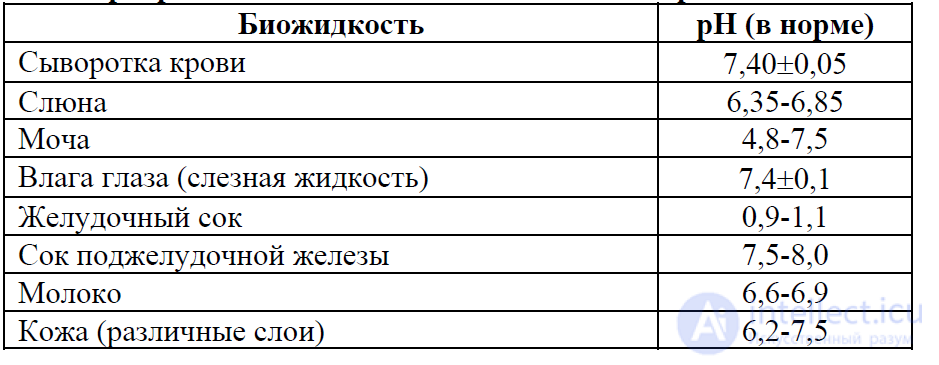
pH values of various biological fluids and tissues of the human body [18]
Supplement 4 to Lecture 5
Buffer capacity of soils [19]
In soils, hydrogen cations brought in by rainwater or produced as a
result of biological activity displace Ca2+ ions from the solid phase. As a result, the soil
acquires a certain buffer capacity – when alkaline substances are added,
the H+ ions bound to the solid phase of the soil pass into the soil solution, compensating for
the loss of H+ ions from this solution through neutralization by alkalis. Among acidic clay
minerals, those with a ribbon (chain) structure have the greatest buffer capacity –
vermiculite (Mg, Ca)0,7 (Mg, Fe3+, Al)6 (Al, Si)8O20
.8H2O and montmorillonite
Na0,7(Al3,3Mg0,7)(Si8O20).nH2O.
Buffer capacity of the ocean [20]
The world ocean has an enormous buffer capacity because it is an
open system. The main buffer reaction is the dissociation equilibrium of carbonic
acid:
H2CO3 ⇔ H+ + HCO3
-
When acidity decreases, additional absorption of carbon dioxide from
the atmosphere occurs, forming the acid:
CO2 + H2O ⇔ H2CO3
When acidity increases, carbonate rocks dissolve (shells,
chalk and limestone deposits in the ocean); this compensates for the loss of
hydrogen carbonate ions:
H+ + CO3
2- ⇔ HCO3
-
CaCO3(s) + CO2 + H2O ↔ Ca2+ + 2 HCO3
-
Solid carbonates are converted into soluble hydrogen carbonates. It is precisely this process of
chemical dissolution of excess carbon dioxide that counteracts the "greenhouse effect" – global warming caused by carbon dioxide absorbing the Earth's thermal
radiation.

Comments