
Lecture 21 min.
Depending on external conditions (temperature,
pressure), many substances can exist in three states of matter: solid, liquid, and
gaseous.
The simplest definition:
gases have neither constant volume nor constant shape at constant temperature;
liquids have a constant volume, but their shape depends on the vessel;
solids have a constant shape and volume.
The theory (and mathematical description) of the gaseous state is the simplest. At
"normal conditions" (0oC or 273.15 K and 1 atm or 101325 Pa) most gases
are described quite satisfactorily by the equation of state of an ideal gas
(the Clapeyron-Mendeleev equation):
pv = nRT
An ideal gas consists of particles (molecules) that are absolutely
rigid elastic spheres of infinitesimal size, whose interaction
(apart from rare elastic collisions) can be neglected. For many approximate calculations and
for solving textbook problems, a corollary of Avogadro's law is used: at standard conditions
1 mole of gas (6.022*10^23 molecules) occupies a volume of 22.4 L.
For real gases, equations of state with corrections are used that
take into account the intrinsic size of the molecules and the interaction between them. In
many cases the approximate van der Waals equation is sufficient:
(p +a/V2)(V - b) = RT
a/V2 – a correction that accounts for the mutual attraction of molecules ("internal pressure")
b – a correction that accounts for the intrinsic volume of molecules and their mutual repulsion.
Actual molar volumes of some gases at standard conditions:
Hydrogen 22.428 L
Helium 22.424 L
Ammonia 22.400 L
Nitrogen 22.408 L
Oxygen 22.392 L
Carbon dioxide 22.261 L
Hydrogen chloride 22.253 L
1. Benoit Paul Emile Clapeyron (1799-1864) was a French physicist and engineer who in 1834 derived the equation
of state of an ideal gas, which was generalized in 1874 by D.I. Mendeleev
2. Johannes Diderik van der Waals (1837-1923) was a Dutch physicist who in 1873 derived the equation
of state of a real gas
The theory of liquids is developed much less well than that of gases, since the properties of
liquids depend on the geometry and polarity of closely neighboring
molecules. In addition, the lack of a definite structure in liquids makes their
formal description difficult – most textbooks devote far
less space to liquids than to gases and solid crystalline substances.
There is no sharp boundary between liquids and gases – it disappears completely at
critical points. For every gas there is a known temperature above which it
cannot be liquid at any pressure; at this critical temperature
the boundary (meniscus) between the liquid and its saturated vapor disappears. The existence of the
critical temperature ("the temperature of absolute boiling") was established by
D.I. Mendeleev in 1860.
Critical parameters (tc, pc, Vc) of some substances
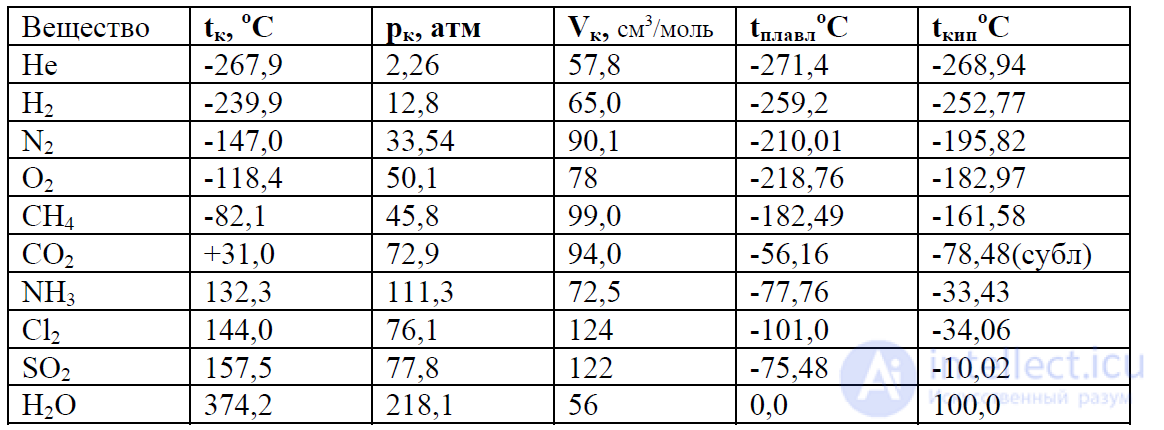
Solid crystalline substances have an ordered structure with
repeating elements, which makes it possible to study them by X-ray diffraction
(the method of X-ray structural analysis, used since 1912).
Solids melt at a fixed temperature. They are described in sufficient
detail in the recommended textbooks.
The glassy state is a solid amorphous state of matter
obtained as a result of deep supercooling of a liquid. This state is
nonequilibrium, yet glasses can exist for a long time. The softening
of glass occurs over a certain temperature range – the glass transition interval,
the limits of which depend on the cooling rate. As the cooling rate of a liquid or vapor
increases, the probability of obtaining the substance in the
glassy state increases. Glasses flow, although very slowly.
The winners of the "Ig Nobel" Prize (Ig Nobel Prize (from the English ignoble –
"shameful," "disgraceful") – for the most useless and absurd scientific research
3. The theory of the method was developed by the German physicist Max Felix Theodor von Laue (1879-1960); the first analysis of the
structure (of sphalerite, ZnS) was carried out by Henry Bragg (1862-1942) and Lawrence Bragg (1890-1971).
4. General Chemistry, ed. Sokolovskaya E.M. and Guzey L.S., Moscow, 1989
Glinka N.L. General Chemistry: Textbook for universities. 15th edition and later. Leningrad, 1983
5 Winners of the Ig Nobel Prize (from the English ignoble – "shameful," "disgraceful")
2005: http://www.newsru.com/world/07oct2005/ignobel.html#1
(http://www.anekdot.ru/a/an0510/o051008;10.html)
3
and achievements) 2005: PHYSICS: The prize went to the University of Queensland in
Australia, whose specialists since 1927 have been observing how
a piece of pitch, which is theoretically a liquid but behaves like a solid,
drips through a funnel – at a rate of one drop every nine years. Strangely,
this is the only study of its kind that was deemed absurd.
In the late 1960s, amorphous metals (metallic glasses) were obtained – this required
cooling the molten metal at a rate of 10^6 -
10^8 deg/s. Most amorphous metals and alloys crystallize when heated
above 300oC. One of the most important applications is in microelectronics (diffusion
barriers at the metal-semiconductor interface) and magnetic storage (hard disk drive heads).
The latter is due to their unique magnetic softness (the magnetic anisotropy is
two orders of magnitude lower than in ordinary alloys).
The liquid crystalline state is intermediate between the crystalline state and
the liquid. Liquid crystals possess both fluidity and anisotropy
(optical, electrical, magnetic). This state is sometimes called
mesomorphic (a mesophase) – because of the absence of long-range order.
The special qualities of liquid crystals were discovered by the Austrian botanist
Friedrich Reinitzer in 1888. It took 85 years before their properties found
commercial application. In 1973 the Japanese company Sharp Electronics released the
first product with an LCD panel: an electronic calculator with a digital display.
The upper limit of existence is the clearing temperature (an isotropic
liquid).
Thermotropic (mesogenic) LCs exist above a certain temperature.
Typical examples are cyanobiphenyls.
Lyotropic LCs form on dissolution, for example, aqueous solutions of soaps,
polypeptides, lipids, DNA...
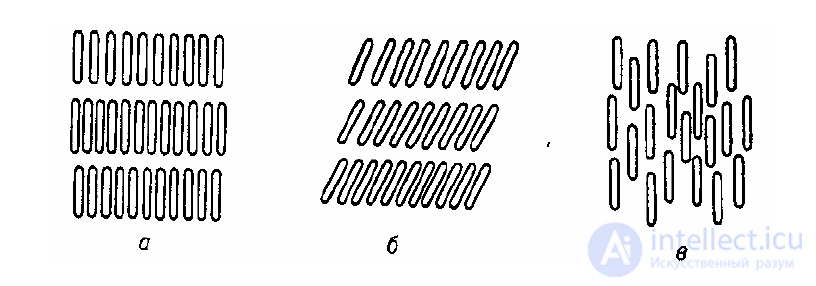
Figure 1. Structure of smectic (a and b) and nematic (c) liquid
crystals.
6. Zolotukhin I.V. Amorphous metals. In: Modern Natural Science: Encyclopedia in 10 vols. Moscow:
Flinta: Nauka, 1999-2000, vol. 1. Physical Chemistry. 328 pp.
7. PC-magazine Alfred Poor. Flat-panel displays: manufacturing methods
http://www.pcmag.ru/?ID=183791
8. Chemical Encyclopedia: in 5 vols. Moscow: Bolshaya Rossiyskaya Entsikl., 1998.
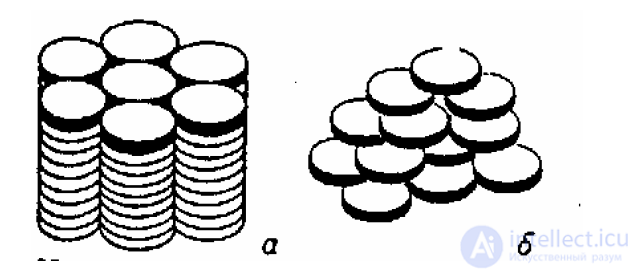
Figure 2. Structure of discotic liquid crystals:
a – columnar phase; b – nematic phase.
Smectic LCs are arranged in layers; nematic LCs retain only
orientation, with a disordered arrangement of the molecular centers of mass.
Cholesteric LCs form layers, with the layers (the orientations of the molecules) rotated by a
certain angle relative to one another.
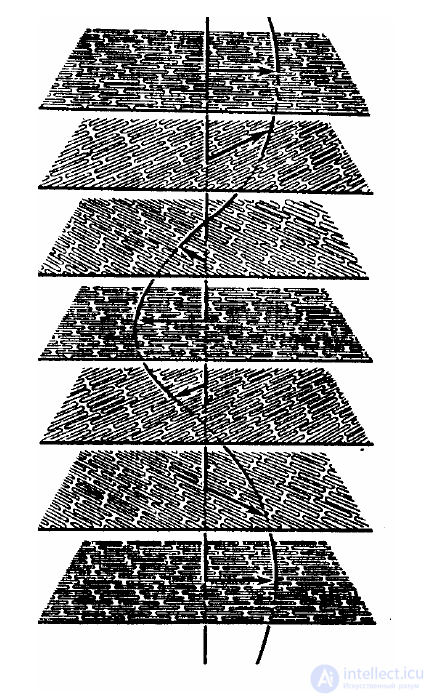
Figure 3. Structure of cholesteric liquid crystals.
Liquid crystals were discovered in 1888 by F. Reinitzer and O. Lehmann.
Jellies are polymer-solvent systems characterized by large
reversible deformations with virtually no viscous flow.
The term "gels" is sometimes used, which in colloid chemistry denotes
coagulated sols.
The most important are jellies based on network polymers with varying degrees of
crosslinking.
When temperature and pressure change, syneresis is possible – the separation of part of the
liquid.
Jellies based on copolymers of acrylic acid and acrylamide are used
to create membranes with controllable permeability, drug depots in the body,
as sorbents (in hygiene products), and as models in biological
research. The strong adsorption of water (several hundred grams per gram of
polymer) is due to the presence in the gel of free counterions, which do not
leave its structure because of electrostatic attraction but tend to surround
themselves with many layers of polar water molecules.
If a system contains real interfaces separating from one another
parts of the system that differ in properties, the system is called heterogeneous
(a saturated solution with a precipitate); if there are no such interfaces, the system is called
homogeneous (a true solution). Heterogeneous systems contain at least two phases.
A phase is the totality of all homogeneous parts of a system that are identical in composition and
in all physical and chemical properties (independent of the amount of substance) and
are separated from other parts of the system by an interface. Within a single phase
properties may change continuously, but at the interface between phases
properties change abruptly. An example of a two-phase system is the surface of a river during
an ice drift.
Components are the substances minimally necessary to make up
a given system (at least one). The number of components in a system equals the number of substances
present in it, minus the number of independent
equations linking these substances.
A component is a substance that can be isolated from a given
system and whose amount can be varied (at least within some limits)
independently of the others.
Disperse systems are heterogeneous systems of two or more phases
with a highly developed interface between them. One of the phases forms
a continuous dispersion medium in which the dispersed phase is distributed in the form of
small crystals, solid amorphous particles, droplets, or bubbles.
Coarsely dispersed systems have particle sizes above 1 µm (specific
surface area not more than 1 m2 /g); finely (highly) dispersed or colloidal systems
contain particles from 1 nm to 1 µm (specific surface area – hundreds of m2 /g).
By state of aggregation they are divided into:
gas-dispersed – aerosols (smokes, dusts, fogs), powders, fibrous
materials;
liquid-dispersed with a solid dispersed phase – coarsely dispersed suspensions and
pastes, highly dispersed sols and gels;
liquid-dispersed with a liquid dispersed phase – coarsely dispersed emulsions,
highly dispersed emulsions and latexes;
liquid-dispersed with a gaseous dispersed phase – coarsely dispersed gas
emulsions and foams;
solid-dispersed – for example, ruby glasses, minerals such as opal,
microporous materials.
Sols (German singular: Sol) (lyosols, colloidal solutions) – highly dispersed
colloidal systems with a liquid dispersion medium. The particles of the dispersed phase of a sol
together with the surrounding solvation shell of molecules (ions) of the dispersion
medium are called micelles. The particle size of a lyosol is within 10^-7 – 10^-5 cm.
Micelles of lyophilic sols consist of amphiphilic (for example, made up of a
hydrophilic and a hydrophobic part) molecules, which are in
9. Khokhlov A.R. Responsive gels. SOZh, No. 11, 1998 http://en.edu.ru/db/journals/article/2494/2494.pdf
thermodynamic equilibrium with unassociated molecules. An example is soap in
water.
Lyophobic sols are nonequilibrium and require stabilization. An example of a micelle of a
lyophobic silver bromide sol:

Another version of the terminology [10]:
A sol is a colloidal-disperse system with colloidal particles isolated from one another, while a gel is one
with colloidal particles in contact (aggregated); a suspension is a
coarsely dispersed system with a relatively low, and a paste a high, concentration of the
dispersed phase.
A solution is a homogeneous multicomponent system. For substances with similar
properties and unlimited mutual solubility, the concepts of "solvent" and
"solute" are relative. For example, in the ethyl alcohol – propyl alcohol system, the solvent is
considered to be the component whose amount
is substantially greater. If water is present in the system, it is often water that is
called the solvent. In the case of limited mutual solubility, the solvent is
considered to be the component whose structure is preserved by the solution.
The solubility of a substance is its maximum possible concentration,
equilibrium at a given temperature. In most tables it
is given in grams of substance contained in 100 g of solvent.
A solution in equilibrium with the dissolved substance is called
saturated. A saturated solution is a heterogeneous system.
The most commonly used ways of expressing the concentration of solutions:
mass fraction (often as a percentage concentration) – the ratio of the mass of the substance to the
mass of the solution:
ω = m(substance)/m(solution) (*100%) ;
molar concentration C – the amount of substance (number of moles) ν per liter of solution:
C = ν(substance)/V(solution) ;
molal concentration Cm – the amount of substance (number of moles) ν per 1
kg of solvent:
Cm = ν(substance)/m(solvent)
The simplest model of a solution can be represented by two sets of
balls – small ones modeling the solvent molecules, and large ones modeling the
molecules (particles) of the solute (Fig. 4):
10. General Chemistry: Textbook/Ed. E.M. Sokolovskaya and L.S. Guzey. 3rd ed. Moscow: Moscow State University Press,
1989. 640 pp., p. 25
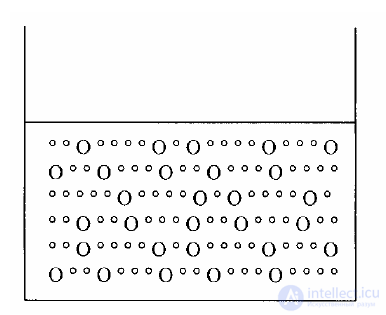
Fig. 4
On the basis of such a model, some important properties of
dilute solutions of nonelectrolytes can be described [11].
Let us consider the first system.
A vessel with pure water was divided into two halves by a semipermeable
membrane – small water molecules can penetrate through the pores in the membrane, but
large sugar molecules cannot. Then sugar was poured into the right half of the vessel
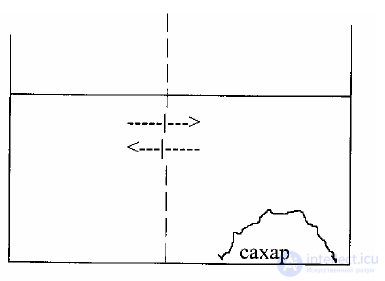
(Fig. 5).
a) How will the rate of water penetration from left to right change?
b) How will the rate of water penetration from right to left change?
c) What will we observe after some time?
Fig. 5
Solution: both rates of water transfer decrease, but on the right (where the sugar is)
it decreases more – sugar molecules "plug" the openings more effectively from the outside
(on the right).
What will equalize the rates of transfer of water molecules? The level on the right
will rise, and the pressure will increase the rate of transfer from right to left (Fig. 6):
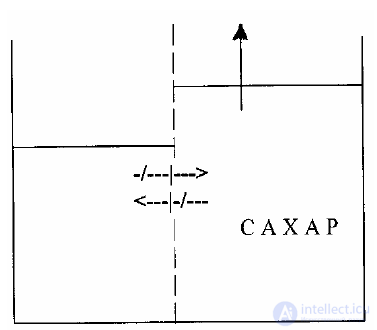
Fig. 6
This phenomenon is called osmosis (from the Greek "osmos" – push, pressure) 12. In 1887
van 't Hoff derived the formula for osmotic pressure [13]:
11. The example problems on transfer across the phase interface given below were compiled by
A.M. Galin, senior lecturer at the SUNC MSU
π = CRT
For calculations it is convenient to use the gas constant R = 0.082 L*atm
At standard conditions the osmotic pressure of a 0.06 M sucrose solution is 1.34 atm, and the conditional
"volume of a mole" (by analogy with an ideal gas) π/C = 22.3; for a more
concentrated 1 M solution the pressure is 24.8 atm, and the "volume of a mole"
is then also 24.8 (the van 't Hoff formula gives 22.4) [14].
Tissue fluids of mammals have π = 6.7-8.1 atm, and plant cell sap ranges
from 2 atm in marsh plants to 45 atm in steppe plants. With such values it becomes
clear why fragile blades of grass break through asphalt. The osmotic pressure of
human blood at 37oC is 7.7 atm (780 kPa); this is the pressure of
physiological saline (0.9% sodium chloride)..
Let us consider the second system within the same simplest model.
In a vessel containing water and ice, a constant temperature of 0oC is maintained.
Then table salt was added to the vessel.
a) How will the rate of ice dissolution change?
b) How will the rate of water crystallization change?
c) What will be observed if the temperature is kept at 0°C even after the salt is added?
(fig. 7)
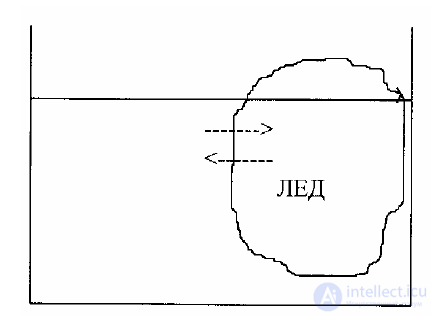
Fig. 7
Solution: the arrows indicating the interphase transitions of water molecules will again
decrease unevenly. At 0°C the ice will dissolve, because the factor that
restores equilibrium is the temperature itself – without thermostatting it falls
because the ice continues to melt (Qfus = 330 J/g)
(fig. 8):
12. The term was introduced by the French biologist Henri Dutrochet (1776-1847) in 1826. Systematic measurements
of osmotic pressure were carried out in 1877 by the German chemist and botanist Wilhelm Pfeffer (1845-
1920).
13. In 1901 the first Nobel Prize in Chemistry was awarded to the Dutch scientist Jacobus Henricus
van 't Hoff (1852-1911) - "for the discovery of the laws of chemical dynamics and osmotic pressure in
solutions".
14. Kireev V.A. A Short Course of Physical Chemistry - Moscow: "Khimiya", 1970. - 640 pp., p. 30
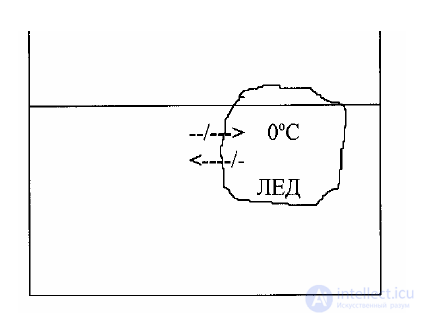
Fig. 8
If a sodium chloride-water system contains 22.4% NaCl by mass, it
will remain liquid down to -21.2°C. A solution with 30.22% calcium chloride by mass freezes at -
49.8°C.
Thus, the dissolved substance affects the freezing point of the
solvent. This is Raoult's second law – the lowering of the freezing point of a solution is
directly proportional to the molal concentration of the solution.
Determining molecular mass from the lowering of the melting point for a
known mass of solute per 1000 g of solvent is called
cryoscopy [15].
Δtf = K Cm = K(g1000)/MG
Cm – molal concentration;
g – mass of the substance dissolved in G grams of solvent;
M – molecular mass of the solute;
K – cryoscopic constant of the solvent (1.853 for water)
Within the same model, let us consider a third system.
A closed thermostatted vessel is partly filled with water, and the rest of it
is occupied only by water vapor. Then table salt was thrown into the vessel.
a) How will the rate of water evaporation change?
b) How will the rate of water condensation change?
c) How will the pressure in the vessel change?
The temperature stays constant throughout (fig. 9):
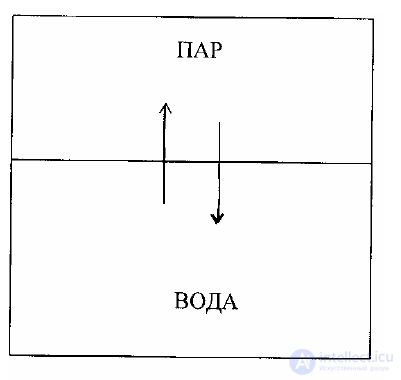
Fig. 9
Solution: the arrows indicating the interphase transitions of water molecules will again
decrease unevenly. Equilibrium will be restored through a decrease of pressure in
the system. The vapor pressure above a solution is always lower than above the pure solvent.
Raoult's first law (1882) – the relative lowering of the vapor pressure above a solution is directly
proportional to the mole fraction of the solute:
(p0 - p1)/p0 = N
N – mole fraction of the solute, corresponds to the ratio of the
numbers of model "ball-molecules" (fig. 4)
p0 – vapor pressure of the pure solvent, p1 – vapor pressure of the solution.
For this reason the boiling point of a solution is higher than that of the solvent (at
the same pressure). An application – a glass of salt placed between window panes will keep
the glass from fogging up.
15. The method was proposed in 1885 by the French physicist and chemist François-Marie Raoult (1830-1901)
Determining molecular mass from the elevation of the boiling point for a
known mass of solute per 1000 g of solvent is called
ebullioscopy:
Δtb = E Cm = E(g1000)/MG
Cm – molal concentration;
g – mass of the substance dissolved in G grams of solvent;
M – molecular mass of the solute;
E – ebullioscopic constant of the solvent (0.51 for water)
General conclusion: we have examined three ways in which equilibrium is established in
the pure solvent – solution system.
In all cases no transitions of solvent particles are accelerated; they are
only slowed down, but unevenly. As the systems approach equilibrium,
significant effects are reached (osmotic pressure, changes in the freezing
and boiling points).
The effects listed above can be described with the help of phase
diagrams. A detailed analysis of the phase diagram of water from the point of view of the phase
rule is well presented by Professor O.S. Zaitsev [16].
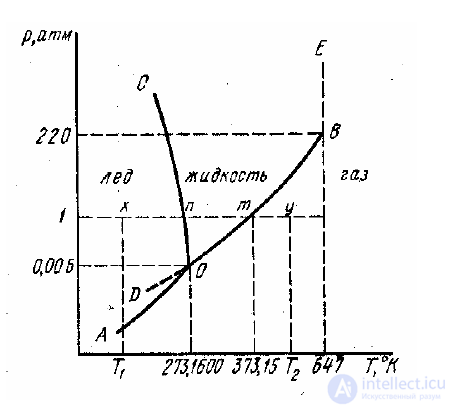
Fig. 10 Phase diagram of water at moderate pressures [17].
Point O – the triple point of equilibrium of the gaseous, liquid and solid states of
water. Point B – the critical point of water. Curve OD corresponds to supercooled
water.
The methods of cryoscopy and ebullioscopy are in fact consequences of
Raoult's law, which can be shown on the phase diagram of water (fig. 11).
16. Zaitsev O.S. Water and the phase diagram of water http://him.1september.ru/2003/28/22-1.htm
17. Eremin E.N. Fundamentals of Chemical Thermodynamics. Textbook for universities. - Moscow: "Vysshaya Shkola",
1974. - 341 pp., p. 108
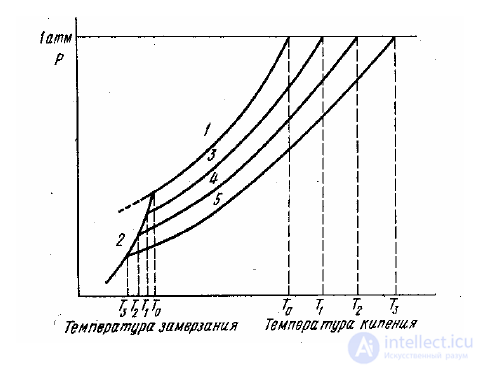
Fig. 11 Vapor pressure as a function of temperature [18].
1 – curve for the pure liquid solvent; 2 – curve for the pure solid solvent; 3, 4, 5 – vapor pressure of the solvent above solutions with increasing
concentration of a nonvolatile substance.
If a solution consists of two volatile components, it can be separated into
its constituents by distillation. The essence of the process in the simplest case
(Raoult's law holds for both components over the whole concentration range)
is shown in
fig. 12.
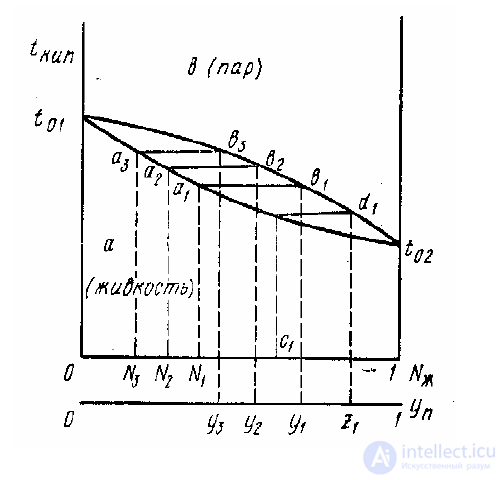
Fig. 12 Dependence of the boiling point of a liquid solution on the composition of the
liquid N and of the vapor Y [19].
When a solution of composition N1 is heated to boiling (point a1), the first portion of vapor
will have the composition corresponding to point b1, i.e. Y1. The resulting condensate will be
enriched in the more volatile component, and the remaining solution will become enriched in the less
volatile component. Through successive steps from the points with index 1 to the points with
index 3 and further to the left we will obtain an almost pure low-volatility component and
condensed vapor fractions enriched in the volatile component. By repeating the
procedure with the vapor condensate, one can eventually separate the solution into the pure
components.
In real systems deviations from Raoult's law are often observed, and on
boiling point - composition diagrams maxima and minima appear. They
correspond to the case when the composition of the vapor and of the liquid is the same (there is no gap ab);
mixtures that boil at a constant temperature are called azeotropic. The most
18. Eremin E.N. Fundamentals of Chemical Thermodynamics, p. 283
19. Eremin E.N. Fundamentals of Chemical Thermodynamics, p. 27
well-known azeotropic mixture is ethanol-water, which boils at 78.17°C and contains 96% ethanol,
whereas pure ethanol (100%) boils at 78.3°C. Such a mixture cannot be separated
by distillation, and other methods are used to obtain 100% anhydrous alcohol.
The phase rule was formulated by J.W. Gibbs in 1876.
For a system in equilibrium, the sum of the number of phases (P) and the number of degrees of
freedom (F) exceeds the number of components (C) by 2:
P + F = C + 2
On the phase diagram of water (fig. 10) there is the triple point O, at which the
number of degrees of freedom F = 0. At this point all three phases are present in a
one-component system. One degree of freedom corresponds to the curve OB,
which separates two phases – in the system one can change either the temperature or the pressure
(the second parameter depends on the first). In a single-phase region, for example the liquid region
COB, both temperature and pressure can be changed independently – the system has two
degrees of freedom.

Comments