
Lecture 3 min.
"Analytical Chemistry"
The credit tests for the discipline "Analytical Chemistry" consist of situational tasks and questions designed to check students' knowledge in the field of analytical chemistry. These tests assess various aspects of the discipline, such as knowledge of the theoretical basis, understanding of analytical methods and their practical application.
Typical questions and tasks that can be encountered in analytical chemistry tests include:
Calculations: Tasks related to chemical calculations, such as calculating solution concentrations, determining the equivalent mass of a substance, calculating oxidation states and other mathematical aspects of analytical chemistry.
Identification of substances: Tasks in which students are asked to identify a particular substance or its concentration in a sample using various analytical methods, such as titration, spectrophotometry, gravimetric methods, etc.
Preparation of solutions and work with analytical instruments: Students may be given tasks related to preparing working solutions, calibrating analytical instruments and measuring sample parameters.
Recognition of reactions: A test may contain questions about the reactions of substances and their outcome in the form of a color change, gas evolution, precipitate formation, etc.
Theoretical questions: Students may be given theoretical questions about the basic principles of analytical chemistry, chemical reactions and methods of analysis.
Application of knowledge: A test may contain tasks in which students are asked to solve specific analytical problems in practice, such as analyzing real samples or calculating analysis parameters.
Analytical chemistry tests are designed to check various aspects of students' knowledge and skills in this area and help them prepare for the credit exam session and successfully master the course material.
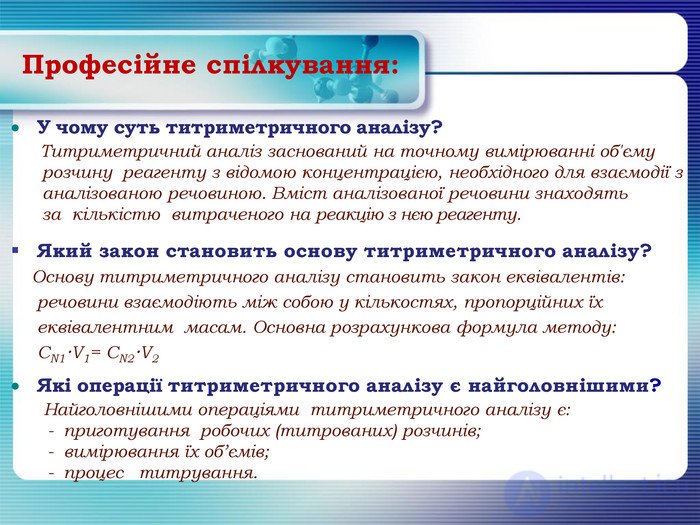
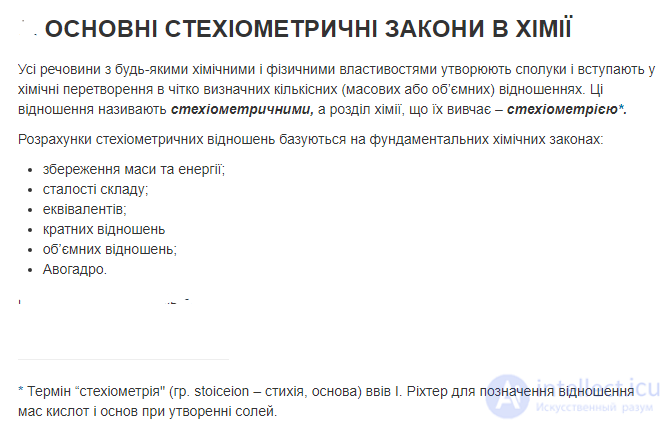
2. The mass fraction shows the composition of a substance in
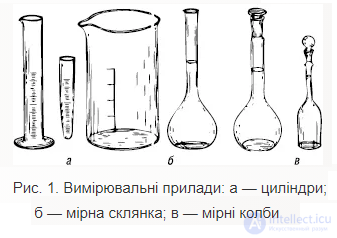
3. Indicate the glassware in which a solution with an exactly specified concentration is prepared:
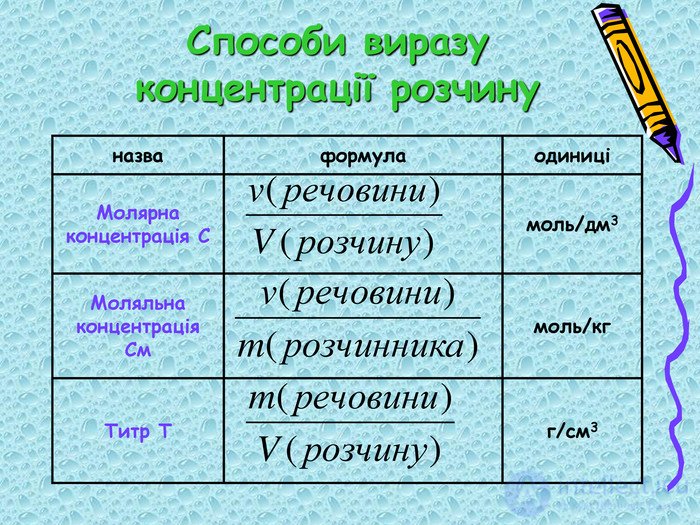
4. The molarity of a solution is expressed in
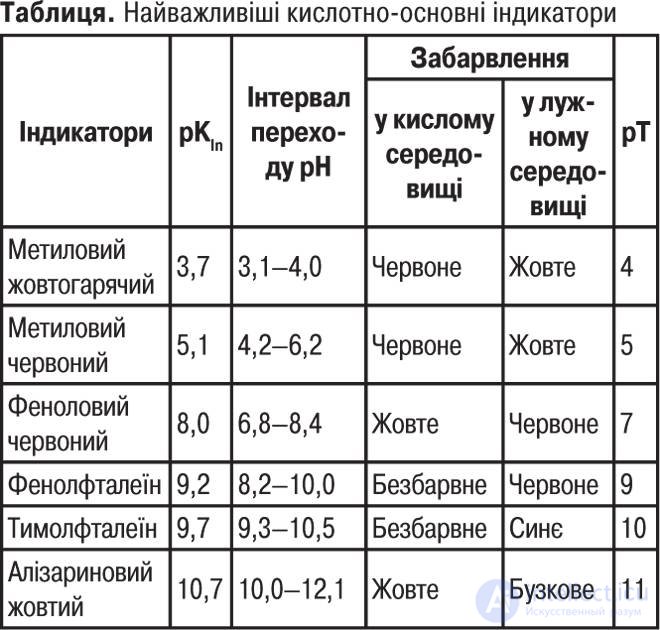
5. What are indicators used for in titrimetric analysis?
6. Indicate the indicator used in iodometry:
7. Indicate the formula for calculating the weighed portion of a substance for preparing a solution of a given normality :
 CN V
CN V8. Which of the given schemes reflects the use of iodine as an oxidizing agent?
9. Which of the proposed formulas is used to determine the gram-equivalent of KMnO4 when a standard KMnO4 solution is used to titrate acidic solutions:
10. Which of the given formulas is used to calculate normality from the known titer of a solution :

Comments