
Lecture 43 min.
The origin and development of chemistry.
Chemistry is the science of transformations of substances associated with changes in the electronic
environment of atomic nuclei.
The chemical view of the world
It has long been noticed that professional chemists are distinguished by the breadth of their views
and an open attitude to everything happening around them. This is easily explained by the fact that
our entire modern material environment is a product of industrial
chemical synthesis. But the main reason, in my opinion, is not only "the chemistry around us".
Chemistry can be defined "unscientifically" as what people who call
themselves chemists do. I very much liked the characterization of chemists given by the 1996
Nobel Prize laureate, the American Harold Kroto (University of Sussex).
He received his prize jointly with Richard Smalley and Robert Curl for the discovery of
fullerenes in 1985. Fullerenes are a new form of elemental carbon; among them
there is, for example, footballene C60, with spherical molecules "stitched" from pentagon-
and hexagon-shaped pieces, like a soccer ball.
H. Kroto wrote:
"Chemists, in my opinion, suffer from a special form of "schizophrenia". Indeed, their
thinking is a whimsical mixture of the most abstract and the most visual
ideas. They know about the subtle quantum-mechanical laws
that determine the properties of molecules, which in turn are responsible for all the
diversity of the world around us. This link between the micro- and macroworld remains
hidden from scientists of other specialties. Moreover, no one has done as much to
improve people's living conditions as chemists, but their merits are not duly appreciated."
A true chemist, even if not directly engaged in synthesis, always
"feels the substance". This feel for substance shows itself in the ability to clean a "hopelessly"
burnt pot, in the ability to find all sorts of rare metals in unremarkable objects at a dump,
and in determining exactly how to repair a plastic
item (weld it or glue it, and if glue, then with what and how).
Even now, among professional chemists the most valued colleagues are not those
who can calculate, "to a certain approximation", the properties of a new molecule, but
synthetic chemists who are able to "feel the substance" and to "cook" this very molecule by an elegant
route from precursor substances that seem unexpected at first glance.
The outstanding spiritual writer and priest of the 19th century, Saint Ignatius
Brianchaninov (Dmitry Alexandrovich Brianchaninov; 1807-1867), stressed the importance of
studying the most material of the sciences, chemistry:
"It seems, the eloquent and intelligent Professor Soloviev told us (Professor Mikhail Feodorovich Soloviev of St. Petersburg
University taught physics and chemistry in the officers' classes of the
Main Engineering School), delivering his introduction to chemistry, that we study this
science precisely in order to learn that we know nothing and can know nothing; so boundless
a field of knowledge does it open before the eyes of the mind! The knowledge we have acquired
in this field is so insignificant! With tangible clarity it proves and convinces that
matter, although as matter it must have its limits, cannot be grasped
and defined by man, both because of its vastness and for many other reasons. Chemistry
follows the gradual refinement of matter, brings it to a fineness scarcely accessible
to human senses, and in this fine state of matter still perceives complexity and
a capacity to decompose into component parts, still finer, although the decomposition itself is already
impossible. Man sees no end to the refinement of matter, just as to the increase of numbers
and measure. He grasps that the infinite must also be immaterial; on the contrary,
everything finite must of necessity also be material. But this is an idea that is
indefinite; its existence is definite. Beyond this, physics and chemistry revolve within the same
matter, and broaden our knowledge of its use for the temporal, earthly needs
of man and human society."
Let us return to the definition:
Chemistry is the science of transformations of substances associated with changes in the electronic
environment of atomic nuclei.
In this definition it is necessary to clarify further the terms "substance"
and "science".
According to the Chemical Encyclopedia:
Substance is a kind of matter that has rest mass. It consists of
elementary particles: electrons, protons, neutrons, mesons, and others. Chemistry studies
mainly substance organized into atoms, molecules, ions and radicals. Such
substances are usually divided into simple and complex (chemical compounds).
Simple substances are formed by atoms of one chemical element and are therefore
the form of its existence in the free state, e.g. sulfur, iron, ozone, diamond.
Complex substances are formed by different elements and may have a constant composition
(stoichiometric compounds or daltonides) or one varying within certain limits
(nonstoichiometric compounds or berthollides).
Chemical synthesis is still closer to art than to science. After all, it is the control of the
behavior of atoms and molecules, which a person without instruments cannot see, in
principle.
Demonstration: "synthesis" with a children's construction set
In the general chemistry course we will become acquainted with the most general principles of
controlling the behavior of matter: chemical thermodynamics and kinetics.
According to thermodynamics (the doctrine of whether the spontaneous
progress of a given reaction is possible), a cast-iron dumbbell cannot exist
in the Earth's atmosphere (ΔG of formation of Fe3O4 is –1014.2 kJ/mol).
Demonstration: cast-iron filings in a gas flame and a sparkling fountain
The doctrine describing the rate of chemical processes is called chemical
kinetics. Knowledge of kinetics makes it possible to set the rate of reactions, sometimes in quite
unexpected ways.
Demonstration: oscillating combustion of a boron-based mixture
There is much more disagreement in the interpretation of the term "science" than of
"substance". Here the saying of René Descartes (Latin Renatus
Cartesius, 1596-1650) is quite applicable: "Define the meaning of words and you will rid humanity of
half of its errors."
Science is usually understood as the sphere of human activity whose function
is the production and theoretical systematization of objective knowledge about
reality; a branch of culture that has not existed in all times or among all
peoples .
The Canadian philosopher William Hatcher defines modern science as "a way of
knowing the real world, which includes both the reality perceived by the human senses
and an invisible reality, a way of knowing based on the construction of
testable models of this reality". This definition is close to the understanding of science held by
Academician V.I. Vernadsky, the English mathematician A. Whitehead, and other
well-known scientists.
In scientific models of the world, three levels are usually distinguished, which in a specific
discipline may be represented in different proportions:
Empirical material (experimental data)
Idealized images (physical models)
Mathematical description (formulas and equations)
A visual, model-based view of the world inevitably leads to the approximate nature of
any model. A. Einstein (1879-1955) said: "As far as the laws of mathematics
refer to reality, they are not certain; and as far as they are certain,
they do not refer to reality."
Many problems in teaching and understanding the foundations of the natural sciences are connected
with confusing reality, its physical models and their mathematical description.
Doctor of Philosophy E.V. Sokolov writes:
"It is impossible in physics to study what does not exist or what is presented by the very method
of study. Equations in physics are legitimate and necessary only as long as they
organize and explain the objective reality under study. To operate in physics
with "pure" mathematical functions is to step out of physics into mathematics, that is,
into intellectualistics. And such a step entails a change in our worldview
and in the goals of science. Moving into the "microworld," studying infinitely small and infinitely
large quantities that are incommensurable with the capacities of human senses, means
moving out of natural science into metaphysics. One can and should do metaphysics, but
it must be remembered that the value of theories in physics, and indeed in any field of natural science,
is determined by their descriptive, explanatory, predictive and manipulative
power, not by rigor and elegance. This power is usually greater the narrower the boundaries
of the domain being explained and described. The simpler a theory, the easier it is to apply, and the
more people can make use of it."
What can an unjustified priority of mathematical description (and
the physical model) over experiment lead to? In modern experimental science
great attention is paid to the correct processing of *results, and the researcher obtains most of the
results after preliminary processing by computer
(Fourier spectroscopy, tunneling microscopy, NMR tomography, etc.). Suppose
that at the beginning of the 20th century E. Rutherford (1871-1937) and his young collaborators H. W. Geiger
(1882-1945) and E. Marsden (1889-1970) had obtained a computerized setup for their experiments on the scattering of α-
particles. It would easily have reproduced the main result,
that the most probable scattering angle of α-particles on gold foil 4*10^-5 cm thick
is 0.87°. For those extremely rare cases (1 in 20,000 measurements)
of scattering through an angle of more than 90°, according to the central limit theorem of probability
theory, the reliability of the experiment is 3*10^-2174 (this is not a typo!); therefore
a computer with a standard program would have discarded such
"random errors" without the slightest doubt. And science would have been left without the planetary model of the atom, at least
for several decades. Only Rutherford's magnificent intuition allowed
him to conclude that the extremely rare "random" results were true, and on their
basis to change the physical model of the atom (instead of J. J. Thomson's "plum pudding"
(1856-1940), something resembling the solar system).
The specific character of natural-science knowledge can be defined by three features:
truth, intersubjectivity and systematicity. The truth of scientific truths
is determined by the principle of sufficient reason: every true thought must be
grounded in other thoughts whose truth has been proven. Intersubjectivity
means that every researcher must obtain the same results when
studying the same object under the same conditions. The systematicity of scientific
knowledge implies its strict inductive-deductive structure.
The improvement of research methods, above all of experimental
technique, has led to the division of science into ever narrower branches. As a result,
the quantity and "quality," i.e. the reliability, of information have increased. However, the impossibility
for one person to have complete knowledge even of neighboring scientific fields
has given rise to new problems. Just as in military strategy the weakest points of defense and
offense turn out to be at the junctions of fronts, in science the least developed areas remain
those that do not lend themselves to unambiguous classification. Among other reasons one can
note the difficulty of obtaining the corresponding qualification level
(academic degree) for scientists working in the "junction of sciences" areas. Yet it is there that
the major discoveries of our time are made.
Biophysics and bioengineering are typical examples of "junction" sciences.
Chemical evolution of matter
The origin of the chemical elements and of planet Earth.
Chemistry as it is studied at school and in general university
courses is an exclusively terrestrial science. On the surface of the Sun there is no point in speaking of
chemistry, because there are no molecules. Under the conditions of cosmic vacuum and low
temperatures, and in the depths of the Earth, many reactions also differ greatly from those that occur in
laboratories under "standard conditions."
In modern science the origin of matter is usually explained within the framework of
the "Big Bang" theory.
Until the middle of the 20th century, scientists considered eternal matter in an eternal Universe
as a whole. Now it is assumed, and not only in the Bible, that the Universe had a beginning.
The modern picture of the Universe began to emerge only in 1924. The American
astronomer Edwin Hubble (1889-1953) calculated the distances to 9 different galaxies,
extrapolating the luminosity of known nearby stars to much more distant ones (more precisely,
he discovered in distant galaxies variable stars, Cepheids, for which
the dependence of luminosity on pulsation period is known). First he determined the
size of the Andromeda nebula and the distance to it (about 2 million light-years). As a
result of spectral studies of starlight in 1929, Hubble discovered that
the magnitude of the redshift of the spectra (toward longer wavelengths) increases with the
distance from us to stars and galaxies. That is, the farther away a galaxy is, the faster it
recedes from us! This phenomenon is modeled by the behavior of points on the surface of
an inflating balloon. Thus the expansion of the Universe was discovered.
Hubble himself could not immediately realize that he had "crushed" the unchanging Universe.
As late as 1934 he was trying to postulate a hitherto unknown physical process
that would explain the apparent scattering of galaxies. The first to grasp Hubble's results as
proof of the existence of a beginning was the Abbé Georges Lemaître (1894-1966) in 1927,
who obtained from Einstein's cosmological equations a formula for the rate of
expansion of the Universe. [10]
However, the expansion of the Universe was predicted theoretically in 1922 by Alexander Alexandrovich
Friedmann (1888-1925) on the basis of general relativity. Einstein himself
at first rejected Friedmann's results as "purely speculative" and acknowledged them only in the
1930s. Hubble's discovery confirmed Friedmann's model. Friedmann's theory made it possible
to build three models:
1) Big Bang ⇒ Big Crunch (expansion – contraction);
2) Big Bang ⇒ expansion with a speed decreasing to a constant value;
3) Big Bang ⇒ expansion with a constantly decreasing speed.
To choose the model precisely, one must know very accurately the present rate of expansion and
the average density of the Universe. The uncertainty in measuring distances and,
accordingly, the rate of expansion is about 5%; the average density is determined much
less accurately (there is no guarantee that all forms of matter to which mass can be ascribed are known).
The average density of the observable Universe determined to date is
about 100 times lower than is required for the pulsating model (1). The alternative to
the absence of mass for a possible subsequent contraction of the Universe is a violation of the law of
universal gravitation at large distances. But it is psychologically much easier
to admit a mass not yet found than a violation of a law so obvious in the solar
system. It is quite possible to allow for the existence of a model intermediate between Friedmann's (1) and
(2,3) models – gradually damped pulsations. However, even in the case of a
single expansion, small stars (of the Sun's type) should be expected to burn out only
after 10^14 years, which is 1000 times the age of the Universe. The time ranges for other
models are even greater.
Consequently, our world has a beginning – the Big Bang occurred 15-20 billion years ago
(measurements of 1995 gave 10-12 billion years [11]). The Big Bang theory was almost rejected in
1947, when the age of the Earth was estimated reliably enough (from uranium decay data) –
the Earth turned out to be almost twice as "old" as the time of the onset of galactic recession calculated by Hubble.
But by 1952 the color-luminosity curves had been recalibrated and the
discrepancy was eliminated.
In 1951 the Catholic Church officially recognized that the Big Bang model
is consistent with the Bible. In 1981 another conference on cosmology was organized in the Vatican,
and the head of the Catholic Church, the Pope, said that the domain of science is everything that came
after the Big Bang, but scientists should not intrude on the divine act of
Creation itself.
The first independent proof of the Big Bang theory was obtained in 1965
.
Various mechanisms of the explosion itself are possible. The "hot Universe" model
was proposed by the American George (Georgiy Antonovich) Gamow (1904-1968), a student of
A. A. Friedmann, in 1940 [12]. The glow of the incandescent early Universe may reach us
now with a strong redshift, into the microwave range.
The relic radio emission predicted by Gamow (photons only slightly warmer than 0 K) was discovered
in 1965. The Americans Arno Penzias and Robert Wilson were testing a new, very
sensitive microwave detector for communication with artificial Earth satellites and
detected a noise level higher than calculated. After careful measurements it became clear
that the source of this noise is the same in all directions and lies outside our
Galaxy. This was proof of the hypotheses of Friedmann and Gamow about the uniform
expansion of the Universe as a result of a hot explosion. In 1978 A. Penzias and R. Wilson
received the Nobel Prize.
It is precisely 1965 that should be regarded as the beginning of the collapse of the steady-state Universe theory in
the minds of most scientists.
Thus the model of an eternal Universe had to be replaced by the long-known
model (Genesis 1:1-5):
In the beginning God created the heaven and the earth.
And the earth was without form, and void; and darkness was upon the face of the deep. And the Spirit of God moved upon
the face of the waters.
And God said, Let there be light: and there was light.
And God saw the light, that it was good: and God divided the light from the darkness.
And God called the light Day, and the darkness he called Night. And the evening and the morning were the first day.
Friedmann's models assume a singularity (what it is, is unknown in
principle). This is a point where the density and the curvature of space-time are infinite, i.e.
of zero size. Big Bang theories without a singularity are much less probable
(E. M. Lifshitz and I. M. Khalatnikov, 1963-1970).
It should be stressed that the Big Bang theory (the singularity and the beginning of
time) follows from general relativity (Roger Penrose's theorem on the collapse of a star into a black hole – 1965;
the joint theorem of Stephen Hawking and
Penrose – 1970). But at the singularity general relativity comes into conflict with the requirements of
quantum mechanics (the dimensions are infinitely small). Cosmology required the joint
consideration of these incompatible theories.
The development of the Universe (according to G. Gamow, 1948).
At the moment of the Big Bang the size of the Universe was zero, and the temperature was
infinitely high (10^26 degrees – the level of the "countdown" accessible to theories,
corresponding to a time of 10^-43 seconds). After one second the temperature had fallen to ten
billion degrees (such a t° is possible in the explosion of a hydrogen bomb). The Universe
then consisted of photons, electrons and neutrinos, a small number of protons and
neutrons, and their antiparticles.
At first there was only "light." For radiation to turn into matter
(the process inverse to annihilation), the energy of the photon producing a particle-
antiparticle pair must be greater than E = 2 mc2 (where m is the rest mass of the particle). The temperature
corresponding to such an energy is T = 2 mc2/k, where k is the Boltzmann constant = 0.00008617
eV/K. The threshold temperature for the production of electron-positron pairs (the mass of the e-
corresponds to an energy of 0.511 MeV) is 6·10^9 K.
The process of the appearance of matter from primary radiation was described long ago (Genesis 1:6-
10):
And God said, Let there be a firmament in the midst of the waters, and let it divide the waters from the waters.
And God made the firmament, and divided the waters which were under the firmament from the waters which were above
the firmament: and it was so.
And God called the firmament Heaven. And the evening and the morning were the second day.
And God said, Let the waters under the heaven be gathered together unto one place, and let the dry land appear: and it was
so.
And God called the dry land Earth; and the gathering together of the waters called he Seas: and God saw that it was
good.
The same passage in the Torah (Bereshit 1:6-8):
And the Almighty said: "Let there be an expanse in the midst of the waters, and let it divide the waters
from the waters."
And the Almighty made the expanse, and divided between the waters which were under
the expanse and the waters which were above the expanse; and it was so.
And the Almighty called the expanse heaven. And there was evening and there was morning: a second day.
According to Gamow's calculations, in the initial mixture of particles there should have been about 40 million photons
for each proton, neutron and electron. The initial
balance of particles and antiparticles differed by about one billionth
(one ten-billionth) in favor of particles, which led to our Universe. After a hundred
seconds the temperature had fallen to a billion degrees, and the first atomic
nuclei began to appear – deuterium, helium, then lithium and beryllium. A few hours after the Big
Bang, new elements ceased to form.
The standard model (standard scenario) is a thoroughly developed theory
starting from 0.01 s – the time of appearance of an equilibrium "gas" in which
earlier stages are not visible. The temperature is 10^11 K, the proportion of neutrons is about 46% of the sum of protons and
neutrons. Assuming that the size of the Universe is inversely proportional to
temperature (the present relic temperature is 3 K, and the "circumference" is about 125 billion
light-years), we obtain that at 10^11 K the circumference is 4 light-years [13]. That is, the rate of
"expansion" is 0.65 light-years (radius) in 0.01 second. Such a significant
excess over the speed of light is due to the fact that space itself is being born
[14].
After about 3 min 2 s the temperature dropped to 1 billion (10^9) degrees,
and nuclei begin to form. The proton/neutron ratio is 8:1 and it has remained so.
The following 500 thousand years passed without change.
The Universe is a mixture of leptons (neutrinos and antineutrinos),
relic radiation (photons) and baryons (hydrogen, helium, and very small amounts of their isotopes) [15].
The four fundamental interactions provide no prerequisites for further
development [16]. The structuring of the Universe before the formation of stars took up to 3 billion years
[17].
Separate regions began to contract again after a million years, forming gas
clusters, and then stars began to appear inside these clusters (future galaxies).
Heavier stars sometimes exploded (supernovae), supplying galaxies with heavy
elements. Then the process of contraction of clouds of cosmic gas began again. Our
Sun is a star of the second or third generation, formed about five billion
years ago. The temperature ranges for the synthesis of elements (nuclei) [18] are as follows: at a
temperature of the Sun's center of about 15 million °C only the synthesis of helium from hydrogen occurs; at
100 million °C helium nuclei fuse into carbon; with a further rise of temperature in the center of
the star to 600 million °C magnesium begins to be synthesized from carbon; at 200 million °C sulfur is formed from
magnesium, and at 4000 million °C iron is synthesized from sulfur atoms
(the processes are complex and multistage). However, by the end of the synthesis of helium from hydrogen the star
has already spent about 2/3 of its nuclear energy. The synthesis of heavier elements
already requires an inflow of energy, which arises in the rapid collapse to a white
dwarf, especially at the stage of its explosion (supernova) [19].
The origin of chemical elements according to the standard model
Table 1*. Primary nucleosynthesis
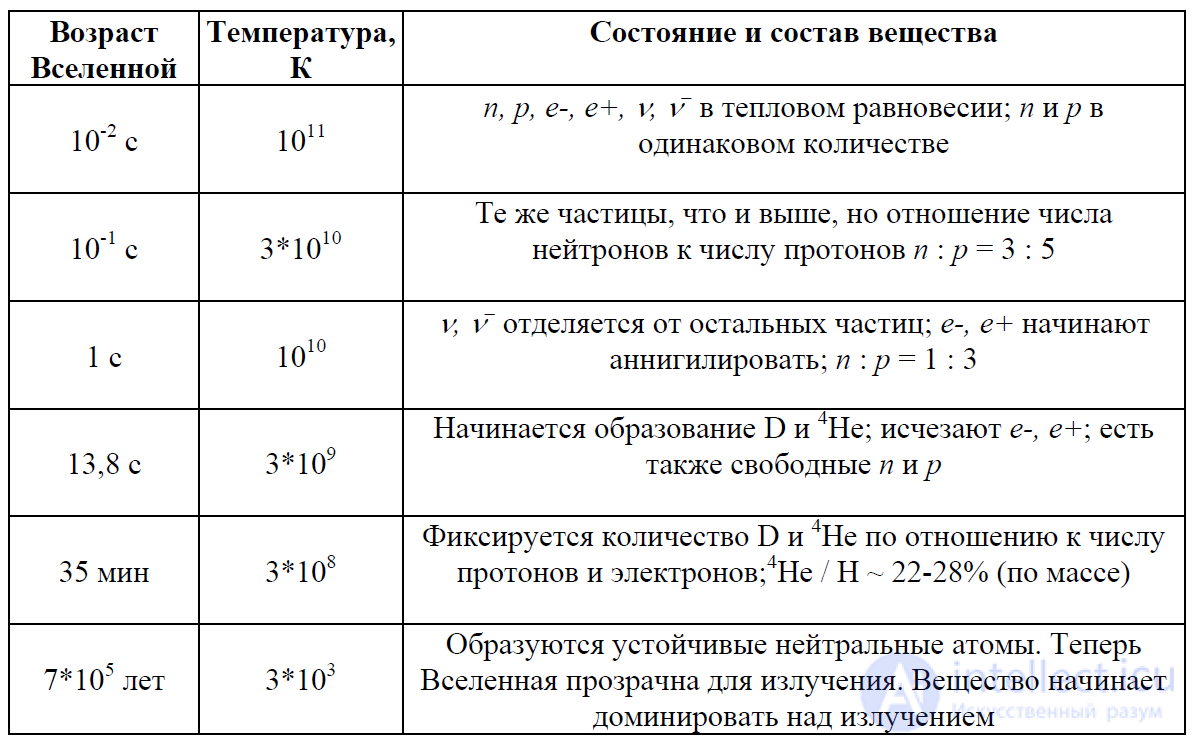
Notation: n – neutron, p – proton, e- – electron, e+ – positron, ν – neutrino, ν– – antineutrino,
D – deuterium, H – hydrogen, He – helium.
* Yu. E. PENIONZHKEVICH, Nuclear Astrophysics, Soros Educational Journal, 1998, No. 10, pp. 68–76.
Faculty of Biology (Specialty: Biophysics)
Faculty of Bioengineering and Bioinformatics, 2007/2008
General and Inorganic Chemistry LECTURES
Lecturer: Senior Researcher of the Faculty of Chemistry, Candidate of Chemical Sciences, Doctor of Pedagogical Sciences
Vyacheslav Viktorovich Zagorsky
Supplement 1 to Lecture 1.
The Origin and Development of Chemistry
The beginning of chemistry [1,2]
In the 1960s astonishing archaeological finds were made in
Anatolia (Turkey) – in the settlement of Çatalhöyük (7th-6th millennia BC). Many
metal articles made of copper and lead were found there, as well as the remains of smelting furnaces. The
settlement itself consisted of well-planned dwellings and grandiose cult
structures. Complex multicolored wall paintings made with
mineral paints have survived. The discovery of such an ancient settlement with a developed culture,
inhabited by more than 7,000 people, allows us to believe that people possessed
certain chemical knowledge at least 10,000 years ago.
The oldest metal object found in Southern Mesopotamia (Ur)
dates to the 4th millennium BC – the time when the Sumerians appeared in the lower reaches of the Euphrates.
It is a spearhead made of copper with an admixture of arsenic and zinc. Glass beads
dated to the 4th millennium BC were found in the same place. The oldest
Egyptian glass beads date to 2500 BC.
One of the oldest surviving manuscripts of Ancient Egypt, the "Ebers Papyrus" (16th century BC),
found in Thebes in 1872, contains recipes for making
medicines. The papyrus describes the operations of boiling down, infusing,
pressing, fermenting and straining plant raw materials. In Memphis, the capital of Ancient
Egypt, the "Brugsch Papyrus" (14th century BC) was found, which also contains
pharmaceutical recipes. These two papyri can be considered the oldest
chemical texts.
In order to unite the secret magic of the priests and the secrets of the craftsmen into
a coherent doctrine of the unity and interconnection of natural phenomena, it was necessary to create
a universal theory that would link and explain the known facts. Such a theory
became Greek philosophy, which arose in the 6th-3rd centuries BC – the doctrine of the first principles,
the "beginnings" of nature. The philosopher Anaximander of Miletus (c. 611-545 BC) introduced the concept of
apeiron ("the indefinite") – a boundless, formless, qualityless
primary substance, unlimited in space and time. It is important to understand that the apeiron is not
material – it cannot be compared either with the "world ether" of the physicists of the late 19th century
or with the "elementary" particles of modern physics; however, one can easily find a
similarity between the apeiron and the Tao of the Chinese philosophers. Apparently Anaximander was the first to
use the concepts of "motion" and "opposition" (the driving force of development)
as philosophical principles that make it possible to build the whole world from a single primary basis.
Anaximander's pupil Anaximenes (585-525 BC) considered air to be the primary principle; by its
condensation material objects were obtained, and by its rarefaction, the soul and fire.
Heraclitus (c. 544-483 BC) suggested that the source of harmony and contradictions in
the world may be the unity and struggle of opposites. He also identified the driving
force of chemical transformations: "Things are joined together by virtue of the relations
of opposites that exist between them."
The ideas of the Milesian school were developed by Empedocles (487/82-424/23 BC), who proposed
the driving forces of world development from the initial state of absolute mixture
– the forces of Love and Strife. It was Empedocles, a connoisseur of crafts and a practicing physician, who created
the first known classification of the material world. He proposed not one but four
primary substances (primary elements, roots) – fire, air, water, earth.
He described each of the primary elements by a combination of four unchanging qualities –
dryness, moisture, heat and cold. Empedocles believed that the diverse substances
are formed as a result of the combination of the smallest fragments of the primary elements. He was the first
to apply to matter the concepts of "union" and "separation."
The driving forces of the fragments of the primary elements, leading to their new combinations,
were, according to Empedocles, "love" and "hatred." The philosopher considered fire an especially important primary element –
as a principle, as a "fiery substance" "dissolved" in physical air.
This "fiery substance" in the later works of the Arab
alchemists turned into "sulfur" (as a philosophical principle, not a substance), then it
became "phlogiston" and until the beginning of the 19th century was used as the "substance of heat" –
"caloric."
One of the most complete syntheses of the works of the Greek philosophers of the 5th-4th centuries BC
has come down to us in the form of the "Dialogues" of Plato (c. 428/427-348/347 BC). In the dialogue "Timaeus"
the four primary elements are presented as combinations of triangles, i.e. they have in
principle a common basis. The properties of the "primary triangles" are such that fire, air and
water can be transformed into one another, and only earth is a truly unchangeable
primary element. Plato separated the concepts of "element" (the idea) and "form of the element" (the substance)
.
Plato's pupil Aristotle (384-322 BC) generalized and developed the ideas of his
predecessors. For example, he introduced a "fifth element" – aether, filling all the
celestial spheres around the Earth that follow the lunar sphere nearest to the Earth. In the
Middle Ages the "fifth element" came to be called the "quintessence" – the "fifth essence"
(Latin). Aristotle's doctrine of the change of qualities is especially important for the further development of the science of matter. He
explained that the emergence of new substances is not simply a mixing
of the primary elements: "When things are combined with one another, all the
content of the mixture becomes one. But this does not happen as if things
were gathered into a heap, but in the way syllables are formed. A syllable is a different quality from
its elements, the letters..."
Unlike Empedocles, Plato and Aristotle were "theorists" and operated
not with substances but only with philosophical concepts.
Alchemy.
In the overwhelming majority of historical introductions to a chemistry course, alchemy
is described as a sort of "pseudo-chemistry," clouded by the mystical consciousness of the people of the
"dark" Middle Ages. This traditional misconception is based on applying the paradigms of modern chemistry
(see above) to alchemy. Still, the distrust of alchemists is to a large extent
explained by the enormous number of imitators –
charlatan gold-makers who appeared in the late period of its development.
In fact, alchemy existed both in the European scientific tradition
and in the Chinese one. European alchemists, whose worldview was shaped by the three
Abrahamic religions (Judaism, Christianity, Islam), developed only "external"
alchemy, as a set of magical techniques for preparing the philosopher's stone (the elixir of
immortality). In China, where three religious teachings coexisted peacefully – Taoism,
Confucianism and Buddhism – external material alchemy was rejected as false,
and the "alchemy of the Tao" developed – a holistic doctrine of achieving longevity and immortality.
Chinese alchemical practices are now also known in Russia –
the health system "qigong," the gymnastics "tai chi chuan," and the martial arts.
The deep philosophy of the alchemists is that before transforming the world on the basis of
limited knowledge, one must purify and transform oneself, as a
part of Nature. One of the most important prerequisites of the alchemists' "Great Work"
(obtaining the "philosopher's stone") is cultivating in oneself a "feeling for matter," that
resonance between the researcher and the object of research in which a person senses
matter "from within". The inseparability of the researcher from the object of study, obvious
to the alchemists, was rediscovered in the 20th century with the development of quantum mechanics.
A scientist of the early 21st century must realize that one cannot change and "improve"
Nature without understanding it fully and without feeling oneself a part of it. For modern chemists
the alchemical approach should become not a "dark past" but the most promising
future – otherwise chemistry will remain a poisonous scarecrow for humanity [7,8,9].
It is important to remember that considering modern chemistry and alchemy from the standpoint of one
and the same scientific paradigm is deeply mistaken. Modern chemistry is the science of the
material world, more precisely, of substances and their transformations. Alchemy is the science
of the interaction of the human soul and spirit with the material world.
Alchemy is discussed in more detail in Supplement 2. In solving modern
scientific problems and in teaching chemistry, the "alchemical" approach is very effective.
For example, the philosopher A.K. Sukhotin writes in his book "Paradoxes of Science" [10]:
"Sometimes enthusiasm (for the object of research) reaches the form of empathy. This
special term denotes the phenomenon of personal analogy. Its meaning is that
the researcher likens himself to the thing he is studying. Say, a chemist
imagines himself a moving molecule, "experiencing" the pushes, the attractions – everything that
happens to it. To achieve a complete picture he must "allow" himself to be pushed and
pulled by molecular forces, to enter into interactions, and so on."
The emergence of modern European science
The turn from alchemy to "real" chemistry began in the 16th century, with the emergence of
capitalism. In the 1920s the German sociologist Max Weber (1864-1920), in his book
"The Protestant Ethic and the Spirit of Capitalism," convincingly proved that the emergence of
capitalism is directly connected with the religious revolution carried out by Martin
Luther (1483-1546).
In the 16th century, as a result of the religious Reformation, the
"Protestant ethic" (a term introduced in the 20th century by M. Weber) and its equivalents
("Calvinist morality," "Puritan work ethic") began to form [11]. According to the norms of such
an ethic, the main signs of being chosen for salvation are strength of faith,
productivity of labor, and business success. Business acumen and wealth became pleasing to God.
According to Luther, to obtain a smaller profit when a greater one is possible is to
sin before God. The Protestant ethic sanctified labor and condemned idleness,
the practical consequence of which in a number of countries was harsh legislation against
vagrants, which proved an effective means of creating a market of cheap labor.
Charity toward beggars, regarded in Catholicism as one of the good deeds,
was condemned by Protestantism – mercy was understood first of all as providing
an opportunity to learn a trade and work. The Protestant ethic condemned drunkenness and
debauchery, demanded strengthening the family, involving children in labor, and teaching them to read and
understand the Bible. The main social values became respect for
any kind of activity useful to people, the need for professional
improvement, and honesty and reliability in human relations.
Protestant ideology gave science freedom of research, finally
separating the Creator from creation. And science quickly became the best justification of this
ideology, pushing religion aside in the sphere of its public application.
In 1802 the great English chemist and physicist Humphry Davy (1778-1829) justified
exploitation in terms of physical concepts: "the unequal distribution of property and
labor, the differences in rank and condition within mankind constitute the source of
energy in civilized life, its driving force, and even its true soul" [12].
The emergence of the science of chemistry
The science of chemistry was born together with the first scientific chemical theory – in
1697 the German chemist Georg Ernst Stahl (1659-1734) published the work
"Fundamentals of Zymotechny, or a General Theory of Fermentation," in which the
doctrine of phlogiston was first set out. Phlogiston (ϕλογιστον – from the Greek "phlogistos" –
inflammable) was, in Stahl's view, a constituent part of all combustible bodies,
released during burning or calcination. The role of air consisted in "absorbing"
phlogiston; the leaves of plants "sucked" phlogiston from the air, and when wood burned
it was released again. Of course, chemists have long explained the causes of combustion on the basis of the
more scientific "oxygen" theory, but it was precisely thanks to the phlogiston theory that chemistry
began to develop rapidly in the 18th century.
The development of commodity-money relations in Europe led to the fact that by the 18th century
the alchemy of true adepts (the initiated) had degenerated into a chase after transmutational
gold. Thousands of "secret" books with fantastic recipes appeared, and tens of thousands of
charlatans passed off the few chemical reactions known by then to only a few people
(for example, the displacement of silver and copper from solutions of their salts by iron) as the beginning of
the Great Work. The main source of income of such pseudo-alchemists was money
given by rich and greedy patrons for the production of the "philosopher's stone." The monarch
Frederick II of Prussia, who kept an alchemical laboratory in Berlin, wrote
in 1751: "Alchemy is a kind of disease that causes
clouding of the mind for a long time, it comes unexpectedly and spreads like an epidemic." [13]
The creator of the phlogiston theory, G.E. Stahl, did not deny the fundamental possibility of
transmutation, but separated alchemy as the "gold-making" of charlatans from serious
chemical research bringing real practical benefit to medicine and
crafts. The rapid progress of real "technological" chemistry, combined with
countless exposures of charlatan gold-makers, meant that by
the middle of the 19th century alchemy had ceased to be a mass "epidemic." The era of
chemistry as a science began.
And the science of chemistry made such progress that in 1887 Berthelot wrote: "There are
no more mysteries left in the Universe." Only a few years remained before the discovery of radioactivity,
elementary particles, and... the transmutation of chemical elements in the course of radioactive
transformations.
The period of development of scientific chemistry is well described in many textbooks. I recommend the
short manual: Asimov A. A Short History of Chemistry. The Development of Ideas and Concepts in
Chemistry. Translated from English. – Moscow: Mir, 1983. – 187 pp.
Chemistry and war [14,15]
The past 20th century fully deserves the name "century of chemistry" – in a hundred years the
chemical industry was created, which changed the world and made our life much
more comfortable. However, it should be remembered that the "worldwide chemicalization" occurred
by no means from noble motives. Chemistry began to develop rapidly as a science as early as the
19th century in connection with the needs of production, but above all military production.
It was precisely the prospect of military application of scientific achievements that provided scientists
with stable state ("government") funding and the very possibility of
doing the work they loved.
At the beginning of the 20th century the governments of developed states (first of all Germany)
provided chemist-scientists with everything necessary for creating a new terrible weapon
[16].
As a result, the authors of chemical weapons of mass destruction turned out, as sad
as it is to admit, not to be generals but outstanding chemist-scientists. The first to
propose using chlorine on a large scale as a combat poison gas was
Professor of Berlin University Walther Friedrich Hermann Nernst (1864-1941,
Nobel Prize in Chemistry 1920). Field tests were conducted by Professor Fritz
Haber (1868-1934, Nobel Prize in Chemistry 1918) [17;18,19].
On April 22, 1915, with a favorable wind direction, German troops
released about 180 tons of chlorine from cylinders in 5 minutes. On a 6 km stretch of the front in the
Ypres river valley about 15 thousand people were affected, 5 thousand of whom died immediately.
The Anglo-French front in this sector was destroyed. The German command, which did not
believe Haber's calculations, did not expect such a terrible effect and did not exploit
a real chance of victory in the battle.
From that day – the "black day of chemistry" – the rapid development of the chemistry of
chemical warfare agents began. In all, during the First World War 180 thousand tons of
various warfare agents were produced, of which about 125 thousand tons were used. At least 40 different substances
were tested at the fronts. The Russian army was the first to use sulfuryl chloride
(July 1916) and chloropicrin (September 1916) [20]. According to official data, during the years of
the First World War 1.3 million people suffered chemical injuries, of whom
100 thousand died immediately [21].
Nevertheless, it was precisely because of the possibility of a new chemical war that chemical
science and education received an unprecedented impetus for development. In the 1930s in the USSR a
number of chemical universities and research institutes were created, and a systematic course of chemistry appeared in schools for the first time
[22].
Chemistry itself, as a natural science, is neutral in worldview and ideology.
This is confirmed by the joint use of the achievements of chemistry in the
manipulative interests of governments of states with different ideologies.
The Soviet government actively spoke out against the proliferation of chemical
weapons and put forward the idea of banning them as early as the Genoa Conference on April 15,
1922. However, during the same conference Russia and Germany signed a treaty on
military cooperation; within the framework of this treaty a Soviet-German
aviation school in Lipetsk, a tank school in Kazan, and a military chemical
proving ground in Shikhany, Saratov Oblast (the "Tomka" project) were created. At the Shikhany proving ground in 1928-1933
military chemists of the Red Army and the Reichswehr tested various munitions with
mustard gas and means of protection [23].
The deadly "progress" of chemistry continued until the end of the 20th century. Chemical weapons, prohibited by
international agreements, were developed by outstanding scientists
of Western countries and the USSR. As is proper, "the gun hanging on the wall" fired –
scientific achievements were used by terrorists of the "Aum Shinrikyo" sect. As a result of
their use of the chemical warfare agent sarin in Japan in 1994 and 1995,
18 people died and 5,500 people were poisoned [24].
When genius serves technocratic evil, "in the interests of society" this
service is disguised in every way as noble work. One of the striking recent
examples is the description, in the "Gallery of Russian Chemists" produced by the supplement "Chemistry" to
the newspaper "First of September," of the biography of the outstanding chemist Martin Izrailevich
Kabachnik (1908-1997) [25]. From the "gallery" biography it follows that the academician created
hundreds of new cholinesterase inhibitors and studied subtle biochemical reactions. A mere trifle is
left unsaid – that these inhibitors, whose industrial production in the
USSR was organized by M.I. Kabachnik, are called VX gases (the most toxic of the
synthetic warfare agents, the lethal dose on contact with the skin is 4-5 mg). It was precisely for the
development of the industrial synthesis of chemical warfare agents that he received the Lenin Prize in 1974,
and later became a Hero of Socialist Labour. Such an example is far from isolated.
The origin of chemical elements. Nuclear reactions
Temperature 3*109 ÷ 3*108 K, time – up to 35 minutes from the Big Bang,
primordial synthesis of helium:
n + p → D + γ
D + n → 3H + γ
D + p → 3He + γ
D + D → 3H + p,
D + D → 3He + n
3H + p → 4He + γ
3He + n → 4He + γ
The result is 4He / (H + 4He) ~ 22-28% (by mass)
In stars at temperatures below 2*107 K, the proton-proton cycle of helium synthesis:
p + p → D + e+ + ν
D + p → 3He + γ
3He + 3He → 4He + 2 p
3He + 4He → 7Be + γ
7Be + e– → 7Li + ν
7Li + p → 2 4He
overall process 4 1H → 4He + 26.7 MeV
(1 eV = 96.48 kJ/mol; 1 MeV = 96480000 kJ/mol)
Catalytic CNO cycle of helium synthesis:
12C + p → 13N + γ
13N → 13C + e+ + ν
13C + p → 14N + γ
14N + p → 15O + γ
15O → 15N + e+ + ν
15N + p → 12C + 4He
At temperatures above 108 K, helium "burning" (12C* – excited carbon nucleus):
3 4He → 12C* + 7.274 MeV
energy of 12C*: 7.654 MeV
4He + 4He → 8Be*
8Be* + 4He → 12C*
12C + 4He → 16O + γ
At temperatures above 5*108 K, "burning" of carbon, oxygen, neon, and silicon:
12C + 12C → 20Ne + 4He + 4.62 MeV
12C + 12C → 23Na + p + 2.24 MeV
12C + 12C → 24Mg + γ - 2.60 MeV
16O + 16O → 28Si + 4He + 9.59 MeV
16O + 16O → 31P + p + 7.68 MeV
16O + 16O → 31Si + n + 1.45 MeV
16O + 16O → 30Si + 2 p + 0.39 MeV
16O + 16O → 24Mg + 2 4He - 0.39 MeV
16O + 16O → 27Al + 4He + p – 1.99 MeV
Neon burning is characterized by a short stage and consists of the
photodisintegration of 20Ne under the action of high-energy γ-quanta with the removal of an α-
particle. The liberated α-particles interact with neon and other nuclei until
the supply of neon is exhausted.
28Si + 4He → 32S + γ
32S + 4He → 36Ar + γ
Unsolved problems of modern cosmology:
1) What is the mass ratio of carbon to oxygen after the helium flash (this
ratio is extremely important for the further evolution of massive stars)?
2) Where exactly does the r-process (from English rapid) of rapid neutron capture take place?
3) Which nuclides owing to proton processes are born in various episodes of
nucleosynthesis?
4) What is the relative contribution of core-collapse supernovae, on the one hand, and
those generated by a CO explosion, on the other, to the formation of iron and other heavy elements?
(Krugosvet encyclopedia http://www.krugosvet.ru/articles/20/1002099/1002099a1.htm)

Comments