
Lecture 20 min.
2.3. "Dispersed knowledge"
Dispersed knowledge as an activity of the mind. People's economic behavior is determined, on the one hand, by their economic interests, and on the other, by a body of knowledge about economic processes. The more pronounced a person's economic interest, and the more complete their knowledge of the supply and demand for goods, the more rational individuals' economic decisions become. This proposition has dominated economic theory ever since the classical tenets of "economic man" developed in the eighteenth century by Adam Smith (1723–1790). It was only in the twentieth century, however, that a theory was developed explaining the intellectual and psychological mechanism by which "economic man" makes decisions – the concept
of dispersed knowledge. Its author is the English economist Friedrich von Hayek
(1899–1992), a representative of economic liberalism who developed the traditions of the Austrian school, and winner of the Nobel Prize in Economics (1974).
The concept of dispersed knowledge was first set out by F. Hayek in the article "Economics and Knowledge" (1936) and later developed in the work "The Use of Knowledge in Society" (1945). Hayek also called this concept the division of knowledge [3, p. 66], by analogy with the concept of the social division of labor developed by Adam Smith.
The essence of Hayek's concept is that the knowledge existing in society represents an endless variety of divergent and even contradictory facts and opinions about the state of supply and demand. Knowledge does not exist in any complete and explicitly expressed form, but is dispersed among individuals and exists only through them.
Since Hayek reduced dispersed knowledge solely to individuals' knowledge of information about supply and demand, he saw the mechanism for using such information exclusively in the market and in market competition, which he regarded as a discovery procedure. He proposed "regarding competition as a procedure for discovering facts which, without resort to it, would remain unknown to anyone, or at least would not be put to use." At the same time, "unlike science, which
seeks to discover "universal"... facts representing regularities of events, economic competition acts as a method of discovering specific facts of significance for achieving particular, temporary goals" [4, pp. 6–7].
Competitive struggle is a struggle with the unknown, that is, a search for new answers to new challenges. Through the mechanism of competition the market makes it possible to discover new information about the state and direction of price movements and about the quantity and quality of goods. It is therefore only after reliable information about these
quantities has been discovered that real competition – the struggle for the consumer – begins.
Dispersed knowledge, understood within the bounds of Hayek's interpretation, is reduced in much modern theoretical research to an interpretation of knowledge as an activity
of the mind leading to the attainment of a good. This approach is shared by many futurologists, sociologists, economists and other researchers engaged in forecasting
the future, when they speak of the role and place of knowledge in the development of society in general and the economy in particular. They call the expected economy the knowledge economy. As
academician V.L. Makarov writes, "the term "knowledge economy" was introduced into scholarly
use by the Austrian-American scholar Fritz Machlup (1962) with reference to one
of the sectors of the economy. Now this term, together with the term "knowledge-based economy," is used to define a type of economy in which knowledge
plays a decisive role, and the production of knowledge is a source of growth. The widely
used concepts of "innovation economy," "high-tech civilization," "knowledge society" and "information society" are all close to the concept of "knowledge
economy"" [1, p. 450]. The authors of the book "The Knowledge Economy" [5] take a similar approach.
F. Hayek, one of the outstanding economists and philosophers of the twentieth century and winner of the 1974 Nobel Prize for his contribution to the theory of economic fluctuations, his comparative analysis of the efficiency of different economic systems, and his research into the legal foundations of the economy, consistently developed and argued the thesis of the fundamental limitedness of human knowledge, including scientific knowledge. He maintained that knowledge exists not only in the form of a finished body of information embodied in formulas or figures. The bulk of knowledge is "dispersed" among people, each of whom possesses a fragment of it, often of an informal, intuitive character. A consequence of this thesis is the impossibility of forming an objective, comprehensive picture of the world and the economy, since any information about a system is worse and poorer than the information that actually circulates within it.
Hayek considered the concept of dispersed knowledge to be one of his principal discoveries. The central element of this concept is the idea of the market as a special kind of information device that identifies, uses and coordinates the knowledge of millions of people independent of one another. Only the market is able to provide a synthesis of the most concrete knowledge with the most abstract. Concrete knowledge consists of practical skills and abilities, craft, and professional techniques and habits. Condensed abstract information takes the form of prices, which allow everyone to fit their specific, concrete knowledge into the overall system of knowledge. A competitive market, more effectively than any other system, makes it possible to use a large volume of concrete and abstract knowledge dispersed among members of society who have no information about one another. "The economic problem is the problem of the best use of the resources available to us. Our task is to ensure the best use of the knowledge possessed by real, existing people." It seems appropriate to stress here that whereas for Schumpeter the main driver of economic development is technological innovation and competition, Hayek draws attention to the informational component, to the particular features of knowledge as an economic resource. He persistently criticizes, as inconsistent with actual innovation processes, the neoclassical theory's assumption that all market agents possess complete information.
Viewing competition as a procedure for discovering the systemic knowledge, dispersed throughout society, about consumer preferences and producers' technological capabilities, Hayek notes that the social optimum of individual behavior is formed through the fullest possible use of precisely this fragmentary knowledge. Supplementing the idea of the division of labor with the idea of the division of knowledge, Hayek rejects the possibility that any individual could possess complete information – knowledge is inevitably partial. The specificity of the abilities individuals acquire in the course of their activity gives them comparative advantages in performing particular kinds of work.
The behavioral aspect of acquiring and using knowledge is determined by the fact that the perception of economic phenomena is subjective and is often mistaken, owing to the phenomena of information asymmetry, imperfect competition and adaptation costs. Mistaken perceptions are systematically reflected in the economic behavior of business agents, which in turn shapes the formation of the macrostructure and alters the character of the maximization of the objective function and of equilibrium.
In this connection particular importance is attached to the content of the concept of competition. Hayek, like Schumpeter, subjects to deep criticism the neoclassical view of competition as a kind of stable state, and considers the theory of "perfect competition" to be far removed from reality. In his article "Competition as a Discovery Procedure" (1968), he writes of competition as a method of generating new knowledge. The acquisition of knowledge in the course of competitive struggle is linked both to the fact that producers discover new needs while consumers discover new means of satisfying them, and to the fact that all economic agents gain new knowledge about themselves and about the extent of their own capacity to create or satisfy needs. From this follows a conclusion important for understanding innovative activity: that any artificial restriction of competition reduces the volume of knowledge available to society.
Hayek lists the following institutions required to secure "an effective competitive order: laws on property and contracts; on corporations and associations (including, in particular, trade unions); policy toward monopolies and quasi-monopolies that would persist even within a system otherwise reasonably arranged in other respects; and the problems of taxation and international trade." The degree of development of the law in these areas can predetermine development either toward or away from a competitive environment. In Hayek's view, the evolution of civil law on cartels, monopolies and the restriction of competition over the first half of the twentieth century in Great Britain and the United States not only failed to make competition more effective but actually contributed to its decline. Thus F. Hayek considered it necessary to extend the problem of preventing monopolization and preserving competition to certain other areas as well, in which the concept of property is bound up with intellectual capital (patents, copyright and publishing rights, trademarks and the like).
Hayek's main works: "The Meaning of Competition." 1946. Russian translation in the collection "Individualism and Economic Order." Moscow, 2000; F. Hayek. "Free" Enterprise and Competitive Order. 1947. Russian translation in the collection "Individualism and Economic Order." Moscow, 2000.
"It seems undeniable to me that in these areas the slavish application of the concept of property, as it was worked out for material things, has done much to encourage the growth of monopolies, and that fundamental reforms may be needed here to make competition work. In the field of industrial patents in particular, we need to examine seriously whether the granting of a monopoly privilege is really the most suitable and effective form of reward for bearing the particular kind of risk associated with investment in scientific research." Hayek makes similarly nontrivial judgments with regard to corporate law, taxation, monetary policy and employment policy.
Dispersed knowledge and its types.
In practical activity dispersed knowledge
(understood in human-centered terms) functions as knowledge of activities (activity-elements) concerning social, cultural, economic and other facts, for the purpose of carrying out economic and socio-cultural activity.
Knowledge of activities relating to the structure and functioning of nature and society, viewed from the standpoint of the person, constitutes individual knowledge,
while viewed from the standpoint of society as a totality of individuals, it constitutes dispersed knowledge.
Dispersed knowledge is individual because it is based on a person's individual perception of the world and the surrounding environment, and also on personal enrichment through the experience of preceding generations. It becomes embodied in facts, skills, intuition, habits and traditions fixed in a person's consciousness, and in the process
of communication between individuals it is passed from one to another. Dispersed knowledge is constantly changing, and for this reason it is impossible to draw up a complete, finished picture of it. Seeing
the world simultaneously through the eyes of all people, and reflecting every nuance of its perception by everyone,
is impossible because of the constantly shifting kaleidoscope of knowledge.
At the same time, people's diverse and multifaceted knowledge can be grouped
into types of knowledge that mutually interpenetrate and exist not only in parallel but
also jointly, merging functionally with one another. They can be represented as
three spheres (fig. 1).
First, there is the knowledge of individual persons, or individual knowledge. It appears as separate particles, fragments of society's aggregate knowledge, belonging exclusively to its holder. Individual (dispersed) knowledge moves according to principles known only to that individual.
Individual knowledge is unique in the sense that it is inaccessible
to anyone other than its holder. Only the specific individual who has accumulated this knowledge (information) can use it, i.e., the information available, to solve particular problems. The fuller and deeper the knowledge, the
more highly qualified a specialist its holder becomes. Herein lie the enormous advantages of individual knowledge.
Second, the mass individual knowledge people have about production, distribution or exchange, and also all their other individual knowledge about human
forms of activity, by grouping and interweaving, form the aggregate knowledge of human society (of the local community) – a chaotic yet stable structure, much as a multitude of birds forms a flock.
Third, this is coordinated knowledge. It arises from people's purposeful and conscious activity in pursuit of their own individual preferences, but which forces them, in order to achieve that goal, constantly to make
mutual compromises. As a result of these processes, first, each person's personal
freedom is preserved, understood as no infringement of everyone's freedom in relation to everyone else,
and second, what F. Hayek called a "spontaneously formed order" comes into being [4, p. 8].
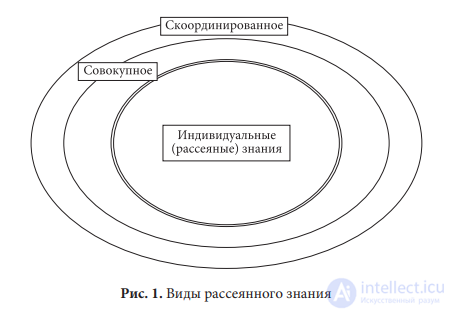
Coordinated knowledge arises only once humanity has reached a certain level of maturity in society and in the science of society, which in turn is linked to the level of development of the productive forces. It involves not merely the conscious and purposeful activity of individuals, as is characteristic of systemic knowledge, but such conscious and purposeful activity of theirs as is oriented toward social values and social preferences. Coordinated knowledge guarantees that public goods are necessarily satisfied, since for the community they represent a higher value than individual needs. In addition, it generates a synergetic effect, expressed in a predictable gain obtained by the interacting agents
In postmodern society, the dispersion of knowledge and the fragmentation of the picture of the world are intensifying, and within this scientific knowledge is losing its defining place and unconditional trust. It is characteristic that scholars who fight "pseudoscience" take a rather negative view of postmodernist theories, describing them as "pseudoscientific" [14, p. 36], i.e., unsubstantiated, and seeing in them a "justification" for the expansion of non-scientific knowledge. In reality postmodernism cannot, in principle, "justify" anything, since, as Lyotard and others have shown, it neither denies nor asserts anything. In postmodern culture, different forms of knowledge can be defined as parallel "language games," as texts placed side by side that narrate the world on the basis of different rules. At the same time, no single system of rules is recognized as the primary, true, or dominant one. Such pluralism and such fragmentation of culture undoubtedly result in a limiting of the priority that modern society assigns to scientific knowledge over its other forms. That is, we return to the situation described
by M. Weber, in which "presuppositionless" scientific knowledge cannot justify its connection with society's values, and therefore loses society's trust.
Analyzing the lessons of history, Hayek shows that the evolutionary development of the state on the basis of strengthening private property rights and, in connection with this, citizens' rights, produces the best economic and social outcomes. "Perhaps no developed civilization has ever achieved success without a government that saw its main purpose as the safeguarding of private property, whereas a 'strong government' has again and again held back the growth and prosperity that such safeguarding did so much to foster."
There is also a direct link between these processes and the scientific and technological development of individual states, seen from a broad historical perspective. Thus, "in imperial China… enormous advances toward civilization and sophisticated industrial technology occurred during the periodically recurring 'ages of turmoil,' when government control was temporarily weakened. …In Egypt state socialism prevailed, beginning with the eighteenth dynasty, for almost two thousand years, and it is largely this that accounts for the stagnant character of Egyptian civilization. …In the same way, regarding the revival of European civilization in the late Middle Ages, one can say that the spread of capitalism — and of its European civilization — owes its origin to political anarchy. Modern industrialism was reached not where governments were strongest, but in the cities of the Italian Renaissance, southern Germany, the Netherlands, and finally in England with its mild system of government, that is, where townspeople ruled rather than warriors." Thus, the less rigid and centralized government administration is, the greater the chances for the development of spontaneous processes of scientific and technological progress.
As is well known, in the period between the First and Second World Wars, and especially after the Second World War, amid the rapid growth of science and education and the sharp increase in the number and influence of scientists and qualified specialists, the ideas of technocracy — the establishment of a political power of specialists who could govern society in a new way — became widespread. In connection with these attempts to rationalize not only science itself but the entire structure of society by means of the most rational scientific ideas, Hayek draws attention to a very important feature of their spread. The influence of rationalism, he writes, was so deep and pervasive that, in principle, the more intelligent and educated a person was, the more likely it was that he held not only rationalist but also socialist views… The higher we climb the ladder of intellect, the closer we associate with intellectuals, the more likely we are to encounter socialist convictions. Rationalists are, for the most part, enlightened and intellectual people, and enlightened intellectuals are, for the most part, socialists.
Criticizing the "fatal conceit" of rationalist technocrats, Hayek insists on the inevitability of capitalism, or of the extended market order, as a mode of social organization that ensures the comprehensive progress of civilization. He insists on the limited possibilities of scientific knowledge in general, and of attempts to use it to rationalize the structure of society through the implementation of state policy, including scientific and technological policy. At the same time, he speaks out clearly against complete freedom for the market mechanism, and clearly identifies the areas where government regulation is inevitable and can be highly effective when it relies on a scientific approach.
The significance of Hayek's ideas for the modern theory of innovation activity is determined above all by the fact that he, more consistently than others:
References
1. Makarov, V.L. The knowledge economy: lessons for Russia // Vestnik of the Russian Academy of Sciences. 2003. No. 5. Vol. 73.
2. Hayek, F.A. Individualism and Economic Order. Moscow: Izograf, 2001.
3. Hayek, F.A. Economics and Knowledge // Hayek, F.A. Individualism and Economic Order. Moscow: Izograf, 2001.
4. Hayek, F.A. Competition as a Discovery Procedure // World Economy and International Relations. 1989. No. 12.
5. The Knowledge Economy / ed. by V.P. Kolesov. Moscow: INFRA-M, 2008.
6. Bogdanov, A.A. Tectology: The Universal Science of Organization. Moscow: Finansy, 2003.
7. Maksimov, L.V. Cognitivism as a Paradigm of Humanities and Philosophical Thought. Moscow: ROSSPEN, 2003.
8. Merkulov, I.P. Cognitive Evolution. Moscow: ROSSPEN, 1999.
9. Smith, A. An Inquiry into the Nature and Causes of the Wealth of Nations. Moscow, 1962.
10. Bastiat, F. Economic Harmonies // Say, J.-B., Bastiat, F. A Treatise on Political Economy / J.-B. Say; Economic Sophisms. Economic Harmonies / F. Bastiat / compiled, with introductory article and commentary by M.K. Bunkina, A.M. Semenov. Moscow: Delo, 2000.
11. Menger, C. Investigations into the Method of the Social Sciences with Special Reference
to Economics // Menger, C. Selected Works. Moscow: Territoriya Budushchego, 2005.
12. Polanyi, M. Personal Knowledge: trans. from English / general ed. by V.A. Lektorsky and V.I. Arshinov. Moscow, 1985.
13. Hayek, F. The Pretense of Knowledge. Alfred Nobel Memorial Lecture, delivered by Friedrich August von Hayek on December 11, 1974 // Nobel Laureates in Economics: Autobiographies, Lectures, Commentaries / ed. by V.V. Okrepilov. St. Petersburg: Nauka, 2007. Vol. 1. 1969-1982.
14. Akerlof, G., Shiller, R. Animal Spirits: How Human Psychology Drives the Economy, and Why It Matters for Global Capitalism / trans. from English
by D. Priyatkin; scientific ed. by A. Suvorov; introductory article by S. Guriev. Moscow: United Press, 2010.
15. Petrov, A.N., Demidova, L.G., Klimov, S. Indicative Planning: Theory and Ways of Improvement. St. Petersburg: Znanie, 2000.
14. Efremov, Yu.N. Pseudoscience, quasi-sciences, and hypothesis // Pseudoscience in the Modern World: Media, Higher Education, School. St. Petersburg: VVM Publishing House, 2013. P. 30-41

Comments