
Lecture 36 min.
Cryptocurrency exchange or digital currency exchange ( DCE ), is a business that allows customers to trade cryptocurrencies or digital currencies for other assets, such as conventional fiat money or other digital currencies. Exchanges may accept credit card payments, bank transfers or other forms of payment in exchange for digital currency or cryptocurrency. A cryptocurrency exchange may act as a market maker, which typically takes the spread between buyers and sellers as a transaction commission for its service, or, as a matching platform, simply charges a fee.
Some brokerage firms that also specialize in other assets, such as stocks, such as Robinhood and eToro , allow users to buy but not withdraw cryptocurrency to cryptocurrency wallets. However specialized cryptocurrency exchanges, such as Binance and Coinbase , allow the withdrawal of cryptocurrency.
Cryptocurrency is a type of digital currency whose internal units of account are tracked by a decentralized payment system (with no internal or external administrator or any equivalent of one), operating in a fully automatic mode. Cryptocurrency itself has no particular physical or electronic form — it is simply a number denoting the quantity of these units of account, which is recorded in the corresponding position of a data packet of the data-transfer protocol and, like all other information about transactions between addresses in the system, is often not even encrypted. At the same time, the mechanisms for generating an address and verifying the authority to operate with it are based on cryptographic methods (a digital signature based on a public-key system, whereby disposal is available only to the holder of the private key corresponding to that address), as is the formation of a transaction packet and its relationship to other packets (sequential hashing, which makes it impossible to alter information about the amount of cryptocurrency) . At the same time, the system holds no information about the owners of addresses or about the fact that an address was created (an address can be generated completely autonomously, without even connecting to the network and without reporting anything to the network afterward) — that is, there is no mechanism to confirm that the recipient's address actually exists or that the access key to it has not been lost. The absence of information about the owner is the basis (though not the only basis) for the anonymity of transaction participants. In their economic conditions and consequences, cryptocurrency payments more closely resemble cash payments than forms of cashless payment[⇨], although cryptocurrencies are designed primarily for remote purchases (for example, over the Internet).
Examples of cryptocurrencies: BTC(Bitcoin), ETH(Ethereum),NEO,XMR(Monero) ,LTC (Litecoin)
Bitcoin (BTC, Bitcoin) is a decentralized cryptocurrency created by Satoshi Nakamoto in 2008. The word "decentralized" means that Bitcoin has no centralized servers for issuing new coins, processing transactions or storing funds. The issuance of Bitcoin is limited — the number of coins will not exceed 21,000,000. According to calculations, the issuance of Bitcoin will end in 2045.
Altcoins (Eng. Altcoins) is the name for all cryptocurrencies except Bitcoin. The first altcoins appeared in 2011. Their purpose was to overcome all the technical limitations that Bitcoin has. As of early December 2017, there were more than a thousand altcoins in the world.
| TICKER | TYPE | MARKET CAP, MILLION USD | PRICE, USD AS OF APRIL 2021 | TRADING VOLUME, MILLION USD | SECTOR |
|---|---|---|---|---|---|
| BTC | Currency | 950,146.56 | 50,836.23 | 50,557.57 | Proof of Work |
| ETH | Currency | 263,623.30 | 2,280.39 | 32,446.36 | Proof of Work |
| BNB | Currency | 77,780.98 | 506.94 | 4,247.12 | Exchange |
| XRP | Currency | 49,446.14 | 1.09 | 8,856.86 | Financial services |
| ADA | Currency | 35,966.59 | 1.13 | 3,622.22 | |
| DOGE | Currency | 34,952.41 | 0.27 | 11,109.91 | Proof of Work |
| DOT | Currency | 27,914.73 | 29.93 | 1,912.40 | |
| LTC | Currency | 15,378.35 | 230.38 | 4,738.13 | Proof of Work |
| BCH | Currency | 14,804.50 | 790.93 | 3,585.38 | Proof of Work |
| VET | Currency | 11,886.47 | 0.18 | 2,697.40 |
Token is a unit of account that is not a cryptocurrency, intended to represent a digital balance in some asset , in other words performing the function of a "securities substitute" in the digital world . Tokens are a record in a ledger distributed across a blockchain. Token management is usually implemented through a smart contract, which records the balance values on token holders' accounts and provides the ability to transfer tokens from one account to another. A token can be accessed through special applications that use electronic-signature schemes. The bulk of the tokens existing today are built on Ethereum's Blockchain protocol in accordance with the ERC-20 standard . Today there are many varieties of tokens, there is even a token in honor of March 8
Difference between a token and a cryptocurrency . A token and a cryptocurrency are not the same thing. Unlike cryptocurrencies, tokens can be issued and managed entirely in a centralized manner. Below are the differences between a token and cryptocurrencies as understood by the creator of Bitcoin, Satoshi Nakamoto.
Differences between a token and a cryptocurrency:
the issuance of tokens can be centralized or decentralized, while the issuance of cryptocurrencies is only decentralized;
Tokens are generated all at once, coins – in the process of mining. Usually the platform that owns the tokens issues them all at once in full and then sends them to the market. Tokens are characterized by ICOs (presales at the stage before a startup is launched). In most cases tokens are sold off in order to raise money for the implementation of some project. The future fate and price of the tokens depends on how successful it turns out to be. Coins are usually mined (issued by miners) over a long period of time. The presence of miners is a mandatory condition for a cryptocurrency to exist successfully and for transactions to take place between participants in the blockchain network.
Tokens are a specialized "currency" that community participants can buy, sell to one another, use to pay for various goods and services, and receive as a reward in gratitude for developing a startup. Some tokens can be traded on third-party exchanges. But most often, if a startup participant decides to sell them, it is easiest to sell them to other participants. Coins, unlike tokens, are close to fiat money. They can be bought and held for the purpose of making a profit and preserving one's capital. Cryptocurrency, for example bitcoin, is now accepted as a means of payment in a great many stores that have no connection to one another.
Examples of tokens.
Contract address of a token - this is the address of the actual token contract that governs the token's logic. This does not refer to the address where your personal tokens are stored! In effect, this is the token's code, including the issuer's currency and exchange, with the smart-contract logic (Read /write) through which its transactions take place.
|
Contract address of a token |
symbol |
name |
|
0xc011a73ee8576fb46f5e1c5751ca3b9fe0af2a6f |
SNX |
Synthetix Network Token |
|
0x261EfCdD24CeA98652B9700800a13DfBca4103fF |
sXAU |
Synth sXAU |
|
0x617aecb6137b5108d1e7d4918e3725c8cebdb848 |
sBNB |
Synth sBNB |
|
0xdac17f958d2ee523a2206206994597c13d831ec7 |
USDT |
Tether USD |
|
0x1f9840a85d5af5bf1d1762f925bdaddc4201f984 |
UNI |
Uniswap |
|
0xa0b86991c6218b36c1d19d4a2e9eb0ce3606eb48 |
USDC |
USD Coin |
|
0xB8c77482e45F1F44dE1745F52C74426C631bDD52 |
BNB |
Binance: BNB Token |
Example of a smart contract for BNB
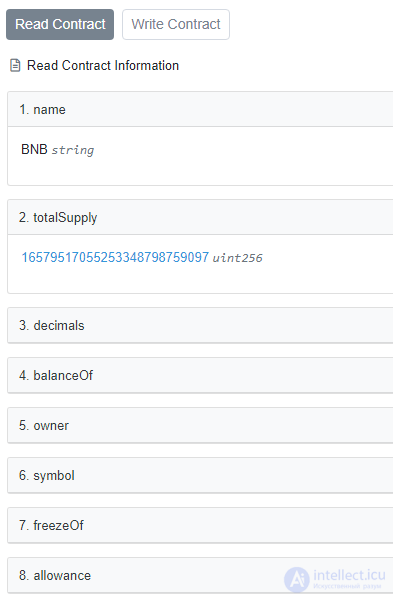
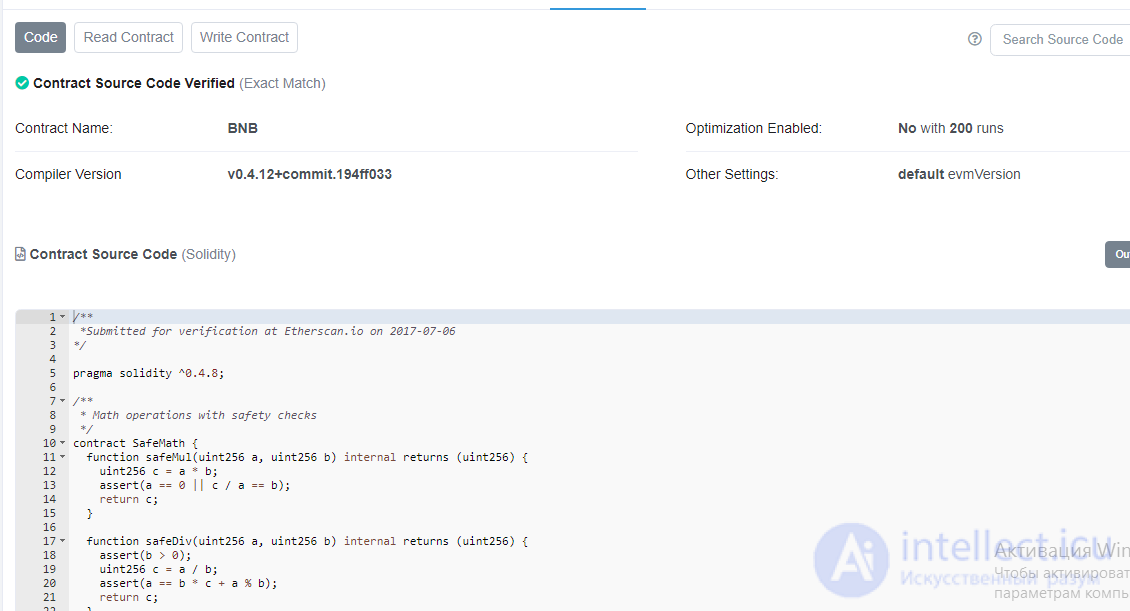 https://etherscan.io/address/0xB8c77482e45F1F44dE1745F52C74426C631bDD52#code
Examples of tokens
| TICKER | TYPE | MARKET CAP, MILLION USD | PRICE, USD AS OF APRIL 2021 | TRADING VOLUME, MILLION USD | SECTOR |
|---|---|---|---|---|---|
| USDT | Token | 49,439.50 | 1.00 | 106,943.82 | Stablecoin |
| UNI | Token | 16,206.93 | 30.97 | 644.34 | |
| LINK | Token | 13,530.66 | 32.29 | 1,666.11 | |
| USDC | Token | 11,242.41 | 1.00 | 1,953.09 | Stablecoin |
| WBTC | Token | 7,939.46 | 50,833.16 | 169.31 | |
| BUSD | Token | 6,976.71 | 1.00 | 4,858.96 | |
| DREP | Token | 6,741.51 | 1.96 | 27.58 | Business services |
| MTXLT | Token | 4,887.10 | 79.12 | 0.0034 | |
| BTT | Token | 4,559.63 | 0.0069 | 2,738.28 | Software |
| CAKE | Token | 4,539.69 | 28.68 | 917.46 |
Application tokens, also called Appcoins, are user tokens intended to provide access to the services of distributed networks . For example, to create applications on the Ethereum network you need to acquire an Ether token. To write files to the Sia distributed file-storage network, you will need Siacoin tokens (SC). To pay for the decentralized network services of Emercoin, you will need tokens of the same name.
Equity tokens are designed to attract the investment needed to develop existing development projects or to build a network from scratch. Unlike utility tokens, they are not used to access the network's applications, but merely serve as digital shares of the company. Equity tokens are the digital equivalent of classic stock-market shares : investors who hold tokens buy them in order to receive dividends, which represent a percentage of income, or a share of the network's transaction fees. For example, Sia pays token holders 3.9% of the revenue from data storage. In a DAO , for example, equity tokens serve as a share in the company.
Credit tokens are tokens used for short-term borrowing of funds with subsequent payment of interest on the loan amount. One of the first projects to use credit tokens was the Steemit network [en] , which uses the SD coin (Steem Dollar). By buying this token, a user is meant to earn 10 percent per annum, with the payouts made in the SD token itself.
Unique tokens ( non-fungible tokens ) are tokens that lack the property of fungibility. These are assets that exist only within their own crypto systems and can be used to record on the blockchain information about ownership of in-game items, digital art objects, and movable and immovable property.
An NFT is a unit of data on a digital ledger called a blockchain, where each NFT can represent a unique digital item, and therefore each one is non-fungible. The first non-fungible tokens were created by Witek Radomski, co-founder of Enjin Coin, who wrote the code for the first such coin in June 2017.
Non-fungible tokens became popular thanks to the game CryptoKitties , which raised $12 million in investment. RareBits , an exchange for non-fungible tokens, attracted $6,000,000 in investment. In March 2021 the price of the Alice token rose by 60,000% after being listed on the Binance cryptocurrency exchange.
Exchanges can send cryptocurrency to a user's personal cryptocurrency wallet . Some of them can convert digital currency balances into anonymous prepaid cards that can be used to withdraw funds from ATMs around the world , while other digital currencies are backed by real commodities, such as gold.
Digital currency issuers are often independent of digital currency exchanges, which makes trading the currency easier. In one type of system, digital currency providers (DCPs) are companies that maintain and manage their customers' accounts, but usually do not issue digital currency to those customers directly. Customers buy or sell digital currency on digital currency exchanges, which transfer digital currency to or from the customer's DCP account. Some exchanges are subsidiaries of a DCP, but many of them are legally independent enterprises. Funds in DCP accounts may be held in real or fictitious currency.
The exchange of digital currency can be either a conventional business or a purely online one. As a conventional business, it exchanges traditional payment methods for digital currencies. As an online business, it exchanges electronically transferred money for digital currency.
Digital currency exchanges often operate outside Western countries to avoid regulation and prosecution. Nevertheless, they process Western fiat currencies and maintain bank accounts in several countries to facilitate deposits in various national currencies.
Decentralized exchanges, such as Etherdelta, IDEX and HADAX, do not hold users' funds on the exchange, and instead facilitate peer-to-peer cryptocurrency trading. Decentralized exchanges are resistant to the security issues that affect other exchanges, but as of mid-2018 they suffer from low trading volumes.
In 2004, three Australia-based digital currency exchange businesses voluntarily closed following an investigation by the Australian Securities and Investments Commission (ASIC). ASIC considered the services offered to legally require an Australian financial services license, which the companies did not have.
In 2006, the American digital currency exchange company Gold Age Inc., based in New York state, was shut down by the U.S. Secret Service after operating since 2002. The business operators, Arthur Budovsky and Vladimir Kats, were charged with "operating an illegal digital currency exchange and money transmitting business" out of their apartments, transferring more than $30 million into digital currency accounts. Customers provided a limited amount of identification documents and could transfer funds to anyone anywhere in the world, with fees sometimes exceeding $100,000. Budovsky and Kats were sentenced in 2007 to five years in prison "for operating an unlicensed money transmitting business, a felony, in violation of the state banking law," ultimately receiving a sentence of five years' probation .
In April 2007, the U.S. government ordered E-Gold's administration to freeze/block approximately 58 E-Gold accounts owned and used by The Bullion Exchange, AnyGoldNow, IceGold , GitGold, The Denver Gold Exchange, GoldPouch Express, 1MDC (a digital gold currency based on e-gold) and others, forcing G&SR (the owner of OmniPay) to liquidate the seized assets.
A few weeks later, four indictments were brought against E-Gold. [10]
In July 2008, WebMoney changed its rules, affecting many exchanges. Since then it has been prohibited [ by whom? ] to exchange WebMoney for the most popular electronic currencies, such as E-gold, Liberty Reserve and others.
Also in July 2008, three directors of E-gold made a deal with prosecutors and pleaded guilty to one count of "conspiracy to commit money laundering" and one count of "operating an unlicensed money transmitting business." [11] E-gold ceased operations in 2009.
In 2013, Jean-Loup Richet, a research fellow at ESSEC ISIS, studied the new money laundering methods used by cybercriminals, in a report written for the United Nations Office on Drugs and Crime . [12] A common approach to money laundering in cyberspace was the use of a digital currency exchange service that converted dollars into Liberty Reserve, which could be sent and received anonymously. The recipient could convert Liberty Reserve currency back into cash for a small fee. In May 2013, the digital currency exchanger Liberty Reserve was shut down after its alleged founder, Arthur Budovsky Belanchuk, and four other people were arrested in Costa Rica, Spain and New York "on charges of conspiracy to commit money laundering, as well as conspiracy to operate and operating an unlicensed money transmitting business". [13] Budovsky, a former U.S. citizen and naturalized citizen of Costa Rica, had been convicted in connection with the 2006 Gold Age raid. [14] The U.S. indictment states that the case " is considered the largest international money laundering prosecution in history " [14].Assets worth more than $40 million were seized pending forfeiture, and more than 30 domain names of Liberty Reserve exchangers were seized. [13] [15] The company is estimated to have laundered $6 billion in criminal proceeds. [13]
After the launch of the decentralized cryptocurrency bitcoin in 2008 and the subsequent introduction of other cryptocurrencies, many virtual platforms were created specifically for exchanging decentralized cryptocurrencies. Their regulation differs from country to country.
In February 2014, Mt. Gox, the largest cryptocurrency exchange at the time, suspended trading, shut down its website and exchange service, and filed for bankruptcy protection in Japan from creditors. [16] [17] In April 2014, the company began liquidation proceedings . [18] This was the result of a major bitcoin theft, in which bitcoins were stolen directly from Mt. Gox's popular wallet over time, starting in late 2011. [19] [20]
In early 2018, Bloomberg News reported on the largest cryptocurrency exchanges based on volume and estimated revenue data collected by CoinMarketCap. [21] Similar statistics were obtained from Statista in an Encrybit survey on the problems of cryptocurrency exchange. According to the survey, the top three cryptocurrency exchanges are Binance, Huobi and OKEX. Other data in the survey included the problems traders face with cryptocurrency exchanges, and traders' expectations. Security and high trading fees are the main concerns. [22] [23]All the exchanges are fairly new and private. Some do not disclose basic information, such as the owners' names, financial data, or even the company's location. [24]
Binance is a cryptocurrency exchange that provides a platform for trading various cryptocurrencies. As of January 2018, Binance was the largest cryptocurrency exchange in the world by trading volume.
Binance was founded by Changpeng Zhao , a developer who had previously built high-frequency trading software. Binance was initially based in China, but later moved out of China due to the tightening of cryptocurrency regulation in China.
After the Chinese government's ban on bitcoin exchange in 2017, Huobi stopped bitcoin withdrawals. Huobi China continues to operate as a blockchain consulting and research platform.
As of March 2018 , Huobi processed about US $1 billion in transactions per day
Criteria used to score exchanges in our crypto exchange ranking:
Bitcoin wallets can be divided into two types: hot and cold. Hot wallets are those connected to the Internet and allow working with bitcoins online. They are easy to access, simple to use, and offer a wide range of settings. Such crypto wallets include:
As for cold crypto wallets, these include all solutions that are not connected to the Internet. Classic cold crypto wallets include:
In the crypto market, the prevailing view is that cold bitcoin wallets are much safer than hot ones. After all, to gain access to the funds stored on them, a hacker must first obtain the wallet itself and then bypass a complex security system (in the case of hardware wallets).
Matbea is a crypto wallet and exchanger combined in one service, giving clients the ability to create a bitcoin wallet, exchange cryptocurrencies, and store them in one place. This lets you buy, sell, store, and spend bitcoins in just a few mouse clicks.
All actions in Matbea are confirmed by SMS, email, and a PIN code. A latest-generation security system has been implemented to protect bitcoins.
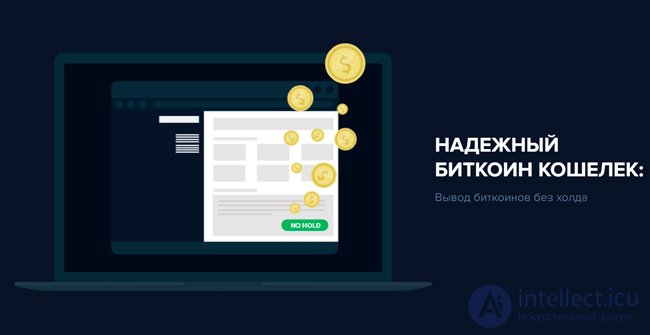
List of payment systems supported by the Matbea service: Yandex.Money, Qiwi, Bitcoin, Litecoin, Dash, Zcash, VISA\MasterCard, any Russian bank (Sberbank Online, Alfa-Bank, VTB24, etc.), mobile phone, Euroset.
Official website of the service: https://matbea.org/
Cryptopay is an online wallet where you can easily store and spend your money in the form of bitcoins, euros, British pounds, or US dollars. Cryptopay is a British company founded in 2013 that strives to offer the best payment solution.
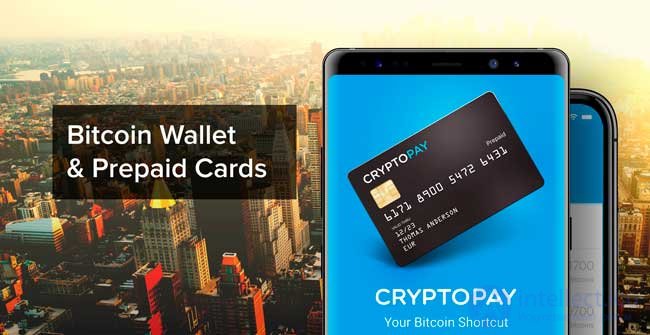
Competitive advantages and features of the wallet:
Coinbase has become known not only as a service that provides users with online wallets, but also as a payment gateway used by many retailers to accept bitcoins in retail sales.
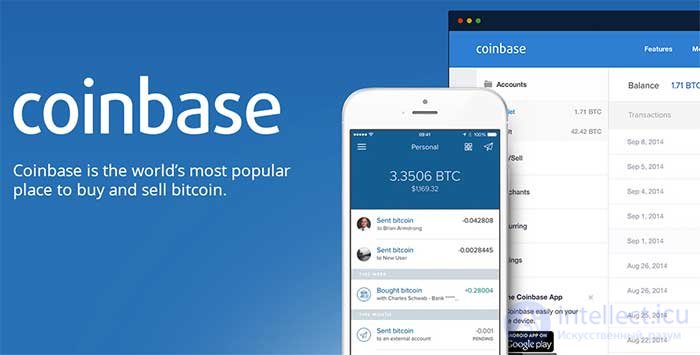
The Coinbase "wallet" is a prime example of a traditional online wallet where the security keys are controlled by the server. Nevertheless, the number of users of the service keeps growing every day thanks to:
A distinctive feature of the Coinbase online wallet that every user should know about is the special procedure for withdrawing funds to a bank card, which involves, in addition to user verification (providing a screenshot of an ID document), also bank verification — during the first purchase of cryptocurrency in euros or dollars, the user must transfer the currency to Coinbase's bank details, providing their own bank account information.
Advantages of the service also include instant transaction confirmation, while the drawbacks include the inability to export private keys and only a partial translation of the interface into Russian.
Blockchain.info — a bitcoin block explorer and cryptocurrency wallet service (for remote storage and use of cryptocurrency access keys). The service also allows viewing blockchain information, such as transactions and the network's hash rate.
The service provides data on the Bitcoin system's created blocks and other blockchain parameters, as well as statistics, including in graphical form. Information from the site and links to it are often published in the media and on bitcoin forums .
The Blockchain wallet, developed by the company of the same name, is the most time-tested and well-known online service for managing bitcoin and other cryptocurrencies. It is actively used by more than two million people around the world.
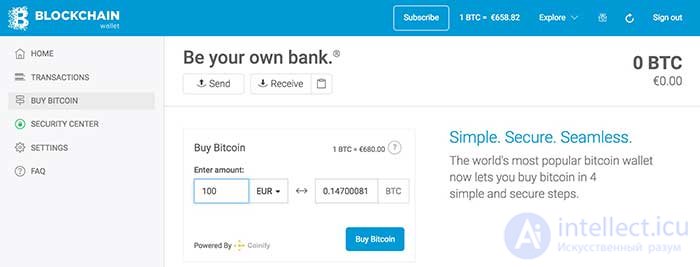
The distinctive features of this online wallet include:
Every day, tens of thousands of transactions are made through the Blockchain wallet. Over the entire existence of the online service, more than twenty million dollars' worth of bitcoins have been transferred through it.
Coinkite is a hybrid multi-currency web wallet developed by a well-known Canadian company, whose range of services also includes debit card servicing and POS terminals. Coinkite offers instant sending of litecoins and bitcoins using terminals, a bank account, or a credit card in Canada and the US, without charging a conversion fee.
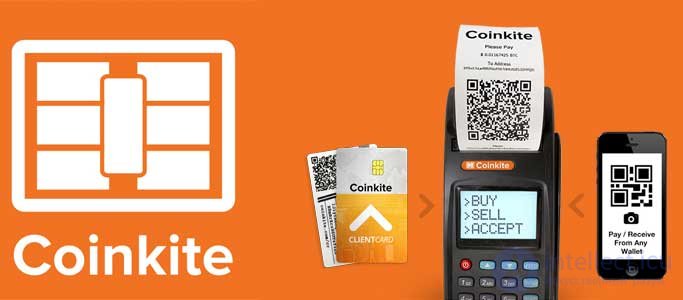
The online wallet under consideration is distinguished by the following characteristics:
The lack of an option to export private keys should not be considered a drawback of Coinkite, since there is no need for it thanks to a unique scheme for forming transaction multisignatures – up to fifteen users can take part in signing! At the same time, the online service may not store private keys at all, or may store one or several backup keys in case users lose theirs. If the multisignature feature is not used, private keys are stored only on the operator's side. However, the developers promise that, in the event of the service closing or a hardware failure, they will send the user symmetric keys that will make it possible to import their private keys and transaction history into another wallet.
Coinkite makes it possible to pay for mobile communication services with the cryptocurrencies Bitcoin, Blackcoin and Litecoin, sending funds by SMS or email.
Besides the traditional use of this online wallet, which works well in all browsers, the Coinkite platform also provides payment terminals and point-of-sale trading tools.
The BitGo online wallet is notable for its high level of security. Every transaction requires two signatures, which makes the bitcoins better protected against malware. The BitGo platform does not have full access to a user's coins: two private keys are held by the user, and a third, kept as a backup, is stored on the server. In addition, using the "wallet" requires passing two-factor authentication. This implementation of wallet security fully eliminates the need to export private keys.
Notable features of BitGo include additional capabilities for business clients, as well as insurance of funds, which became available in 2015 after the developer signed a cooperation agreement with Innovation Group LLC.
The most significant drawbacks of this online wallet are the lack of a mobile version and the lack of a Russian-language interface.
GreenAddress is the first project by a Russian-speaking developer built with a professional approach. The service offers multi-platform online wallets with a fairly broad set of features:
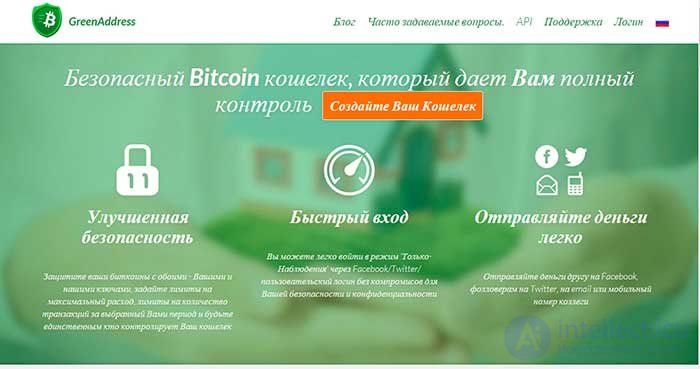
Despite the operator's low reliability rating, the online wallet allows fairly secure management of one's coins – besides the multisignature mentioned above, technologies such as 2FA, a PIN code, and an HD wallet (a seed – a secret phrase) have been implemented for this.
Another advantage of GreenAddress is the availability of mobile apps for iOS, Android, and ChromeOS.
Hive is a multi-currency online wallet that supports Litecoin and Bitcoin.
Access to the "wallet" can be obtained through any browser after entering the key phrase. The same process applies when managing the cryptocurrency from a mobile device, and the passphrase must be entered both when logging into the wallet from a browser and through the Android or iOS app. This phrase effectively serves as the key to the wallet, which is why it is important to take care to store it securely.

Private keys are stored using HD wallet technology (a seed, a secret phrase), so there is no need to export them.
The Hive online wallet for Mac supports the BIP70 protocol, used by popular payment gateways – Coinbase, BitPay – as well as by many merchants that accept Bitcoin.
The service does not have a Russian-language interface.
StrongCoin began operating in 2011 and is one of the first online wallets for managing cryptocurrency. The developers classify the service as hybrid, although in reality it is not. Payments are processed in the browser, while private keys are stored in encrypted form on the server side. Private keys can always be exported.
The StrongCoin service is notable for:
A drawback of StrongCoin is the lack of a mobile version, as well as a Russian-language interface.
Xapo is an online wallet from a company that owns a secure "cold" Bitcoin storage facility. Users' coins are stored on secure servers offline, without a connection to the Internet. The high level of cryptocurrency security is provided by five servers located in a former military bunker in the Swiss Alps. The overall security of the ground network is checked and monitored by the X-Ray satellite system.
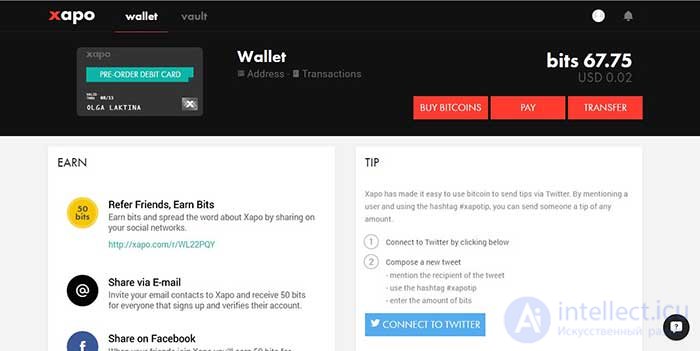
The Xapo online "wallet" provides convenient everyday use of the bitcoin wallet both from a computer or laptop and from a mobile device, along with insured "cold" storage in a vault. A distinctive feature of the service is the ability to link a Xapo debit card to the wallet, which can be used to pay for purchases at points of sale around the world.
The main drawback of this online wallet is the lack of modern security measures. Its implementation involves de-anonymizing the user – submitting documents and providing a mobile phone number. Also, not everyone will find it convenient to manage their coins with Xapo because the service lacks a Russian-language interface.
By 2016 several cryptocurrency exchanges operating in the European Union had obtained licenses under the EU Payment Services Directive and the EU Electronic Money Directive.[25] The adequacy of such licenses for operating a cryptocurrency exchange has not been tested in court. The European Council and the European Parliament have announced that they will issue regulations introducing stricter rules for exchange platforms.
In 2018 the U.S. Securities and Exchange Commission stated that "if a platform offers trading of digital assets that are securities and operates as an "exchange," as defined by the federal securities laws, then the platform must register with the SEC as a national securities exchange or qualify for an exemption from registration."[26] The Commodity Futures Trading Commission now permits public trading of cryptocurrency derivatives.[27]
Among Asian countries, Japan is more open, and its rules require a special license from the Financial Services Agency to operate a cryptocurrency exchange.[28] China and Korea remain hostile: China banned bitcoin miners and froze bank accounts.[29] [30] Although Australia has not yet announced its final rules on cryptocurrency, it requires its citizens to disclose their digital assets for capital gains tax purposes.
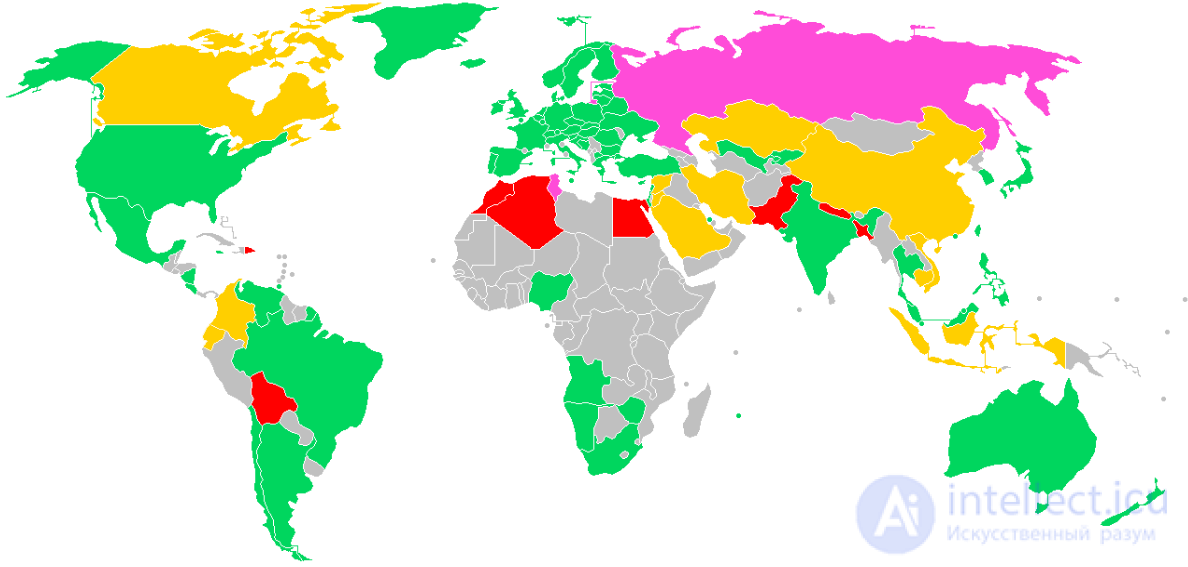
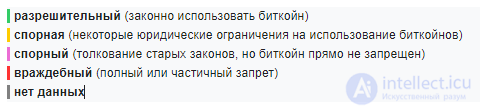
Legal status of bitcoin
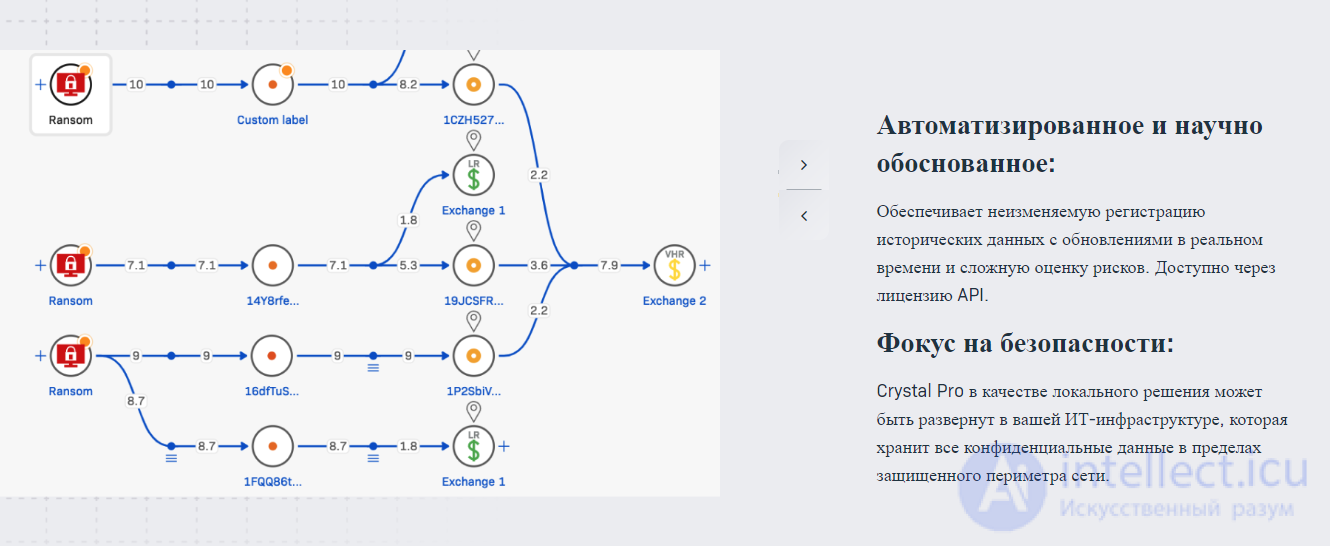
Crystal is a blockchain analytics company headquartered in Amsterdam that develops solutions for streamlining cryptocurrency compliance operations and assisting in the investigation of financial crimes. Crystal works worldwide with clients from the digital asset industry, the banking and regulatory sectors, and law enforcement agencies. Crystal's universal blockchain analytics tool provides blockchain analytics and compliance tools for streamlining "Know Your Transaction" (KYT) processes and anti-money laundering (AML) efforts to detect financial crime and optimize operations.
Crystal Blockchain helps do the following:
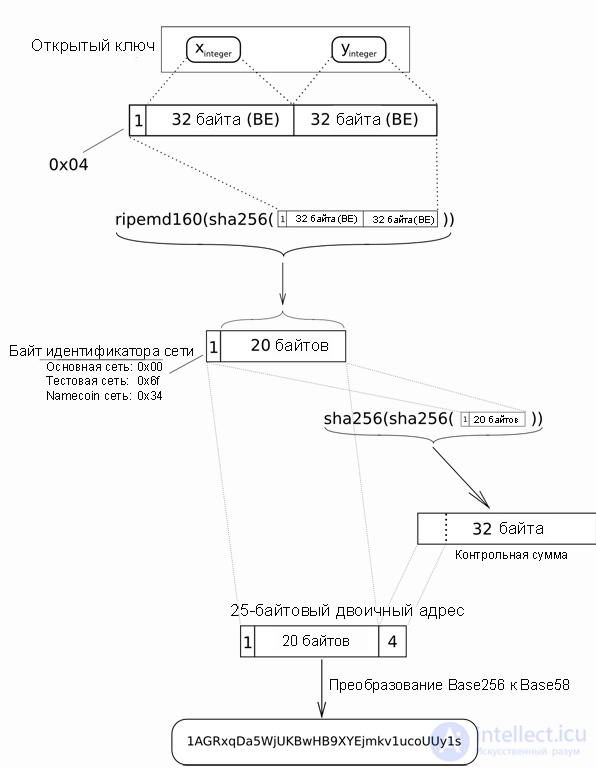
1. Take the public key
2. Perform SHA-256 hashing of the public key
3. Perform RIPEMD-160 hashing of the SHA-256 result
4. Add the network byte identifier before the RIPEMD-160 hash
5. Perform SHA-256 hashing on the extended RIPEMD-160 result
6. Perform SHA-256 hashing on the previous SHA-256 hash; the result will be the checksum:
7. Take the first 4 bytes of the resulting hash:
8. These 4 checksum bytes from step 7 are added to the end of the extended RIPEMD-160 hash from step 4. This is the 25-byte binary Bitcoin address.
9. The result of step 8 is converted into a base58 string. This is the most commonly used format for a bitcoin address.

Comments