
Lecture 32 min.
A bitcoin generator is any program that makes it possible to obtain BTC in one way or another. As of today, six types of bitcoin generators can be named in total, besides trading cryptocurrency on an exchange:
A bitcoin faucet is a service that provides cryptocurrency to registered users at set intervals.
Now let's look at each method of generating bitcoins separately.
Mining, also extraction (from the English mining — extraction of minerals) — an activity aimed at creating new structures (usually meaning new blocks in the blockchain) to keep cryptocurrency platforms running. Creating each successive structural unit is usually rewarded out of new (issued) units of the cryptocurrency and/or transaction fees. Mining generally comes down to a series of computations that search through parameters to find a hash with given properties. Different cryptocurrencies use different computation models, but they are always time-consuming enough to find an acceptable answer and quick to verify a solution once found (see proof of work). Such computations are used by cryptocurrency algorithms to protect against double-spending of the same units, while the reward motivates people to spend their computing power and keep the networks running.
Mining is not the only technology for creating new blocks and handling issuance. The alternatives are forging (minting) and ICOs. Usually only one technology is used, but some cryptocurrencies use combinations of them.
A transaction is confirmed once it makes it into a newly mined block. There is nothing "random" about it, don't listen to nonsense.As an example, hash computations are used similar to those in the Bitcoin system, where the mining process consists of searching for a value of a special additional parameter, Nonce, that will yield a hash whose numeric value is no greater than some given number — the Difficulty Target, the target value at the current difficulty level.
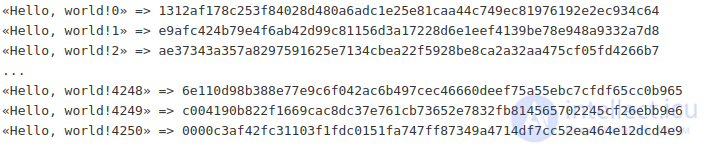
Example hashes for the same phrase but with different values of the additional parameter. The last row in the example has the lowest hash value.
In the Bitcoin system, the difficulty level is recalculated every 2016 blocks (roughly once every 2 weeks). It increases or decreases depending on how much the time it took to create that batch of blocks differs from 20,160 minutes (2016 * 10). This mechanism ensures that blocks appear on average every 10 minutes regardless of the combined power of all miners. In other cryptocurrencies, the recalculation of both the hash and the target difficulty level can differ significantly. In many altcoins the average block formation time is significantly lower, down to a few seconds.
The Bitcoin system provides for only one way of additional issuance — new bitcoins are received as a reward by whoever generated the next block. The reward received for a block can be spent after obtaining 120 confirmations (that is, the network allows the reward to be spent after roughly 20 hours).
The probability of a solo miner getting a reward in any given ten-minute period is roughly equal to the ratio of their computing power to the computing power of the entire network. And if this ratio is very small, then the probability of getting a reward even over a long stretch of time will also be low. Those wishing to get as large a reward as possible sought to bring as much computing power as possible to bear. In the early versions of the client there was a "generate new bitcoins" button .
The nature of the mining task allowed for maximum parallelization of computations. Owing to their design, graphics processing units (GPUs) with a small additional program (hundreds of times more powerful than a CPU ) and FPGA boards (performance comparable to graphics cards, but superior to them in energy efficiency) turned out to be well suited for this. After that, mining with a central processor, as used in the standard client, became impractical because of the too-low probability of getting a reward, and the button was removed. Then came the release of specialized processors (ASICs) that do nothing but compute hashes for the Bitcoin network, more powerful and energy-efficient than GPUs and FPGAs, and all the more so than CPUs. Starting around 2012 -2013, mining widely used cryptocurrencies on anything other than specialized chips, including on graphics cards, became unprofitable — the cost of the electricity consumed exceeds the average return. For example, by the start of 2015 the difficulty of mining Bitcoin, the best-known cryptocurrency, had grown 10,000-fold .
Dozens of startups developed their own implementations of ASIC miners, with new, more powerful generations of chips able to come out every six months (usually the density of transistors in logic circuits doubles every 2 years) .
With the shift of mining to ASICs, companies engaged in industrial-scale mining began to appear, setting up large mining operations in places with cheap electricity and, sometimes, not too high an ambient temperature, in particular in Inner Mongolia (China) . Some of these companies present themselves as "cloud" miners, renting out part of their resources .
To reduce the influence of luck and obtain a more even and predictable reward, miners combine their computing power into pools (from the English pool — a common fund). A feature of the computations performed by miners is the ability to apply maximum parallelization of the process, in which each pool participant searches for their own solution without coordinating their actions with those of other participants; it is enough merely to avoid duplicating the calculation of the same parameters by different participants. Payments to a miner are often calculated from the standard variants (shares) they have sent to the pool (blocks with a hash that would be suitable if the difficulty parameter were currently equal to one). Finding a block on average requires a number of standard variants equal to the current difficulty.
From the point of view of the cryptocurrency system, a pool acts as a powerful solo miner that receives a reward on the same basis as anyone else. But owing to its combined power, a pool's probability of getting a reward equals the sum of the probabilities of each of its participants getting a reward. The reward received is distributed among members according to rules set by the pool's owner. There are 3 main types of reward payout :
These payout types have the following popular variants:
As of 2016, most of the large Bitcoin mining pools are located in China: in March 2016, more than half of the network's power was split between three major Chinese pools[ , and fourth place is held by the pool of BitFury, one of the first[13] manufacturers of mining chips, founded by people from the former USSR[14].
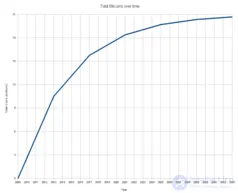 Number of bitcoins over time (years 2009 to 2033)
The issuance of new batches of cryptocurrency units usually follows rules known in advance and does not depend on any regulatory body (see the chart of the number of bitcoins up to 2033). Most often, the standard batch of new units, in the form of a reward, goes to whoever formed the next block in the blockchain. In mining, the probability of success is proportional to the share of computing power employed relative to the total power of all miners of a given cryptocurrency, but the result at any given moment is random.
The size of the standard reward can remain unchanged forever. But in many cryptocurrencies, the size of the issuance reward gradually decreases. For example, the bitcoin reward was originally 50 bitcoins per block, but after every 210,000 blocks are formed (roughly once every 4 years) it is halved[15], i.e., it forms a decreasing geometric progression. In this case, the total issuance volume is calculated as the sum of all terms of the decreasing geometric progression and will not exceed 21 million bitcoins. As of May 2014, 12.7 million bitcoins were in circulation . On November 28, 2012, the first halving of the issuance reward from 50 to 25 bitcoins took place[16]. The next halving occurred on July 9, 2016. In 2031, issuance will stop altogether (reward size 50 → 25 → 12.5 → … → 0).[17][15] Block formation will continue afterward, but the reward will no longer have an issuance component and will be formed solely from voluntary transaction fee contributions[18].
Miners gain the right to use the reward they received only after a certain number of new blocks have been formed (for example, in bitcoin this is 120 blocks, meaning the reward can be spent roughly a day after it is received).
Hidden mining is mining that uses someone else's resources — for example, employees running mining on corporate servers, or mining code embedded in viruses and trojans.
In June 2011, Symantec reported that mining could be run on botnets. In its report for the second quarter of 2011, Kaspersky Lab reported a trojan module that carried out hidden mining[19].
In April 2013, a major outbreak was recorded of trojan programs spreading via text messages in Skype, aimed at finding and stealing cryptocurrency wallet files (wallet.dat) and at hidden CPU mining[20][21].
Before 2011-2013, hidden bitcoin mining was common (before the mass adoption of GPU mining and specialized processors such as ASICs). Later, hidden mining was used to obtain other cryptocurrencies.
When installing the µTorrent torrent client (version 3.4.2 build 28913 and later), users are offered an additional program called EpicScale, which allows the computer's idle resources to be used for distributed computing. µTorrent representatives assure that the EpicScale network is currently used for mining cryptocurrency (without specifying which one), with part of the proceeds going to fund the company and part to charity[22]. According to a number of publications, EpicScale mines bitcoin[23][24]. Other publications report that it mines Litecoin[25][26][27][28].
In 2017, reports emerged about a number of websites[29][30] containing JavaScript for hidden mining of certain cryptocurrencies (in Russian this type of mining came to be called "browser mining," and in English "cryptojacking"[31]). Similar components were found in several browser extensions[32].
According to IBM X-Force's September report, over the first 8 months of 2017 the number of computers infected with mining malware increased sixfold[33].
The rules of bitcoin issuance gave a greater advantage to those who took up mining when the network's total power was still small. For instance, by 2013 the amount of work needed to generate a block was already more than half a million times greater than at the network's launch. As the miners' total computing power increases, block generation becomes more energy- and hardware-intensive. This is accompanied by a planned reduction in the size of the mining reward.
Sergio Demian Lerner, based on an analysis of the earliest transaction blocks, claims that from January 3, 2009 to January 25, 2010, only one person was mining, who mined about 1 million bitcoins, most of which have never been spent[34].
In Russia in 2017, Dmitry Marinichev, the internet ombudsman under the President of the Russian Federation, spoke about a plan to raise 100 million dollars to build a 20-megawatt mining farm in a region with a surplus of electricity[35][36][37].
Since 2017, North Korea has used cryptocurrency mining to support its national currency[38][39].
In 2018, the government of Armenia adopted a resolution establishing a free economic zone in Hrazdan[40]. The organizer of the free economic zone is the company ECOS, which is responsible for developing the technology cluster. The zone includes educational and communication projects, research laboratories, electronic platforms for attracting startup investment, and a data center for mining[41][42].
Mining different cryptocurrencies can use different procedures for confirming proof of work. For a number of cryptocurrencies, including Bitcoin, specialized processors (ASICs) were created, which, due to their better performance and relative cost-effectiveness, displaced other mining methods. In other cases, this approach turned out to be less effective. As of the end of 2017, mining a number of cryptocurrencies, including Ethereum, remains more efficient using GPU processors. A significant rise in cryptocurrency prices led to increased demand for mining equipment, including graphics cards[43]. This prompted Sapphire and Asus to release a line of specialized mining components[44][45].
Mining systems based on proof of work are extremely resource-intensive.
Bitcoin miners
Of all the above-mentioned types of bitcoin generators, setting up your own mining farm requires quite a lot of effort and money, but it pays off with the greatest profit.
A bitcoin farm is a complex of computer equipment whose computing power is directed at mining cryptocurrency. It usually consists of several graphics cards connected to a computer, or in some cases to several computers.
But by now, bitcoin farms have come to look somewhat different. As the popularity of the "first" cryptocurrency grew, entire hangars filled with rows of racks began to be set aside for mining it.
However, as mentioned above, as the network's hash rate grew, so did the mining difficulty. Because of this, mining even on the most serious farms with expensive mining cards took a back seat, becoming unprofitable, since farms based on integrated circuits such as ASICs took the lead instead.
Bitcoin mining pools
Continuing the thought above, many miners who had GPU farms did not sell their equipment or switch to mining other cryptocurrencies. Instead, they began joining together into mining pools.
By pooling the computing power of many machines, the chances of solving the task of finding a block, and thus receiving the reward, are significantly increased. The profit is then divided among all participants in proportion to their contribution.
Either way, both the first and second methods involve substantial investment: buying equipment, maintaining it, and paying for electricity. The last item takes a significant share of the income, depending on the farm's power.
Cloud mining of bitcoins
Unlike farms, this method requires much less expense, which makes it extremely attractive. After all, earning passive income without much effort is very tempting.
With cloud mining of bitcoin, a user generates bitcoins by using the services of large companies that usually have data centers around the world. In effect, cloud mining is renting equipment from such an organization.
Earlier we already looked in detail at several companies that have established themselves in the market, of which, incidentally, there are not that many. The main risk here is the high likelihood of running into scammers, so before renting capacity one should carefully look into the company and study reviews of it.
Bitcoin faucets
This method requires practically no investment to obtain Bitcoin. It is enough to acquire a special program that automates the process of collecting satoshis from faucets. Bitcoin bots are special programs that allow small amounts of cryptocurrency to be earned in an automated, hands-off mode.
Bitcoin bots appeared with a single purpose – to collect satoshis from so-called faucets. In effect, it is a script that helps avoid spending time solving captchas, watching ads, and so on.
The principle of operation is quite simple: satoshis are collected once per a certain interval of time. On some services this may be five minutes, and on others, several hours or a full day. The advantage of the bot is that it can be set up to collect from dozens of bitcoin faucet sites.
In addition, bots also exist on Telegram, though in the messenger the process is more mechanical than automatic. Telegram's administration has recently begun marking such services with the unflattering label "SCAM".
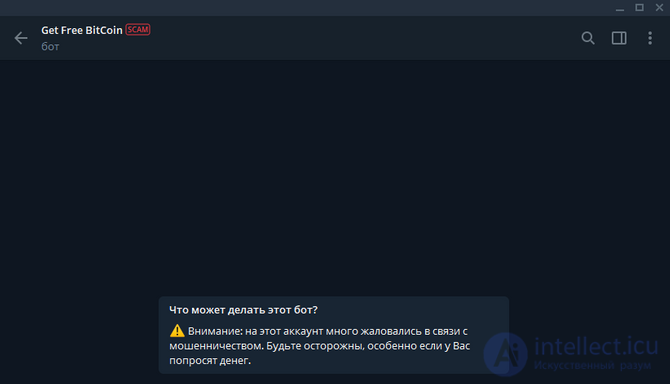
A bot marked as scam on Telegram
The process in them is just as simple – you need to open the bot and press the "Get cryptocurrency" button. After that, a random number of satoshi is credited to your account. The reward amount is set by the service. And to increase earnings, the bots suggest going to a website, registering, and watching ads, for which you get a bit more satoshi.
Among all the bots found, only four turned out not to be flagged as scams by the Telegram team:
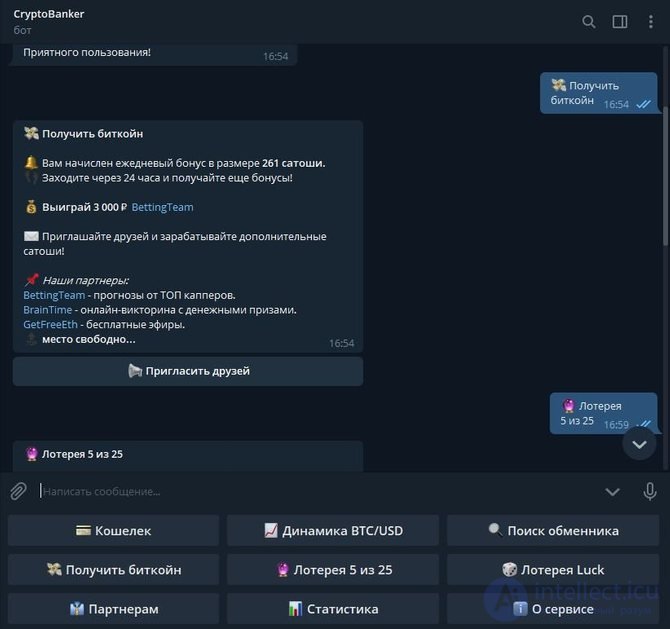
The standard interface of a Telegram bot
As for the second and third, judging by their absolutely identical interface and messages, these are the same bot under different names.
Websites for generating bitcoins
Such services mostly work online, meaning they don't require installation on a computer – it's enough to go to the website. They can be opened from a PC as well as from a tablet or smartphone.
In most cases, only three things are needed to register and generate bitcoins – a Bitcoin wallet, an email, and a login/password pair. After that, satoshi are supposed to arrive in your wallet, but in most cases this is only theory. In practice things look far less rosy.
A nice-looking website (sometimes not so nice), clever talk about blockchain technology, and a tempting offer of even a small income with no investment. Such services often set a fairly high withdrawal threshold for the cryptocurrency, and when it comes to withdrawal, the user is asked to pay a fee. The user then transfers the money but gets nothing in return.
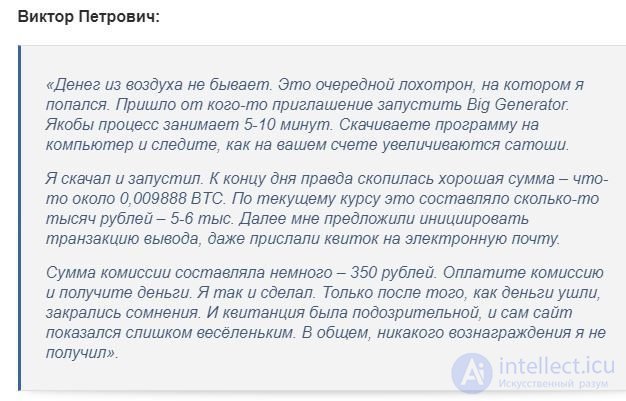
Such websites earn money from huge amounts of advertising and traffic, but that's still far from proof that the service pays out anything at all. Most of the ones reviewed online haven't been updated since 2016, and one of them still shows a Bitcoin exchange rate of $576.
One example of a fraudulent bitcoin generator
Of all the online bitcoin generators covered in various reviews, only one can be singled out as trustworthy:
But instead of resorting to services like these, it's better to read the reviews of those who have tried their luck with online bitcoin generators.
Bitcoin games
There are currently many online games that let you earn real money by playing. Bitcoin games aren't very different from them, except that the income comes in satoshi.
But unlike bots and online bitcoin generators, the earnings here are actually justified. The user receives cryptocurrency every time they reach a new level, win a tournament, and so on.
Online casinos with cryptocurrency deposits and withdrawals have also become popular recently. We certainly won't be reviewing them here, but if you're interested, Google will easily help you find them.
For the most part, most of these games require you to invest at least some money, but there are also ones that really do give out satoshi for meeting certain participation rules. Let's look at a few of these games, which are popular bitcoin generators in their own right.
This is a quiz-genre game. Everyone has surely heard of "Knowledge is power," where players answer questions against the clock. Well, in Satoshi Quiz the slogan is "Knowledge is money."
In it, players are asked to answer questions in various fields – mathematics, history, science, and so on. A correct answer pays out 100 satoshi, though the amount can vary depending on the question's difficulty.

An example question on Satoshi Quiz // Source: Satoshiquiz.com
You can play both in the browser and on iOS and Android smartphones. The minimum withdrawal amount is 0.001 BTC. The most active participants also receive monthly rewards. For reaching first place on the leaderboard a player gets 30,000 satoshi, for second place – 10,000, and for third place – 2,000.
This is a game from Russian developers. The idea is to build a tea plantation. Players are paid real money for picking leaves. Users are currently offered a welcome bonus of 10,000 virtual coins, which can be used to buy one bush.
However, further development of the plantation without investment isn't possible. The game offers a referral system. Withdrawals are available from 1 ruble, but only if you have at least one referral or have topped up your balance.
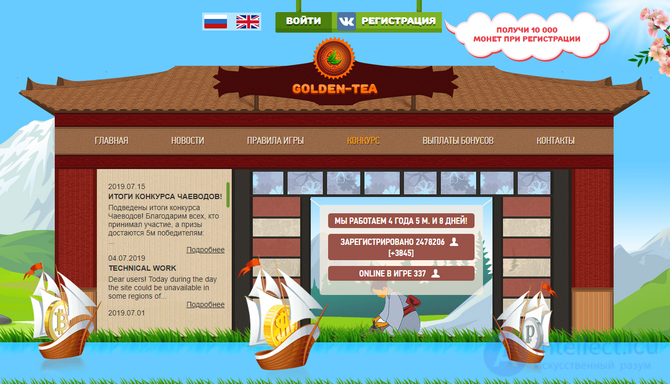
The Golden Tea website interface // Source: golden-tea.com
Note that this game is something of a financial pyramid scheme. It stays active only as long as new participants keep joining. So it should be played with extreme caution. That said, Golden Tea was created in 2015 and remains active to this day.
This is an arcade game with a simple storyline. The player controls a monkey named Toby, who needs help getting from point A to point B while collecting bananas along the way.

The Sarutobi interface // Source: mandelduck.io
Toby swings on a vine, and the player needs to push it forward at the right moment. Collected bananas can be exchanged for satoshi and withdrawn starting from 0.001 BTC. The game is available both in the browser and on iOS and Android smartphones.
Another arcade game inspired by the popular Crash Bandicoot. It lets you compete with friends, including online, while accumulating satoshi.
Our task is to control a fox cub named Crash, who has to collect apples. The more apples the better, since they can later be exchanged for satoshi.

The Bandirun interface // Source: bandurun.com
Any number of apples can be exchanged, but at a low rate; 500 apples get a medium rate, and 4,500 or more get a high rate.
Of course, these are far from all the bitcoin games out there – dozens, if not more, of similar projects can be found online.
Bitcoin faucets are a reward system built as an app or a website: they give out rewards in the form of satoshi (1 satoshi is one hundred-millionth of a bitcoin). Visitors have to complete the tasks described on the site. Different faucets may offer different cryptocurrencies, not just bitcoin.
A bitcoin faucet is a service that gives cryptocurrency to registered users at set intervals.
What tasks do users usually perform? They solve captchas, play games, click on ads, or watch videos. For every completed task they earn bitcoins. Let's look at a few popular bitcoin faucets:
Is this an effective way to earn cryptocurrency? Well, in reality it's not an option for people who have a full-time job. Faucet rewards always amount to a few cents or a dollar. Such services are made more as an advertising function.
Different countries take very different attitudes toward the Bitcoin system. In a number of countries, transactions with bitcoins are officially permitted. They are usually treated as a commodity or an investment asset and, for tax purposes, are subject to the corresponding legislation. In some countries bitcoins are recognized as a unit of account – for example, in Japan bitcoin is legal tender, with a tax on its purchase. In Germany, since March 2018, paying for goods with cryptocurrency no longer incurs a capital outflow tax – for tax purposes, cryptocurrency transactions have become the same as transactions with other means of payment. In other countries (for example, in China) transactions with bitcoins are banned for banks but permitted for private individuals
In many countries the status is still undefined or is changing. Initially, the Bank of Thailand stated that a license to conduct currency-exchange operations was required for transactions with bitcoins. Later, a clarification was published stating that, due to a lack of legal grounds, bitcoin exchange in Thailand does not fall under Thai currency law, since foreign currencies are not involved in the transactions. Some time later the Bank of Thailand further clarified that bitcoins can be exchanged for foreign currency, and through that exchange they are still connected to it, so a license is required
Even within a single country, various government agencies, ministries and courts may treat bitcoins differently. In the US, bitcoins are treated as property. In March 2013, FinCEN announced that transactions exchanging any cryptocurrency for fiat money must be regulated the same way as transactions exchanging fiat money for other fiat money[136]. Exchange offices must register as money services businesses[en] and report suspicious transactions to law enforcement. In November 2013, the US Senate held hearings on virtual currencies. Although no final decision was made, cryptocurrencies were not banned; there was a stated wish to monitor and study them and to work on regulating this business . In August 2013, a defendant accused of fraud argued that bitcoins are not money and that he therefore bore no financial obligations to investors. A judge in the Eastern District of Texas (USA) ruled that when bitcoins are transferred into an investment fund they constitute a currency or a form of money, meaning the investors transferred money into the fund and the fund now bears the corresponding obligations[138]. On March 25, 2014, the US Internal Revenue Service issued guidance on the taxation of transactions with bitcoins and other virtual currencies[139], which are treated as property
On October 22, 2015, the European Court of Justice (ECJ) ruled that transactions exchanging bitcoins for fiat currencies are exempt from VAT. The court's ruling specifies that VAT law applies to the supply of goods and the provision of services . Bitcoin transactions were classified as payment transactions involving currencies, coins and banknotes, and are therefore not subject to VAT. The court recommended that all EU member states exclude cryptocurrencies from the assets subject to taxation

Comments