
Lecture
Changing someone's mind (re-persuasion) is the process of altering a person's beliefs or views, often by providing new information, logical arguments, or emotional influence.
Re-education is a deeper and longer process that affects not only beliefs but also behavior, the value system, and emotional responses. It can be voluntary (self-development, therapy) or externally initiated (for example, in a social or educational setting).
Re-education is upbringing aimed at restructuring wrongly formed views and changing patterns of behavior that complicate the process of personality formation.
The film "Liquidation"
- Son, give me back my watch! And if you ever reach into someone else's pocket again, I'll give you a thrashing!
Pedagogically neglected pupils require special attention from professional educators, parents, and everyone who regularly deals with such children
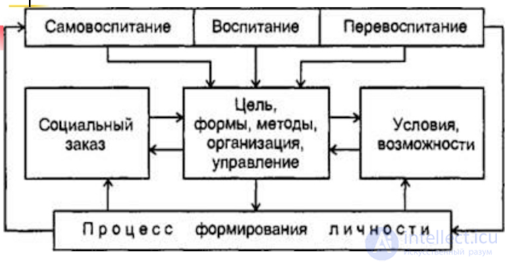
There are differences between upbringing in its pure form and re-education.
If upbringing is the formation of personality qualities "from scratch", then re-education is the remaking of a personality that has already been raised (formed) in some way. If words play an important role in upbringing, in re-education the effect of words is limited. Here the main influences are examples and the organization of new behavioral experience.
The process of re-education involves:
Let us consider them in more detail
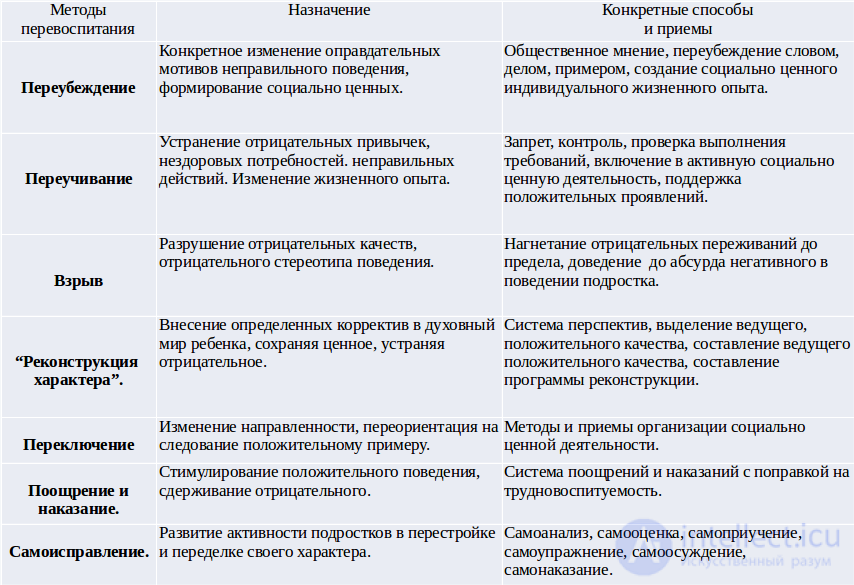
The process of re-education includes general methods of upbringing (re-persuasion, re-teaching, encouragement, punishment, etc.) and special ones that are characteristic only of re-education ("explosion", redirection, "reconstruction of character").
The leading methods of re-education are re-persuasion, re-teaching, and the "explosion" - the destruction of the negative.
The "explosion" method is a specific method of re-education developed by A. S. Makarenko. What "explodes" is not the inner world of the personality as a whole, but its spoiled relations with society and the collective. The "explosion" involves bringing the individual's conflict with the collective to its limit; at the same time, a clear alternative is set: change in order to become a respected member of the collective, or leave it and become an object of contempt for one's peers. It is important to saturate the very process of the "explosion" with as much emotional experience as possible, in order to give the pupil a sense of dissatisfaction with himself and awaken a passionate desire to become better. The "explosion" method performs only one function of re-education: it destroys the links between negative qualities and loosens the structure of difficulty in upbringing, but it does not eliminate the shortcomings themselves.
Therefore the "explosion" method must be followed by re-persuasion, re-teaching, and the cultivation of positive qualities.
The reinforcement (consolidation) of a conditioned reflex is determined by reward (food or stimulation of the pleasure center), while negative reinforcement is an electric shock or the absence of reward.
Maria Montessori was convinced that both reward and punishment are harmful to a person's inner orientation and that people should learn by following their own motivation. This is primarily because the desire to take part in the life of adults is organically inherent in the nature of the growing child.
Whoever disobeys may be punished.
What is punishment? It is hardest of all to define the most common things. The most general definition is probably this: punishment is a means of control that consists in deliberately causing unpleasantness to a subordinate being, in order to change undesirable behavior or a way of thinking.
The subordinate being may be a beloved dog that failed to follow a command, a beloved child who scattered his toys, or beloved parents whom the child punishes with his crying.
Punishment is not the same as negative reinforcement. Negative reinforcement follows immediately after the undesirable behavior, whereas punishment may be delayed.
Most often, punishment is retribution for a misdeed, but sometimes one person's punishment serves to demonstrate strength in order to subdue or intimidate someone else. "Beat your own so that outsiders are afraid..." When using a show of force as a means of raising one's status, a parent (and a boss, too) must understand that force alone will not earn respect. Punishment is not a goal but a means. If the means is unfit (behavior and thoughts do not change, or change in the wrong direction), it should not be applied in vain or to someone's harm. If punishment becomes an end in itself (for example, a relief for the parent's soul), it is not punishment but a dumping of aggression. The better the management, the fewer the punishments. The higher a parent's qualification as a manager, the better he knows his child and cares about the child's emotional balance, and the better he anticipates and prevents an undesirable situation, the less need there is for punishment.
Not all of us are educators by training or by life, and in everyday life punishment is more often not an effective educational measure but a stereotyped, poorly thought-out aggression or revenge, a payback for what has been done, allowing one person, supposedly with justification, to vent his displeasure on another. The usual consequences of such stereotyped punishments are a spoiled mood for everyone and a broken connection, and the result is nothing.
From the Internet: "I don't know what they show on Russian TV, but here they are running *** 911: an American program about American families, and the nannies are British women, each with 15 to 25 years of experience, and the 'head nanny', who doesn't go out on calls herself but supposedly supervises, used to be a nanny in the British royal family. Parents send requests to Nanny Central, a short video about the horrors of their family: usually 2 or more (up to 7) children, often twins (once there was a family with 3 pairs of twins (aged 8, 4 and 2), another time 1 ten-year-old girl and quadruplets aged 4, then 5 boys aged 9 and younger, and so on). Although the nanny is called in 'for the children', in the course of the work it usually turns out that the problem is, first of all, the parents: in their disagreements with each other (which the children sense) and, as a result, in the inconsistency of their policy toward the children. When the nanny introduces a routine (which turns out to be a bigger problem for the parents to maintain than for the children), separates the children and parents into different beds (which turns out to be harder for the mothers than for the children), does not allow the parents to raise their voices, let alone spank the children, and teaches them to TALK OUT problems and mutual grievances, insists that parents sort out all conflicts between themselves by talking rather than shouting at each other or silently isolating themselves from each other, then the children also stop raging, fighting, disobeying, and so on. If the parents respect each other, the children will respect them too. If the parents know how to sort out their relationship in a civilized way, the children don't throw tantrums."
On the other hand, it is unrealistic to raise a child without resorting to punishment at all. By observation, good parents punish a child seriously only once or twice in a lifetime, somewhere around the age of three or four, when the child tests the parents' strength. If this battle is won, good life and mutual understanding are restored, interrupted only occasionally by rather symbolic punishments. Sometimes parents use the warning "One! Two! Three!", sometimes a time-out without warning, and sometimes the child has to be deprived of something for a while for misbehaving - but all these educational measures live somewhere on the periphery of the relationship between parents and children, while at the center is something else: lively and warm communication, discussion of common topics, help with schoolwork, shared leisure, sports... The wiser the parents, the more rarely they face the need to punish their children, and the more opportunities they have to raise a child without resorting to punishment.
In re-education, a complete change of personality is far from always necessary. What matters is to correct individual negative elements of character while preserving its healthy basis. This method can be called "reconstruction".
It is characterized by the following features: in the spiritual world of the individual, the stock of positive qualities is preserved, and from it those main elements are singled out that should be developed and improved first; qualities that the individual falsely regards as positive are modified in such a way that a healthy element appears and develops in them (for example, instead of morbid vanity, healthy self-respect is formed; instead of self-conceit, self-confidence; instead of fault-finding, criticalness and self-criticism).
The negative qualities that need to be eliminated become the object of criticism from peers and authoritative adults. With their help re-persuasion is carried out, and an intolerant attitude toward his own shortcomings is formed in the difficult pupil.
In the pupil's whole way of life, his positive qualities are displayed and applied as fully as possible, and at the same time conditions are created in which shortcomings and negative qualities become inapplicable.
In the method of "reconstruction" of character, the main direction is the intensification of the development of the leading positive quality, for example love for the mother, respect for adults, loyalty in friendship, a steady interest in some activity, pursuit, sport, or art.
"Reconstruction" begins with studying the pupil and clearly defining the prospects of his positive development. Here it is necessary to foresee which quality to make the leading one and to develop intensively, in order to ensure the integral formation of positive qualities and their connection with one another.
Then the positive qualities that have not been exercised for a long time because of unfavorable conditions are brought back into play. They are restored and linked with the leading positive quality.
Next, a program is outlined for cultivating those qualities that easily and quickly attach themselves to the leading one.
The next stage of the "reconstruction" of character is the accumulation of socially valuable life experience, which promotes the rapid development of positive qualities. Such a way of life for the pupil is ensured under the following conditions: the schoolchild's constant participation in socially useful activity; condemnation of any manifestations of the negative by educators and peers; the student's self-education; and the presence of constant positive examples.
At each stage of the "reconstruction" of character, the educator, with the active support of public opinion, encourages the pupil to analyze his own successes and to set the next tasks in developing his strengths and abilities.
On the whole, the method of "reconstruction" of character is more complex and longer than re-persuasion or the "explosion". As a rule, it is combined with methods of re-education and upbringing. "Reconstruction" is carried out partly on the basis of the "explosion" method and habituation.
Character is modified at the junction of re-persuasion and interesting activity. Self-correction takes place on the basis of forward-looking goals and a healthy way of life in the collective. With the method of "reconstruction" of character, the following conditions must be ensured: unity of pedagogical requirements, a healthy way of life, and an optimistic atmosphere in the collective, arising as a consequence of the pupil's successes, constant achievements, and progress in activity, in relationships, and in behavior.
In carrying out the method of "reconstruction" of character, a number of general pedagogical requirements must also be met:
1. On the basis of a comprehensive study of the personality and the circumstances of his life, determine the goal and the leading direction of re-education, paying attention to the following: which positive quality is the leading one, what the main shortcoming is, which harmful influences sustain the negative in the pupil's spiritual world, which positive influences work most effectively, which primary group should become the main factor in restructuring the pupil's spiritual world (family, class, sports club, etc.), and in what order it is advisable to organize the strengthening and enrichment of the personality's positive stock.
2. Ensure a healthy way of life for the pupil within his immediate social environment. For this, a system of general educational measures is carried out: establishing control over his free time, redirecting attention to useful affairs and activities, combating negative outside influences, involving the adolescent in various socially useful activities, and organizing a clear routine that demands regular effort, self-organization, self-control, and self-discipline.
3. Mobilize all the pupil's inner strength and reserves to fight the negative qualities. The positive forces may be not only existing positive qualities, healthy needs, and useful habits, but also certain age-related characteristics. Thus, to overcome all shortcomings it is useful to use the sense of being grown up, the striving for independence, the need for self-assertion, the growth of physical strength and the development of mental abilities. To overcome laziness, first of all one must use rapid physical development; to overcome egoism, the rapid development of self-awareness, on the basis of which an adequate self-esteem is formed. Educational work is meant to sharpen the conflict between positive qualities and the natural progressive tendencies of mental development, on the one hand, and negative phenomena in the adolescent's spiritual world, on the other.
4. Develop special measures and determine pedagogical tactics for overcoming the student's resistance to educational influences.
5. Choose the optimal variant of "reconstruction" of character, taking into account the gaps in the adolescent's upbringing and his living conditions.
The first variant of the method
of "reconstruction" is built on a series of "micro-explosions" of the negative, in which shortcomings and negative qualities are destroyed one after another. At the same time, some changes are necessarily introduced into the pupil's way of life that limit the manifestations of the negative while preserving the individual's general activity.
The second variant
involves restoring lost positive behavioral experience and useful habits.
The third variant
is the formation of objective self-esteem, linking the study of the essence of moral qualities with self-study. On this basis an intolerant attitude toward the negative in oneself is formed, and upbringing passes into self-education. Self-re-education is the optimal path of character reconstruction.
The fourth variant
- is based on including the individual in a system of responsible dependencies within the collective. The adolescent's character is "straightened out" on the basis of the positive example of peers, the high demands the students place on one another, and mutual upbringing.
Combinations of different variants are also possible, each of which contains specific pedagogical requirements: in re-education through the collective, the requirements for raising an individual within a collective are observed; in self-correction, the requirements for organizing self-education.
What, then, characterizes the redirection method? First of all, the social motivation of activity changes: sometimes a new one is added to the old, and sometimes a completely opposite system of motives is advanced that excludes the former one.
The most effective motivation is the one based on the principle of contrast: in the Gorky Colony, former thieves were entrusted with receiving food and money. At the same time, respect for the colonist's personality, his increased status in the collective, his responsibility to his comrades, and his standing as a colonist were constantly emphasized. With such motivation, a radical restructuring of the motives of activity and behavior takes place.
Further, it is important to partly use in the pupil's new activity his former experience, habits, skills, and positive qualities.
Thus, for example, sometimes even when social motives had not yet formed, Makarenko's pupils nevertheless took an active part in colony life, because there they could apply their resourcefulness and strength, their boundless energy and solidarity.
Hard agricultural labor, work in the orchard and in the field, was not easy for the colonists. But what motives drove them!
To create a fairy-tale life with their own hands, to turn dreams into reality, to acquire a trade, to taste the bread they had grown themselves for the first time.
This use of existing natural and acquired strengths and abilities in a new undertaking, with a noble goal, in an activity attractive to everyone and to the pupil personally, is precisely the essence of the redirection method in Makarenko's practice.
The new motivation, as it were, cemented and bound together the whole positive stock of the personality, organized it for the new work, and channeled its activity into a new course of socially significant life. Social motives of behavior created such a spiritual atmosphere that a return to the former behavior was impossible.
In the redirection method, age-related characteristics are of particular importance.
In essence, many adolescents are characterized by independence, sociability, a striving for leadership and self-assertion, and a need for self-expression. Any activity in which these age-related needs and aspirations are manifested and satisfied can serve as the main content of socially oriented activity, which eases the restructuring of the motives of behavior and changes concrete actions and deeds.
Finally, redirection is possible only in a healthy children's collective, one that is able to support the educator's individual influences on difficult adolescents and to draw groups of children with certain moral gaps into socially valuable activity and into a system of responsible dependencies
.
For the successful implementation of the redirection method, the following requirements must be met:
1. Study the adolescent well and outline forward-looking lines of development on the basis of socially valuable activity that includes the pupil in a system of responsible dependence within the collective.
2. Find out the situation in the children's collective, determine the direction of public opinion, redirect the children's attention to an interesting and socially useful undertaking common to all, and captivate them with the work, as Makarenko did, involving pupils in productive labor or preparing them for a summer trip around the country, that is, creating collective prospects.
3. Help each adolescent find an occupation to his liking, and give him the opportunity to show and develop his strengths and abilities, skills and habits, in activity for the common good.
4. Fill with joy and positive emotions the socially valuable activity in which the pupils are involved.
5. Exercise pedagogical supervision, and make sure that during redirection the former actions and deeds are not reproduced or copied; otherwise the new motivation will not be able to take hold and relapses into negative behavior will be inevitable.
6. Work out tactically the whole course of redirection, taking into account the pedagogical situation, the level of development of the children's collective and the capabilities of the teaching staff, and the pupils' level of upbringing.
It is rational to reinforce the redirection method with the method of persuasion (in cases of lying, spitefulness, cruelty, or callousness in the pupil), with the method of habituation (in cases of laziness or indiscipline), and with "reconstruction" of character (in cases of mischief, egoism, self-infatuation, etc.).
On the whole, the redirection method, by consolidating the positive stock of the personality, works effectively in the process of re-education in correcting negative formations of the initial and middle level. Depending on the adolescent's individuality, redirection should be aimed at different spheres of activity and communication, even though at times we are dealing with one and the same manifestation of the negative.
A creative approach on the part of the educator is also needed in choosing the technique of reorienting from a negative example to a positive one.
It has been noticed that for difficult adolescents the criteria of positive behavior often do not match the generally accepted ones. And often what is clearly negative seems right to them. This happens because adolescents are influenced not so much by the content of an example as by its vividness and originality.
It is no accident that many of them imitate those who flaunt an adult's independence. Important motives for following a negative example are the desire to look "no worse than others", as well as a feeling of solidarity or, conversely, rivalry (doing what everyone does so as not to look like a "black sheep", or doing it differently from everyone else in order to surprise one's peers).
It should be noted that teachers' demands and their promotion of a good example have little effect on difficult adolescents. Following a good or bad example is based not only on imitation but also on empathy, on the basis of shared interests and enthusiasms.
A study of the causes of adolescents' negative behavior revealed that a bad example is most often followed by children who either have certain moral and physical shortcomings or are in an acute state of stress.
Fear of a stronger comrade prompts about 70% of the adolescents surveyed to follow a negative example, fear of being taken for a coward - 24%, weak character and lack of willpower - almost all of them, unwillingness to be left outside the collective - 15-17%, and thoughtless imitation ("as everyone does, so do I") shows up in 85%. Two or three causes are at work at once, determining how firmly the negative example is followed.
Most often a comrade's bad example is followed by schoolchildren with weak will and a low general level of development.
So, the main directions of redirection
are the transfer of abilities and skills from the antisocial sphere to socially useful activity, the switch from a negative example to a positive one, and drawing adolescents into observing the traditions of the collective, in which their habits and needs become healthier and more socialized.
The switching method requires regular legal education as the leading condition of its effectiveness.
Many teenagers have no idea at what age and for which crimes they can be punished; what is forbidden by law; what kinds of bladed weapons exist, and which of them it is a crime merely to carry, and so on.
Relearning consists of two parts: unlearning and habituation. When applying this method, one should remember that the correction of a personality always takes place through the replacement or compensation of what is being eliminated by something positive, that is, healthy habits are formed in place of bad ones, and rational, moral actions in place of wrong ones.
Relearning relies on re-persuasion and consolidates its results. These two methods are the main, leading ones; with them, practically any task of re-education can be solved.
To give a person a different vision, it is best to begin by agreeing with them.
Re-persuasion is influencing the opinion of a partner, and sometimes changing the convictions of another person.
These are quite different things. Influencing a person's opinion is not very difficult; changing their convictions is much harder. If a person has not merely a conviction but a prejudice, then conversations with them on these questions are practically pointless.
In everyday life, re-persuasion is a form of discussion aimed at changing another person's vision. As a rule, to give a person a different vision, it is best to begin by agreeing with them. One of the effective ways of persuading is the Socratic method, the Socratic dialogue.
In pedagogical practice, re-persuasion acts both as an independent method of re-education and as the foundation of the effectiveness of other methods. That is why special importance is attached to it. Re-persuasion is aimed simultaneously at changing consciousness, life experience and moral feelings. As a result of influencing a person's consciousness, a feeling of dissatisfaction and disgust with the bad in oneself arises. By activating moral feelings, the educator helps the pupil understand the causes of emotional dissatisfaction and change their way of life, by having the pupil reflect on their own behavior in light of a set of moral requirements. The sense of joy from moral deeds and of displeasure from immoral ones contributes to the formation of socially valuable life experience.
In recent years, artificial intelligence, in particular conversational models (AI chats), has gained considerable popularity as a tool for communication, learning and psychological support. These technologies are used not only in everyday life but also in more delicate social processes, such as the re-persuasion and re-education of a person. This is not about manipulation but about gentle, ethical influence, which can be directed at dismantling harmful beliefs, correcting thinking and forming new, more adaptive attitudes.
The potential of AI chats in these processes
AI chats such as ChatGPT offer unique opportunities for supporting these processes:
Neutrality and unobtrusiveness
A chatbot does not judge, interrupt or press with authority. This creates an atmosphere of safety in which the user can openly explore their views.
A rational approach
The model is able to present logical arguments, analogies and facts, structuring the dialogue and gently leading the interlocutor toward rethinking.
Empathetic communication
Advanced AI can maintain the emotional tone of a conversation and show sympathy and understanding, which is important in the process of changing beliefs.
Personalization
The model adapts its style of response to the particular user, choosing effective communication strategies.
Constant availability
Unlike a living person, an AI friend or mentor is always "online" and ready for dialogue at any time.
Examples of application
In 2023, a neural network managed to persuade flat-earth conspiracy theorists.
Correcting destructive beliefs
A user who holds harmful attitudes (for example, racism, sexism or conspiracy theories) can start a dialogue with an AI and receive information, examples and alternative points of view. This can become the first step toward changing their position.
Help with cognitive distortions
People suffering from anxious or depressive thoughts can learn to notice and correct their distortions (for example, catastrophizing or black-and-white thinking) in a dialogue with an AI, receiving recommendations, analogies and gentle support.
Educational re-education
AI can become a mentor, helping a person to relearn, to move away from dogmatic thinking and to accept new scientific or ethical norms.
Ethical aspects
However, such possibilities come with risks:
Manipulation: when used unethically, AI can be used to impose ideologies or to influence political views or consumer preferences.
Pseudo-therapy: despite its effectiveness in simple cases, AI does not replace a qualified psychologist or psychotherapist.
Dependence: a user may become accustomed to communicating with AI and lose the motivation for live interpersonal communication.
"Re-education", as the researcher M. Fitsula notes, "is a special kind of pedagogical activity of educators and pupils, aimed at overcoming the shortcomings of their personality, developing the positive qualities it already has and forming on this basis new, socially significant, useful traits and properties"1. The educator has to deal with adolescents who show only individual traits that contradict moral norms. In such cases we are speaking not of re-education but of correction.
Re-education is a rather complex, lengthy and multifaceted process, which must perform certain functions: restorative, compensatory, corrective and stimulating.
Re-education is based on the general principles of upbringing. However, in working with pedagogically neglected children, attention should be focused on the principles that follow from the social and psychological characteristics of these children. They are:
In the system of bringing up the younger generation, preventive measures should occupy an important place, so as to prevent the mass appearance of difficult-to-educate children. Attention should be focused on the social preconditions for preventing the appearance of "difficult" children, which are global in nature. They include:
In the process of overcoming the moral illness of individual children, namely poor upbringing, several stages are distinguished in terms of complexity and multi-aspect character.
The first stage is diagnostic (the positive and negative qualities of upbringing are studied and analyzed, along with the conditions that contributed to the appearance and formation of negative qualities; ways and means of neutralizing negative manifestations and activating positive ones are determined. The educator compiles a detailed profile of the pedagogically neglected pupil).
The second stage is planning and determining the directions of work. The class teacher, together with all the educators who deal with the "difficult" pupil, develops a detailed re-education plan and determines the place and role of each educator.
The third stage is purposeful pedagogical activity (the planned re-education of the particular person is carried out with the involvement of everyone who can positively influence the child (parents, relatives, classmates, teacher-educators, etc.). This work is coordinated primarily by the class teacher. An analysis of the socio-psychological changes in the pupil's behavior is carried out, and new prospects and lines of development are determined).
In working with pedagogically neglected children, one often has to face rather complex cases of a peculiar "moral illness". In such cases it is necessary to resort to a pedagogical consilium, which provides for a comprehensive analysis of the causes that led to the difficulties in the pupils' lives, as well as of the features of their behavior, and the determination of ways and means of re-education.
In the process of re-educating pedagogically neglected children, general pedagogical methods of upbringing are used.
Despite the complexity and length of re-education, educators must believe in the power of educational influence on the individual and do their best to help such a child become a full-fledged person. As M. Fitsula points out, school and family can cope with such a difficult task, taking into account that the effectiveness of the re-education process depends on the vulnerability, plasticity and strength of biological predispositions, on the duration of the individual's negative experience and on their readiness for correction. The re-education process does not affect all difficult-to-educate pupils equally: it affects most strongly those pupils who are very pliable, when the educational influence is strong. Weak effects of educational influence are observed when pupils resist it or are not yet able to perceive it positively. The consequences of the influence of the educational environment also depend on the educator's ability to rely on the individual's existing positive fund and to involve them in active cooperation in their own correction. In addition, the success of educational influence on difficult-to-educate pupils depends on involving them in useful activity and ensuring a high tempo of their life. The content of educational work with difficult-to-educate pupils must correspond to their individual and age characteristics and have a high emotional intensity. The re-education process requires establishing benevolent relationships between difficult-to-educate pupils and their parents, teachers and peers, and requires educators, parents and representatives of the public to master the methods and techniques of re-education and to be able to use them in a specific life situation.
Methods of re-education
1. Methods of destroying a negative type of character:
2. Methods of restructuring the motivational sphere and self-awareness:
3. Methods of restructuring life experience:
4. Methods of preventing negative behavior and stimulating positive behavior:
In the context of pedagogy, re-education means the process of changing students' behavior, attitudes and values in a more desirable direction, with the aim of achieving the harmonious development of the personality and socialization. Re-education may be needed when children display undesirable or destructive behavior that impairs their development and their interaction with the world around them.
The methods and means of re-education can be varied and depend on the specific situation, the personality of the child and their needs. Here are some of them:
Dialogue and communication: one of the most important methods. It is important to establish an open and trusting dialogue with the child in order to understand the reasons for their behavior, explain why particular behavior is undesirable, and show alternative paths.
Positive reinforcement: rewarding desirable behavior with positive results or praise. This can strengthen the child's motivation to choose more appropriate actions.
Modeling: demonstration of desirable behavior by adults, teachers and older children, so that the child can observe and imitate this behavior.
Play methods: games, role models and role-playing games can help the child master new ways of interacting and behaving.
Individual approach: take into account the child's individual characteristics, interests and needs when developing re-education methods.
Self-development: helping the child recognize their own abilities and potential, which can promote self-development and a change in behavior.
Psychological help: in cases where a child experiences emotional or psychological difficulties, the help of psychologists or upbringing specialists may be required.
It should be noted that the choice of re-education methods and means must be based on a deep understanding of the individual needs and character of each child. It is important to create a supportive and favorable environment that gives the child the opportunity to change their behavior in a positive direction.

Comments