
Lecture
«Morphology of the Folktale» (in later editions also «Morphology of the Wonder Tale») is a work by V. Ya. Propp, published in 1928, in which the author reveals the structure of wonder tales on the basis of a sample of one hundred tales from A. N. Afanasyev's collection «Russian Folktales.» The «Morphology…» became one of the most popular studies in twentieth-century folklore studies, and Propp's ideas had a direct influence on the development of structuralism and narratology.
The morphology of the folktale means the description of the tale according to its component parts and the relations of the parts to one another and to the whole.
In studying folklore, Propp noticed that the tale contains constant and variable quantities. The constants are the functions of the dramatis personae and their sequence. By function Propp means the act of a character defined from the point of view of its significance for the course of the action.
Four central propositions are developed in the «Morphology…»:
The variable parameters include: the number and means of executing the functions, the motivations and attributes of the characters, and the linguistic style.
Thus the functions performed, in their sequence, constitute a single compositional core for all wonder tales:
Whether a dragon abducts a princess, or a devil abducts a peasant's or a priest's daughter, this is a matter of indifference from the point of view of composition. But these cases may be regarded as different subjects.
In all, Propp identifies 31 possible functions in the wonder tale. Many of the functions are arranged in pairs (prohibition – violation, struggle – victory, pursuit – rescue, and so on). The functions are also logically grouped according to the spheres of action of the characters of the wonder tale, that is, the tale has a total of seven dramatis personae: the hero, the villain, the dispatcher, the donor, the helper, the princess, and the false hero.
As a result:
Discarding all local, secondary formations and keeping only the basic forms, we obtain that tale in relation to which all wonder tales appear as variants. Our investigations in this respect have led us to those tales in which a dragon abducts a princess, in which Ivan meets Baba Yaga, obtains a horse, flies off, defeats the dragon with the help of the horse, returns, is pursued by the dragon, meets his brothers, and so on, as the basic form of the wonder tale in general.
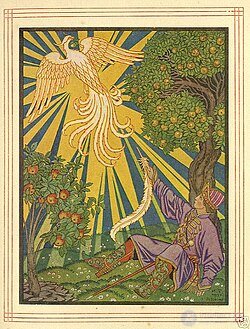
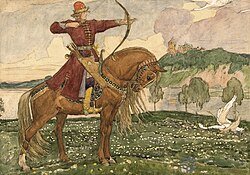
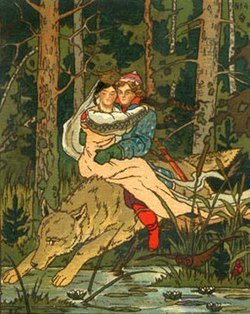
V. Ya. Propp identifies the following functions, giving each a brief verbal designation and a conventional symbol:
I. One of the members of a family absents himself from home (absentation, e)
II. An interdiction is addressed to the hero (interdiction, б)
III. The interdiction is violated (violation, b)
IV. The villain makes an attempt at reconnaissance (reconnaissance, в)
V. The villain receives information about his victim (delivery, w)
VI. The villain attempts to deceive his victim in order to take possession of him or his belongings (trickery, г)
VII. The victim submits to deception and thereby unwittingly helps his enemy (complicity, g)
VIII. The villain causes harm or injury to a member of a family (villainy, A).
VIII-a. One member of a family lacks something, or desires to have something (lack, a)
IX. Misfortune or lack is made known; the hero is approached with a request or command, is sent or dispatched, or is allowed to depart (mediation, B)
X. The seeker agrees to, or decides upon, counteraction (beginning counteraction, C)
XI. The hero leaves home (departure, ↑)
XII. The hero is tested, interrogated, attacked, and so on, which prepares the way for his receiving either a magical agent or helper (first function of the donor, D)
XIII. The hero reacts to the actions of the future donor (the hero's reaction, E)
XIV. The hero acquires the use of a magical agent (provision or receipt of a magical agent, F)
XV. The hero is transferred, delivered, or led to the whereabouts of an object of search (guidance, G)
XVI. The hero and the villain join in direct combat (struggle, H)
XVII. The hero is branded (branding, marking, J)
XVIII. The villain is defeated (victory, I)
XIX. The initial misfortune or lack is liquidated (liquidation of misfortune or lack, K)
XX. The hero returns (return, ↓)
XXI. The hero is pursued (pursuit, chase, Pr)
XXII. The hero is rescued from pursuit (rescue, Rs)
XXIII. The hero, unrecognized, arrives home or in another country (unrecognized arrival, X)
XXIV. A false hero presents unfounded claims (unfounded claims, F)
XXV. A difficult task is proposed to the hero (difficult task, Z)
XXVI. The task is resolved (solution, R)
XXVII. The hero is recognized (recognition, U)
XXVIII. The false hero or villain is exposed (exposure, O)
XXIX. The hero is given a new appearance (transfiguration, T)
XXX. The villain is punished (punishment, N)
XXXI. The hero is married and ascends the throne (wedding, S)
Propp notes that the central historical question – «Where does the folktale come from?» – cannot be answered without examining the peculiarities of the narrative as such: «If we do not know how to break the tale down into its component parts, we will not be able to carry out a proper comparison. And if we do not know how to compare, then how can light be shed, for example, on Indo-Egyptian relations, or on the relations of the Greek fable to the Indian, and so on?»
Having pointed to the complete uniformity of the structure of wonder tales, Propp leaves the question of the tales' origin from a single source to historical research, which appeared in 1946 under the title «The Historical Roots of the Wonder Tale.»

Comments