
Lecture
The monomyth (the single myth, the hero's journey, the quest) is one of the archetypal plots, consisting in the fact that the hero of the narrative leaves the ordinary world, undergoes trials, meets allies and enemies, achieves the goal (or fails), changes inwardly, and returns home with new knowledge/power. In narratology and comparative mythology, the hero's quest or the hero's journey, also known as the monomyth, is a common pattern of stories in which the hero sets out on an adventure, wins a decisive crisis, and returns home changed or transformed.
The term «monomyth» to describe the wanderings of a fictional hero was first used by Joseph Campbell, who borrowed it from James Joyce's novel «Finnegans Wake». According to Campbell, in any heroic myth the protagonist passes through a series of trials. One and the same mythologeme is characteristic both of Ancient Greece or Scandinavia and of Indian mythology. Campbell's conclusions are based on the analysis of Russian magic tales undertaken in the 1920s and 1930s by Vladimir Propp.
According to J. Campbell, the hero passes through several stages of the journey before the myth reaches its apogee and the protagonist becomes a hero:
The theory of the monomyth was widely reproduced in popular-science literature and gained broad renown. For example, Christopher Vogler considers the «hero's journey» to be the principal (basic) plot archetype. At the same time, professional researchers of mythology often assess Campbell's conclusions skeptically. Thus, Yu. E. Berezkin points out that the ancient Greek myths about Odysseus and Theseus (in the part concerning his journey from the Peloponnese to Athens), which Campbell cites to illustrate the supposedly universal plot of the «hero's journey», have no parallels whatsoever in the Indo-European sphere, and that their closest analogues are found among the Indians of North America.

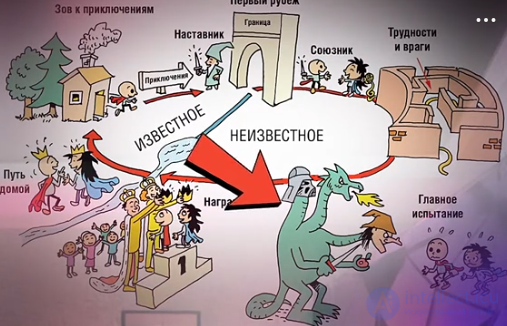
An illustration of the hero's path
In his book «The Hero with a Thousand Faces» (1949), Campbell describes 17 stages of the monomyth. Not all monomyths necessarily contain all 17 stages explicitly; some myths may focus on only one of the stages, while others may treat the stages in a somewhat different order. In the terminology of Claude Lévi-Strauss, the stages are separate mythological themes that are «bundled» or assembled into the structure of the monomyth.
The 17 stages can be organized in various ways, including a division into three «acts» or sections:
In the departure part of the narrative, the hero or protagonist lives in the ordinary world and receives a call to set out on an adventure. The hero is reluctant to follow this call, but is helped by a mentor.
The initiation section begins with the hero crossing the threshold into the unknown or the «special world», where he must undergo trials or ordeals, alone or with the help of helpers. Eventually, the hero reaches the «innermost cave» or the central crisis of his adventure, where he must undergo the «ordeal», overcoming the main obstacle or enemy, attaining the «apotheosis» and gaining a reward (a treasure or an «elixir»).
In the «Return» section, the hero must return to the ordinary world with his reward. He may be pursued by the guardians of the special world, or he may be unwilling to return and be rescued or forced to return by outside intervention. The hero once again crosses the threshold between the worlds, returning to the ordinary world with the treasure or elixir he has obtained, which he can now use for the benefit of his fellows. The hero himself is transformed by this adventure and gains wisdom or spiritual power over both worlds.
| Act | Campbell (1949) | Christopher Vogler (2007) |
|---|---|---|
| I. Departure |
|
|
| II. Initiation |
|
|
| III. Return |
|
|
The hero begins in an ordinary situation, from which he receives information that prompts him to set out into the unknown. According to Campbell, this region is represented by
a distant land, a forest, a kingdom underground, beneath the waves or above the sky, a secret island, a lofty mountain peak, or a deep dream; but it is always a place of strangely fluid and polymorphous beings, of unimaginable torments, superhuman deeds, and impossible delight. The hero may set out on his way of his own will to undertake the adventure, as Theseus did when he arrived at his father's city, Athens, and heard the terrible story of the Minotaur; or he may be carried off or sent abroad by some benign or malignant agent, like Odysseus, who was driven across the Mediterranean by the winds of the angry god Poseidon. The adventure may begin as a mere blunder... or, again, one may be strolling idly when some fleeting phenomenon catches the wandering eye and lures one away from the beaten human paths. Examples might be multiplied ad infinitum from every corner of the world.
Often, when the call sounds, the prospective hero at first refuses to accept it. This may be caused by a sense of duty or obligation, by fear, uncertainty, a feeling of one's own inadequacy, or any other reason that keeps a person in his present circumstances. Campbell says that
Refusal of the call turns the adventure into its negative. Walled up in boredom, hard work, or «culture», the subject loses the power of significant affirmative action and becomes a victim to be saved. His flowering world becomes a wasteland of dry stones, and his life feels meaningless — even though, like King Minos, he may through titanic effort succeed in building an illustrious empire. Whatever house he builds, it will be a house of death: a labyrinth of cyclopean walls hiding from him his Minotaur. All he can do is create new problems for himself and await the gradual approach of his disintegration.
Once the hero, consciously or unconsciously, has made the decision to undertake the quest, his guide and magical helper appears or becomes known. Most often this supernatural mentor gives the hero one or more talismans or artifacts that will help him later on. Campbell writes:
Such a figure represents the benign, protecting power of destiny. The fantasy is a reassurance — a promise that the paradisal world first known in the mother's womb is not to be lost; that it supports the present and stands in the future as well as in the past (is omega as well as alpha); that though omnipotence may seem to be endangered at the thresholds of the world, protective power is always and ever present within the sanctuary of the heart. One has only to know and trust, and the ageless guardians will appear. Having responded to his own call, and continuing to follow courageously as the consequences unfold, the hero finds all the forces of the unconscious at his side. Mother Nature herself supports this mighty task. And insofar as the hero's act coincides with that for which his society itself is ready, he seems to ride on the great rhythm of the historical process.
It is at this point that the hero truly steps out onto the field of adventure, leaving the known limits of his world and setting out into an unexplored and dangerous realm where the rules and boundaries are unknown. Campbell tells us:
With the personifications of his destiny to guide and aid him, the hero goes forward in his adventure until he comes to the «threshold guardian» at the entrance to the zone of magnified power. These guardians bound the world in the four directions – and above and below – symbolizing the limits of the hero's present sphere, or life horizon. Beyond them is darkness, the unknown, and danger; just as beyond the parental watch is danger to the infant, and beyond the protection of his society is danger to the members of the tribe. The ordinary person is more than content, is even proud, to remain within the indicated bounds, and popular belief gives him every reason to fear even the first step into the unexplored.
…
The adventure is always and everywhere a passage beyond the veil of the known into the unknown; the powers that watch at the boundary are dangerous; to deal with them is risky; yet for anyone with competence and courage the danger fades.
The belly of the whale symbolizes the hero's final separation from the familiar world and from himself. By entering this stage, the person shows his readiness for metamorphosis. On first reaching this stage, the hero may encounter a minor danger or setback. In Campbell's words,
The idea that the passage of the magical threshold is a transit into a sphere of rebirth is symbolized in the worldwide image of the belly of the whale. The hero, instead of conquering or conciliating the power of the threshold, is swallowed into the unknown and would appear to have died.
…
This popular motif emphasizes the lesson that the passage of the threshold is a form of self-annihilation. … Instead of passing outward, beyond the confines of the visible world, the hero goes inward, to be born again. The disappearance corresponds to the passing of a worshipper into a temple, where he is to be quickened by the recollection of who and what he is, namely dust and ashes unless immortal. The temple interior, the belly of the whale, and the heavenly land beyond, above, and below the confines of the world are one and the same. That is why the approaches and entrances to temples are flanked and defended by colossal gargoyles, [equivalent to] the two rows of teeth of the whale. They illustrate the fact that the devotee, at the moment of entry into a temple, undergoes a metamorphosis. … Once inside, he may be said to have died to time and returned to the World Womb, the World Navel, the Earthly Paradise. … Allegorically, then, the passage into a temple and the hero's plunge through the jaws of the whale are identical adventures, both denoting, in picture language, the act of renewal and the renewal of life.
In the exemplary Book of Jonah, the Israelite who gives Jonah his name refuses to carry out God's command to foretell the destruction of Nineveh and tries to flee by sailing to Tarshish. A storm arises, and the sailors cast lots to determine who is to blame for it. He allows himself to be thrown overboard to calm the storm, and is saved from drowning by being swallowed by a «great fish». For three days Jonah surrenders to God's will, and is safely vomited onto the shore. Afterward he goes to Nineveh and preaches to its inhabitants. Jonah's passage through the belly of the whale can be regarded as a symbolic death and rebirth in Jungian analysis.
In The Power of Myth, Campbell agrees with Bill Moyers that the trash-compactor scene on the Death Star in the original film Star Wars is a vivid example of this stage of the path. ]
The road of trials is a series of ordeals that the hero must pass through in order to begin his transformation. Often the hero fails one or more of these trials, which frequently occur in threes. Eventually the hero overcomes these trials and moves on to the next stage. Campbell explains that
Once past the threshold, the hero enters a dream landscape of curiously fluid, ambiguous forms, where he must survive a succession of trials. This is the favorite phase of the myth-adventure. It has produced a world literature of miraculous tests and ordeals. The hero is covertly aided by the advice, amulets, and secret agents of the supernatural helper whom he met before his entrance into this region. Or it may be that he here discovers for the first time that there is a benign power everywhere supporting him in his superhuman passage.
…
The original departure into the land of trials represented only the beginning of the long and really perilous path of initiatory conquests and moments of illumination. Dragons have now to be slain and surprising barriers passed — again, again, and again. Meanwhile there will be a multitude of preliminary victories, unretainable ecstasies, and momentary glimpses of the wonderful land.
Here the hero receives objects that will help him in the future. Campbell suggests that
The ultimate adventure, when all the barriers and ogres have been overcome, is commonly represented as a mystical marriage of the triumphant hero-soul with the Queen Goddess of the World. This is the crisis at the nadir, the zenith, at the uttermost edge of the earth, at the central point of the cosmos, in the tabernacle of the temple, or within the darkness of the deepest chamber of the heart.
…
The meeting with the goddess (who is incarnate in every woman) is the final test of the hero's talent to win the boon of love (charity: amor fati), which is life itself enjoyed as the encasement of eternity.
And when the adventurer, in this context, is not a youth but a maid, she is the one who, by her qualities, her beauty, or her yearning, is fit to become the consort of an immortal. Then the heavenly husband descends to her and conducts her to his bed – whether she will or not. And if she has shunned him, the scales fall from her eyes; if she has sought him, her desire finds its peace.
At this stage the hero faces temptations, often of a physical or pleasurable nature, that may cause him to abandon or stray from his quest. Woman need not be represented by a woman. Woman is a metaphor for the physical or material temptations of life, since the hero-knight was often tempted by lust in the course of his spiritual journey. Campbell relates that
The crux of the curious difficulty lies in the fact that our conscious views of what life ought to be seldom correspond to what life really is. Generally we refuse to admit within ourselves, or within our friends, the fullness of that pushing, self-protective, malodorous, carnivorous, lecherous fever which is the very nature of the organic cell. Rather, we tend to perfume, whitewash, and reinterpret, meanwhile imagining that all the flies in the ointment, all the hairs in the soup, are the faults of some unpleasant someone else. But when it suddenly dawns on us, or is forced upon us, that everything we think or do is necessarily tainted with the odor of the flesh, then, not uncommonly, there is experienced a moment of revulsion: life, the acts of life, the organs of life, woman in particular as the great symbol of life, become intolerable to the pure, pure soul. … The seeker of the life beyond life must press beyond [woman], surpass the temptations of her call, and soar to the immaculate ether beyond.
At this stage the hero must confront whoever holds the ultimate power in his life and be initiated by it. In many myths and tales this is a father or father-figure who holds power over life and death. This is the central point of the journey. All the previous stages led to this place, and all subsequent ones will proceed from it. Although the meeting with a male being most often symbolizes this stage, it need not be a man — simply someone or something possessing incredible power. In Campbell's words,
Atonement consists in no more than the abandonment of that self-generated double monster – the dragon thought to be God (superego) and the dragon thought to be Sin (repressed id). But this requires an abandonment of the attachment to ego itself, and that is what is difficult. One must have faith that the father is merciful, and then a reliance on that mercy. In addition to this, the center of belief is transferred outside of the bedeviling god's tight scaly ring, and the dreadful ogres dissolve. It is in this ordeal that the hero may derive hope and assurance from the helpful female figure, by whose magic (pollen charms or power of intercession) he is protected through all the frightening experiences of the father's ego-shattering initiation. For if it is impossible to trust the terrifying father-face, then one's faith must be centered elsewhere (Spider Woman, Blessed Mother); and with that reliance for support, one endures the crisis – only to find, in the end, that the father and mother reflect each other, and are in essence the same.
Campbell later clarifies:
The task of the hero who goes to meet the father is to open his soul beyond terror to such a degree that he will be ripe to understand how the sickening and insane tragedies of this vast and ruthless cosmos are completely validated in the majesty of Being. The hero transcends life with its peculiar blind spot and for a moment rises to a glimpse of the source. He beholds the face of the father, understands — and the two are atoned.
This is the moment of realization in which a deeper understanding is attained. Armed with this new knowledge and perception, the hero gains resolve and is ready for the more difficult part of the adventure. Campbell reveals that
Those who know not only that the Everlasting lies in them but that what they and all things really are is the Everlasting, dwell in the groves of the wish-fulfilling trees, drink the brew of immortality, and listen everywhere to the unheard music of eternal concord.
The ultimate boon is the achievement of the goal of the quest. It is what the hero set out on the journey for. All the preceding steps serve to prepare and purify the hero for this step, since in many myths the boon is something transcendent, such as the elixir of life, a plant that confers immortality, or the Holy Grail. Campbell asserts that
The gods and goddesses, then, are to be understood as embodiments and custodians of the elixir of Imperishable Being, but not themselves the Ultimate in its primary state. What the hero seeks through his intercourse with them is therefore not finally themselves, but their grace, that is, the power of their sustaining substance. This miraculous energy-substance and this alone is the Imperishable; the names and forms of the deities who everywhere embody, dispense, and represent it come and go. This is the miraculous energy of the thunderbolts of Zeus, Yahweh, and the Supreme Buddha, the fertility of the rain of Viracocha, the virtue announced by the bell rung at the Mass during the consecration, and the light of the ultimate illumination of the saint and sage. Its guardians dare release it only to the duly proven.
Having attained bliss and enlightenment in the other world, the hero may be unwilling to return to the ordinary world in order to bestow the boon on his fellow men. Campbell continues:
When the hero-quest has been accomplished, through penetration to the source, or through the grace of some male or female, human or animal, personification, the adventurer still must return with his life-transmuting trophy. The full round, the norm of the monomyth, requires that the hero shall now begin the labor of bringing the runes of wisdom, the Golden Fleece, or his sleeping princess, back into the kingdom of humanity, where the boon may redound to the renewing of the community, the nation, the planet, or the ten thousand worlds. But the responsibility has frequently been refused. Even Gautama Buddha, after his triumph, doubted whether the message of realization could be communicated, and saints are reported to have died within the supernal ecstasy. Numerous indeed are the heroes fabled to have taken up residence forever in the blessed isle of the unaging Goddess of Immortal Being. [ 34 ]
Sometimes the hero must flee with the boon if it is something that the gods guard jealously. The return from the journey may be just as adventurous and dangerous as the journey itself. Campbell asserts that
If the hero in his triumph wins the blessing of the goddess or the god and is then explicitly commissioned to return to the world with an elixir for the restoration of society, the final stage of his adventure is supported by all the powers of his supernatural patron. On the other hand, if the trophy has been attained against the opposition of its guardian, or if the hero's wish to return to the world has been resented by the gods or demons, then the last stage of the mythological round becomes a lively, often comical, pursuit. This flight may be complicated by marvels of magical obstruction and evasion.
Just as the hero may need guides and helpers to set out on the journey, he often needs powerful guides and rescuers to bring him back to everyday life, especially if the hero has been wounded or weakened by his experience. Campbell explains:
The hero may have to be brought back from his supernatural adventure by assistance from without. That is to say, the world may have to come and get him. For the bliss of the deep abode is not lightly abandoned in favor of the [tumult] of the awakened state. … Society is jealous of those who remain away from it, and will come knocking at the door. If the hero… is unwilling, the disturber suffers an ugly shock; but on the other hand, if the summoned one is only delayed – sealed in by the [ecstasy] of the perfected being … there occurs an apparent rescue, and the adventurer returns.
Campbell writes in The Hero with a Thousand Faces that «the returning hero, to complete his adventure, must survive the impact of the world». The aim of the return is to preserve the wisdom gained in the course of the quest and to integrate it into society. Campbell writes:
The many failures attest to the difficulties of this life-affirming threshold. The first problem of the returning hero is to accept as real, after an experience of the soul-satisfying vision of fulfillment, the [ups and downs] of life. Why re-enter such a world? Why [share] the experience of transcendental bliss? As dreams that were momentous by night may seem simply foolish in the light of day, so the poet and the prophet may find themselves playing the idiot before [others]. It is easy to abandon the whole community to the devil and to retire again into [bliss]. But if some spiritual obstetrician has drawn the seminaway forth through the retreat, then the work of [extracting the eternal truth] cannot be avoided.
For the human hero, this may mean achieving a balance between the material and the spiritual. The person becomes confident and competent in both the inner and the outer world. Campbell shows that
Freedom to pass back and forth across the world division, from the perspective of the apparitions of time to that of the causal deep and back – not contaminating the principles of the one with those of the other, yet permitting the mind to know the one by virtue of the other – is the talent of the master. The Cosmic Dancer, declares Nietzsche, does not rest heavily in a single spot, but gaily, lightly, turns and leaps from one position to another. One can speak from only one point at a time, but this does not invalidate the insights of the rest.
In discussing this stage, Campbell refers to the apostles of Jesus, who became selfless in their devotion by the time of the transfiguration of their teacher, as well as to a similar orthodoxy represented by Krishna, who said: «He who does My work and regards Me as the Supreme Goal… without hatred of any being — that man comes to Me». Campbell goes on to illustrate that
Through prolonged psychological practices a person wholly relinquishes all attachment to his personal limitations, idiosyncrasies, hopes, and fears, no longer resists the self-annihilation that is prerequisite to rebirth in the realization of truth, and at last becomes ripe for the great at-one-ment. His personal ambitions are wholly dissolved; he no longer tries to live but yields willingly to whatever may come to pass in him; he becomes, that is to say, an anonymity.
At this stage, mastery leads to freedom from the fear of death, which in turn is freedom to live. This is sometimes called living in the present moment, without anticipation of the future and without regrets over the past. Campbell asserts:
The hero is the champion of things becoming, not of things become, because he is. «Before Abraham was, I AM». He does not mistake apparent changelessness in time for the permanence of Being, nor is he fearful of the next moment (or of the «other thing») as destroying the permanent with its change. [Quoting Ovid's Metamorphoses:] «Nothing retains its own form; but Nature, the great renewer, ever makes up forms from forms. Be sure that nothing perishes in the whole universe; it does but vary and renew its form». Thus the next moment is permitted to come to pass.
The concept of the monomyth has been popular in American literary studies and writing manuals at least since the 1970s. Christopher Vogler, a Hollywood film producer and writer, created a 7-page memo, «A Practical Guide to The Hero with a Thousand Faces», based on Campbell's work. Vogler's memo was later expanded into the book «The Writer's Journey: Mythic Structure for Writers».
George Lucas's 1977 film «Star Wars» was classified as a monomyth almost immediately after its release. In addition to the extensive discussion between Campbell and Bill Moyers broadcast in 1988 under the title «The Power of Myth», Lucas gave an extensive interview in which he stated that after completing «American Graffiti», «it occurred to me that there really was no modern use of mythology… so that was when I started doing more strenuous research into fairy tales, folklore, and mythology, and I started reading Joe's books. … It was very eerie because in reading The Hero with a Thousand Faces I began to realize that my first draft of Star Wars was following classic motifs». Moyers and Lucas also met for an interview in 1999 to discuss further the influence of Campbell's work on Lucas's films. In addition, the Smithsonian Institution's National Air and Space Museum sponsored an exhibition in the late 1990s called «Star Wars: The Magic of Myth», which discussed how Campbell's work had influenced the «Star Wars» saga.
Numerous literary works of popular fiction have been identified by various authors as examples of the monomyth pattern, including Spenser's «The Faerie Queene», Melville's «Moby-Dick», Charlotte Brontë's «Jane Eyre», the works of Charles Dickens, William Faulkner, Somerset Maugham, J. D. Salinger, Ernest Hemingway, Mark Twain, W. B. Yeats, C. S. Lewis, J. R. R. Tolkien, Seamus Heaney, and Stephen King, Plato's allegory of the cave, Homer's «Odyssey», L. Frank Baum's «The Wonderful Wizard of Oz», and Lewis Carroll's «Alice's Adventures in Wonderland», as well as many others.
Stanley Kubrick introduced Arthur C. Clarke to Joseph Campbell's book «The Hero with a Thousand Faces» while working on the film «2001: A Space Odyssey». In his diary, Arthur C. Clarke called Joseph Campbell's book «very inspiring».
Campbell's approach to myth, a genre of folklore, has been criticized by folklorists, scholars specializing in the study of folklore. The American folklorist Barre Toelken notes that few psychologists have taken the trouble to acquaint themselves with the complexity of folklore, and that historically psychologists and authors influenced by Jung have tended to build elaborate theories around single versions of a tale that support the theory or assumption. To illustrate his point, Toelken uses Clarissa Pinkola Estés's book «Women Who Run with the Wolves» (1992), citing its inaccurate presentation of folkloric data, as well as Campbell's «monomythic» approach. Regarding Campbell, Toelken writes: «Campbell could construct a monomyth of the hero only by referring to those stories that fit his preconceived template, and by excluding equally valid stories… which did not fit the pattern». Toelken traces the influence of Campbell's monomyth theory on other popular works of the time, such as Robert Bly's Iron John: A Book About Men (1990), which, he says, suffers from a similar flaw in the selection of sources.
Similarly, the American folklorist Alan Dundes sharply criticizes both Campbell's approach to folklore, calling him a «non-specialist» and citing various examples of source bias in Campbell's theories, and the media's representation of Campbell as an expert on myth in popular culture. Dundes writes: «Folklorists have had some success over the past two centuries in promoting the results of their efforts, so that representatives of other disciplines, having read a minimal amount of the literature, have come to believe in their own competence in matters of folklore. The world seems full of self-proclaimed experts on folklore, and some, such as Campbell, have been accepted as such by the general public (and by public television, in Campbell's case)». According to Dundes, «there is no single idea promulgated by amateurs that has done more harm to the serious study of folklore than the notion of the archetype».
According to Northup (2006), traditional comparative mythology since Campbell's time has moved away from «highly general and universal» categories in general. This approach is illustrated by Consentino (1998), who notes: «It is just as important to emphasize differences as similarities, in order to avoid creating a (Joseph) Campbell-style porridge of myths that loses all local color». Similarly, Ellwood (1999) argued: «The tendency to think in generic terms of peoples, races… is undoubtedly the deepest flaw in mythological thinking».
Others find the categories with which Campbell works so vague that they are meaningless and lack the necessary support for a scholarly argument: Crespi (1990), responding to a videotaped presentation by Campbell of his model, characterized it as «unsatisfactory from the standpoint of social science. Campbell's ethnocentrism will raise objections, and his analytical level is so abstract and devoid of ethnographic context that myth loses the very meanings supposed to be embodied in the 'hero'».
In a similar vein, the American philosopher John Shelton Lawrence and the American religious-studies scholar Robert Jewett discussed the «American monomyth» in many of their books, such as The American Monomyth (1977), The Myth of the American Superhero (2002), and Captain America and the Crusade Against Evil: The Dilemma of Zealous Nationalism (2003). They present it as America's reaction to the Campbellian monomyth. The plot of the «American monomyth» is as follows: «A community in a harmonious paradise is threatened by evil; ordinary institutions fail to cope with the threat; a selfless superhero appears to renounce temptations and carry out a redemptive mission; aided by fate, his decisive victory restores the community to its paradisal condition; the superhero then recedes into obscurity». One modern example of this is the character «Reacher» in Lee Child's books and the television series based on them, each book beginning and ending with the superhero in a state of obscurity.
The monomyth has also been criticized for its emphasis on the male path. Maureen Murdock's The Heroine's Journey (1990) and Valerie Estelle Frankel's From Girl to Goddess: The Heroine's Journey through Myth and Legend (2010) set out the stages of a female hero's path that differ from Campbell's monomyth. Similarly, in the book The Virgin's Promise, Kim Hudson describes an analogous female path, paralleling the male hero's path, that concerns personal growth and «creative, spiritual, and sexual awakening» rather than an outward quest.
According to a 2014 interview between director Nicole L. Franklin and comic artist and illustrator Alice Meichi Li, the hero's journey is «the journey of someone who has privilege. Whether it's a man or a woman, the heroine does not begin with privilege». Being unprivileged, in Li's view, means that the heroine may not receive the same level of social support that the hero enjoys in the traditional mythic cycle, and instead of returning from her quest as a hero and mentor, she instead returns to a world in which she or he is still part of an oppressed demographic. Li adds: «They don't really return the elixir. They make their way through our patriarchal society with unequal pay and inequality. In the final chapter they may be on equal footing. But when you have oppressed groups, all you can hope for is to advance twice as far by working twice as hard».
In an article published in Salon in 1999, the science-fiction writer David Brin criticized the monomyth pattern, calling it supportive of «despotism and tyranny», and stating that, in his opinion, modern popular literature should strive to move away from it in order to support more progressive values.

Comments