
Lecture
The academic course «Literary Studies» has as its task to provide knowledge of literary studies and, in particular, of the theory of literature, to master a correct understanding of the essence
of literature as one of the arts, the ability to find one's way in the literary process, and to know the methods and techniques of analyzing literary works of various genres and kinds, written under differing
socio-political conditions. An equally important task of the course is the assimilation of the evolutionary path of development of Russian and world literary studies, beginning with antiquity and
ending with the most recent achievements realized in the practice of contemporary schools and movements.
Literary studies is the science that studies the specifics, genesis, and development of verbal-artistic creativity. The subject of literary studies is literature and literary phenomena. There are principal literary disciplines and auxiliary ones. The principal ones include the theory of literature, the history of literature, and literary criticism. The history of literature studies literature as a process, its past. Literary criticism deals with the current state of literature. Individual examples of literary-critical analysis remain exemplary for a long time. The theory of literature studies the conceptual apparatus, the essence of literary phenomena, the structural elements of a literary work, and the laws of the literary process. Poetics is a component part of the theory of literature, the science of the system of poetic devices, of the forms of verbal-figurative expression. All the disciplines are interconnected. The theory of literature is the foundation for the others. The theory of literature addresses two tasks: it determines the philosophical foundations of literary studies as a whole, and the methodology and methods for researching literary phenomena. The second task: within the theory of literature a language is developed, with its own categorical and terminological apparatus.
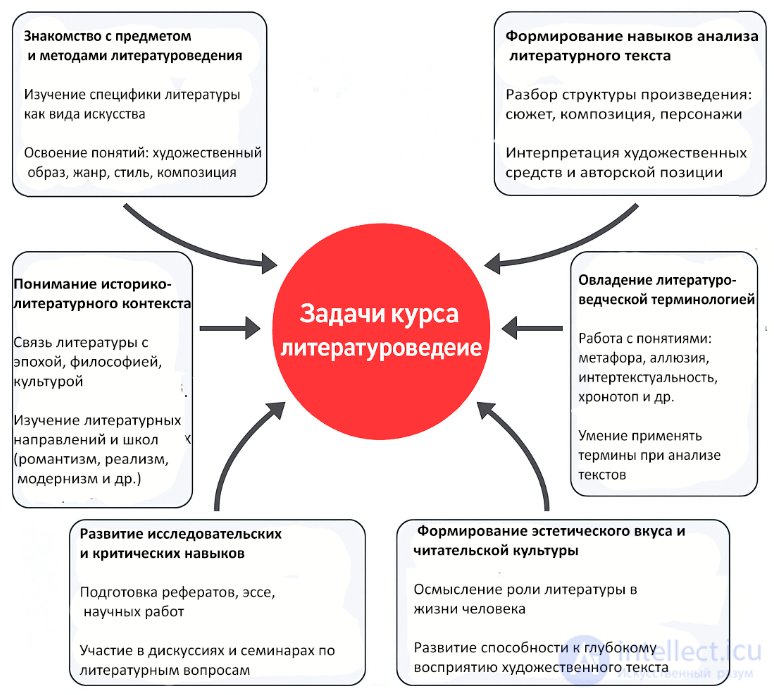
The course «Literary Studies» sets itself several key tasks aimed at forming in students a systematic understanding of literature as an artistic and cultural phenomenon. Here are the main goals and objectives of the course:
Introduction to the subject and methods of literary studies
Studying the specifics of literature as an art form
Mastering the concepts of artistic image, genre, style, composition
Developing skills in the analysis of a literary text
Analyzing the structure of a work: plot, composition, characters
Interpreting artistic devices and the author's position
Understanding the historical-literary context
The connection of literature with its era, philosophy, and culture
Studying literary movements and schools (romanticism, realism, modernism, etc.)
Mastering literary-critical terminology
Working with the concepts of metaphor, allusion, intertextuality, chronotope, and others
The ability to apply these terms when analyzing texts
Developing research and critical skills
Preparing reports, essays, and scholarly papers
Participating in discussions and seminars on literary questions
Cultivating aesthetic taste and a culture of reading
Reflecting on the role of literature in human life
Developing the capacity for a deep perception of the literary text
Literary studies is one of the two most important philological disciplines. The other
philological science is linguistics (from the Latin lingua – language). Both sciences
are united by a common orientation toward the study of the word. However, their tasks are specific.
Whereas linguistics investigates language, its functions, universal characteristics, structure, and
historical development, literary studies studies the artistic literature of various peoples and reveals
the laws of its development.
Literary studies and linguistics constantly interact with one another: artistic literature
serves as one of the sources for linguistic studies; literary studies helps linguistics
understand the substantive specifics of artistic creativity and explain its linguistic features.
The principal and auxiliary disciplines of literary studies. Literary studies, as the science studying
artistic literature, developed from ancient times, at first — within the framework of philosophy and
aesthetics, and from the end of the 18th century – as an independent discipline. Modern literary studies, as the
science of artistic literature, unites three leading branches: the theory of literature, the history
of literature, and literary criticism. The prevailing view is that literary studies consists of
the theory of literature, the history of literature, and literary criticism. These disciplines are called
the principal ones.
The theory of literature studies the nature, specifics, and general laws of the development of artistic
literature, the fundamental laws of creativity that writers of different eras and peoples follow, consciously or subconsciously.
It establishes the criteria and principles for the analysis and evaluation of literary
material.
The history of literature investigates the literary process and, on this basis, clarifies the place and significance of
individual literary phenomena.
Literary criticism is a particular response to the important literary events of the day. Its main task
is a comprehensive analysis of new literary phenomena and their evaluation from the standpoint of the stage of development
at which society currently stands.
Literary studies, like any other science, has a whole series of auxiliary disciplines besides.
First of all, one should mention literary historiography and bibliography, as well as textual criticism and
paleography.
The interconnections of the disciplines of literary studies. The theory of literature, the history of literature, and
literary criticism, as the principal disciplines of literary studies, are closely interconnected. Each of
them necessarily draws on the achievements of the other two disciplines.
The theory of literature develops through the generalization and philosophical-aesthetic
interpretation of facts and information about individual artistic works, the activity of writers, and the succession of
literary trends and movements. The history of literature constantly relies on the universal
propositions and principles worked out by the theory of literature. Tracing the historical-literary
process as a lawful, forward movement from the past to the present, the history of literature
constantly uses the conceptual and terminological apparatus of the theorist.
Literary studies and linguistics. In studying the literature of one people or another, scholars
cannot manage without knowledge of languages and their history. Here linguists actively
assist literary scholars. Indeed, in the early stages of humanity's development, literature existed only in
oral form, and later, with the natural advance of society, a people would create its own
writing system, which allowed literature to develop on the basis of a particular system of letters.
Literary studies and history. Works of artistic literature are always a part of
the cultural heritage of a given people. Written under the specific historical conditions of their day, they are
part of the historical memory of that people. The science of literature cannot fail to take into account
the strong interconnection between artistic creativity and the development of a particular people. In this sense
literary studies functions as a historical scholarly discipline, helping history to study
the social existence of a given people. The time in which a work of literature is written always leaves its
imprint on it. Like historians, literary scholars must be able to work with archives, to find in
them the materials they need, to analyze them, and to comment on them.
Literary studies and art history. The subject of literary studies is artistic
literature, which, in turn, is part of art, the study of which is the concern of
art history. Literary studies and art history have much in common.
First and foremost, both of these sciences study literary works, which
reflect reality in images.
However, the art historian turns, besides literary works, also to works of painting, sculpture,
architecture, and musical art, which likewise share this figurative reflection of reality.
Literary studies and other scholarly disciplines. Artistic literature is one of the
many forms of art. This is precisely why literary studies constantly interacts with aesthetics,
the science that, over the course of several millennia, has been engaged in developing the theoretical problems
of art. Philosophy is the methodological basis for literary studies. Literary studies has
much in common in its subject of research with folklore studies.
Literary studies has close ties with psychology, since one of the subjects depicted
in artistic literature is the inner world of the human being. The science of literature also has close
ties with sociology, hermeneutics, ethics, and a number of other scholarly disciplines.
Auxiliary disciplines: Bibliography – information about artistic literature and works on literary studies. Source studies – the sources of the history and theory of literature. Textual criticism – establishing the exact text of literary monuments and historical documents for their scholarly publication. Archeography – monuments of writing. Paleography – monuments of ancient writing, for the purpose of reading them and determining the time and place of their creation.
Three doctrines underlie the science of literary studies: the doctrine of literary creativity, the doctrine of the literary work, and the doctrine of the literary process.
The theory of literature interacts with linguistics, philosophy, aesthetics, and psychology (the psychology not only of creativity but also of perception).
Reality => the artist => evaluation.
1. What is the task of the course in literary studies?
2. With which philological disciplines is the course connected?
3. Explain the connection between literary studies and linguistics.
4. Explain the connection between literary studies and history.
5. Explain the connection between literary studies and art history.
6. Name the principal and auxiliary disciplines of literary studies.
7. Describe the main types of theoretical-literary scholarly works.

Comments