
Lecture
Literary speech absorbs the most varied forms of verbal activity. For many centuries the language of imaginative literature was governed by the rules of rhetoric and oratory. Speech (including written speech) had to be persuasive and impressive; hence the characteristic devices – numerous repetitions, «embellishments», emotionally charged words, rhetorical(!) questions, and so on. Authors competed in eloquence, stylistics were governed by ever stricter rules, and literary works themselves were often filled with sacred meaning (especially in the Middle Ages). As a result, by the seventeenth century (the age of Classicism) literature had become accessible and comprehensible only to a fairly narrow circle of educated people. That is why, from the seventeenth century on, all of European culture evolved from complexity toward simplicity. V.G. Belinsky called rhetoric «a false idealizing of life». Elements of colloquial speech began to penetrate the language of literature. The work of A.S. Pushkin stands, as it were, at the crossroads of these two traditions of verbal culture. His works often form an alloy of rhetorical and colloquial speech (a classic example: the introduction to «The Stationmaster» is written in an oratorical style, while the tale itself is stylistically quite simple).
Colloquial speech is connected, above all, with people's communication in their private lives, and so it is simple and free of regulation. In the nineteenth and twentieth centuries literature as a whole came to be perceived by writers and scholars as a kind of conversation between the author and the reader; it is no accident that addresses such as «my dear reader» are associated, above all, with this era. Literary speech often also incorporates written forms of non-literary speech (for example, diaries or memoirs); it readily permits departures from linguistic norms and carries out innovations in the sphere of verbal activity (recall, for instance, the word-creation of the Russian Futurists).
Today one can find the most contemporary forms of verbal activity in literary works – SMS quotations, excerpts from emails, and much else. Moreover, different art forms are often mixed: literature and painting/architecture (for example, the text itself is inscribed within a certain geometric figure), literature and music (a soundtrack is indicated for a work – a phenomenon undoubtedly borrowed from LiveJournal culture), and so on.
Language, naturally, is not the property of literary creation alone; it encompasses every aspect of surrounding reality. Let us therefore try to identify those specific features of language that make it a means of artistic reflection of reality.
Literary language (also standard language) is the cultivated part of the national language, possessing, to a greater or lesser degree, norms fixed in writing; it is the language of all manifestations of culture expressed in verbal form.
Literary language is a supra-dialectal subsystem (form of existence) of a national language, characterized by such features as normativity, codification, polyfunctionality, stylistic differentiation, and high social prestige among speakers of that national language. It is the possession of everyone who commands its norms. It functions both in written and in colloquial forms. The language of imaginative literature (the language of writers), although usually oriented toward the same norms, contains a great deal that is individual and not generally accepted. In different historical eras and among different peoples, the degree of closeness between the literary language and the language of imaginative literature has varied.
Literary language is the common written language of a given people, and sometimes of several peoples – the language of official and business documents, school instruction, everyday written communication, scholarship, journalism, imaginative literature, and all manifestations of culture expressed in verbal form, most often written, but sometimes also oral. This is why the written-bookish and oral-colloquial forms of a literary language are distinguished, the emergence, correlation, and interaction of which are governed by certain historical regularities.
Literary language is a historically formed linguistic system, recognized by society, distinguished by strict codification.
The notion of the «fixedness» of the norms of a literary language has a certain relativity (for all the importance and stability of a norm, it is mobile over time). One cannot imagine a developed and rich culture of a people without a developed and rich literary language. Herein lies the great social significance of the problem of the literary language itself.
Among linguists there is no single opinion on the complex and multifaceted concept of the literary language. Some researchers prefer to speak not of the literary language as a whole, but of its varieties: either the written-literary language, or the colloquial-literary language, or the language of imaginative literature, and so on.
The literary language cannot be identified with the language of imaginative literature. These are different, though correlated, concepts.
The study of the literary language is carried out within linguistics. In literary scholarship what is examined is not simply the literary language but the language of imaginative literature.
The function of cognition and the function of communication are the two principal, closely connected sides of language. In the course of historical development a word may change its original meaning, sometimes to such an extent that we begin to use certain words in meanings that contradict them: for example, red ink (from the word «black», «to blacken») or a cut-off slice (from «to break off»), and so on. These examples show that the creation of a word is an act of cognition of a phenomenon; language reflects the workings of human thought, various aspects of life, historical phenomena. It has been calculated that around 90,000 words are in use today. Every word has its own stylistic coloring (for example: neutral, colloquial, vernacular) and its own history, and, moreover, a word acquires additional meaning from the words surrounding it (from c o n t e x t). An unfortunate example in this sense was given by Admiral Shishkov: «Borne by swift steeds, the knight suddenly tumbled from his chariot and smashed his mug». The phrase is comical because words of different emotional coloring are combined in it.
The task of selecting particular verbal means for a work is fairly complex. This selection is usually motivated by the imagery system underlying the work. Speech is one of the important characteristics of both the characters and the author himself.
The language of imaginative literature carries within it an enormous aesthetic principle, and so the author of a literary work does not merely generalize linguistic experience but, to some extent, also determines the speech norm, being a creator of language.
The language of a literary work. Imaginative literature is a multitude of literary works, each of which constitutes an independent whole. A literary work, existing as a finished text written in a particular language (Russian, French), is the result of the writer's creative act. A work usually has a title; in lyric poems its function is often performed by the first line. The centuries-old tradition of the external presentation of a text underscores the special significance of a work's title, both in manuscript form and after the invention of printing. Works are diverse: typological properties on the basis of which a work is assigned to a particular literary kind (epic, lyric, drama, etc.); genre (novella, short story, comedy, tragedy, narrative poem); aesthetic category or artistic mode (the sublime, the romantic); rhythmic organization of speech (verse, prose); stylistic dominant (verisimilitude, convention, plot-centeredness); literary movements (Symbolism and Acmeism).
Aesopian language (named after the fabulist Aesop) is a form of cryptic writing in literature, an allegory that deliberately disguises the author's thought (idea). It resorts to a system of «deceptive devices»: traditional allegorical techniques (allegory, irony, periphrasis, allusion), fable «characters», and semi-transparent contextual pseudonyms. Since the slave Aesop could not directly point to the vices of his masters in his fables, he replaced their images with images of animals possessing the corresponding traits. For this reason the language of allegory is called Aesopian.
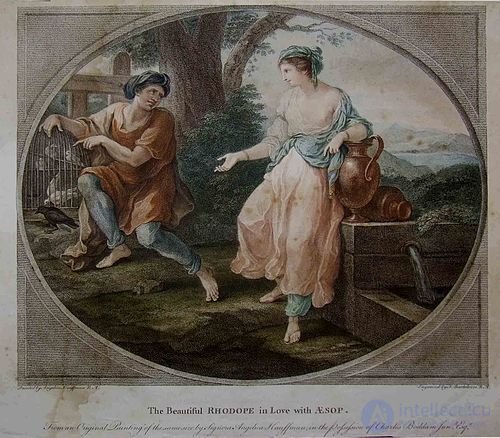
«The Beautiful Rhodopis and Aesop». F. Bartolozzi after an original by A. Kauffman
The use of Aesopian language was studied by the Soviet literary scholar Lev Loseff. He defined Aesopian language as a literary system of interaction between author and reader, in which the meaning remains hidden from the censor . He also noted that the use of Aesopian language remained a favorite device of writers, including himself, under conditions of Soviet censorship. Maliheh Tyrell defines the term in the context of the Soviet Union and notes that the use of Aesopian language spread to other national literatures under Soviet rule:
In brief, this form of literature, like Aesop's fables about animals, cloaks itself in allegorical statements, hints, and euphemisms in order to avoid political censorship. «Aesopian language» or literature is a technical term used by Sovietologists to denote the allegorical language employed by Russian or nationally Russian nonconformist writers to conceal anti-regime sentiments. The purpose of this «Aesopian» literature under Soviet rule was to mislead the authorities while at the same time shedding light on the truth for local readers.

Comments