
Lecture
As is well known, the main characteristics of loudspeaker systems are driver size, power, frequency range and price. We will look at the remaining parameters in this article.
In English, the loudspeaker unit itself is called a driver, and that is quite fitting. Just as an engine becomes a car only when it is complemented by everything mankind has developed for the purpose, a driver becomes a loudspeaker only in its proper acoustic enclosure.
Tweeters and midrange drivers are relatively simple: tweeters carry their acoustic enclosure with them, while midrange drivers require one of minimal size.
Bass drivers are another matter. Almost everything here is determined by the choice of enclosure, and depending on that choice, all the parameters mentioned to you will have to be reconsidered: power, frequency range and, in a certain sense, price. For with a skillful choice of parameters, you can achieve nauseating sound from the most expensive and well-bred bass driver.
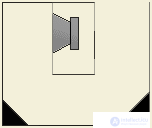
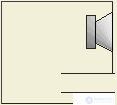
Let us consider the types of loudspeaker enclosures:
 |
 |
|
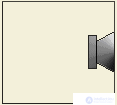
Acoustic baffle |
Sealed box |
|
|
 |
|
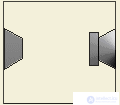
Bass reflex |
Loudspeaker with a passive radiator |
 |
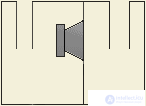 |
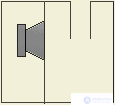
| Band-pass loudspeaker (4th order) | Band-pass loudspeaker (6th order) |
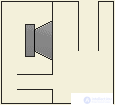 |
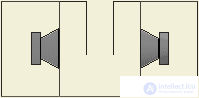 |
| Quasi-band-pass loudspeaker | Three-chamber band-pass loudspeaker (4th order) |
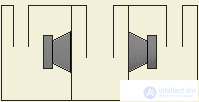 |
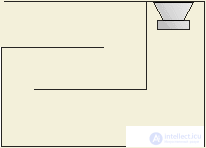 |
| Three-chamber band-pass loudspeaker (6th order) | Acoustic labyrinth |
 |
 |
| Folded horn | Aperiodic loading (acoustic resistance) |
The task of any low-frequency enclosure is solved by the ancient principle of "divide and rule". "Divide" means that the vibrations radiated by one side of the cone must be separated from the vibrations produced by its opposite side, which occur simultaneously and in antiphase with the first. "Rule" means that the "excess" sound waves cut off in this way can be dealt with in different ways.
Historically, the first acoustic enclosure was the acoustic baffle. It holds the line, keeping vibrations from one side of the cone from reaching the other and preventing them from cancelling each other out, down to frequencies at which the shortest distance between the front and back of the cone becomes comparable to half the wavelength of the radiated frequency. Below that frequency the baffle "admits its complete incompetence" and lets the antiphase waves cancel each other as they please.
To prevent this acoustic short circuit at a frequency of, say, 50 Hz, the baffle would have to measure 3 by 3 meters. For this reason, this type of enclosure lost its practical significance long ago, although it is still used as a reference when measuring driver parameters.
Structurally, the simplest of the enclosures used in practice is the sealed box (sealed or closed in foreign terminology, abbreviated SB). Here the unwanted vibrations are dealt with decisively and bluntly: trapped in the closed space behind the cone, they sooner or later die out and turn into heat. The amount of this heat is minuscule, but in the world of acoustics everything is a matter of small perturbations, so the way this thermodynamic exchange takes place is not irrelevant to the characteristics of the loudspeaker system.
If sound waves inside the loudspeaker enclosure are left to wander unattended, a significant part of their energy will be dissipated in the volume of air contained in the enclosure; it will heat up, albeit slightly, and the elasticity of the air volume will change, in the direction of increased stiffness. To prevent this, the internal volume is filled with a sound-absorbing material.
While absorbing sound, this material (usually wadding, whether natural, synthetic, glass or mineral) also absorbs heat. Because the heat capacity of the sound-absorbing fibers is much greater than that of air, the temperature rise becomes much smaller, and the driver "feels" as if there were a substantially larger volume behind it than there actually is. In practice, this method makes it possible to increase the "acoustic" volume relative to the geometric one by 15–20%. This, and not the absorption of standing waves, as many believe, is the main point of introducing sound-absorbing material into sealed loudspeakers.
A variety of this type of enclosure (and not of the previous one, as is often supposed) is the so-called "infinite baffle". In English-language sources, this type of enclosure is called infinite baffle or free-air. All these names are equally misleading.
We are all adults here and understand that an infinite baffle cannot exist in practice. In reality, an infinite baffle is taken to be a sealed box whose volume is so large that the elasticity of the air enclosed within it is much lower than the elasticity of the cone suspension, so the driver simply does not notice this elasticity and the characteristics of the loudspeaker system are determined only by the parameters of the driver.
Where the boundary lies beyond which the box volume becomes effectively infinite depends on the driver parameters. In practical tasks, however, such a volume is always the interior of the trunk, which, even in a small car, will give the response of an "infinitely large" volume even for a large driver. It is another matter that not every driver will work well in such an enclosure, but we will discuss that separately when we talk about choosing a driver for an enclosure (or vice versa).
For all the (apparent, incidentally) simplicity of the sealed box as an enclosure for the low-frequency section of car audio, this solution has many advantages that other, more sophisticated designs lack.
First, the simplicity (or near-triviality) of calculating its characteristics. A sealed box has just one parameter, its internal volume. Surely one parameter can be chosen correctly with some effort! The room for error here is reduced to a minimum.
Second, over the entire frequency range, down to zero, the cone's vibrations are restrained by the elastic reaction of the air volume inside the box. This significantly reduces the likelihood of driver overload and mechanical damage. I do not know how comforting this sounds, but among avid bass lovers, drivers in sealed boxes do sometimes burn out, yet they almost never "spit themselves out".
Third, only the sealed box is a second-order acoustic filter, that is, it has a frequency response roll-off below the resonance frequency of the driver-box system with a slope of 12 dB/octave. And it is precisely this slope, but with the opposite sign, that the frequency response of the car cabin's interior volume has below a certain frequency. If you guess, calculate or measure it (as the case may be), it becomes possible to obtain a perfectly flat frequency response at low frequencies.
Fourth, with a sensible choice of driver parameters and box volume, the sealed box has no equal in transient response, which largely determines the subjective perception of bass notes.
Why do we need all the other types of speaker enclosures?
The problem is efficiency. A sealed box has the lowest efficiency of any type of acoustic enclosure. Moreover, the smaller we make the box volume while keeping the same operating frequency range, the lower its efficiency becomes. There is no hungrier beast, in terms of input power, than a small-volume sealed box, which is why the drivers in them, as already mentioned, may not get spat out, but they often burn out…
The next most common type of speaker enclosure is the phase inverter (ported, vented, bass-reflex), which is kinder to the radiation from the rear side of the cone. In a bass-reflex enclosure, part of the energy that in a sealed box is "put up against the wall" is put to peaceful use.
To do this, the internal volume of the box is connected to the surrounding space by a tunnel containing a certain mass of air. The size of this mass is chosen so that, in combination with the elasticity of the air inside the box, it creates a second oscillating system that receives energy from the rear side of the cone and radiates it where it is needed and in phase with the radiation of the cone.
This effect is achieved over a not very wide frequency range, from one to two octaves, but within it the efficiency increases significantly, following the principle "there is no waste — only unused resources." Besides higher efficiency, the bass-reflex enclosure has another very important advantage — near the tuning frequency the amplitude of the cone's oscillations is greatly reduced.
At first glance this may seem like a paradox — how can a huge hole in the loudspeaker cabinet restrain the movement of the cone — but it is nevertheless a fact of life. Within its operating range, the bass-reflex enclosure creates perfectly hothouse conditions for the driver: exactly at the tuning frequency the oscillation amplitude is at a minimum, and most of the sound is radiated by the tunnel. The permissible input power here is at its maximum, while the distortion introduced by the driver is, conversely, at its minimum.
Above the tuning frequency the tunnel becomes less and less "transparent" to sound vibrations because of the inertia of the air mass contained within it, and the loudspeaker works as a sealed one. Below the tuning frequency the opposite happens: the inertia of the tunnel gradually fades away, and at the lowest frequencies the driver works practically unloaded, as if it had been taken out of the enclosure.
The oscillation amplitude increases rapidly, and with it the risk of the cone being spat out or of the voice coil being damaged by hitting the magnet system. In short, if you do not take precautions, a trip to buy a new driver becomes a real prospect.
Besides caution in choosing the volume level, the means of protection against such trouble is the use of infrasonic (subsonic) filters. By cutting off the part of the spectrum where there is no useful signal anyway (below 25–30 Hz), such filters keep the cone from running wild at the risk of its own life and your wallet.
The bass-reflex enclosure is significantly more finicky about the choice of parameters and tuning, since three parameters have to be selected for a specific driver: the box volume, the cross-sectional area and the length of the tunnel. Very often the tunnel is made so that the tunnel length of an already finished subwoofer can be adjusted, changing the tuning frequency.
Because of the two coupled oscillating systems, the bass-reflex enclosure is a fourth-order acoustic filter, that is, its frequency response theoretically rolls off at 24 dB/octave below the tuning frequency. (In practice, from 18 to 24.) Obtaining a flat frequency response when installed in a car cabin is practically impossible.
Depending on the ratio of the cabin size (and hence the characteristic frequency at which the rise of the cabin's internal acoustic response begins) to the tuning frequency of the bass-reflex enclosure, the overall response can range from a delicate hump to crazy Amur waves. The hump, that is, a smooth rise of the frequency response at the lowest frequencies, is often just what is needed for the best subjective perception of bass in a noisy space, whereas sharp amplitude swings resulting from an unfortunate choice of parameters have earned the bass-reflex enclosure, quite undeservedly, the nickname boom-box ("thumper").
To set the record straight, let us note that a booming effect can also be obtained from a sealed box — next time I will explain how; and a properly calculated bass-reflex enclosure is capable of delivering very clear and musical bass at a reasonable input power.
A variation of the bass-reflex design is the loudspeaker with a passive radiator (or radiator). Foreign-language terms: passive radiator, drone cone. Here the second oscillating system, which makes it possible to utilize the energy taken from the rear side of the cone, is implemented not as a mass of air in a tunnel but as a second cone, not connected to anything but weighted to the required mass.
At the tuning frequency this cone oscillates with the greatest amplitude, and the main one with the smallest. As the frequency goes up, they gradually swap roles. Until recently this type of acoustic enclosure found no use in mobile installations, although it is used quite often in home ones. The reasons for the dislike were the unjustified trouble of obtaining a second cone (usually this is the same kind of driver, but without a magnet system and voice coil) and the difficulty of placing two large cones where an ordinary bass-reflex enclosure needs to accommodate a cone and a small tunnel.
However, very recently car subwoofers with a passive radiator have appeared — necessity forced it. The point is that drivers of a new generation have recently begun to appear, with a very large cone excursion, designed to work in small volumes. The volume of air they "blow out" during operation is very large, and the tunnel would have to be made considerable in diameter (otherwise the air velocity in the tunnel would rise so much that it would hiss like a steam locomotive).
And the combination of a small volume and a large tunnel diameter forces the tunnel to be long. It turned out that bass-reflex enclosures of conventional design for such drivers would have been adorned with pipes a meter long. To avoid such needless oddities, it was preferred to concentrate the required co-oscillating mass in a passive radiator with a cone excursion the same as that of the active driver.
The third type of subwoofer, used quite often in car installations (although less often than the previous two), is the bandpass loudspeaker (bandpass or bandapass). Sometimes it is called a "loudspeaker with symmetric loading" (symmetric loading). If the sealed box and the bass-reflex enclosure are acoustic high-pass filters, then the bandpass one, as its name implies, combines high-pass and low-pass filters.
The simplest bandpass loudspeaker is the single 4th-order (single reflex). It consists of a sealed volume, the so-called rear chamber, and a second one equipped with a tunnel, as in an ordinary bass-reflex enclosure (the front chamber). The driver is mounted in the partition between the chambers so that both sides of the cone work into fully or partially enclosed volumes — hence the term "symmetric loading."
Among traditional designs, the bandpass loudspeaker, in any variant, is the champion in efficiency.
Here, efficiency is directly related to the bandwidth. The frequency response of a bandpass loudspeaker has a bell shape. By choosing the appropriate volumes and tuning frequency of the front chamber, one can build a subwoofer with a wide bandwidth but limited output, that is, the bell will be low and wide, or one with a narrow band and very high efficiency within that band. The bell then stretches upward.
The bandpass — is a finicky thing to calculate and the most labor-intensive to build. Because the driver is buried inside the enclosure, you have to resort to tricks in assembling the box so that a removable panel does not compromise the rigidity and airtightness of the structure. Matching the frequency response of the subwoofer, the cabin and the front speakers is also a well-known headache. The impulse response is not the best either, especially with a wide passband. So what makes up for this?
First of all, as already mentioned, the highest efficiency.
Second, all the sound is radiated through the port tunnel, while the driver is completely enclosed. When laying out such a subwoofer, considerable possibilities open up for an installer (or hobbyist) with imagination. It is enough to find a small spot at the junction of the trunk and the cabin where the mouth of the tunnel can be placed — and the way is open for the most powerful bass.
Specially for such installations, JLAudio, for example, makes flexible plastic tunnel sleeves, which it suggests (and many agree) using to connect the subwoofer output to the cabin. Something like a vacuum cleaner hose, only thicker and stiffer.
Even greater efficiency is offered by 6th-order bandpass speakers with two tunnels. The chambers of such a subwoofer are tuned about an octave apart. A dual bandpass gives lower distortion in the passband, because the driver is loaded by ports on both sides of the cone, with all the advantages of such loading, but it has a steeper frequency response roll-off below the passband compared with a single bandpass.
An intermediate position is occupied by the so-called quasi-bandpass speaker, also known as the series-tuned type, in which the rear chamber is connected by a tunnel to the front one, and the front one by another tunnel to the surrounding space.
Three-chamber bandpass speakers are simply alternative constructional implementations of ordinary bandpass ones, and are made up of two ordinary ones, after which the wall separating them is removed.
There are three more variants of acoustic enclosure for low-frequency speakers that exist but find practically no use. The first of the outsiders is the acoustic labyrinth, where the "removal of energy" from the rear of the cone takes place along a long pipe, usually folded for compactness, but still increasing the dimensions of the subwoofer beyond what is acceptable in a mobile installation.
The second is the exponential horn, which, to obtain a sufficiently low cutoff frequency, must have cyclopean dimensions, which makes it a rarity in the low-frequency section even in stationary systems, where there is more room than in a car.
The third type, with only isolated cases of use, is the loudspeaker with an aperiodic load in the form of a lumped acoustic resistance (aperiodic membrane). Here it used to be called a PAS — an acoustic resistance panel. The idea is that the load on the cone is a closely positioned semi-permeable barrier, for example, dense fabric or a layer of glass wool sandwiched between perforated panels.
In theory, such a load is non-elastic and, like a shock absorber in a car suspension, damps acoustic energy without affecting the resonance frequency of the driver. But that is in theory. In practice, the air volume between the driver and the PAS created such a mess of characteristics and reactions that the results became hardly predictable.
So, from a quick look at the main types of acoustic enclosure it is clear that there is no perfection in the world. Any choice will be a compromise. And to make the essence of the compromise clearer, let us conclude this remote acquaintance as is proper — by summing up interim results. Let us compare the variants considered from the standpoint of the main factors determining the success of their use in a mobile audio installation.
These factors should include:
The efficiency inherent in a given type of acoustic enclosure ultimately determines how powerful an amplifier will be needed to achieve the required loudness level, and at the same time how hard the driver's life will be.
In the frequency range of 40–80 Hz, the most important for reproducing information in the bass register, the places are distributed as follows: narrowband bandpass speakers are the champions in this category, especially the two-tunnel 6th-order ones. They are followed by the wideband two-tunnel one and the ordinary bass reflex. And finally, the hungriest for input power are the sealed box and the wideband single bandpass.
In the lower octave and a half of the musical range (30–80 Hz), all types of acoustic enclosure behave decently at low power levels. The bass reflex and the bandpass speaker are somewhat better than the others, but not by much. At high power, however, the competitors spread out along the distance. The best results here should be expected from the dual bandpass speaker. It is followed by the single bandpass and the bass reflex. And the chain is closed by the sealed box, which gives the greatest distortion at large signal amplitudes.
Accurate reproduction of the attack edges of bass instruments is almost the most important quality for bass speakers. There is little use in deep bass efforts if they are smeared and sluggish. In this respect the sealed box promises the best results (if correctly calculated).
The transient response of a bass reflex can be very respectable, but on average it will still be inferior to the sealed enclosure. Single bandpass speakers have decent characteristics, which, however, deteriorate as the passband widens.
The worst response to an impulse signal is shown by the dual bandpass speaker, again especially the wideband one.
Starting from a certain frequency, the subwoofer's work must be handed over to the midbass drivers of the front speakers. For the sealed box and the bass reflex this is not a problem, and the system designer has considerable freedom in choosing the crossover frequency, since both this frequency and the roll-off slope are determined by external circuits. Narrowband bandpasses, however, often have their own frequency response roll-off starting already at 70–80 Hz, where far from all midbass drivers can take over the song painlessly. The requirements on the midbass drivers become more complicated, and working with the crossover does not get any easier.
Let us put all the above into a table, based on the familiar five-point scale:
| Bandpass speaker | ||||||
|---|---|---|---|---|---|---|
| single | dual | |||||
| Sealed box | Bass reflex | Narrow band | Wide band | Narrow band | Wide band | |
| Distortion at low power | 4 | 5 | 5 | 4 | 5 | 4 |
| Distortion at high power | 2 | 4 | 4 | 3 | 5 | 4 |
| Impulse response | 5 | 4 | 4 | 2 | 3 | 2 |
| Matching with the front speakers | 5 | 5 | 2 | 4 | 2 | 4 |
| Overload capability in the working range (above 30 Hz) | > | 4 | 5 | 4 | 5 | 4 |
| Overload capability in the infra-low-frequency range below 30 Hz) | 5 | 2 | 5 | 5 | 2 | 2 |
| Smoothness of the frequency response, taking into account the car's interior acoustics. | 5 | 4 | 2 | 3 | 2 | 3 |
| Sensitivity to calculation and construction errors | 5 | 4 | 2 | 2 | 2 | 2 |
To choose the type of system, you need to know the Thiele-Small parameters of your driver, such as the total Q factor Qts and the resonance frequency Fs. There is a widespread opinion that for:
Qts > 1.2 are drivers for open baffles, optimum 2.4;
0.6 < Qts < 1.2 — drivers for sealed boxes, optimum 0.7–0.8;
0.4 < Qts< 0.6 — for bass reflexes, optimum — 0.4;
0.2 < Qts< 0.8 — for systems with a passive radiator;
Qts < 0.4 — for horns.
Some hold that drivers should be sorted not by Q factor but by the value of Fs/Qts, as a guideline:
Fs/Qts > 30 baffle and open enclosure;
Fs/Qts > 50 sealed enclosure;
Fs/Qts > 85 bass reflexes;
Fs/Qts > 105 bandpasses (bandpass resonators).
If the speakers are mounted in doors, you can take Fc = Fs and Qtc = Qts, that is, it is necessary and sufficient to know the parameters of the "bare" driver. That is, in fact, why we strive to know them.

Comments