
Lecture
Loudspeaker — a device that converts electrical signals into acoustic signals (sound) and radiates them into the surrounding space (usually an air medium). It consists of one or more radiating drivers, which are the actual sound sources, and an acoustic enclosure, which is needed to radiate sound more efficiently in a given frequency band.
Functionally, telephones (headphones) are similar to loudspeakers, but unlike loudspeakers, they are not designed to radiate sound into open space.

Electronic symbol for a speaker
Loudspeaker system
Subscriber radio outlet
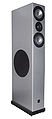
Loudspeaker system

Subscriber loudspeaker

Outdoor loudspeakers
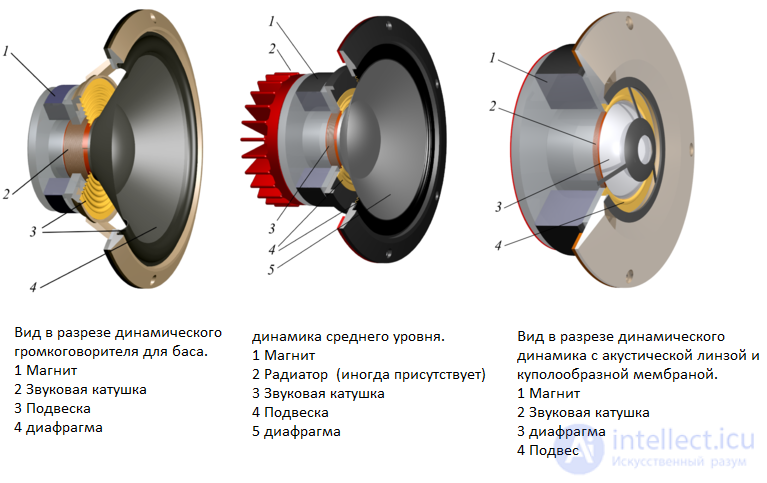
The main working element of an electrodynamic loudspeaker is the cone (diaphragm), which converts mechanical vibrations into acoustic ones. The loudspeaker cone is set in motion by a force acting on a coil rigidly attached to it and located in a radial magnetic field. An alternating current corresponding to the audio signal that the loudspeaker is to reproduce flows in the coil. The magnetic field in the loudspeaker is created by a ring-shaped permanent magnet and a magnetic circuit consisting of two flanges and a core. Under the action of the Ampère force, the coil moves freely within the annular gap between the core and the upper flange, and its vibrations are transmitted to the cone, which in turn creates acoustic vibrations propagating in the air medium.
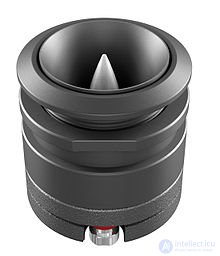
Hertz ST 25 car compression-horn high-frequency loudspeaker
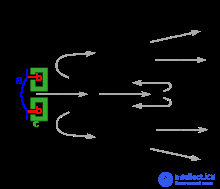
Structure of a horn loudspeaker used in megaphones and outdoor public address systems
Horn loudspeakers are most often used when high loudness is required but high sound quality is not — in that case it is enough to build a compact horn loudspeaker that develops considerable sound pressure at low input power (and therefore has high efficiency).
A horn loudspeaker consists of a direct-radiation electrodynamic driver and a horn. It is most often used in megaphones for public address at outdoor mass events (in parks, streets and squares), as an outdoor device for mass notification at industrial facilities, and for radiating alarm signals; a network of such loudspeakers is at the disposal of civil defense and emergency units. In the past they were used in multiband acoustics, mainly in the film industry, to reproduce mid and high frequencies from 1000 to 20 000 Hz, but horn loudspeakers were later abandoned in this role, because it is difficult to achieve high sound quality with horn loudspeakers of small size. Such loudspeakers are unsuitable for lower frequencies, since they would require a horn of excessive size.
Nowadays horns with compression drivers are sometimes used in the consumer Hi-Fi industry (Klipsch, Cerwin-Vega!), in professional audio (JBL Pro), and are also quite widespread in the niche of so-called Hi-End Audio — exclusive audio equipment for home use (Avantgarde Acoustic, Acapella Audio Arts, Cessaro), where large spherical horns are most often used in the high- and mid-frequency ranges, while the low frequencies are handled by an active bass unit built on dynamic drivers (although there are examples of fully horn-loaded systems across the entire audible frequency range). Such products are exclusive and are distinguished by extremely high cost[1].
Alexander Graham Bell patented his first electromagnetic driver (capsule) as one of the components of his telephone in 1876-1877. In 1878 the design was improved by Werner von Siemens. Nikola Tesla also claimed the invention of a similar device in 1881 but did not patent it. At about the same time, Thomas Edison obtained a British patent for a system that used compressed air as a sound amplification mechanism in his early cylinder phonographs (see siren (acoustics)), but ultimately installed an ordinary metal horn in which the air vibrations were produced by a diaphragm connected to a stylus. In 1898 H. Short patented a design of a loudspeaker controlled by compressed air, and then sold the rights to Charles Parsons, who had earlier obtained several more British patents by 1910.
Several companies, including the Victor Talking Machine Company and Pathe, produced players that used heads driven by compressed air. However, such devices (indirect-radiation heads) found only limited use because of poor sound quality and their inability to reproduce low-volume sounds. Variants of such systems were used in public address installations (for large areas, stadiums, etc.) and, much more rarely, in industry, in test equipment such as vibration test stands, for example for testing space hardware for resistance to the low-frequency vibrations produced by a launching rocket.
The modern moving-coil driver design was developed in 1898 by Oliver Lodge. The principle was patented in 1924 by Chester W. Rice and Edward W. Kellogg.
The first drivers with electromagnets were very large, while powerful permanent magnets were hard to obtain because of their considerable cost. The electromagnet winding, called the field winding, is magnetized by the current passing through another winding of the driver (the bias coil). This arrangement has a dual role, since it also filters the voltage supplying the amplifier to which the given loudspeaker system is connected. As it passes through the winding, the AC hum is amplified; however, the AC frequencies tend to modulate the audio signal fed to the voice coil and add to the audible noise of the connected sound reproduction device.
The quality of loudspeaker sound reproduction systems was comparatively low until the early 1950s. The continuing improvement of enclosure design and materials has led to a substantial improvement in sound reproduction quality. The most significant improvements are: an improved frame, the discovery of high-temperature adhesive bonding technology, improved manufacturing technology for permanent magnets, improved measurement techniques, and finally the computer-aided design and analysis of components.
The design of low-frequency loudspeakers (woofers), both of the whole structure and of its individual elements, is based on special requirements, the main ones being as follows:
To meet such requirements, the design of woofers pays great attention to the structural and technological development of all elements: the surround, the spider, the cone, the dust cap, the voice coil, the flexible voice coil leads, the magnetic circuit and the cone holder (basket).
The number and power of loudspeakers are calculated from the geometric parameters of the room. As a rule, only the area of the part of the room where the listeners are located is taken into account.
In enclosed rooms it is recommended to install ceiling loudspeakers, since they make it possible to achieve the most uniform sound distribution. When providing sound coverage for galleries, corridors and open areas, horn loudspeakers are used because of their high sound directivity and high efficiency.
When designing sound coverage for rooms, it must be taken into account that the sound wave from a ceiling loudspeaker at the height of the listeners' ears covers an area whose radius is taken to be the difference between the mounting height of the loudspeaker and the distance from the floor to the listeners' ears. For uniform sound coverage of a room, the loudspeakers should be installed so that these areas overlap each other slightly.
For ceiling heights up to 5 m, the required number of ceiling loudspeakers is calculated using simplified formulas. The distance between loudspeakers must not exceed the calculated value; otherwise the sound pressure will be distributed unevenly, and in some areas of the room the sound quality from the loudspeakers may deteriorate significantly. If the sound power is increased in this case, not only does the useful loudness rise, but the level of the reverberation background (echo) also increases. To compensate for this effect, the floor and walls of the room are covered with carpets or other sound-absorbing materials.
Another problem is related to placing loudspeakers in rooms with high ceilings. Closely spaced loudspeakers are a source of strong interference for each other. If the loudspeakers are placed farther apart and the sound power is increased, the reverberation background will rise. In such cases the loudspeakers are often lowered on cords, or wall-mounted loudspeakers are installed — flush-mounted or column type.
In corridors, galleries and other elongated rooms, horn loudspeakers are recommended. Such loudspeakers are placed in the middle of the corridor and aimed in opposite directions. The range of a horn loudspeaker is several tens of meters
The efforts of loudspeaker diaphragm designers are directed at a single goal: increasing the stiffness of the cone while at the same time reducing its mass. If the cone turns out to be too heavy and too soft, it cannot follow the motion of the voice coil accurately. It simply does not have time to fully deflect and return, and bending vibrations give rise to extraneous tones and additional coloration of the sound. It is therefore highly desirable that the natural resonances be small or lie outside the working frequency range.
The classic materials for making a cone (diaphragm) are cellulose for low-frequency drivers and silk for high-frequency ones. Today, however, plastic, metal and other exotic materials are also widely used.
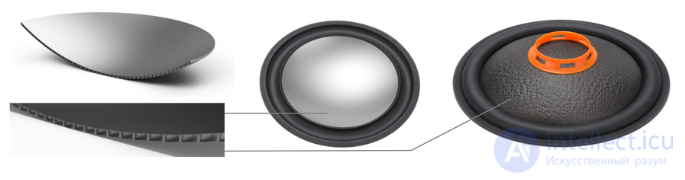
Construction of a cone made with RDT II technology
Hybrid designs deserve separate mention: for example, an aluminum polygonal cone attached to a base of the familiar paper cone (ELAC Concentro AS-XR). Another "sandwich" variant is a honeycomb aramid core with an inner layer of carbon fiber and an outer layer of aluminum-magnesium alloy with a ceramic coating (Monitor Audio Platinum RDT II). Compared with traditional "homogeneous" solutions, such a "composite" diaphragm is light, strong and able to respond to the signal faster without deforming.
Reproducing the whole range of sound with a single driver is practically impossible, which is why a wide variety of multi-way designs appear, consisting of several drivers, each responsible for its own frequency band of the overall sound picture. However, such systems use crossover filters, and in their operation an undesirable effect may occur: drivers of different bands can start working out of sync, with one lagging behind another.
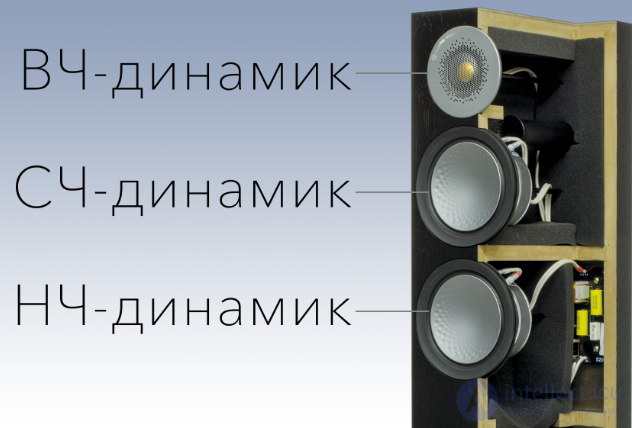
A loudspeaker system of classic multi-way design
Developments of full-range drivers that need no crossover still do not give acceptable results: in fact, none of such designs is free of limitations, both at the edges of the frequency response (which leads to distortion of the lowest and highest frequencies) and in overload capacity (the ability of the speaker to adequately reproduce a musical signal at high volume).
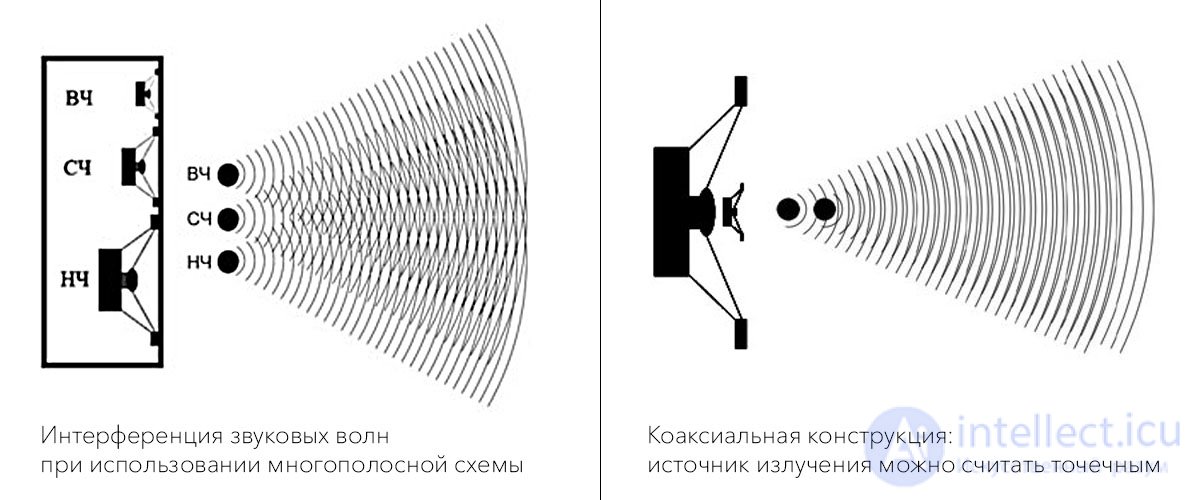
Another problem of a multi-way design, caused by the spatial separation of the drivers that reproduce sound waves of different ranges, can be interference wave distortion (reinforcement of sound oscillations at some points in space and their attenuation at others as a result of the superposition of two or more sound waves), familiar to us from school physics.
The coaxial driver design helps to deal with this problem; it places the tweeter on the acoustic axis of the woofer. It can be called a sort of intermediate variant between an ordinary multi-way system and a full-range radiator: the speaker still contains a crossover, but the radiation source can be considered a point source.
|
Given the age of the dynamic radiator concept and, as a consequence, the experience and knowledge accumulated about it, today it is something like a CRT television on the verge of the arrival of plasma (or like the internal combustion engine on the eve of the arrival of Tesla). It is clear that new technologies will sooner or later win (more on this below), but for now they are only at the beginning of their path, while the dynamic driver is at its peak. So if you need loudness and no distortion, and preferably also a wide frequency and dynamic range (the difference between the quietest and loudest sounds the system can reproduce), there can be only one answer: the classic multi-way cone design. |
Most often these are various film radiators, primarily ribbon and electrostatic ones. A metal or metallized ribbon has extremely low resistance, so to work with an amplifier it requires a matching transformer with a wide frequency response and low losses, while the large radiating surface area implies a large number of powerful bar magnets, which significantly increases the cost of the finished product.
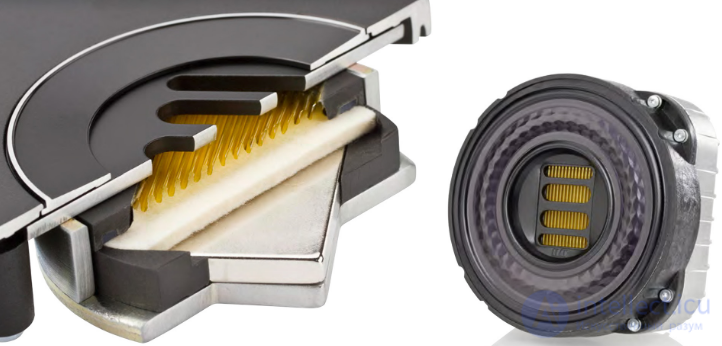
Cross-section of a ribbon driver
An isodynamic (planar magnetic) radiator is a variant of the ribbon one: a conductive track in the form of a meander is deposited on the film, and its length raises the resistance to acceptable values. If the film is folded like an accordion, the result is a Heil radiator, whose advantages include greater strength (thanks to stiffening ribs) and loudness (owing to the larger radiating surface area). Such HF radiators are used in some ELAC speakers.
In electrostatic radiators the film is fixed between perforated stators; a high voltage is applied to them, and the resulting electrostatic field moves the membrane.
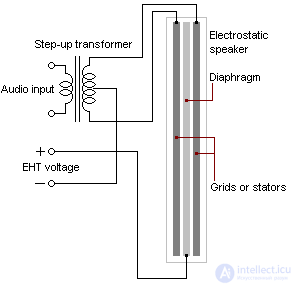
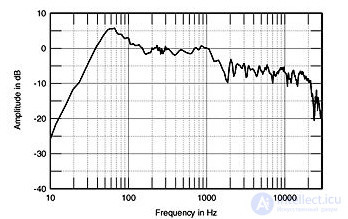
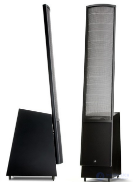
Loudspeaker systems with electrostatic radiators, their frequency response and appearance
The advantage of film radiators is a relatively low level of nonlinear distortion; their drawbacks are a complex load for the amplifier and a narrow, dipole radiation pattern, but most importantly an obvious lack of low-frequency output. Attempts to solve this problem with hybrid schemes using a cone LF section reveal another feature of the film: it is a line source of sound with a flat wavefront. A dynamic driver, by contrast, is a point source with a spherical wavefront. In the first case the sound pressure level drops by 3 dB when the distance doubles, in the second by 6 dB.
There are also far more exotic radiators, for example the rotary subwoofer or the ionophone. But their specialization is narrow frequency response ranges.
The sound wave we hear is produced by the vibration of the driver's cone. For correct reproduction, the sound pressure must be the same for all audible frequencies. However, the fundamental problem of all drivers is that they radiate sound both forward and backward with the same intensity. To eliminate this problem, an acoustic enclosure is created for the driver, that is, it is placed in a cabinet.
The horn (a continuously widening tube) has been a natural means of amplifying sound since ancient times, with very high efficiency. However, its cross-section grows exponentially, and the lower the reproduced frequency, the larger the mouth opening must be: already at 60 Hz a flare 1.8 m in diameter is required!
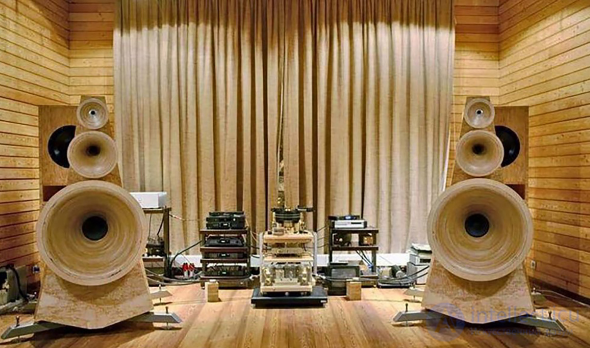
Horn loudspeaker systems can astonish with their dimensions
In addition, there is a characteristic horn coloration of the sound, especially noticeable in vocal parts. These drawbacks can be overcome only in very expensive and bulky designs.
The ideal design of a loudspeaker system is called an infinite baffle. It implies that the air behind the cone does not impede its motion and, at the same time, the radiation of this rear side has no effect on the radiation of the front side, which is in antiphase with it. In other words, in practical implementation it is a closed box of such a volume that the influence of the air inside it on the cone's movement can be neglected.
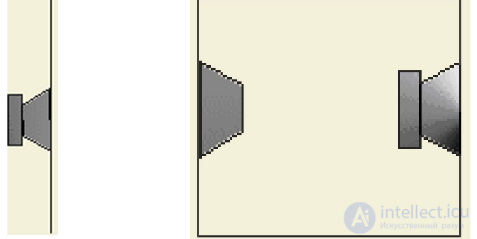
Infinite baffle and the isobaric scheme
When they are connected to the amplifier in parallel, the load on the rear side of the outer driver's cone will be compensated by the corresponding vibrations of the outer side of the inner driver's cone. This variant of acoustic enclosure is called isobaric. The downsides? Twice as many drivers are needed for the speaker, and it is twice as hard for the amplifier to work with two drivers.
a labyrinth lined with sound-absorbing material. This acoustic design is also called a quarter-wave resonator (recall the Cambridge Audio R50 speakers), for the simple reason that, to work effectively down to a certain frequency, its length must be at least a quarter of the wavelength at that frequency; for the coveted 20 Hz, for example, that is more than 4 m. In this case an ordinary enclosure turns into a genuine piece of cabinetmaking, with the cost that follows from it.
whose operating principle is reflected in its name. A tube of precisely calculated length and diameter installed in the speaker enclosure inverts the phase of the radiation from the rear of the driver until it matches the phase of the radiation from the front.
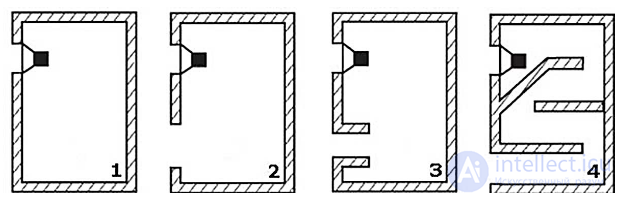
The most common types of acoustic enclosure: closed (1), bass-reflex with a simple opening (2), bass-reflex with a tube (3), labyrinth (4)
Sometimes, to minimize possible noise from the airflow through the port, it is closed off with a passive radiator, that is, effectively yet another driver, but without a magnet system.
All the other nuances described above matter only if you are confident that you interpret them correctly for yourself. In other words, you can choose speakers based on, for example, the diaphragm materials or the design of the crossover filters, but only when their effect on the sound you are looking for is perfectly clear to you.
Naturally, evaluating the sound requires personal experience of listening to a particular model. And if you set realistic goals, I would allow two to three weeks for the preparatory stage and put in the roadmap visits to showrooms for no more than five samples that appeal most to you personally. Choosing among dozens of different speaker models risks turning into an endless carousel, so it makes sense to set strict price and functional limits for yourself from the start and act strictly within them.
Sound quality is undoubtedly the main, but not the only, criterion of evaluation. Be sure to pay attention to the appearance of the speakers: the aesthetic component also plays an important role. And loudspeakers that blend harmoniously into the interior of a room and sound good will give their owner more pleasure than excellent-sounding but absurd-looking samples.

Comments