
Lecture
The physiological and psychological neoformations of kittens are a fascinating process that begins right after birth and continues throughout their early development. On the first day of life, newborn kittens are completely dependent on their mother: their eyes are closed and their movements are limited. The main sources of information about the world are tactile sensations and smell. They immediately begin to look for their mother, sensing her warmth and scent. Kittens start to suckle actively, receiving important nutrients for growth.
On the second or third day one can notice that kittens begin to make their first sounds, quiet squeaks that serve to communicate with the mother and to express hunger. Physically, their bodies begin to adapt to the external environment, especially the digestive and respiratory systems. By the fifth to seventh day kittens become a little more active and begin to move in search of their mother, improving their basic motor skills. During this period they are still blind and completely dependent on the mother.
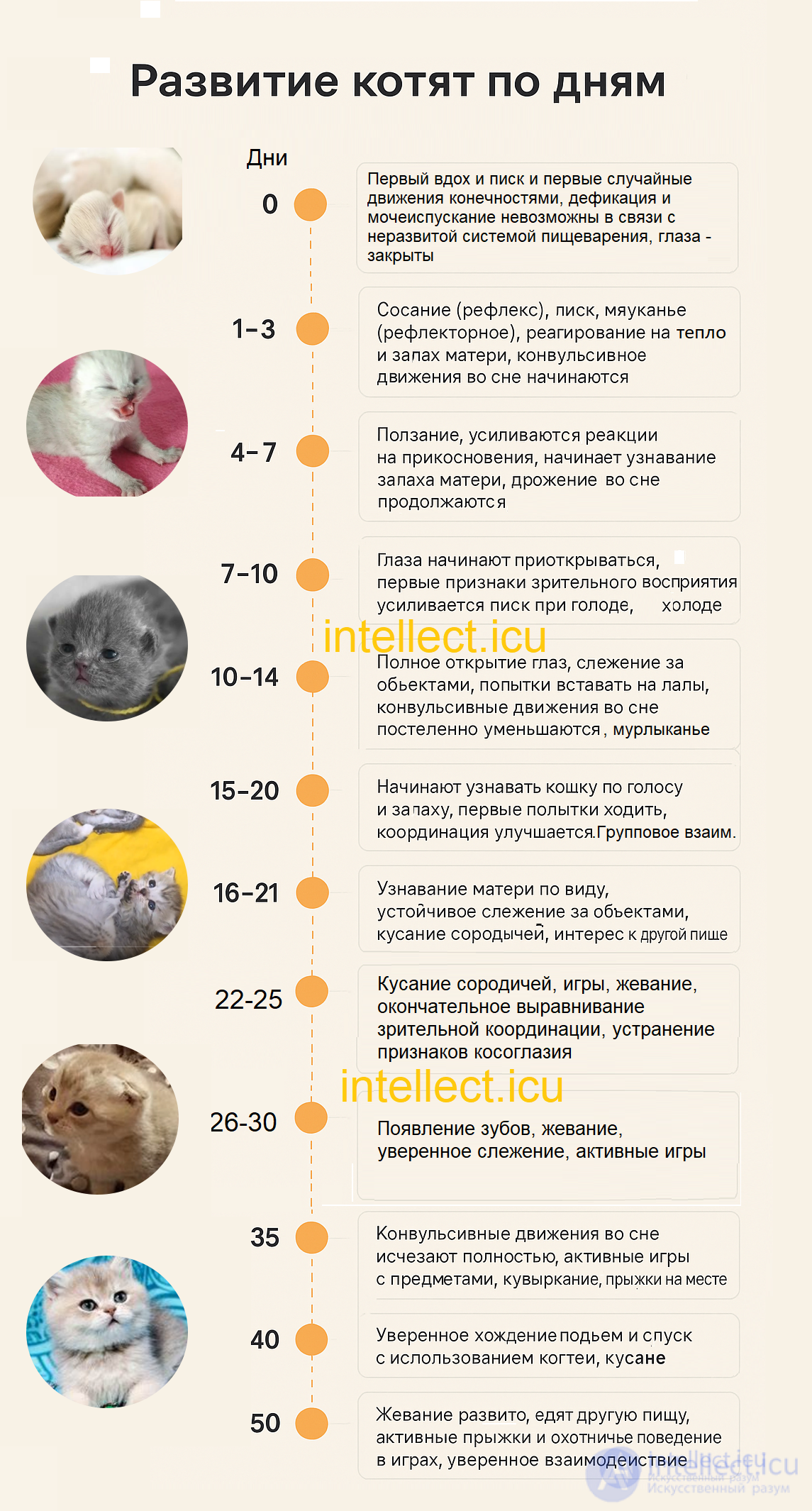
In the second week of development the physiological changes become more noticeable: the eyes open, although vision is still very weak. Kittens begin to develop hearing actively and to orient toward new sounds. This is an important stage for their future perception of the world. In psychological terms, kittens begin to interact more with their littermates, which promotes their socialization.
By the third week kittens begin to try their first unsteady steps. Vision improves, and they begin to be aware of the space around them. An interest in surrounding objects appears, and an exploratory instinct forms. By the fourth week their physiological development allows them to show the first signs of independence, such as attempts to leave the nest. Psychologically, kittens become more curious and begin to play with one another, which helps develop communication skills.
|
Day of the cat's life |
Analogy with human age |
Neoformations | Problems |
|---|---|---|---|
| 1–10 | 1–14 days | Fertilization and implantation in the cat. Fertilization, attachment of the embryos to the uterus. Symptoms are almost unnoticeable. | Embryo resorption is possible under stress or illness |
| 11–20 | 3–8 weeks | Early stage of pregnancy in the cat. Slight drowsiness, reduced activity, possible nausea. The nipples turn slightly pink. | False pregnancy, toxicosis, loss of appetite. |
| 21–30 | 9–12 weeks | Formation of the fetuses in the cat. The belly enlarges, behavior changes, and the cat becomes more affectionate. |
Exposure to toxins (for example anthelmintic or anti-flea preparations) can lead to the death or disability of the fetuses because of elevated estrogen levels, coat density increases |
| 31–40 | 13–24 weeks (2nd trimester) | Middle stage of pregnancy in the cat. Clear enlargement of the belly; the kittens can already be felt by palpation. Increased appetite. | Insufficient nutrition leads to delayed development of the fetuses. Exposure to toxins can lead to the death or disability of the fetuses |
| 41–50 | 25–36 weeks | Late stage of pregnancy in the cat. The kittens move actively, and the cat looks for a quiet place. | Constipation is possible, as well as strain on the heart and kidneys. White stool and a small |
| 51–63 | 37–40 weeks | Prepartum period in the cat. The cat actively looks for a secluded place (a burrow, a crevice, some enclosed space under something). Reduced appetite, the cat prepares a "nest," vaginal discharge (odorless and colorless). Milk may appear. | Premature birth, complications in multiple pregnancy. |
|
63-65 (58–72) |
38–42 weeks, 9th month | Birth in the cat. Contractions begin, and the cat usually gives birth on her own. | Delayed labor, weak labor activity, a kitten becoming stuck. A drop in the cat's estrogen leads to hair loss |
| 0 | 0 |
rupture of the afterbirth and umbilical cord, first breath and squeak, and first random movements of the limbs; defecation and urination are impossible because of the undeveloped digestive system; eyes are closed |
absence of independent thermoregulation (the temperature must be maintained at 28-32 degrees) the mother's milk may dry up (so you need to keep a supply of powdered milk for the kittens), or the kittens may lose their appetite; feeding every 2-3 hours in the mother, maximum stretching and tension of the uterus |
| 1–3 | 0.2 years | Suckling (reflex), squeaking, mewing (reflexive), reaction to the warmth and scent of the mother, onset of convulsive movements during sleep, uncontrolled urination especially after stimulation by the mother, first sounds made in protest and discomfort (squeaks), first purring sounds expressing satisfaction of needs | |
| 4–7 | 0.3 years | Crawling, reactions to touch, recognition of the mother's scent, trembling and twitching during sleep continue, first reactions to sound (the appearance of hearing), appearance of natural pigmentation on the nose and ears in dark-coated individuals, darkening of the coat in dark-coated individuals | bloody vaginal discharge may begin in the mother |
| 7–10 | 0.5 years | The eyes begin to open slightly, weak visual perception, signs of temporary strabismus may be observed, formation of independent thermoregulation, less frequent feeding every 3-5 hours | eye infection in kittens; in the mother, normalization of stool color and shape |
| 10–14 | 0.7 years |
Eyes fully open, vision develops but the image is blurred, tracking of objects with errors, attempts to stand on the paws, strabismus gradually decreases as the eye muscles strengthen. Purring begins (at first during contact with the mother cat while feeding) |
undernutrition or overeating with corresponding poor results |
| 15–20 | 0.8 years | Recognition of the mother cat by voice and scent, start of confident walking, improved coordination, group interaction, body mass doubling (compared with the newborn), display of affection for the mother cat | |
| 16–21 | 0.9 years | Independent urination and defecation, recognition of the mother by sight, interest in other food, appearance of milk teeth, freezing and watching objects that make loud sounds, first simple games (waving the paws in place), no change in the direction of gaze following a moving object | |
| 21–25 | 1 year | Biting littermates, play, chewing, final alignment of visual coordination, disappearance of signs of strabismus, the kitten needs to be trained to use the litter box | |
| 26–30 | 1.2 years | Appearance of all the teeth, chewing, confident tracking, active play, a person needs to play with the kitten so that it gets used to people, licking (grooming) | in the mother, restoration of the size of the uterus |
| 30–35 | 1.2–1.4 years | Disappearance of convulsive movements during sleep, jumping, tumbling, less sleep, the coat forms: the undercoat becomes thicker, the pattern appears, and the lines become sharper. | swallowing of dangerous inedible objects is possible |
| 36–40 | 1.4–1.6 years | Confident climbing up and down with claws, active play with toys | |
| 41–50 | 1.6-2 years |
Full mastery of eating skills, well-developed motor skills, confident behavior in the environment. appearance of a feeling of fright and fear without aggression, jumping, grabbing food and trying to hide it, hiding, running |
|
| 50-60 | 2–2.5 years |
The kitten no longer needs its mother's milk, can hunt on its own, eat anything, and use the litter box if trained to. a sense of caution appears, of the snake-worm type; near the edge of a height, stretching the head out to get a view; hide-and-seek games with littermates. in 20% of kittens growling appears on the "mine, I won't give it up" principle; group play is hunting |
|
| 60-90 | 2.5-3.5 years | knows all the locations, responds to its name and other sounds, can be given to other people, re-education is very difficult, first vaccinations are needed | |
|
90-120 (4 months) |
3-6 years | can bite and scratch hard, milk teeth are replaced by permanent teeth | |
| 5-6 months | 6-8 years | feline adolescence, milk teeth are completely replaced by permanent molars | |
| 7 months | 8-9 years | sexual maturity: males begin to mark territory, females may have their first heat | |
| 8 months | 10 years | activity declines, and they cannot yet produce full-fledged offspring. The coat is soft and shiny, with no alopecia or matting | |
| 9-12 months | 15 years | muscles - pronounced definition; gracefulness and ease of movement; increased activity, endurance. | |
| 1-2 years | 25 years | weight stops increasing, activity declines, reproductive age. By the age of two, cats have formed a full set of vital behavioral skills, including survival mechanisms and reproductive behavior. The incisors of the lower jaw begin to wear down | |
| 2-5 years | 25-36 years |
The cat is at the peak of physiological development, is in good health and highly active, has full reproductive capacity and is able to repeatedly produce viable offspring. The enamel turns yellow, and traces of deposits appear. The incisors of the lower jaw are very noticeably worn Until about 7 years the coat is in excellent condition: smooth, fluffy, with a good pattern. |
|
| 5-10 years | 35-55 years | still retains robust health and has no pronounced chronic diseases. It has sufficient energy potential, yet is calmer in behavior and has a more mature perception of its surroundings, which indicates formed behavioral adaptation and accumulated life experience. Wear begins to show on the canines, and dark spots appear on the enamel. After about 7 years the remaining incisors are completely worn down. Canines in poor condition Canines in poor condition |
|
| 10-14 years | 55-72 years |
the animal becomes less mobile |
chronic or hereditary diseases appear with improper nutrition. Tolerates moving house, children and any changes poorly. The iris of the eyes may be: clouded; speckled; with uneven, blurred edges; with a faded color, leukoma or cataract. The coat is dull and thinned. Matting and signs of alopecia often appear. Half of the teeth are lost |
| 15 years and older | more than 74 years | decline in cognitive functions, manifested as worsening memory, slowed reaction to external stimuli, disorientation in space, and a changed sleep-wake cycle. The animal may show signs of anxiety, behavioral disorders, reduced interest in its surroundings and reduced social activity. These age-related changes are often comparable to cognitive dysfunction syndrome, similar to senile dementia in humans. The canines fall out | |
* All the numerical values given are averages and may vary considerably depending on the breed. The lifespan of cats is also influenced by factors such as the presence of diseases, the quality of the diet, and hereditary predisposition.
By the fifth or sixth week, kittens are already quite active, and their motor skills improve significantly. They begin to eat soft food, gradually giving up milk. Psychologically they become more confident and develop their personalities, exploring the world and interacting with people. At this stage trust in humans forms, if they are petted enough and given enough attention.
By the eighth week, kittens are ready for independent life. They play actively, run, and explore their territory. Their vision and hearing are fully developed, and physiologically they are able to eat solid food. Psychologically, kittens develop attachment to the people and animals around them and begin to show individual character traits.
This process of growth and development is full of changes that underline the uniqueness of each stage. Kittens turn from helpless babies into independent, curious creatures with a vivid character. Every day brings something new into their lives, forming the foundation for adult life.
Kittens learn and develop through many kinds of learning, depending on their age. Here are the main ones:
Imprinting in kittens begins in the first days of life, when they remember their mother by her smell, warmth and sounds. This process is especially active in the first weeks of life, since it helps the young identify the source of protection and food.
Imitation and mimicry (from 2 to 8 weeks):
By watching their mother and other kittens, the young copy their actions, for example how to groom themselves, play or interact with the world around them. This helps them acquire basic behavioral skills.
Imitation becomes noticeable a little later, from about 2-3 weeks, when kittens open their eyes and begin to see the world around them. At this point they begin to copy the mother's behavior: grooming the coat, finding their way around in space, and interacting with other kittens. Imitation develops and strengthens as they grow up and actively explore the world. This way of learning is especially active up to 8 weeks, while kittens depend on their family, and later becomes the basis for further behavior and adaptation.
Play (from 3 weeks onward):
Play is the main way kittens learn, and it continues throughout life. Through games they develop motor skills, the exploratory instinct and socialization. For example, chasing moving objects trains hunting reflexes.
Learning through the environment (from 4 weeks onward):
Kittens actively explore space, interacting with objects and encountering different situations. This helps them learn to adapt to change.
Feedback (from 6 weeks):
Kittens learn through reactions to their actions: if something is forbidden or rewarded, they remember what is and is not allowed.
Learning through interaction with people (from 5 weeks):
Petting, communication and play with people help kittens adapt to living together with humans. The more positive moments there are, the easier the process of bonding.
Trial and error (from 6 weeks onward):
The trial-and-error method lets kittens find out how best to get to food, a toy, or to overcome an obstacle. This develops resourcefulness.
Learning in kittens is a multilayered process that lays the foundation for their behavior and interaction in adult life. Each stage of development is unique and gives the kitten new skills needed for further growth.

Comments