
Lecture
Electroantennography, the electroantennogram (or, in English, "Electroantennography", abbreviated EAG), is a method of measuring the electrical potentials that arise in the antennae of insects or in the sensitive palps of animals in response to chemicals such as pheromones or other chemical compounds spread in the air or on a surface. Electroantennography ( electroantennography ) is an electro-olfactographic study of action potentials in the antennae (antennae, Latin for feelers, tentacles) of insects, carried out, for example, to explain the mechanism of odor perception or in research of practical significance, such as preparing pheromone traps, or building biomonitoring systems.
Electroantennography (EAG) is a method of recording electrical potentials from insect antennae. These potentials provide information about the olfactory perception of insects. The EAG method records "slow" potential changes caused by the summation of simultaneous membrane depolarizations of numerous receptor cells. The EAG signal of an insect antenna responding to a short (<0.5 s) odor stimulus usually lasts for several seconds.
In many insects the antennae play an important role in sensing the environment, especially when it comes to communication with other individuals of the same species. Pheromones, which are usually used for communication between individuals of the same species, can evoke electrical signals in insect antennae, which are perceived by the nervous system and interpreted as information about various aspects of the environment, such as mating, danger or food availability.
Electrophysiology is the study of the electrical properties of biological material, such as all types of nerve cells, including the peripheral sensory receptors of insects. Insect antennae carry a large number of sensilla and are the main site of olfaction in most insects. Electrical recordings can be made either from individual sensilla on the antenna (single-cell recordings) or from the whole antenna (electroantennogram) (as explained by Rumbo, 1989)
Insect antennae are part of their olfactory system, made up of neurons that receive information about the chemical composition of the air (chemical stimuli). The cell membrane of the neurons contains specialized proteins, including odorant receptors and ion channels. Voltage-gated ion channels are responsible for generating and transmitting the nerve impulse, i.e. the signal that a receptor-odorant complex has formed.
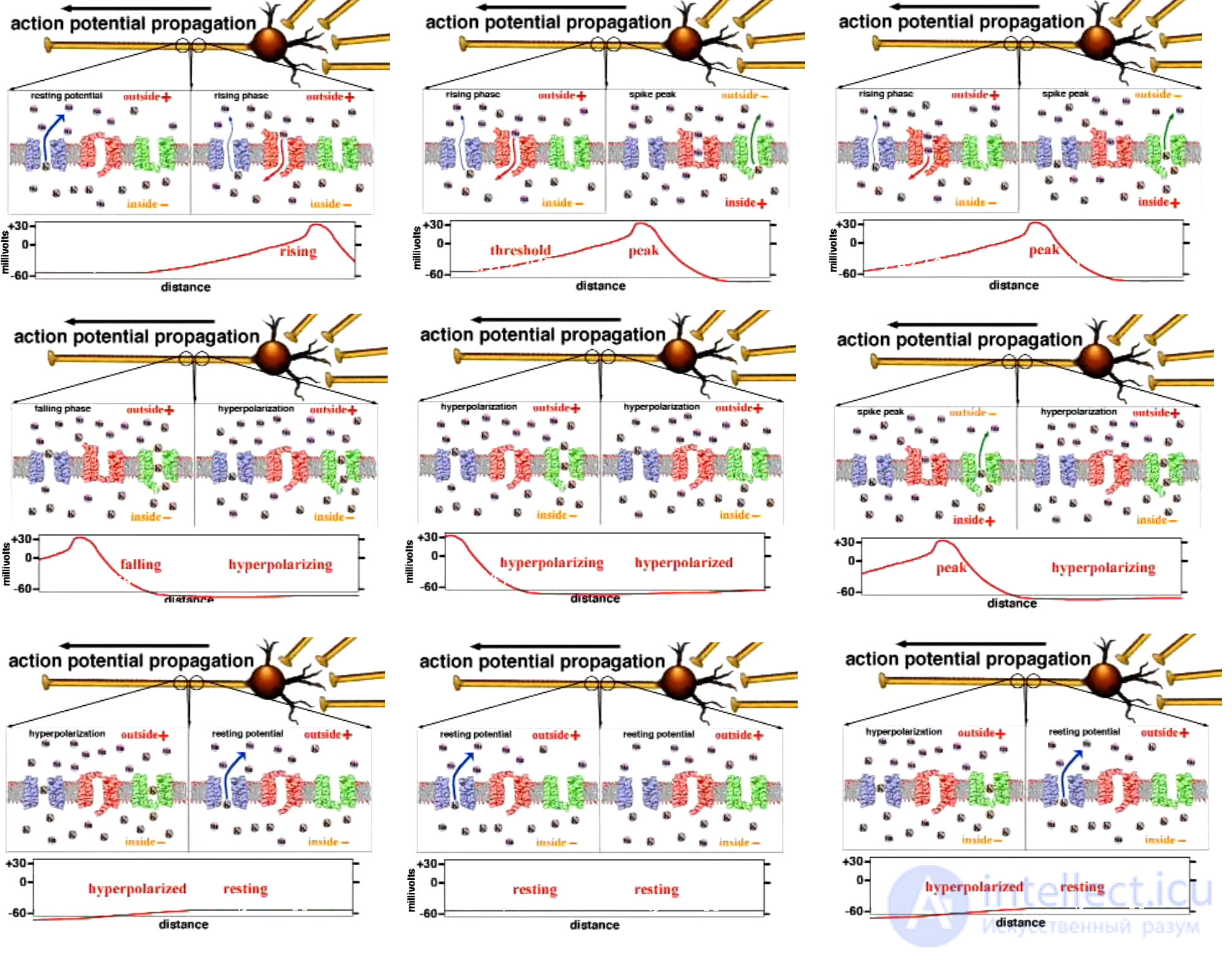
Movement of the membrane depolarization zone
Through the open channels ions such as Na + , K+ , Cl - and Ca 2+ diffuse in accordance with the concentration gradient. This causes changes in the electrical membrane potential. When the threshold potential is reached, an action potential (spike) is generated, which is sent to the supraesophageal ganglion (brain) and makes it possible to recognize the stimulus and the corresponding response (see reflex )
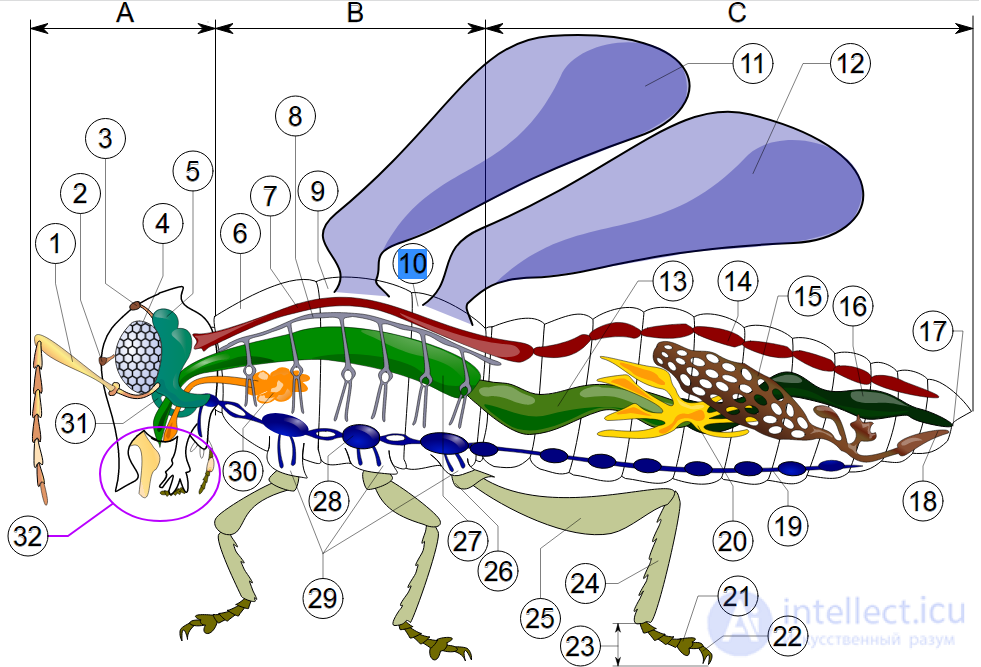
Parts of the olfactory organ in the insect body:
1 — antennae , 5 — supraesophageal ganglion (brain)
Electroantennography is usually performed either by removing the antenna from the animal and inserting two chloridized silver wires to make contact at its two ends and amplifying the voltage between them, while applying an odor puff to see the deflection, as in the figure, or by leaving the animal intact and introducing a ground wire (silver/silver chloride) or a glass electrode filled with a buffer solution into some part of the body, usually inserted into the eye, and the other to the tip of the antenna. A glass electrode with a large opening can also be placed directly over the tip of the antenna, for example when recording from the antenna of Drosophila melanogaster (the fruit fly). The latter method is useful if an experiment on the whole animal is being carried out while the antennogram is being built.
This method is widely used in screening insect pheromones by studying the response to fractions of a mixture of compounds separated by chromatography. Usually the wire inserted into the antenna is a thin silver wire chloridized in bleach. This is an old practice. Usually chemically sharpened tungsten wires are inserted into a single neuron of the antenna. Further detailed study of the odor response at the olfactory sensory level can be carried out by recording from sensilla.
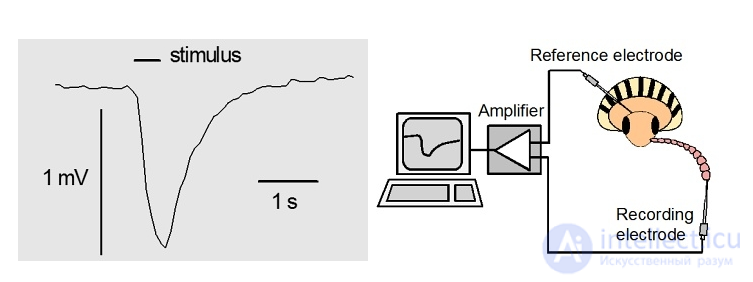
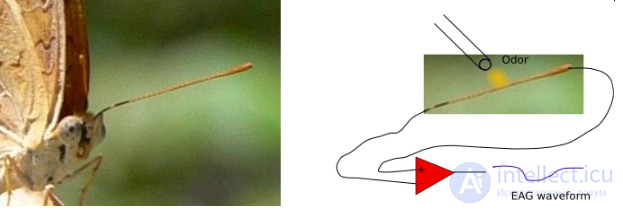
Setup for an antennogram
Potentials are measured in the extracellular hemolymph inside the antenna. To do this, one electrode must be connected to the distal end of the antenna. The second electrode is connected to the other end of the antenna or to the insect's head. The potentials are amplified by a high-impedance amplifier (usually 100-fold).
In conjunction with gas chromatographic separation, the insect antenna can be used as an "electroantennographic detector" (EAD).
Multidimensional EAG, a new method of using the selectivity of insect antennae for analyzing complex mixtures of odorants, is based on the presence of different populations of group-specific olfactory receptor molecules within a single antenna. Different odor qualities are represented by orthogonal vectors, and their mixtures by sums of vectors in a multidimensional "odor space". This method was developed and validated using the antennae of the widely known and readily available Colorado potato beetle and a special biosensor system. The possibilities and limitations of the multidimensional EAG approach to the qualification and quantification of odor are investigated by analyzing mixtures of artificial odorants and samples of natural odors.
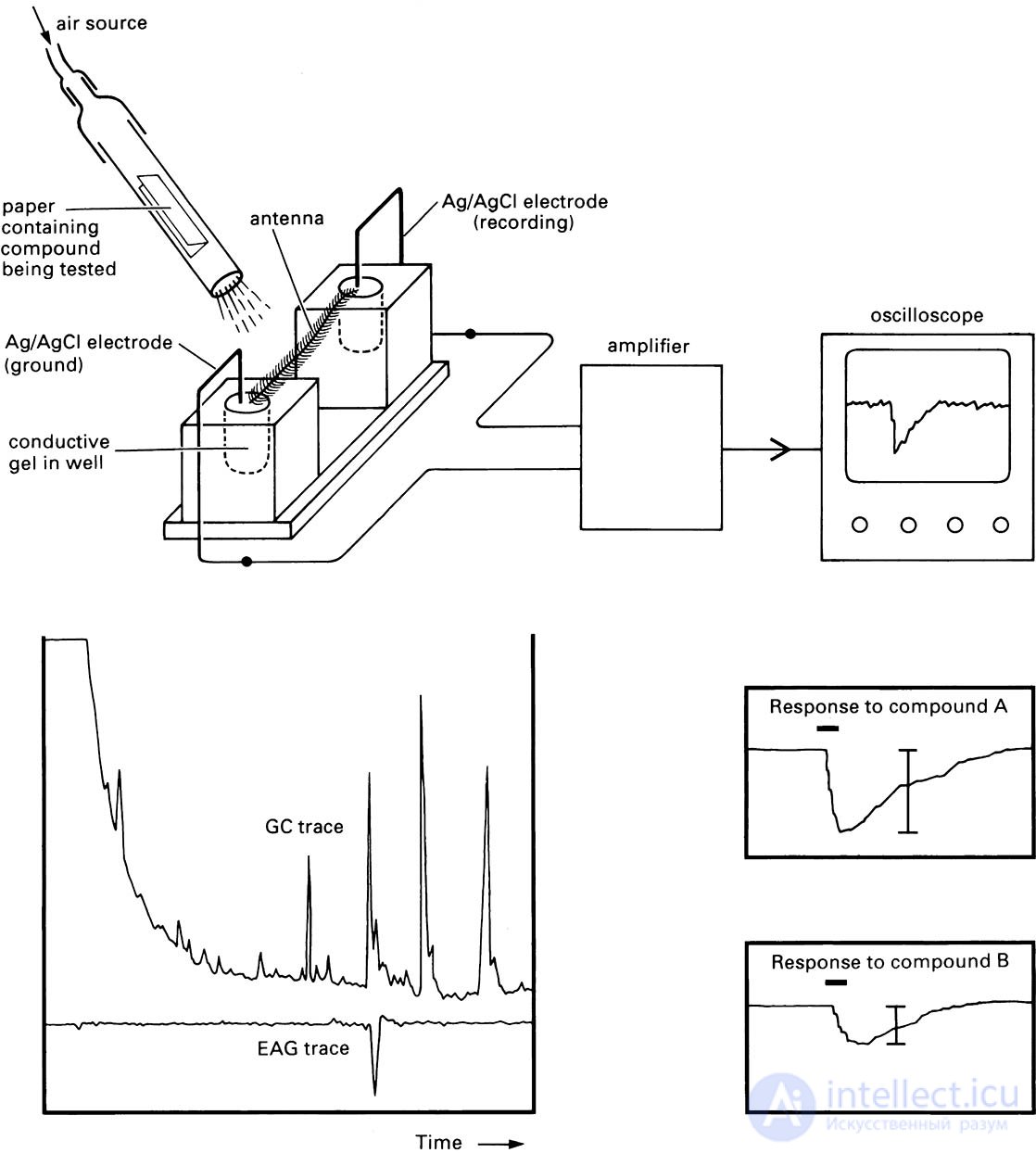
The electroantennogram (EAG) method measures the overall response of the receptor cells of an insect antenna to particular stimuli. Recordings can be made using an antenna that is either excised or attached to an isolated head or to the whole insect. The illustrated example evaluates the effect of a particular biologically active compound (a pheromone) blown onto an isolated antenna of a male moth. A recording electrode connected to the tip of the antenna detects an electrical response, which is amplified and visualized as a trace, as in the EAG setup shown in the upper figure. Antennal receptors are very sensitive and specifically perceive certain odors, such as the sex pheromones of potential conspecifics or volatile chemicals emitted by the insect's host. Different compounds usually evoke different EAG responses from the same antenna, as shown by the two curves in the lower right corner. which is amplified and visualized as a trace, as in the EAG setup shown in the upper figure. Antennal receptors are very sensitive and specifically perceive certain odors, such as the sex pheromones of potential conspecifics or volatile chemicals emitted by the insect's host. Different compounds usually evoke different EAG responses from the same antenna, as shown by the two curves in the lower right corner. which is amplified and visualized as a trace, as in the EAG setup shown in the upper figure. Antennal receptors are very sensitive and specifically perceive certain odors, such as the sex pheromones of potential conspecifics or volatile chemicals emitted by the insect's host. Different compounds usually evoke different EAG responses from the same antenna, as shown by the two curves in the lower right corner.
The earliest measurements of the electrical activity of single neurons (John Zachary Young, 1937) concerned the axons of giant squid . In the 1940s they were the subject of research aimed at explaining the mechanism of impulse transmission in the nervous system . Besides JZ Young, this work was done by KS Cole and HJ Curtis ( J. Gen. Physiol. 1938; J. Cellul. Comp. Physiol. 1942), GJ Marmont ( J. Cellul. Comp. Physiol. (1949) and AL Hodgkin , AF Huxley and BJ Katz ( Arch. Sci. Physiol.1949 and others). Hodgkin, Huxley and Katz inserted a glass rod (600 µm in diameter) on which two silver wires (20 µm in diameter), insulated from each other and coated with silver chloride, were wound in a spiral. Both electrodes were connected to ring-shaped electrodes placed outside the axon, one of them through an external voltage source and the other through an ammeter. They measured the intensity of the current flowing radially in the nerve after voltage pulses of various magnitudes lasting about 10 µs. A model was developed of a cell membrane undergoing polarization and depolarization . In 1963 Alan Lloyd Hodgkin and Andrew Huxley received the Nobel Prize in Physiology or Medicine for this research (jointly with JC Eccles , who studied the neurons of cats and frogs) :
for their discoveries concerning the ionic mechanisms involved in excitation and inhibition in the peripheral and central portions of the nerve cell membrane .
At the same time as the study of the neurons of large squid, interdisciplinary work (at the junction of biochemistry , biophysics and neurophysiology ) was under way to explain the mechanism of olfaction . Among other things, this included numerous attempts to identify the chemoreceptors that receive stimuli (see Linda B. Buck , Richard Axel , odor coding ), and measurements of the potentials evoked by odorants (including pheromones ) in the receptor cells of insects with pectinate antennae.
Since the middle of the twentieth century, for example, results of studies on the olfaction of the silkworm moth , which is sensitive to the smell of bombykol , have been published. Studies of these and many other insect species continue to this day. Recordings of the changes in potential were called electroantennograms (EAG). They were recorded after cutting off the antennae, using a glass Ag-AgCl electrode with an electrolyte bridge . In parallel, chromatograms (GC) of the air flowing around the antenna were recorded (GC-EAG recording) .
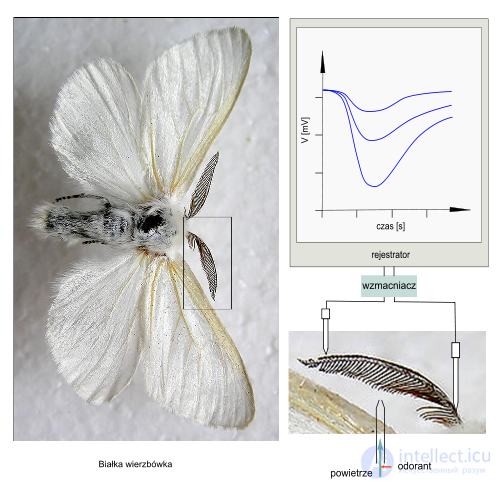
Principle of measuring action potentials in insect antennae
The response of the biosensor depends on the type of odorant and its concentration in the air.
The method of analyzing experimental data obtained by GC-EAG is illustrated by the results of a study of neuron activity in the antennae of female Bombyx mori, carried out by J. Ziesmann and co-authors in 2000 . The conclusions obtained by comparing simultaneously recorded chromatograms and electroantennograms (see the publication, Fig. 3 ) are summarized below in tabular form,
| Compound | Retention time min. |
Response of the "benzoic acid" neuron |
Response of terpene neurons |
| phenol | 11.04 | – | ? |
| pelargonaldehyde | + | + | |
| 2-ethylhexanoic acid | 15.22 | + | 0 |
| caprylic acid | 17.07 | + | + |
| benzoic acid | 17.19 | + | 0 |
| pelargonic acid | 19.93 | + | + |
| decanoic acid | 22.45 | + | (+) |
| dimethyl phthalate | 24.64 | – | + |
Electroantennography is used in scientific research to study the response of insect antennae to various chemical stimuli. It can help scientists understand how insects detect and interpret odors and pheromones, and which molecules may serve as key signals in their behavior and communication.
Electroantennography allows a deeper study of the interaction between insects and their environment, which may be important for various fields such as agriculture (in the context of pest control) and ecology (for understanding the behavior and interactions of insects in natural ecosystems).
The average sensitivity of the antennae to a particular odor can be calculated using an electroantennogram.
This method has been widely used in pheromone identification studies as a rapid bioassay for testing compounds for activity. For example, the response of a male moth's antenna to a natural sex pheromone obtained from a conspecific female moth is compared with its response to components or mixtures of synthetic pheromones. Clean air is blown continuously over the antenna at a constant rate, the test samples are introduced into the air stream, and the EAG response is observed. The same samples can be passed through a gas chromatograph (GC) (which can be coupled to a mass spectrometer to determine the molecular structure of the tested compounds). In this way, the biological response of the antenna can be directly correlated with the chemical separation (seen as peaks on the GC trace).
In addition to lepidopteran species, EAG data have been collected for cockroaches, beetles, flies, bees and other insects to measure antennal responses to a range of volatile chemicals that affect host attraction, mating, egg laying and other behaviors. EAG information is most useful when interpreted in combination with behavioral studies.
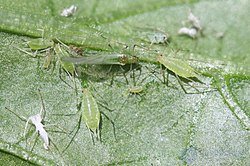
Electroantennographic studies of aphids (Aphidoidea) make it possible to determine the variability of sensory sensitivity within a species, between successive developmental forms, or depending on diet. In summer they occur as wingless or winged insects (depending on population density ); they reproduce parthenogenetically (identical clones are produced ); in autumn, sexually reproducing forms appear . Within a species there are also different feeding habits ( monophagy , oligophagy ) or polyphagy.). They are considered an excellent model for studying the biological variability of organisms depending on the environment ( phenotype ) or determined by genetic factors ( genotype ). Electroantennographic studies of this variability were carried out in 1993–1996 by J. H. Visser and P. G. M. Piron. They developed standard measurement procedures, that is, ways of preparing antennae, types of standard odorants , ways of dosing them during testing, and ways of describing the shape of the recorded EAGs. Using (E)-2-hexenal (the main compound giving tomato fruit their aroma ) as a reference, it was found, among other things, that the winged form of Myzus persicae(EAG: 407 µV) is more sensitive to this odor than the wingless summer form (EAG: 256 µV) .
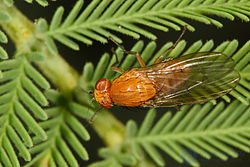
Electroantennography is one of the tools for studying the so-called biological clock (see chronobiology , for example biological rhythm , photoperiodism ) .
In a study of the antennae of the fruit fly ( D. melanogaster ) it was found (Krishnan et al., 2005) that the neurons of its antennae contain a "molecular oscillator": the sensitivity of the insects to various odors changes rhythmically, both under natural conditions and in constant darkness. It was thus shown that the rhythm is endogenous. Using genetic engineering methods, it was proven that the clock works completely independently of the brain. This was confirmed by experiments with several lines of transgenic insects.. In an experiment considered especially spectacular, in insects lacking a functional clock in the brain (the so-called lateral neurons, LN), only their antennae were restored to working order. EAG recordings of such insects revealed rhythmic changes in sensitivity to stimuli, which indicates its complete independence from the brain. It was also shown for the first time that the antennal clock responds directly to light, without the involvement of the central nervous system .
At the Technical University of Kaiserslautern, the AG Pheromone working group led by Uwe T. Koch is developing environmentally safe methods of protecting crops from pests. The techniques used involve natural pheromones or substances that imitate their effect on the insects that destroy crops - disrupting mating behavior. New methods of monitoring the condition of crops are also being developed and introduced, using insect antennae as sensors in measuring instruments [16] .
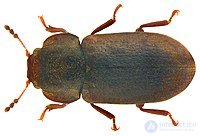
Insect antennae have also been considered promising biosensors for detecting wood-rotting fungi . The research was carried out at the University of Göttingen (Institute of Forest Zoology and Forest Protection). On the basis of chromatographic analyses it was established that the degree of danger to wood can be monitored by determining the concentrations of 1-octen-3-ol, 3-octanone and 3-octenol (markers of fungal odor ) . Using the GC-MS -EAG method, C. boleti was identified as a species whose antennae are sensitive to the smell of the markers and which can be used in devices for monitoring forest threats (a design by Uwe T. Koch)
Scientists at Pennsylvania State University are looking for ways to protect crops from herbivorous insects that cause them serious damage, using the "smell of fear" method. In the study, the scientists used gas chromatography-mass spectrometry to identify and extract the volatile odors emitted by ladybugs. They then applied electroantennography (EAG), connecting the antennae of a living aphid to a special apparatus, to study the aphid's response to each of the individual chemical components emitted by ladybugs. They found that some pests, such as aphids, react to the chemicals that ladybugs, their natural predators, emit. The researchers developed a special scented cocktail based on these chemical compounds to repel pests from fields and gardens without using toxic pesticides. This method could become a safer and more effective alternative for farmers, reducing pest damage and lowering the negative impact on the environment.

Comments