
Lecture
Domestication (from Latin domesticus, "belonging to the house") is the process of changing wild animals or plants in which, over many generations, they are kept by humans in genetic isolation from their wild form and are subjected to artificial selection.
Domestication theory, or media domestication theory, is a theory in communication and the social sciences that identifies how groups of people, and especially families and households, "tame" new technological innovations in society and appropriate them for use. It examines how a person makes choices about using technological innovations, and how those choices may be informed, and constrained, by the concept of the moral economy or by a set of values held in the community. The theory was first formulated by Roger Silverstone and Eric Hirsch.
The theory rests on a cause-and-effect relationship among decisions made in its various processes, such as appropriation, objectification, incorporation and conversion, which help a person make a decision and fit a given technology into everyday life. Domestication helps us understand how the values and beliefs of a community influence its adoption of technological innovations, and reveals why members of communities choose particular priorities and turn to particular technologies.
Variability, like heredity, is a fundamental property of organisms. In the course of a species' development, both wild and domestic animals change. However, domestication has led to such sharp changes that animals have become little like their wild ancestors. Such changes, arising in the course of domestication, are called domestication-related changes. Their cause is artificial selection.
The vast majority of domestication traits are specific and do not occur in wild animals. However, wild animals also show some changes that are very similar to those observed in domestic animals. For example, the appearance of hairless individuals, observed in almost all domestic animals, also occurs in wild ones such as the hippopotamus and the elephant, and a typical domestication trait, hornlessness (polledness), is also characteristic of female antelopes.
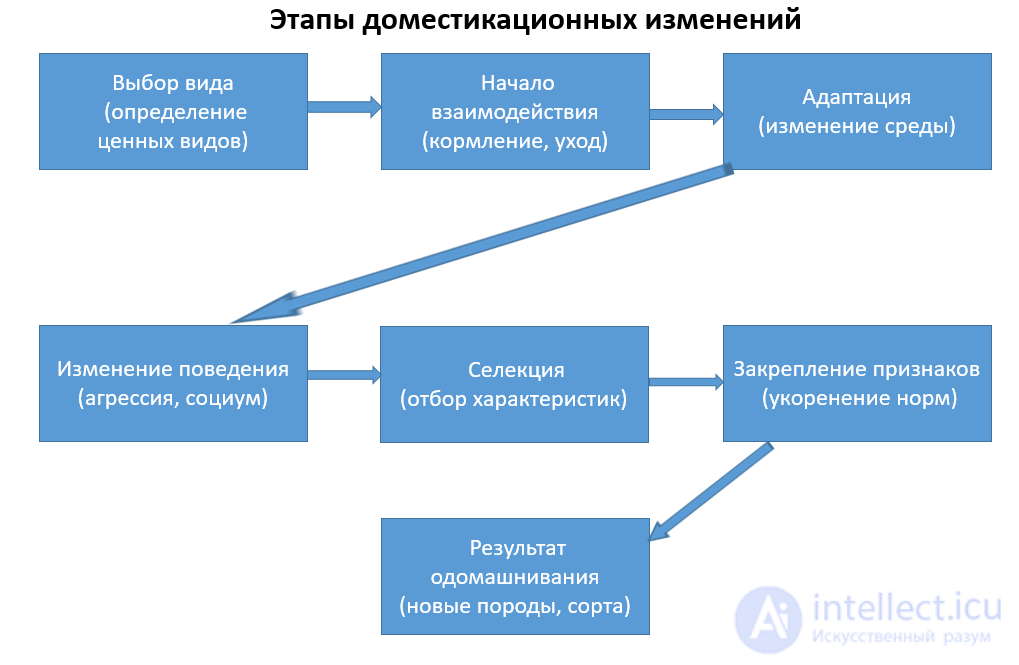
All the changes that arose under the influence of domestication can be divided into two groups:
1) changes associated with specialization of productivity, which resulted from purposeful human activity in breeding animals of the desired breeds (development of the udder in dairy cattle, variety in the quantity and quality of wool in sheep of the corresponding breeds, build characteristics in draft and riding horses, in dairy and beef cattle, etc.);
2) changes not associated with specialization of productivity or with purposeful human activity. These include, for example, drooping ears in dogs, rabbits, pigs, sheep and others, a drooping mane in domestic horses, a tail curled into a ring in pigs, piebald coloring, hornlessness, and so on.
It is characteristic that the same domestication traits are observed in animals of different species and even different classes. This points to a common origin and to common causes producing similar changes. The number of domestication traits is not related to the antiquity of origin. The dog, for example, was domesticated early and has many domestication traits, whereas the donkey, despite an almost equally ancient origin, is characterized by very conservative heredity, a small range and few such traits.
The degree of change in living conditions on the transition from the wild to the domestic state has a great influence on the appearance of domestication traits. The more sharply conditions change during domestication, the more domestication traits appear. Thus, the living conditions of domestic donkeys and reindeer changed little compared with their wild habitat, and these animals have relatively few domestication traits.
The opinion of some authors that domestication traits appear in domestic animals because natural selection does not act on them should be considered mistaken (according to such authors, domestication traits also appear in wild animals, but are eliminated by natural selection as non-adaptive).
Among wild animals, many individuals with newly arisen traits that reduce their viability to some degree are indeed eliminated by natural selection and consequently take no part in the further evolution of the species. But natural selection also operates among domestic animals (although not to the same degree as among wild ones), because in transforming domestic animals, especially in the early period, humans could not take into account all the relationships between the organism and its environment and therefore could not eliminate natural selection entirely. Far from all domestication traits are associated with reduced viability or reduced adaptation of the organism to environmental conditions.
The adaptation of animals to domestic life proceeded in two directions:
1) adaptation to the natural environment. For example, the formation of the fat-tail and fat rump in sheep and of the hump in camels increased these animals' suitability for long journeys through waterless semi-deserts and deserts;
2) adaptation to the environment created by humans and to the demands that humans placed on domesticated animals. For example, the adaptation of their digestive organs to digesting rations rich in concentrates, and the adaptation of domesticated animals to stall housing, to the intense functioning of the mammary glands in dairy cattle, and to the yoke, to work in harness, and to the saddle in working animals.
The most significant changes that have occurred in connection with domestication include the following:
Behavior and nervous system. First of all, animals were selected for behavior, that is, for their attitude toward humans and other animals. Thus, individuals with an orienting and passive-defensive reaction were preferred over those with an active-defensive one. As Charles Darwin already noted, compared with their wild ancestors, the sense organs of many domestic animals are less developed. In many domestic animals such sense organs as hearing, smell, sight and some others are less developed. However, in dogs and horses, which were required to have highly developed sense organs and nervous activity, these, thanks to artificial selection, not only remained at the level characteristic of wild animals but in some cases even surpassed it. In the course of domestication, many conditioned reflexes in animals faded and were replaced by new ones; new reactions of the organism to changed environmental conditions and new norms of animal behavior were created, and so on. Accordingly, new adaptive reactions of animals were also developed, the functions of individual organs and of the organism as a whole changed, as did the external and internal structure of the animals, and the character of the wild ancestors was lost: the behavior and temperament of domestic animals became calmer.
Body size and shape. Depending on living conditions (feeding, housing, etc.) and the direction of the artificial selection carried out by humans, animals have changed both toward larger and toward smaller body size compared with the original wild forms. Body shape (proportions) in domestic animals also changed substantially; for example, marked short-leggedness is noted in dogs of many breeds, in cattle (the Dexter-Kerry breed in England), in zebu and in sheep. Wild and domestic animals differ substantially in body proportions, and among domestic animals, beef types differ from dairy types (in breadth of body, development of musculature, especially on the thighs and hams, in the size of the head, neck, and so on).
Coat color and hair covering. Wild animals have a protective coat color with a characteristic zonal distribution of pigment along the length of the hair (agouti). Domestic animals often have an altered and highly varied coloring (of a single tone, or piebald to various degrees up to complete albinism, the absence of any pigmentation). The appearance and distribution of piebald patches in domestic animals follow a fairly definite, regular pattern and are probably connected with the activity of the nervous system, and they manifest differently in animals of different species. The color of the hair covering is related to some degree to the viability of animals (weakly pigmented animals, and especially complete albinos, are less viable), and in many cases it is also of great economic importance, especially in wool sheep farming, karakul breeding, rabbit breeding and fur farming. The inheritance of different colors is well studied, which makes it possible to breed animals with the desired color. Changes in the character of the wool coat are of even greater economic importance. Unlike wild animals, which have a fairly uniform coat (of coarse hair, guard hair and down), in domestic animals it has become extremely varied. Among domestic animals there are short-haired, very long-haired and medium-haired animals (for example, sheep), animals with a heterogeneous coat (containing guard hair and down in varying proportions) and a homogeneous one (thus the coat of fine-wool sheep consists only of fine hair, down), animals with a smooth coat and others that are curly, and so on. Structural changes in the hair itself are no less significant (this is easy to see in sheep of different breeds). Occasionally, completely hairless animals appear among domestic animals, including partly featherless birds (naked-neck chickens). Domestic poultry show the same variety in plumage as the coat of mammals (curliness, long feathers, the formation of crests on the head, etc.).
Skin, ears, tail. Great changes in the course of domestication occurred in the skin of animals and in the development of organs such as the ears and tail. Changes in the skin concern mainly the development of subcutaneous tissue and the folding of the skin itself. In domestic animals of many breeds the subcutaneous fat layer is strongly developed (especially in lard-type pigs and in beef breeds of cattle and sheep, and others); in others, on the contrary, this layer is reduced to a minimum (riding-type sport horses). In some breeds of domestic animals the skin is gathered into numerous folds (in masked pigs, in Negretti-type Merino sheep, in rabbits, in some breeds of dogs, etc.). Skin folding is occasionally observed in wild animals as well (Central African antelopes). Long and drooping ears occur in dogs, rabbits, goats, sheep, pigs and zebu, and much more rarely in horses, donkeys and cattle. In cattle of some southern breeds the surface of the skin (as an adaptation for increased heat loss) is enlarged through an increased number of folds on the brisket. Considerable variation is also observed in domestic animals in the development of the tail. The tail is completely or almost completely absent in sheep of some breeds (fat-rumped), in dogs, and less often in cattle. Marked lengthening of the tail and an increase in the number of tail vertebrae is observed in long-tailed, thin-tailed and fat-tailed sheep and some other animals.
Skeleton. Even such relatively constant parts of the organism as the skeleton, and especially the skull, have undergone considerable changes. The most frequently observed change in the head of animals in the domestic state is a shortening of the facial part of the muzzle, associated with changes in the skull. The latter amount to a general impoverishment of the bones (they become thinner and less strong), and sometimes to a shortening of the facial part of the skull (achondroplasia). While in cattle, pigs and dogs the skull has undergone very strong changes, in animals such as the camel, llama, horse and donkey it has changed very little. The strong shortening and curvature of the skull in the now extinct South American niata cattle was described by Charles Darwin. Very great variability in skull shape is observed in dogs, in which all transitional forms of skulls can be found, from the long and narrow (in the greyhound) to the brachycephalic (in the bulldog). Shortening of the muzzle is observed in goats and one-humped camels. In domestic rabbits, by contrast, the skull becomes more elongated. Sharp fluctuations are observed in the development of horns, both in size and in number (from multiple horns to their complete absence, polledness). In domestic animals horns have ceased to play a protective role; as a result, animals with all sorts of deviations from the norm (in the size, shape and direction of the horns) were not eliminated by natural selection. This is why such variety in the size, shape, direction and number of horns is observed among domestic animals. Whole breeds of polled cattle have even been created, whose animals repay their feed better with products (they do not spend the nutrients of the ration on growing essentially unnecessary horns), are calmer, and are easier to care for. The skeleton of domestic animals is characterized by less development of pronounced tubercles on the bones and, at the sites of muscle attachment, of roughness (owing to the weakening of the musculature). The skeleton of domestic animals has become relatively lighter; of all its parts the vertebral column has become heavier, while the skull and the limb bones have become lighter. The bones have become less strong, more porous, brittle and rich in spongy substance than before domestication.
Internal organs. In connection with the changed living conditions of domesticated animals, their internal organs, those of digestion, respiration, circulation and others, also underwent change. Thus, the length of the intestine in domestic pigs has increased compared with wild ones, while in domestic cattle and in rabbits it has decreased (especially in early-maturing beef breeds, which consume less bulky feed and more concentrates); in sheep of primitive breeds it has become longer, while in modern beef breeds it has shortened considerably.
Reproductive qualities. The reproductive system of domestic animals has undergone very sharp changes. The sexual cycles, estrus, heat, ovulation, time of mating and time of birth of offspring have changed greatly in most domestic animals. In wild animals the birth of young is strictly tied to a particular season, whereas many domestic animals can produce offspring at any time of the year. In most domestic animals fertility has risen sharply. The increase in fertility in domestic animals greatly facilitated selection (a greater opportunity to choose the best animals from numerous offspring) and thereby contributed to the faster formation of new breeds. During domestication, the fertility of animals did not increase at once but gradually, as a result of long selection and their adaptation to domestic conditions. At the beginning of this process, at the taming stage, animals caught by humans sometimes even lost fertility in captivity; only with time was it gradually restored and increased. It is known that wild animals in zoos do not breed at first, and then, as they become accustomed and adapt to the new environment, their sexual functions and fertility are restored.
Productivity (performance). Under the influence of domestication, the productivity of animals changed sharply, both quantitatively and qualitatively. Thus, the meat qualities of domestic animals (especially of specialized beef breeds) improved as a result of the intensified development of the most valuable parts of the body (shoulders, loin, thighs and the whole hindquarters), as well as through increased early maturity, changes in the histological structure of the muscles and in the distribution of fat in the body, and improvement in the chemical composition of the meat and its taste. Isolated fat deposits are characteristic, for example, of animals with a hump (zebu, camels), and of sheep of some breeds (fat-tailed and fat-rumped). Humans have achieved still greater success in increasing milk productivity and improving the quality of the milk obtained from cattle, sheep, goats, dairy breeds, water buffaloes and some other animals. The wool productivity of sheep has risen sharply. In addition, domestic animals have acquired changes of enormous economic importance, such as earlier sexual maturity, increased early maturity, a better capacity for fattening and for making use of feeds rich in nutrients, and so on.
The great variety of modern animal breeds is the result of the conscious activity of humans, who change and direct the evolution of domestic animals through artificial selection. By domesticating animals, humans weaken the action of natural selection to a considerable degree and change its direction; as a result, many newly arisen forms that would be unable to survive in a natural environment can, under domestic husbandry, be preserved and evolve further under direct human control.
The changes that arise in domesticated animals become entirely different in character from those in their wild ancestors, especially at the higher stages of social development, when humans, noticing slight and at first barely perceptible deviations in a direction desirable to them, create conditions that promote the strengthening of these deviations in individual animals and their descendants.
Through long methodical selection and mating, at first unconscious and later more systematic and directed toward a definite goal, domesticated animals underwent the enormous changes that sharply distinguish them from their wild ancestors. Altered living conditions and the deliberate pairing of animals with different traits multiply variability many times over and change its character. The changes accumulated over centuries in animals transformed by domestication become ever more varied. New changes occur in every generation, and the possibilities for creating more perfect forms widen. This accelerating growth of diverse hereditary changes made effective selection possible in different directions.
The role of human labor should be especially emphasized in breeding the numerous breeds of domestic animals by means of artificial selection and in creating conditions that ensure the development of the organism in the desired direction. Human labor, purposeful selection and well-founded mating of animals under specific living conditions were the decisive factor in creating breeds of domestic animals. Thus, the development of productive forces and relations of production, that is, socio-economic conditions, ultimately determines the paths of evolution of domestic animals.
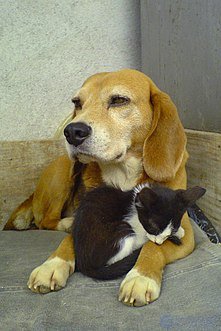
Like cat and dog: a beagle and a kitten
The first domesticated species was the wolf. At first it served as a hunting helper, and later it also performed guard duties. The domestication of dogs began in the Aurignacian period of the Upper Paleolithic . The first evidence of humans and dogs living together (the tracks of a wolf or dog paw and a child's foot) was found in the Chauvet Cave in France. These tracks are 26,000 years old. This is also supported by finds of canid remains from the Upper Paleolithic, discovered in excavations in Ukraine (Cherkasy and Chernihiv regions — Mezin, Mezhyrich), in Russia (Eliseevichi-1, Kursk Oblast; Razboinichya Cave, Altai Republic), in Belgium (Goyet), and in the Czech Republic (Předmostí). However, among the many dozens of wolves and Arctic foxes found at Eliseevichi and Mezin, the carcasses were not used after skinning and most of the bones were preserved as anatomically connected groups and partly as nearly complete skeletons, which would hardly have been possible if dogs had really been present at the settlement.
Domestic cats came close to humans about ten thousand years ago in the Fertile Crescent and its surroundings, retaining mostly the hunting qualities of their predatory relatives. Domestic cats spread with farmers throughout the Near East. Several thousand years later a second wave of cat dispersal covered practically all of Europe and North Africa. At present about 200 breeds of domestic cats are recognized by various international feline organizations.
About 3 to 4 thousand years ago, ferrets, domesticated European polecats, appeared in Ancient Egypt.
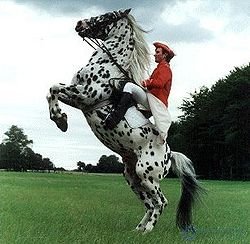
A Knabstrupper of leopard-spotted coat
At least 8 thousand years ago, people tamed goats, sheep, pigs and cows.
The taming of the now extinct wild aurochs (Bos primigenius) led to the emergence of two main taxa of cattle, B. taurus and B. indicus. Nuclear DNA analysis shows that the domestication of B. taurus (taurine cattle) and B. indicus (zebu) took place in the Near East and Southwest Asia from geographically separate and genetically distinct populations of the wild aurochs. Mitochondrial DNA analysis shows that taurine cattle (Bos taurus) was domesticated in the Near East in the Neolithic. Later in Europe, partial hybridization of domesticated cattle with local aurochs took place[10][11][12].
An important event for later history was the domestication of horses about 5,500 years ago. Before they began to be used as working animals, they served as a source of meat and milk. According to research as of 2018, it turned out that the Przewalski's horse is not an ancestor of domestic horses but a horse that was already tamed and became feral in ancient times. The study analyzed the remains of 20 fossil horses of the Botai culture found at the Krasny Yar site in Kazakhstan. Also added to the study were 22 samples from other ancient horse finds — three samples from Yakutia and Taymyr, seven Przewalski's horses; the final study also included 7 Bronze Age genomes from 4100 to 3000 years ago, 18 Iron Age genomes from 2800 to 2200 years ago, 7 genomes of horses of the Roman Empire from between 2000 and 100 years ago, and 22 modern horses of 18 breeds.
Analysis of the results showed the following:
The overall conclusion is that in human history two independent periods of taming and systematic domestication of horses are known. The first is the Botai culture, which domesticated the Botai horses. However, for some reason these horses died out, and in genetic terms only the feral Przewalski's horses remain from them. The second period of horse domestication occurred in the Bronze Age, with almost no recorded influx of genetic material from Botai horses. Geneticists and historians concluded that Botai horses were used in the Botai culture only as farm animals, and were not used for campaigns or for military action. In the last 4,000 years there is not a single horse that was a direct descendant of the Botai horse. This points to a second wild ancestor of modern domestic horses, but the place of domestication is not yet known, owing to the incompleteness of the fossil material.
The presumed regions where the ancestors of modern horses were domesticated are the steppes between the Black and Caspian Seas, Anatolia, Iberia, Western Iran, the Levant, or the territory of present-day Hungary. Genetic data indicate that between 3000 and 2000 BCE domestic horses had already spread across the European steppes. Some researchers link this sharp leap in horse migration to the migration of the Yamnaya culture.[13][14]
The first animal used for hauling loads, about 7,500 years ago, was the ox, a castrated bull. Donkeys and horses joined it later. They began to be used for riding comparatively late. Some time afterward the camel was tamed as well.
In more recent history, llamas and reindeer were domesticated, as well as small animals such as guinea pigs and mice.
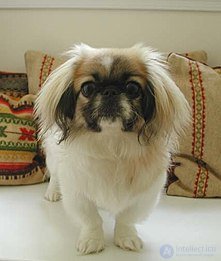
Over the last 2,000 years the Pekingese has barely changed in appearance
Since the middle of the 20th century, scientists of the Belyaev school at the Novosibirsk Institute of Cytology and Genetics of the Siberian Branch of the Russian Academy of Sciences have been conducting an experiment on the domestication of farmed foxes. At present the research group is headed by Professor Lyudmila Trut, Doctor of Biological Sciences. During the experiment the animal develops an emotional attachment and even devotion to humans. But most importantly, the wild animal learns new ways of communicating with humans, learns to understand gestures, glances and words, and to use these social signals in the process of "communication."
Professor Lyudmila Nikolaevna Trut writes that "the genetic transformation of behavior (from wild to domestic) entails morphological and physiological changes similar to those that occurred in the historical past in dogs and other domestic animals."
In July 2014 a group of scientists led by Adam Wilkins of Humboldt University published a paper suggesting that, in the course of animal domestication, people unintentionally selected animals with genetic defects in neural crest cells for breeding. In trying to breed tamer and more docile individuals, people selected above all animals with underdeveloped adrenal glands, which are responsible for "fight or flight" behavior in stressful situations. Since migrating neural crest cells are responsible for the formation of the adrenal glands, genetic defects in precisely these cells became fixed in the offspring.
The degree of domestication of different animal species may vary depending on human needs. In the process of domestication, under the influence of new environmental conditions and artificial selection, animals acquired traits that distinguish them from their wild relatives, and the more significant these traits are, the more labor and time humans spent obtaining animals with the properties they needed. At the same time, as Dorian Q. Fuller of the Institute of Archaeology at University College London (UCL) writes, "all domesticated animals have certain characteristic traits (although it is not necessary for all domestic animals to have all of the following traits at once)."
The characteristic traits of animal domestication include:
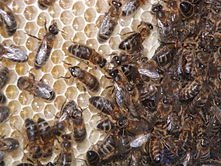
Bees on honeycombs with honey
Apparently, the first (unintentional) steps toward the domestication of animals can be considered the rearing by females of one species of the young of other species (known cases exist for some species of monkeys). Females that do not yet have offspring of their own, and are unable to take young from other females, may take, for example, puppies. The puppies grow up with the monkey troop and help drive off strangers (guarding)[
| Species | Period | Region |
|---|---|---|
| Dog (Canis lupus familiaris) | up to 33,000 BCE | Eurasia |
| Domestic sheep (Ovis orientalis aries) | between 11,000 and 9000 BCE | Southwest Asia |
| Domestic pig (Sus scrofa domestica) | 9000 BCE | Near East, China, Germany |
| Domestic goat (Capra aegagrus hircus) | 9000 BCE | East, West and South of the Fertile Crescent |
| Cow (Bos primigenius taurus) | 8000 BCE | India, Near East, North Africa |
| Cat (Felis catus) | 7500 BCE | Cyprus and the Near East |
| Chicken (Gallus gallus domesticus) | 6000 BCE | India and Southeast Asia |
| Guinea pig (Cavia porcellus) | 5000 BCE | Peru |
| Domestic donkey (Equus africanus asinus) | 5000 BCE | Egypt |
| Domestic duck (Anas platyrhynchos domesticus) | 4000 BCE | China |
| Asian water buffalo (Bubalus bubalis) | 4000 BCE | India, China |
| Domestic horse (Equus ferus caballus) | 4000 BCE | Eurasian steppes |
| Dromedary camel (Camelus dromedarius) | 4000 BCE | Arabia |
| Llama (Lama glama) | 3500 BCE | Peru |
| Silkworm (Bombyx mori) | 3000 BCE | China |
| Reindeer (Rangifer tarandus) | 3000 BCE | Russia |
| Rock pigeon (Columba livia) | 3000 BCE | Mediterranean |
| Domestic goose (Anser anser domesticus) | 3000 BCE | Egypt |
| Bactrian camel (Camelus bactrianus) | 2500 BCE | Central Asia |
| Yak (Bos grunniens) | 2500 BCE | Tibet |
| Gaur (Bos gaurus frontalis) | unknown | Southeast Asia |
| Alpaca (Vicugna pacos) | 1500 BCE | Peru |
| Domestic ferret (Mustela putorius furo) | 1500 BCE | Europe |
| Muscovy duck (Cairina momelanotus) | unknown | South America |
| Helmeted guineafowl | unknown | Africa |
| Carp (Cyprinus carpio) | unknown | East Asia |
| Turkey (Meleagris gallopavo) | 500 BCE | Mexico |
| Banteng (Bos javanicus) | 400 BCE | Southeast Asia |
| Goldfish (Carassius auratus auratus) | 200 BCE | China |
| European rabbit (Oryctolagus cuniculus) | 6th century | Europe |
| Species | Period | Region |
|---|---|---|
| Zebu (Bos primigenius indicus) | 8000 BCE | India |
| Honey bees | 4000 BCE | Several regions |
| Fallow deer (Dama dama) | 1000 BCE | Mediterranean |
| Indian peafowl (Pavo cristatus) | 500 BCE | India |
| Ringed turtle dove (Streptopelia risoria) | 500 BCE | North America |
| Japanese quail (Coturnix japonica) | 1100-1900 | Japan |
| Mandarin duck (Aix galericulata) | unknown | China |
| Mute swan (Cygnus olor) | 1000-1500 | Europe |
| Domestic canary (Serinus canaria domestica) | 1600 | Canary Islands |
As a result of domestication, changes arise in animals that are called domestication changes. For the most part these changes are specific, that is, they cannot arise on their own. They arise as a result of selection carried out by humans who are trying to obtain animals with a desired level of development of particular traits. The main groups of traits affected by domestication changes are behavior and the nervous system, productivity, reproductive qualities, coat color, ear and tail carriage, coat quality, development of the skeleton and internal organs, and body size and weight.
1. Indicate the domestication changes in dogs
2. Indicate the main domestication changes in horses
3. Indicate the domestication changes in sheep
4. Indicate the domestication changes in goats
5. Indicate the domestication changes in pigs
What are the causes of domestication changes in animals?
What does the number of domestication changes in different animal species depend on?
Into which two groups can all the changes in animals that arose during their domestication be divided?
Changes in which traits are observed in animals when they are selected for behavior?
What determines the further evolutionary paths of domestic animals?

Comments