
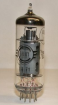
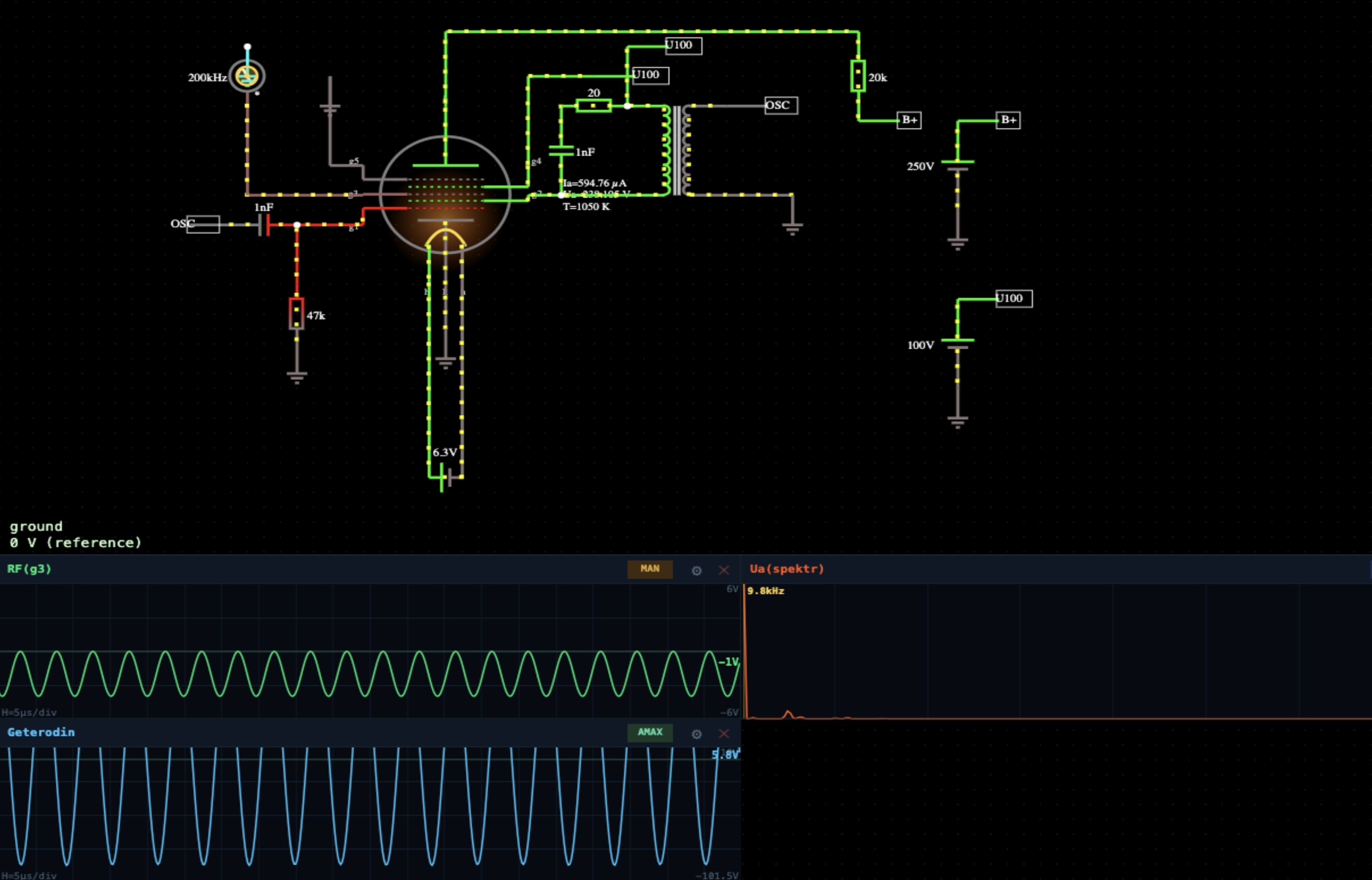
The octode develops the heptode further: eight electrodes, six grids. The arrangement is the same — g1 oscillator grid, g2 oscillator anode, signal on g4, screen g5, suppressor g6 — but an extra shield grid g3 is inserted between the two sections.
It cures the converter's main weakness: at short wavelengths the oscillator and signal sections pull each other, and the oscillator frequency drifts with the signal tuning. The extra screen breaks that coupling. The price of the isolation is a lower conversion transconductance: compare the level of the difference line with the heptode.
This page is a utility for simulating octode: local oscillator and mixer with a shield grid online with specified initial values.
Using the model. Everything works as in the heptode: the 159 kHz oscillator starts by itself, the 1 nF / 47 k grid-leak sets about −7 V of bias, the 200 kHz signal arrives on g4, and the anode spectrum carries the 41 kHz difference line.
It is worth comparing the two valves directly: open the heptode circuit alongside and see how differently the signal grid "feels" the oscillator. Note too that the octode needs stronger feedback (a tickler ratio of 0.15 against 0.10 for the heptode) — the extra grid intercepts part of the stream and the oscillator section's gain drops.


Comments