
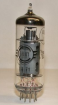
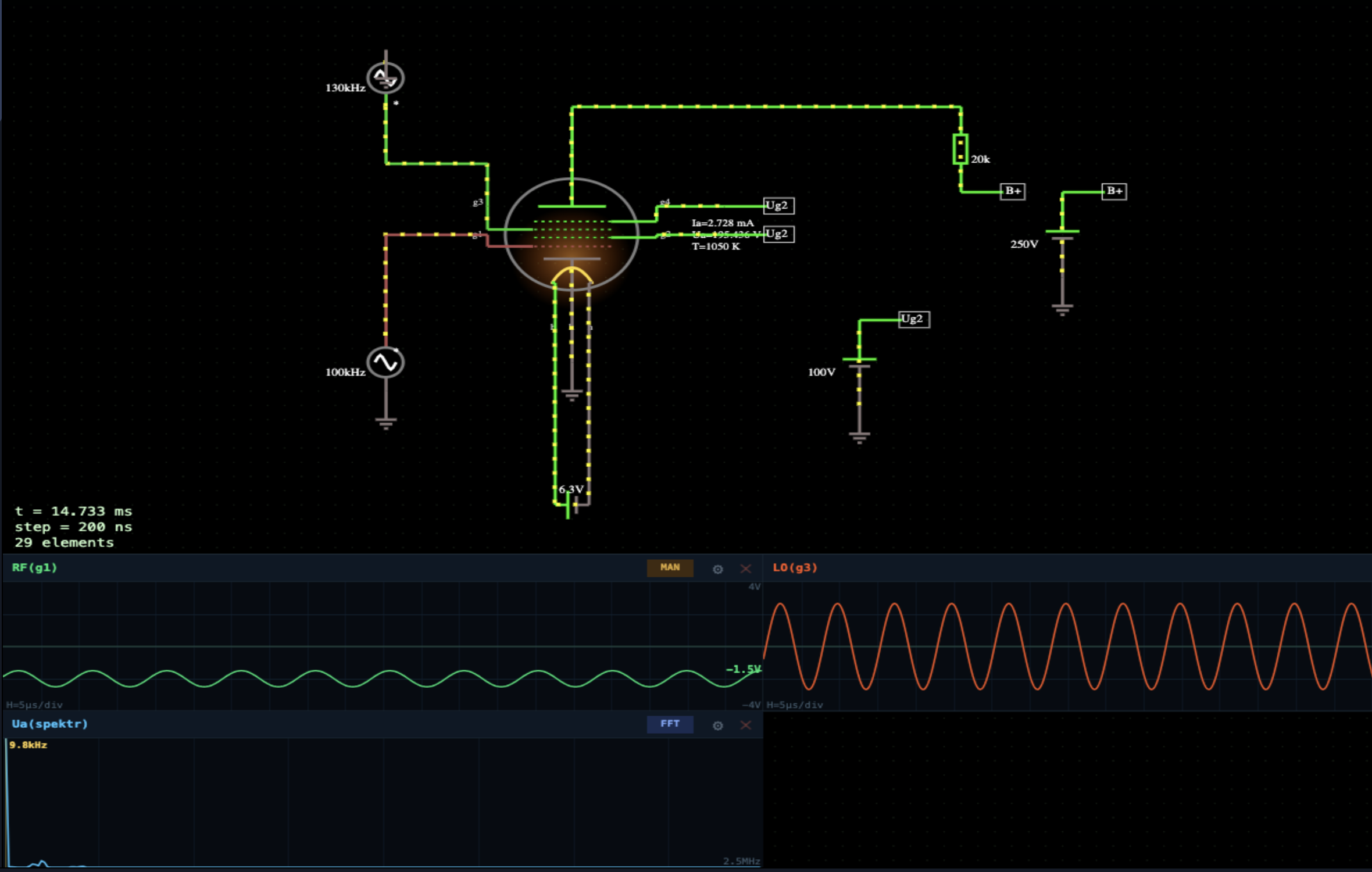
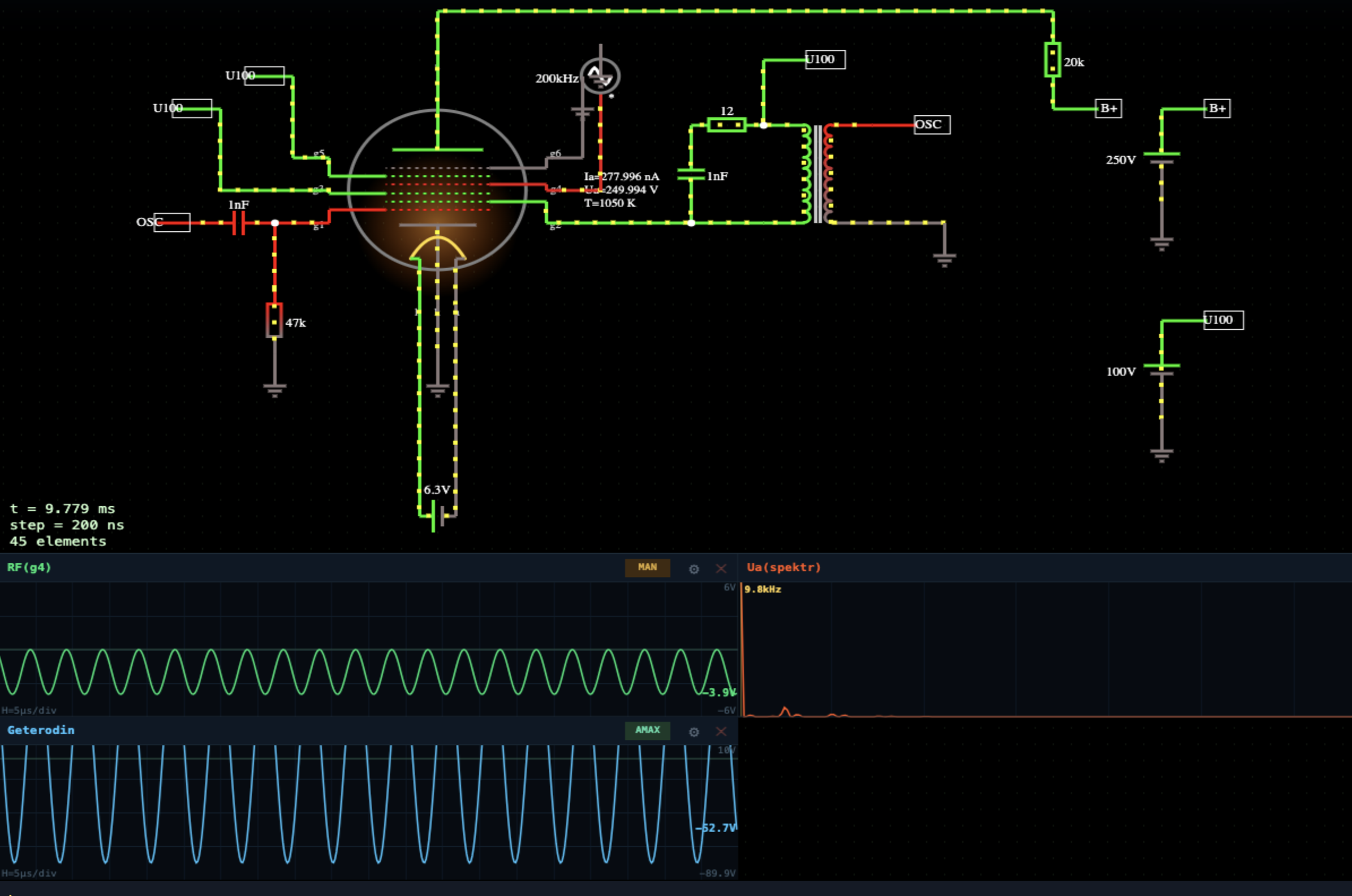
A heptode (pentagrid converter) combines the local oscillator and the mixer in one envelope. The first grid g1 is the oscillator grid and the second g2 its anode; the signal goes to the third grid g3, screen g4 decouples the two sections and suppressor g5 flattens the anode characteristic. One valve instead of two — which is why heptodes ended up in every valve superheterodyne.
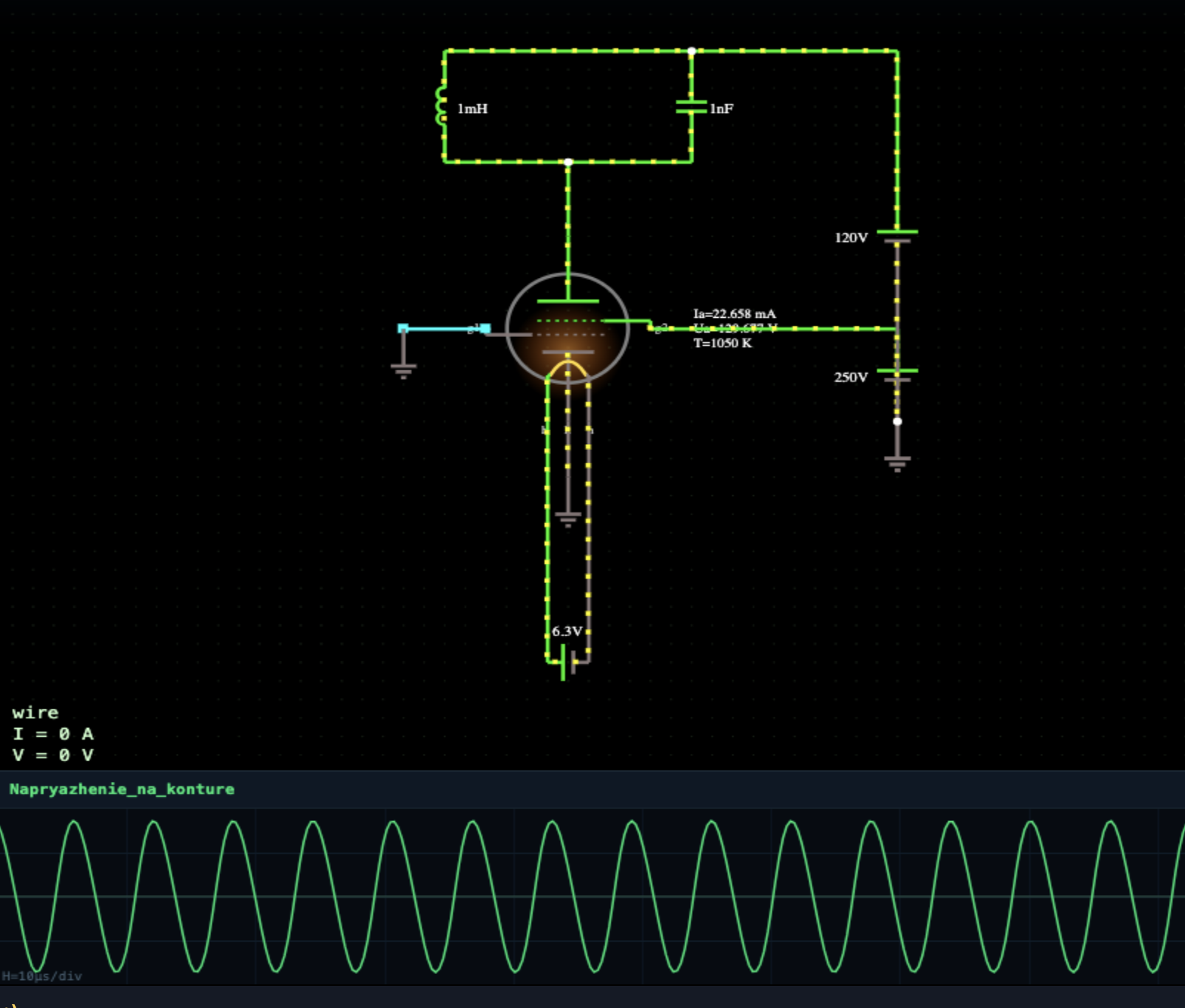
The oscillator here is real: a 1 mH ∥ 1 nF tuned circuit hangs on g2, the feedback returns to g1 through a tickler winding, and the amplitude is limited by the classic 1 nF / 47 k grid-leak network (automatic bias from grid current). An external 200 kHz signal is applied to g3.
This page is a utility for simulating heptode: local oscillator and mixer in one valve online with specified initial values.
Using the model. Once the cathode is hot the oscillator starts on its own — watch the lower "Geterodin" scope: a 159 kHz oscillation grows out of the noise and settles at roughly ±15 V. Grid g1 meanwhile takes up about −4.5 V of negative bias, produced by the grid current draining through the 47 k resistor. That bias is what stops the amplitude growing.
The spectrum scope on the anode shows both original frequencies and the conversion product at 41 kHz. The "RF amplitude" slider changes the signal level — the difference line follows it linearly while the oscillator line stays put, because the oscillator runs independently. Increase the tank capacitance and the oscillator frequency drops, taking the intermediate frequency with it. Reduce the coupling (or raise the 20 ohm loss resistance) and oscillation ceases.



Comments