
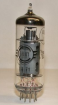
A hexode is a valve with two control grids, each with its own screen: g1 and g3 control the same electron stream independently of one another. The anode current is therefore the product of two functions — and the product of two sine waves, by the trigonometric identity, gives the sum and difference frequencies. That is how the valve moves a signal to another frequency.
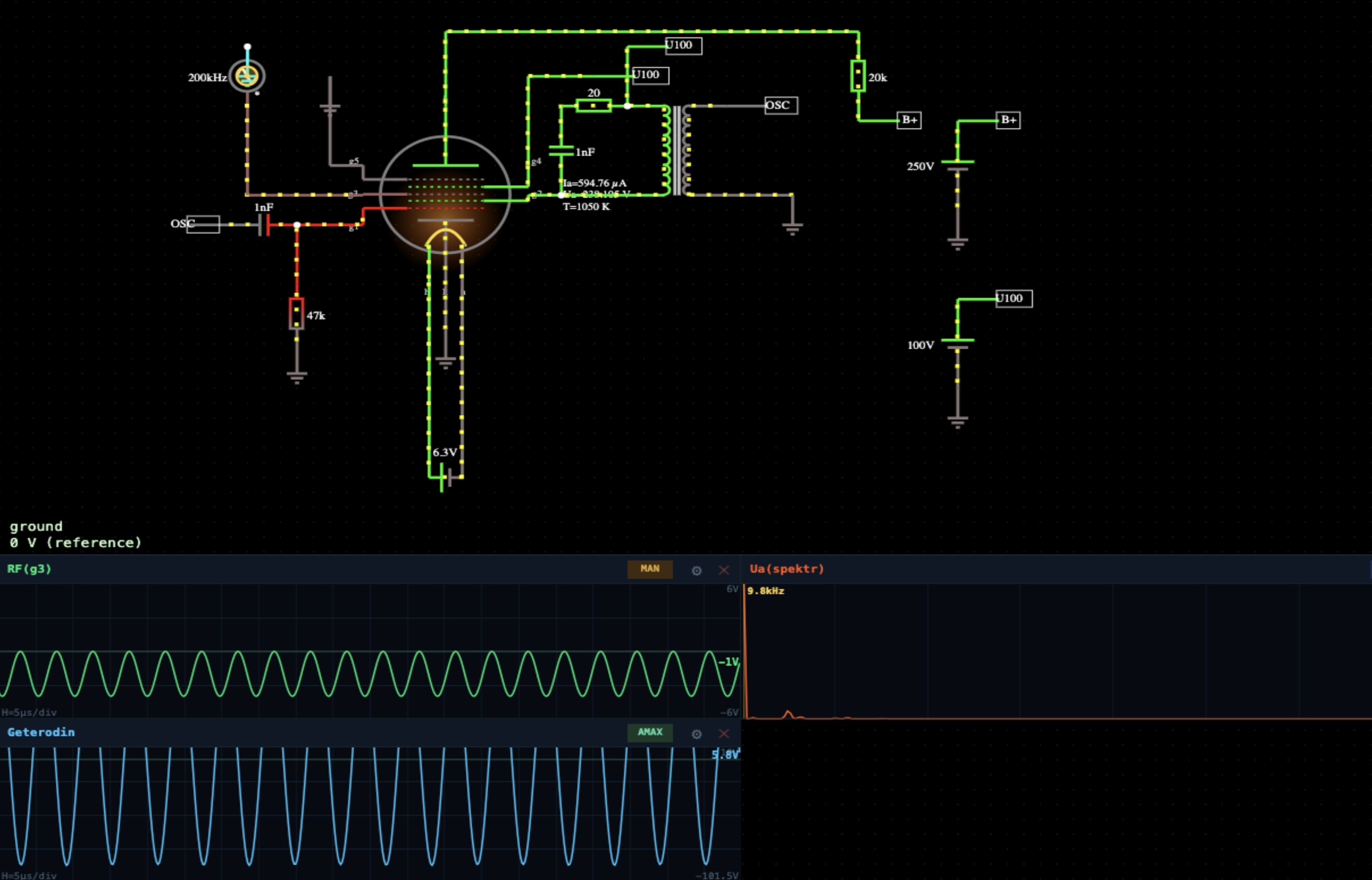
Here g1 carries a weak 100 kHz signal and g3 a strong 130 kHz local-oscillator voltage. Screens g2 and g4 are fed from +100 V and the anode is loaded with 20 k.
This page is a utility for simulating hexode: frequency mixer online with specified initial values.
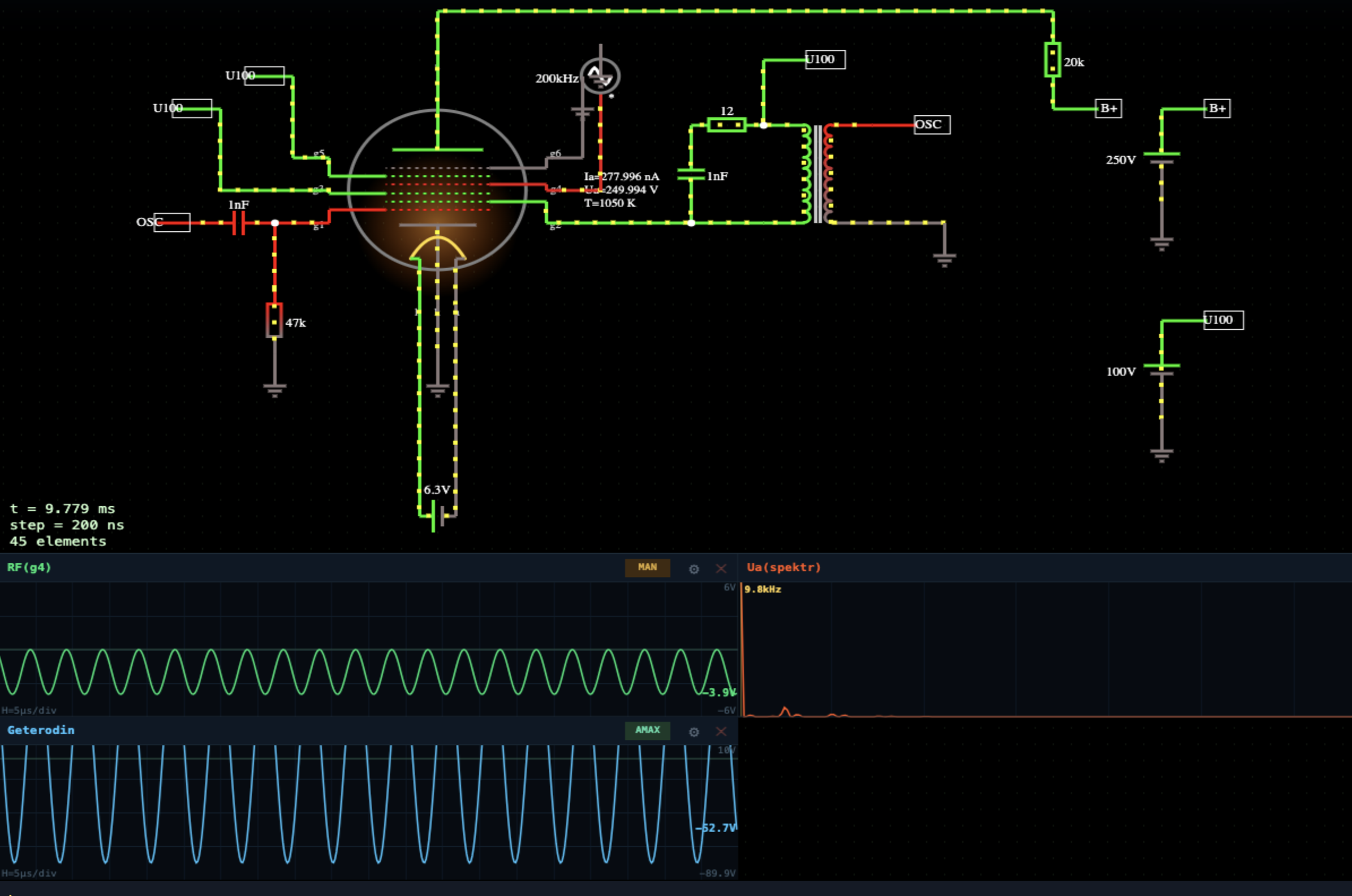
Using the model. The third scope runs in spectrum (FFT) mode and shows four lines at once: the original 100 and 130 kHz and the two conversion products, 30 kHz (difference) and 230 kHz (sum). The difference frequency is the intermediate frequency of a superheterodyne receiver.
Change either generator's frequency and both sidebands follow, while their spacing stays equal to the difference. Turn the oscillator voltage down to zero and the conversion disappears, leaving plain amplification of the g1 signal: there is nothing left to multiply by. In a real receiver the anode resistor is replaced by a circuit tuned to the difference frequency, which picks that one line out of this spectrum.

Comments