
Lecture
"Every sandpiper praises its own swamp" This phenomenon can be interpreted as a manifestation of the psychological tendency to prefer and positively evaluate one's own experience and environment against the backdrop of less familiar or foreign counterparts. This tendency often correlates with the phenomenon of ethnocentrism and subjective confidence in the correctness of one's own choices and preferences.
Ethnocentrism (from Greek ἔθνος "people, tribe" + Latin centrum "center <of a circle>, focal point") — a worldview that regards one's own culture as the standard by which judgments are made about people of other cultures; "a preference for one's own ethnic group, manifested in the perception and evaluation of life phenomena through the prism of its traditions and values" . It presupposes that the individual belongs to a distinctly expressed culture (possessing a stable identity, language, traditions and customs) .
The term was introduced in 1906 by W. Sumner, who defined it as "a view of things in which one's own group is the center of everything, and all others are scaled and rated with reference to it" . "The nature of ethnocentrism is determined by the type of social relations, ideology, the content of national policy, as well as the personal experience of the individual" . "Ethnocentrism as a mechanism for shaping interethnic and intergroup relations became relevant in the works of L. Gumplowicz, W. Sumner, S. Freud, and has not lost its scientific significance to this day" .
Ethnocentrism is a phenomenon in which one culture evaluates and perceives other cultures based on its own cultural norms and values, considering them less significant or even wrong. This happens because people spend most of their lives within their own culture, and it becomes a kind of standard for understanding the rest of the world. One's own culture becomes the center of everything and is regarded as the only correct one. If something from another culture does not correspond to one's own values, customs and norms, it is considered less valuable and is often even rejected.
American psychologists M. Brewer and Donald Campbell identify the main features of ethnocentrism:
Perceiving elements of one's own culture as natural and correct, and elements of other cultures as unnatural and incorrect.
The idea that the customs and norms of one's own group are universal for everyone.
The belief that it is natural for a person to cooperate with and help members of their own group, to prefer their own group, to take pride in it, and, conversely, to distrust and even come into conflict with members of other groups.
Ethnocentrism can influence intercultural interaction and lead to stereotypes, bias and conflicts between cultures.
The phenomenon of ethnocentrism represents a group of people's inclination to evaluate their own culture, customs, values and way of life as more outstanding, correct and superior compared to the cultures and ways of life of other groups. This phenomenon manifests itself in how people may evaluate and compare their own cultural heritage with the culture of other groups, as well as in how they may attach greater importance to their own traditions and customs.

T. G. Stefanenko believes: "Ethnocentrism does not initially carry a hostile attitude toward other groups and can be combined with a tolerant attitude toward intergroup differences."
The main characteristics of ethnocentrism include:
Exaggeration of one's own values: Ethnocentrism often manifests itself in exaggerating the importance and correctness of one's own cultural values and practices.
Stereotypes and bias: Ethnocentrism can lead to the formation of stereotypes and bias toward other cultures, which can hinder understanding and cooperation between cultures.
Rejection and assimilation: Some forms of ethnocentrism can lead to the rejection of other cultural groups or attempts at their forced assimilation.
Social distance: Ethnocentrism can lead to the formation of social distance between different cultural groups, which can hinder intercultural interaction.
"Ethnocentrism is increasingly rarely used to denote prejudice and negativism in attitudes toward other ethnic groups and, unlike the terms 'ethno-egoism' and 'ethnophobism', is regarded primarily as a tendency to prefer one's own ethnic group and its representatives in comparison with other groups". There is a division of ethnocentrism into 3 types:
Let us return to our expression about the marsh. This expression means that people often take pride in or praise what belongs to them or to what they are closely connected, and each person considers right that to which he is accustomed. It emphasizes individualism and people's tendency to defend and emphasize their own interests, their place, or their achievements, sometimes even against the backdrop of more general or universal values. This expression can be used both in a positive and in a negative context, depending on the situation.
The expression "every sandpiper praises its own marsh" implies that people often tend to take pride in or value what belongs to their own environment, milieu, or field, where they feel most confident or successful. Like a "sandpiper" living in its own "marsh", people may devote great attention and appreciation to their own achievements, their culture, way of life, profession, and so on, sometimes even to the point where they underestimate or neglect other aspects of life or of the world around them.
In this context, the phrase can be used to indicate a person's tendency to defend their interests, often comparing them with the interests of others, and to emphasize their uniqueness or importance. It can also indicate that a person may be biased or narrow-minded in their worldview, since they see the world only through their own prism of experience and interest, a perfect kind
Habits play an important role in shaping our beliefs and values. A person who grew up in a family with certain traditions and rules tends to accept them as the norm and consider them right. For example, if a family always gathers for dinner and discusses the day, this can create a belief in the importance of family relationships and communication.
Cultural background also influences what a person considers to be right. Different cultures have different norms and values. For example, in one culture it may be normal to arrive late to a party, while in another this is considered disrespectful. People raised in different cultural environments can have very different views on what is considered right.
Personal experience also influences what we consider to be right. Positive and negative events in life shape our beliefs. For example, a person who has gone through severe financial hardship may consider it right to save money and avoid unnecessary spending, while a more well-off person may not see such a need.
It is important to note that a person's ability to adapt and change their views is not limited by their habits. People can learn and broaden their horizons by becoming aware of the diversity of opinions and cultural characteristics. This capacity for adaptation can help a person reconsider their beliefs and arrive at new ideas about what is considered right.
In different countries there are similar expressions that speak to how people often praise what they have or what is familiar to them. In Russia, for example, they say: "Every sandpiper praises its own bog." In Ukraine, it is believed that even a toad can be proud of its bog: "Every toad praises its own bog," "To people it's like a shed, but to me it's like a flower." "Every dog is proud on its own dung heap," and in Belarus they say: "The toad croaks, praising its own bog." In European countries, birds are said to have a tendency to praise their own nests. For example, in Spain they say: "A cada pajarillo agrada su nidillo," in Portugal - "O passarinho ama o seu ninho," in Italy - "Ad ogni uccello il proprio nido è bello," and in France - "À chaque oiseau son nid est beau."
In Poland, on the contrary, hens are proud of their eggs and say: "Każda kura swoje jajko chwali." In England, cooks prefer to praise their own broth: "Every cook praises his own broth," and in Greece gypsy women praise their own sieve: "Κάθε γύφτισσα το κόσκινο παινεύει." The Japanese, on the other hand, express their philosophy by saying that wherever you live becomes your capital: "住めば都・すめばみやこ" (Miyako is the ancient name of Kyoto, Japan's first capital).
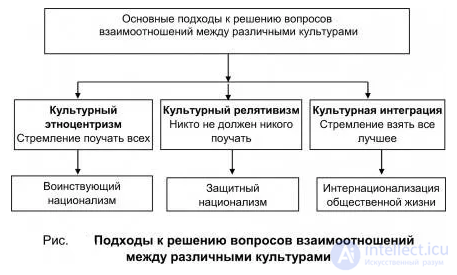
Fig. approaches to resolving issues of relationships between different cultures.
Cultural ethnocentrism is a concept that describes the tendency of people or groups to evaluate and judge other cultures and customs exclusively from the standpoint of their own culture, treating it as the yardstick and standard for assessing everything else.
The main features of cultural ethnocentrism include:
Regarding one's own culture as more significant: People prone to cultural ethnocentrism tend to see their own culture as superior and more valuable than the cultures of other peoples.
Understanding one's own values as universal: Ethnically ethnocentric people may believe that their values, norms, and customs apply to the whole world, and not only to their own cultural group.
A negative attitude toward differences: Cultural ethnocentrism can lead to underestimation, misunderstanding, and even a negative attitude toward differences in the culture and customs of other groups.
Rejection or even disdain for other cultures: People affected by cultural ethnocentrism may refuse to acknowledge the equality or value of other cultures, which can lead to conflicts and bias.
Cultural ethnocentrism can be caused by insufficient knowledge or experience of intercultural interaction. It can also intensify under conditions of nationalism or cultural isolationism. It is important to understand that cultural ethnocentrism can become an obstacle to intercultural interaction and cooperation, and therefore respect and understanding of other cultural viewpoints play an important role in building harmonious intercultural relations.
Cultural relativism is a concept that holds that values, norms, and moral judgments are relative and depend on cultural context. This means that what is considered morally right or wrong can differ from culture to culture, and there is no single universal system of values applicable to all cultures.
The main ideas of cultural relativism include:
The absence of universal truths: Cultural relativism denies the idea that universal truths exist in morality or ethics. Instead, it holds that every culture has its own values and moral norms, which must be respected.
The contextuality of judgments: Assessments and judgments about morality and the rightness of actions should be considered within the context of a specific culture and time. What may be considered right or wrong in one culture may be entirely different in another.
Respect for diversity: Cultural relativism emphasizes the importance of respecting the diversity of cultures and what is considered important within them. It also implies tolerance of differences and the absence of judgments about the superiority of one culture over another.
Criticism of universalism: Cultural relativism criticizes the ideas of universal moral norms and rules, viewing them as the imposition of one culture's own values on others.
Cultural relativism often calls into question moral and ethical standards that may seem natural in one culture but provoke discussion and even protest in another. This concept can serve as a basis for discussing moral and ethical issues in an intercultural context and underscores the importance of respecting cultural diversity.
Cultural integration, also known as cultural fusion or multicultural coexistence, is the process of merging and interaction between different cultural groups, communities, and traditions within a single social environment or country. This process can occur for various reasons, such as immigration, globalization, intercultural exchange, or political change.
The main aspects of cultural integration include:
Cultural diversity: Different cultural groups with their own traditions, languages, religious beliefs, and customs coexist within a single society.
Interaction and exchange: People from different cultural groups come into contact and exchange ideas, knowledge, art, culinary recipes, and much more.
Inclusivity and equality: Cultural integration fosters the creation of a more inclusive society, where all citizens have equal rights and opportunities, regardless of their cultural affiliation.
Preservation of cultural identity: An important part of cultural integration is the ability of cultural groups to preserve their uniqueness and identity, even while living alongside other cultures.
Learning and education: Efforts are made in educational institutions and through the media to raise awareness and understanding of different cultures, which fosters respect and tolerance.
Multicultural policy: State and municipal authorities may implement policies aimed at maintaining a multicultural environment and providing support to different cultural groups.
Cultural integration has its pros and cons. On the one hand, it can enrich society with new knowledge and experience, and foster intercultural understanding and cooperation. On the other hand, it can give rise to cultural conflicts and raise questions about how to balance diversity with unity.
Effective cultural integration requires effort on the part of society, the state, and the cultural groups themselves, in order to create a harmonious and sustainable environment in which every person can feel accepted and respected, regardless of their cultural affiliation.
There are several approaches to resolving issues in the relationships between different cultures. Each has its own characteristics and is applicable in different situations:
Dialogue and mutual understanding: This approach involves active interaction and exchange of information between representatives of different cultures with the aim of understanding their views, values, and expectations. Dialogue helps reduce misunderstanding and bias.
Intercultural education: Educational programs aimed at teaching students and the public about aspects of intercultural interaction, adaptation, and respect for cultural differences.
Mediation and counseling: Used in cases of conflict or complex situations, when a third party is needed who possesses mediation skills and can help resolve disputes between cultures.
International cooperation: Countries and international organizations can cooperate in addressing global problems, such as climate change, migration, and the fight against poverty, based on respect for different cultures and a striving for joint solutions.
Respect for cultural rights: States and organizations can develop laws and policies that protect the rights and interests of various ethnic and cultural groups, ensuring equality before the law and access to resources and services.
Tourism and cultural exchange: Travel and cultural exchange can foster mutual understanding and respect, allowing people from different cultures to get to know one another through direct interaction.
Research and science: Scientific research on cultures and intercultural interactions helps expand knowledge and improve understanding of the processes taking place between different cultures.
Diplomacy and international relations: States can use diplomatic channels to resolve international conflicts and create conditions for cooperation between different cultures.
The choice of approach depends on the specific situation and goals, and an effective solution often involves a combination of several methods and approaches.
Every person considers what they are accustomed to as correct, largely due to the influence of habits, cultural context, and personal experience. However, it is important to remember that people are capable of change and adaptation. Understanding this helps us be more open to a diversity of opinions and values, which in turn contributes to more harmonious coexistence in a world where every person has their own unique path and experience.
Ethnocentrism can have both positive and negative consequences. On the one hand, it can strengthen and support cultural identity and solidarity within a group. On the other hand, it can contribute to conflicts and misunderstandings between different cultures. Ethnocentrism is often a subject of study in sociology, anthropology, and intercultural communication.

Comments