
Lecture
The Galactic cultural field is a hypothetical but conceptually grounded form of self-organization of information and intelligence on the scale of the entire Galaxy. The term was proposed within the framework of philosophical and scientific research, in particular the work of A. D. Panov, and is linked to the idea that highly developed civilizations, especially post-singular ones, may form a stable network for the transmission of knowledge, even without knowing about each other directly
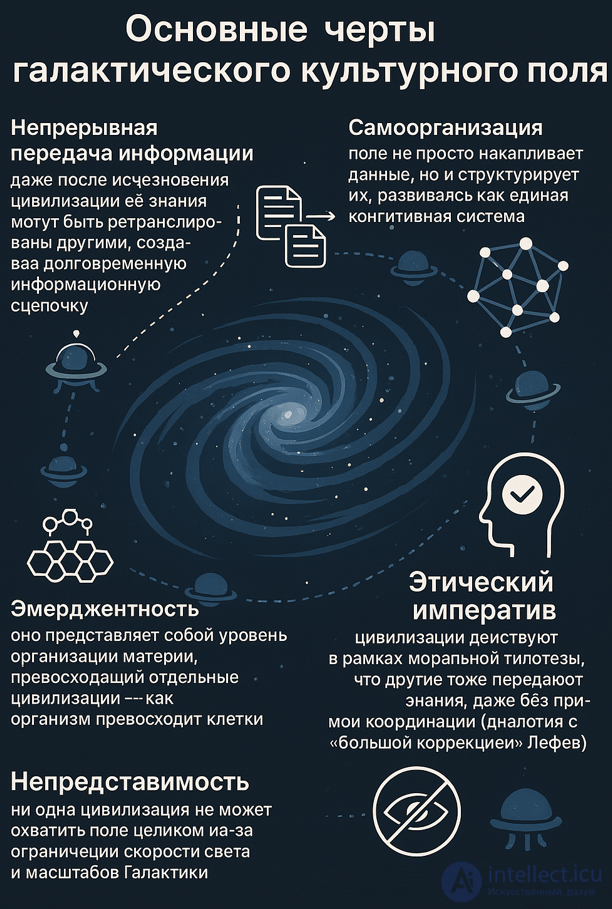
Continuous transmission of information: even after a civilization's disappearance, its knowledge may be relayed by others, creating a long-term informational chain.
Self-organization: the field does not merely accumulate data, but also structures it, developing as a unified cognitive system.
Emergence: it represents a level of organization of matter that surpasses individual civilizations — just as an organism surpasses its cells.
Inconceivability: no single civilization can grasp the field in its entirety due to the limitations of the speed of light and the scale of the Galaxy.
Ethical imperative: civilizations act within a moral hypothesis that others also transmit knowledge, even without direct coordination (an analogy with Lefebvre's "Great Correction").
If we accept that Earth's civilization is not a unique manifestation of cosmotechnological intelligence in the Galaxy, then a natural question arises: how are these civilizations connected to one another — if not in space, then at least in time?
Imagine that the transmission of even a single signal from a post-singular civilization is highly likely to be received and relayed further by at least one other. This idea leads us to a state of contact saturation — a special phase in the evolution of the Galaxy in which the network of intercivilizational signals becomes self-sustaining.
This state resembles a phase transition in physics: a small change in parameters (in this case, the number of civilizations or the duration of their existence) leads to a sharp change in the entire system. Here, positive feedback plays a key role: receiving information from outside extends the cognitive activity of civilizations, strengthens their stability, and stimulates further transmission of knowledge.
When flows of information begin to be transmitted between civilizations, including those that have vanished, a unified cultural field is formed. It:
does not require symmetrical connection (civilizations may not know about each other directly);
accumulates and transforms knowledge, even if the sources perished long ago;
develops, acquiring properties of self-organization and evolution.
This field is no longer merely the sum of individual pieces of knowledge, but a new superstructure that exists independently of specific intelligent species.
Such a field becomes a qualitatively new level of organization of matter, comparable to the transition from individual cells to an organism:
It lives longer than any civilization.
It processes more information than any technological system.
It is unknowable from within: due to the limitations of the speed of light and distances, no single civilization is able to "see" the cultural field in its entirety.
Interestingly, civilizations within such a field are like neurons in a brain, unaware of themselves. A participant in a global coherent process may not even suspect its existence, although it actively takes part in it — transmitting, altering, losing, and gaining knowledge, following a logic that surpasses individual thought.
The cultural field emerging in the Galaxy is not merely an informational relic, but an active form of ethical self-organization of a multitude of cosmic subjects. This stage of cosmic evolution can well be interpreted as a variant of the "Great Correction" proposed by V. A. Lefebvre.
In his model, civilizations, lacking the ability to coordinate their actions directly, act on the basis of a moral imperative — as if all others were acting the same way. This requires trust in the universality of reason and implies that the highest form of behavior is the informational-ethical design of the future, even without any guarantee of receiving a response.
If at least several dozen highly developed communicative civilizations exist simultaneously in the Galaxy, their messages — even ones not addressed to specific recipients — can create a coherent environment with growing information and increasing structural complexity. In this case:
Each message is an act of trust in the Universe.
Each civilization is a relay and transformer of ethical experience.
Even the silence of the cosmos turns out not to be proof of absence, but a consequence of the extreme difficulty of detection.
Suppose there are 10,000 civilizations in the Galaxy. Then the nearest one would be about 750 light-years away. Given that even post-singularity civilizations have only a planetary energy budget, they cannot afford omnidirectional beacons. This means:
Cosmic miracles are excluded.
Contact is possible only through ultra-precise, narrowly directed transmissions.
Searching for other civilizations requires expenditures comparable to the full resource potential of a developed civilization.
We see nothing — not because "they don't exist," but because we have not yet developed to the stage at which contact becomes a vital necessity.
For now, Earth's civilization feels no internal pressure to go beyond science. But when internal sources of knowledge are exhausted, external data, even if random, will become invaluable. It is then that SETI will cease to be a marginal program and will become the key to the next phase of evolution — civilization as an element of the Galaxy's cognitive ecosystem.
Such an approach requires:
Development of methods for detecting weak signals.
Preparation for recognizing non-anthropocentric meanings.
Evolution toward systems capable of integrating fragmented and implicit messages.
The creation and development of the cultural field is a movement of reason toward transcending itself, toward the formation of new levels of organization of matter:
Super-individual ones.
Super-temporal ones.
Super-conceptual ones (in terms of our current philosophies and sciences).
This is not merely an informational structure — it is a noetic organism in which reason participates as a process, not as a subject.
The Galactic cultural field is not merely a hypothesis about a possible connection between extraterrestrial minds. It is a model of the deep interconnection and self-development of information on a Galactic scale, in which even lost civilizations continue to be part of a single mind — a mind without a center, without a body, and, perhaps, even without a final goal.

Comments