
Lecture
The Age of Enlightenment is one of the fascinating epochs (the period of the "long eighteenth century") in the history of European culture, associated with the development of scientific, philosophical, and social thought.
This intellectual movement was grounded in rationalism and freethinking. The Age of Enlightenment is separated from the age of humanism by the era of the religious Reformation and the Catholic reaction.
Having begun in England under the influence of the scientific revolution of the seventeenth century, this movement spread to France, Germany, Russia, and encompassed other states and countries of Europe. The French philosophes were especially influential, becoming "masters of thought." The principles of the Enlightenment formed the basis of the American Declaration of Independence and the French Declaration of the Rights of Man and of the Citizen.
The intellectual movement of this era had a major influence on the subsequent changes in the ethics and social life of Europe and America, on the struggle for national independence of the American colonies of European countries, on the abolition of slavery, and on the formulation of human rights. It also undermined the authority of the aristocracy and the influence of the Church on social, intellectual, and cultural life.
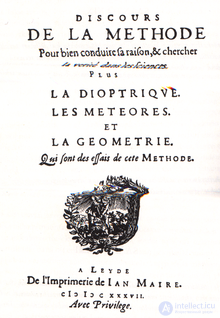
Descartes' "Discourse on the Method"
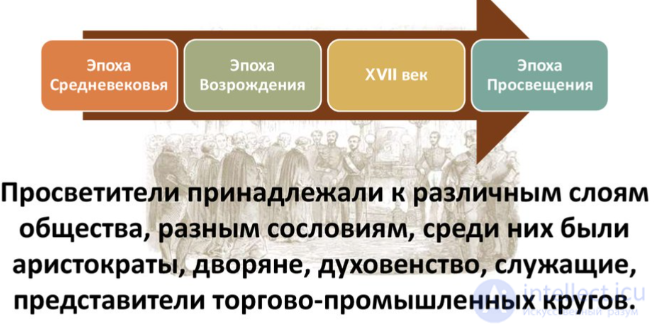
The term enlightenment itself entered the Russian language, as it did English (The Enlightenment) and German (Zeitalter der Aufklärung), from the French (siècle des lumières), and refers primarily to the philosophical movement of the eighteenth century. At the same time, it is not the name of any single philosophical school, since the views of Enlightenment philosophers often differed substantially from one another and even contradicted each other. Enlightenment is therefore considered not so much a specific direction of philosophical thought as a complex of ideas. The philosophy of the Enlightenment was grounded in a critique of the traditional institutions, customs, and morality that existed at the time.
There is no single consensus on the dating of this worldview-defining era. Some historians place its beginning at the end of the seventeenth century (or even its middle), while others place it in the middle of the eighteenth century. In the seventeenth century, Descartes laid the foundations of rationalism in his work "Discourse on the Method" (1637). The end of the Age of Enlightenment is often associated with the death of Voltaire (1778) (the same year Jean-Jacques Rousseau died) or with the beginning of the Napoleonic Wars (1803–1815). At the same time, there is a view that ties the boundaries of the Enlightenment era to two revolutions: the "Glorious Revolution" in England (1688) and the Great French Revolution (1789).
During the Age of Enlightenment there was a departure from a religious worldview and a turn to reason as the sole criterion for the understanding of man and society. For the first time in history, the question of the practical application of scientific achievements for the benefit of social development was raised.
Scholars of a new type sought to disseminate knowledge, to popularize it. Knowledge was no longer meant to be the exclusive possession of a select and privileged few, but was to be accessible to all and to have practical benefit. It became a subject of public communication and public discussion. Even those who had traditionally been excluded from learning — women — could now take part in these discussions. Special publications aimed at them even appeared, for example, the 1737 book "Newtonianism for Ladies" by Francesco Algarotti. It is characteristic how David Hume begins his essay on history (1741):
There is nothing I would recommend more earnestly to my female readers than the study of history, as an occupation of all others best suited both to their sex and education, much more instructive than their ordinary books of amusement, and more entertaining than those serious compositions which are usually to be found in their closets.
— "Essay of the study of history" (1741).
The culmination of this drive to popularize knowledge was the publication of Diderot and others' "Encyclopédie" (1751-1780) in 35 volumes. It was the most successful and significant "project" of the century. This work brought together all the knowledge accumulated by humanity up to that time. It clearly explained every aspect of the world, life, society, the sciences, crafts and technology, and everyday things. And this encyclopedia was not the only one of its kind. Others had preceded it, but only the French one became so famous. Thus, in England, Ephraim Chambers published a two-volume "Cyclopaedia" in 1728 (from the Greek for "circular instruction"; the words "-pedia" and "pedagogy" share the same root). In Germany, between 1731 and 1754, Johann Zedler published the "Great Complete Universal Lexicon" (Großes Universal-Lexicon) in 68 volumes. It was the largest encyclopedia of the 18th century, containing 284,000 headwords. By comparison, the French "Encyclopédie" had 70,000. But, firstly, the French encyclopedia became more famous, even among contemporaries, because it was written by the most celebrated people of the time, and this was widely known, whereas the German lexicon was compiled by a great many authors unknown to anyone. Secondly, its articles were more controversial, polemical, open to the spirit of the age, and in part revolutionary; they were struck out by censors, and there was persecution. Thirdly, by that time French, not German, had already become the international language of science.
Alongside the general encyclopedias, specialized ones also appeared, devoted to various individual sciences, which by then had grown into a separate literary genre.
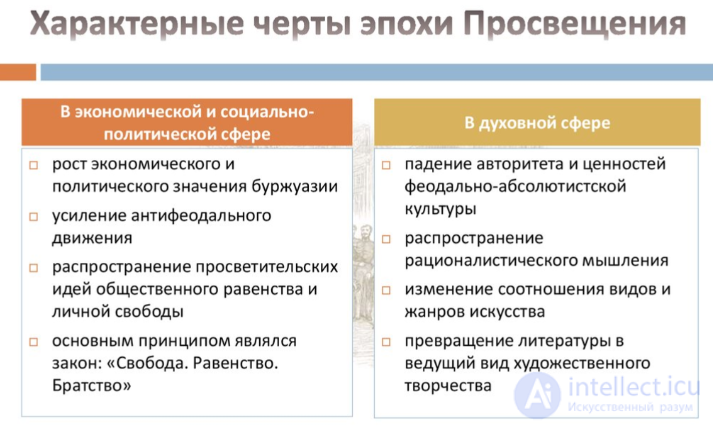
Latin ceased to be the language of science. Its place was taken by French. Ordinary, non-scholarly literature, meanwhile, was written in national languages. Among scholars a great dispute arose at the time over languages: whether modern languages could supplant Latin. On this subject, and indeed on the whole question of the superiority of antiquity over modernity, Jonathan Swift, the famous Enlightenment figure and author of "Gulliver's Travels," wrote, for example, the satirical tale "The Battle of the Books," published in 1704. In the fable of the spider and the bee contained in this tale, he expressed brilliantly and wittily the essence of the dispute between the supporters of ancient and modern literature.
The principal aspiration of the age was to discover, through the workings of human reason, the natural principles of human life (natural religion, natural law, the natural order of economic life according to the Physiocrats, and so on). From the standpoint of such rational and natural foundations, all historically formed and actually existing forms and relations were subjected to criticism (positive religion, positive law, and so on).
The views of the thinkers of this era contain many contradictions. The American historian Henry May distinguished four phases in the development of the philosophy of this period, each of which, to some degree, negated the one before it.
The first was the phase of moderate, or rational, Enlightenment, associated with the influence of Newton and Locke. It was characterized by religious compromise and a perception of the universe as an ordered and balanced structure. This phase of the Enlightenment is a natural continuation of the humanism of the 14th-15th centuries as a purely secular cultural movement, characterized moreover by individualism and a critical attitude toward tradition. But the Age of Enlightenment is separated from the age of humanism by the period of the religious Reformation and the Catholic Counter-Reformation, when theological and ecclesiastical principles once again gained the upper hand in the life of Western Europe. The Enlightenment continues the traditions not only of humanism but also of progressive Protestantism and rationalist sectarianism of the 16th and 17th centuries, from which it inherited the ideas of political freedom and freedom of conscience. Like humanism and Protestantism, the Enlightenment took on a local and national character in different countries. The transition from the ideas of the Reformation era to the ideas of the Age of Enlightenment can be observed most conveniently in England at the end of the 17th and beginning of the 18th centuries, when deism developed — deism being, to a certain extent, both the culmination of the religious evolution of the Reformation era and the beginning of the so-called "natural religion" preached by the Enlightenment thinkers of the 18th century. There existed a conception of God as the Great Architect, resting from his labors on the seventh day. To mankind he had granted two books — the Bible and the book of nature. Thus, alongside the caste of priests there now emerged a caste of scholars.
The parallelism between spiritual and secular culture in France gradually led to the discrediting of the former for hypocrisy and fanaticism. This phase of the Enlightenment is called skeptical and is associated with the names of Voltaire, Holbach, and Hume. For them, the only source of our knowledge is unprejudiced reason. Related to this term are others, such as: the enlighteners, enlightenment literature, and enlightened (or educational) absolutism. The expression "the philosophy of the eighteenth century" is used as a synonym for this phase of the Enlightenment.
The skeptical phase was followed by the revolutionary phase, associated in France with the name of Rousseau, and in America with Paine and Jefferson. Characteristic representatives of the last phase of the Enlightenment, which spread in the nineteenth century, are philosophers such as Thomas Reid and Francis Hutcheson, who returned to moderate views and respect for morality, legality, and order. This phase is called didactic.
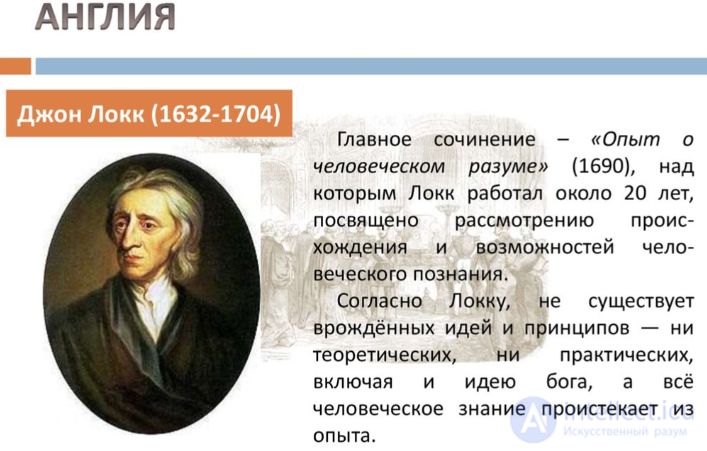
A characteristic enlightenment idea is the denial of all divine revelation, which particularly affected Christianity, considered the primary source of errors and superstitions. As a result, the choice fell on deism (God exists, but He only created the World and thereafter does not intervene in anything) as a natural religion, identified with morality. Disregarding the materialist and atheist convictions of some thinkers of this era, such as Diderot, the majority of the enlighteners were followers of deism precisely, who through scientific arguments tried to prove the existence of God and His creation of the universe.
In the Age of Enlightenment, the universe was regarded as an astonishing machine, which is an efficient cause rather than a final one. God, after creating the universe, does not intervene in its further development and in world history, and man, at the end of his journey, will be neither condemned nor rewarded by Him for his deeds. Laicism becomes the guide for people in their moral behavior, the transformation of religion into a natural morality, whose commandments are the same for everyone. The new concept of tolerance does not exclude the possibility of professing other religions only in private life, not in public.
The Enlightenment's attitude toward the Christian religion and its connection with civil authority was not the same everywhere. Whereas in England the struggle against absolute monarchy had already been partly resolved through the 1689 "Bill of Rights", which officially put an end to religious persecution and relegated faith to the subjective-individual sphere, in continental Europe the Enlightenment retained a sharp hostility toward the Catholic Church. States began to take the position of independence of domestic policy from the influence of the papacy, as well as an ever-increasing restriction of the curia's autonomy in church matters.
The Jesuits, uncompromising defenders of papal authority, amid the growing conflict between church and state and public opinion calling for the destruction of the order, were expelled from almost all European countries. In 1759 they were driven out of Portugal, followed by France (1762) and Spain (1769). In 1773 Pope Clement XIV published the brief Dominus ac Redemptor, in which he decreed the dissolution of the Society of Jesus. All the order's property was confiscated and, for the most part, directed toward the creation of public institutions controlled by the state. However, the Jesuits did not disappear entirely from Europe, since in Russia Catherine the Great, although quite close to the idea of the Enlightenment, refused to publish the papal brief on the dissolution.
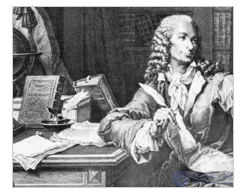
Portrait of Voltaire from the palace of the Prussian king Frederick the Great, Sanssouci. Engraving by P. Baquoy.
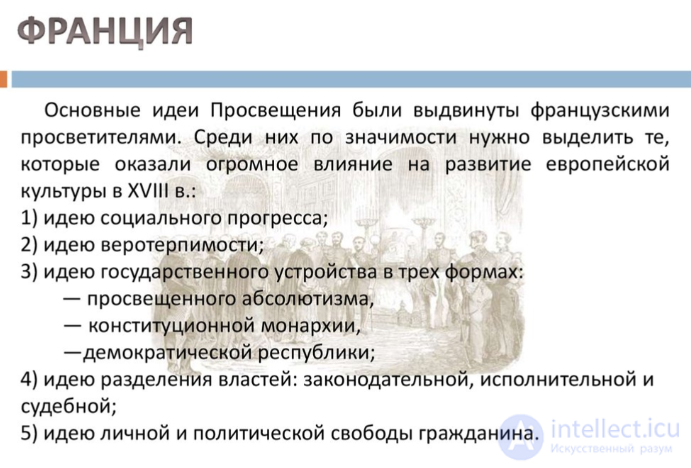
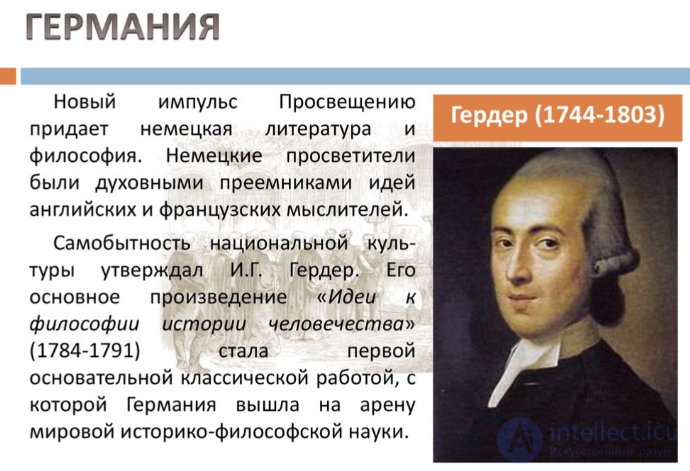
French enlightenment literature, represented by Voltaire, Montesquieu, Rousseau, Diderot, and other writers, gained pan-European significance in the eighteenth century. Their common trait was the dominance of rationalism, which in France directed its criticism toward political and social issues, whereas the German enlighteners of this era were more occupied with resolving religious and moral questions.
Under the influence of the ideas of the Enlightenment, reforms were undertaken that were meant to restructure the whole of social life (enlightened absolutism). But the most significant consequence of the ideas of the Enlightenment was the American Revolution and the Great French Revolution.
At the beginning of the 19th century, the Enlightenment provoked a reaction against itself, which, on the one hand, was a return to the old theological worldview, and on the other, a turn toward the study of historical activity, which had been greatly neglected by the ideologists of the 18th century. Already in the 18th century, attempts were made to define the essential character of the Enlightenment. Of these attempts, the most remarkable belongs to Kant (An Answer to the Question: What Is Enlightenment?, 1784). The Enlightenment is not the replacement of one set of dogmatic ideas with another set of dogmatic ideas, but independent thinking. In this sense, Kant contrasted enlightenment with enlightenment as process and declared that it is simply the freedom to use one's own intellect[14].
Contemporary European philosophical and political thought, liberalism for example, largely derives its foundations from the Age of Enlightenment (John Locke is considered the founder of economic liberalism). Philosophers of our time consider the strict geometric order of thought, reductionism, and rationalism to be the principal virtues of the Enlightenment, contrasting them with emotionality and irrationalism. In this respect, liberalism owes its philosophical basis and its critical attitude toward intolerance and prejudice to the Enlightenment. Among the well-known philosophers who hold such views are Berlin and Habermas.
The ideas of the Enlightenment also underlie political freedoms and democracy as the fundamental values of modern society, as well as the organization of the state as a self-governing republic, religious tolerance, market mechanisms, capitalism, and the scientific method. Since the Age of Enlightenment, thinkers have insisted on their right to seek the truth, whatever it may be and whatever threat it may pose to the foundations of society, without being subjected to threats of punishment "for the Truth."
After the Second World War, with the birth of postmodernism, certain features of modern philosophy and science came to be regarded as shortcomings: excessive specialization, disregard for tradition, unpredictability and the danger of unforeseen consequences, as well as an unrealistic assessment and romanticization of the figures of the Enlightenment. Max Horkheimer and Theodor Adorno even considered the ideology of the Enlightenment a "totalitarian system" that led, in particular, to fascism and the Holocaust.
The eighteenth century entered the history of culture as the Age of Enlightenment. This is the period of the industrial revolution and the transfer of political power into the hands of a new class - the bourgeoisie. The long era of the dominance of traditional agrarian culture comes to an end. As a result of the industrial revolution, a new industrial culture becomes established. But it is also a period of political revolutions in Europe, handing power over to the industrial bourgeoisie. The essential content of industrial culture is a three-tier system of machines and mechanized technologies. Changes in technical and technological culture require renewal in the economic, social, and political spheres. A wave of innovation sweeps through the entire edifice of culture. First and foremost, science changes - its place and role in society changes. Agrarian production rests on practical knowledge acquired by man through experience. It is in fact neutral, indifferent to scientific knowledge. But mechanical production, machines as technical devices, outgrow empirical knowledge, manual labor, and craft. They require the technological application of science. Science is transformed, both objectively and subjectively, into a direct productive force. Moreover, investments in science began to yield profit, became economically expedient. The culture of the Enlightenment is precisely a reflection of the changing role of science in production and in society. If the preceding stages of culture marked the transition from myth to religion, and the transition to Logos (reason) was but an exception found only in ancient Greece, then the Enlightenment demonstrates the transition from religion to science. Above all, culture pondered its own foundations: what lies at the base - good or evil, reason or feeling, harmony or conflict - and cultural shifts begin with the clarification of these questions. In 1705 Mandeville's pamphlet "The Grumbling Hive" appeared, and then, in 1714, he wrote "The Fable of the Bees." The conclusion Mandeville draws rests on the thesis that "private vices produce public benefits." Thus conflict, greed, evil, and injustice are necessary aspects of culture, and it is pointless to try to eliminate them from life. Using the example of a beehive, Mandeville depicts the life of society: as long as the bees worked together in harmony and did not think about virtues, the hive lived and prospered. But as soon as the bees were seized by a passion for virtue and a hatred of vice, a commotion arose, a bear heard it, came, and destroyed the hive. Is it not the same in society? As long as everyone works, society lives, but as soon as conflicts begin, the sciences and arts that serve the wealthy cease to develop, fall into decline, unemployment begins, and society disintegrates and weakens. A stronger adversary then subjugates it. The conclusion to which Mandeville leads the reader is that society and culture are founded on deceit, greed, and injustice. Shaftesbury upholds the exact opposite position. In 1711 his book "Characteristics of Men, Manners, Opinions, Times" was published. In it the author asserted that modern society is founded on harmony. Harmony and accord are not only attainable but already really exist in the world. It is natural for man to be drawn toward goodness, justice, and reasonable actions, while greed and evil are a deviation from the norm - a moral deformity, since every normal person is inclined toward mutual aid. Thus an antinomy was exposed - whether good or evil lies at the foundation of culture, reason or unreason, harmony or conflict. The Enlightenment attempts to resolve this antinomy by acknowledging that good forms the basis of culture, while evil must be fought, because it can be uprooted. After all, evil is an anomaly, a deformation of culture. But evil cannot be fought by resorting to methods in which evil itself would predominate. Society must not resort to methods of violence, since violence begets violence and evil rather than eradicating it from culture. Therefore, in transforming culture, one must resort to means adequate to and consistent with culture. The champions of the Enlightenment proposed to renew and perfect culture by cultural means. The Enlightenment thinkers consciously took the standpoint of goodness, reason, and justice - a reason that would not reconcile itself with unreason, with religion, occultism, superstition, with "darkness" and ignorance.
The culture of the Enlightenment did not remain unchanged: emphases, attitudes, and ideas shifted. Three stages are usually distinguished in the development of the culture of the Enlightenment:
The Age of Enlightenment is of fundamental significance for the subsequent history of Western Europe. It became a time in which art splintered into a growing number of trends and movements. The eighteenth century in the history of Western European civilization became the century of Reason and Enlightenment.

Comments