
Lecture
Cultural studies (from Latin cultura "cultivation, tillage; upbringing" + Ancient Greek λόγος "thought as cause") is a body of research studying culture as a structural whole.
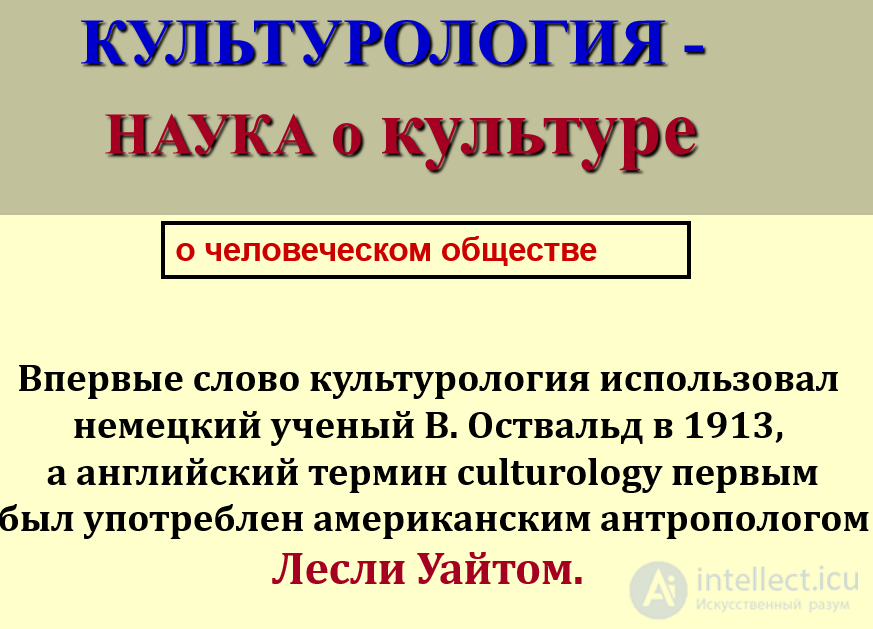
The term "cultural studies" was proposed by the American anthropologist Leslie White to designate a new scientific discipline as an independent science within the complex of social sciences. However, in foreign scholarly classification, cultural studies is not singled out as a separate science. In English-speaking countries this field of knowledge is called cultural studies, while in German-speaking countries it is called Kulturwissenschaft. In Europe and America the phenomenon of culture is understood predominantly in a socio-ethnographic sense, so the main science in this area is considered to be cultural anthropology.
The subject of cultural studies is the study of the phenomenon of culture as the historical-social experience of people, which is embodied in specific norms, laws and features of their activity, is passed down from generation to generation in the form of value orientations and ideals, and is interpreted in the "cultural texts" of philosophy, religion, art, and law.
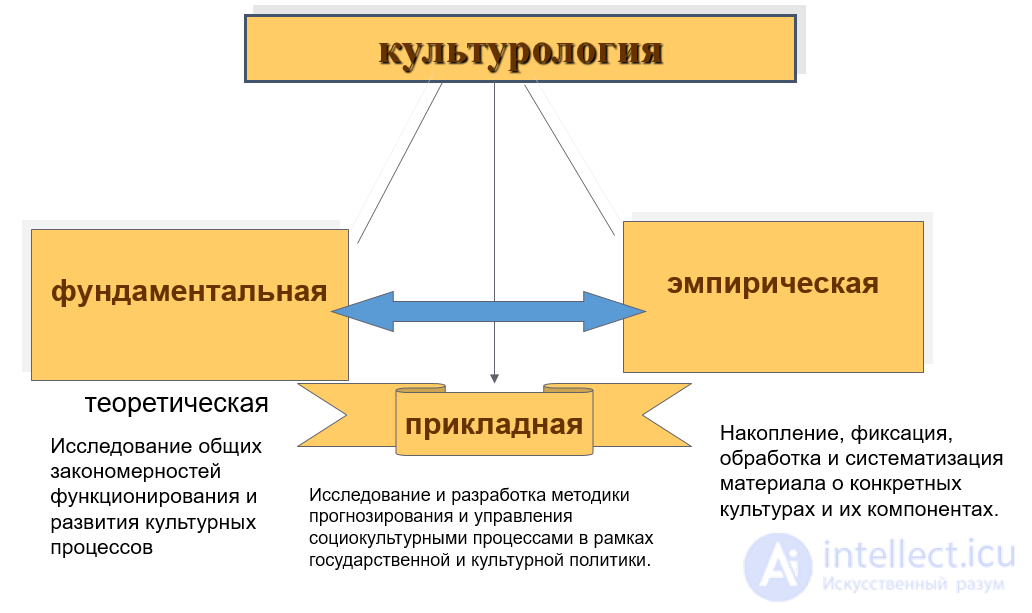
The purpose of cultural studies today is to teach a person at the level of culture, as its creator. Depending on the goals and subject areas, the level of knowledge and generalization, fundamental and applied cultural studies are distinguished.
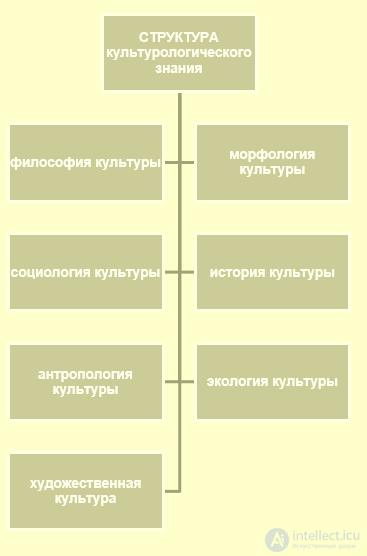
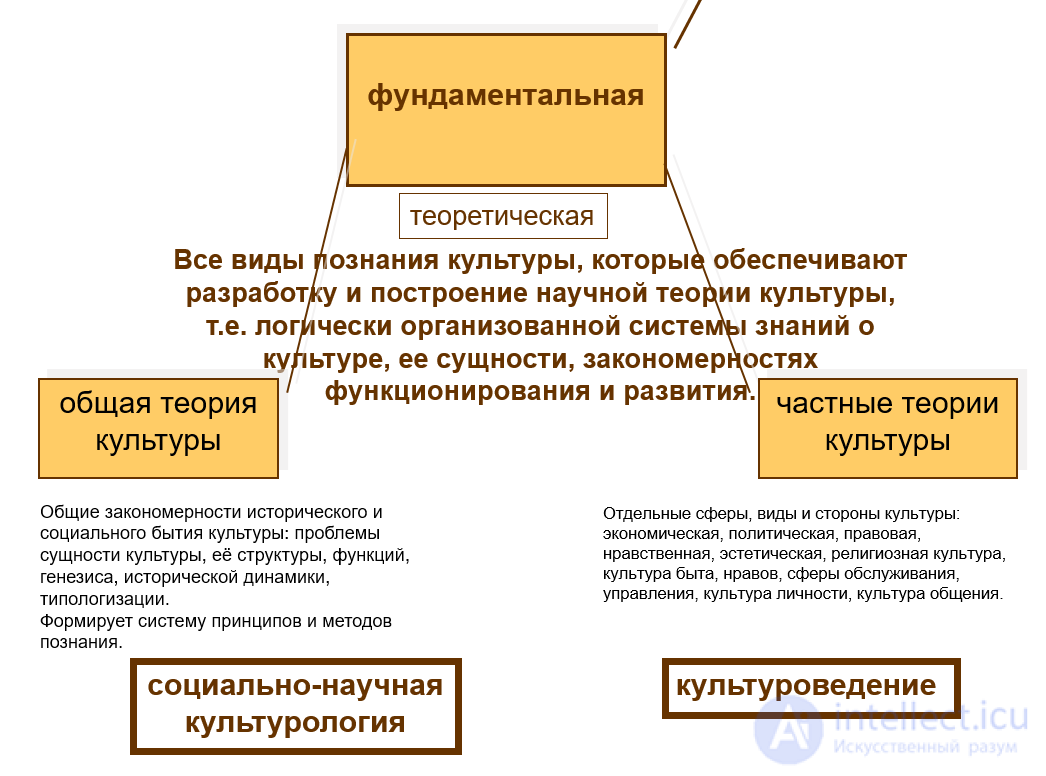
Fundamental cultural studies examines culture with the aim of theoretical and historical understanding of this phenomenon, and is engaged in developing a categorical apparatus and research methods; at this level, the philosophy of culture can be singled out.
Applied cultural studies, relying on fundamental knowledge about culture, studies its individual subsystems — economic, political, religious, artistic — with the aim of forecasting, designing, and regulating current cultural processes.
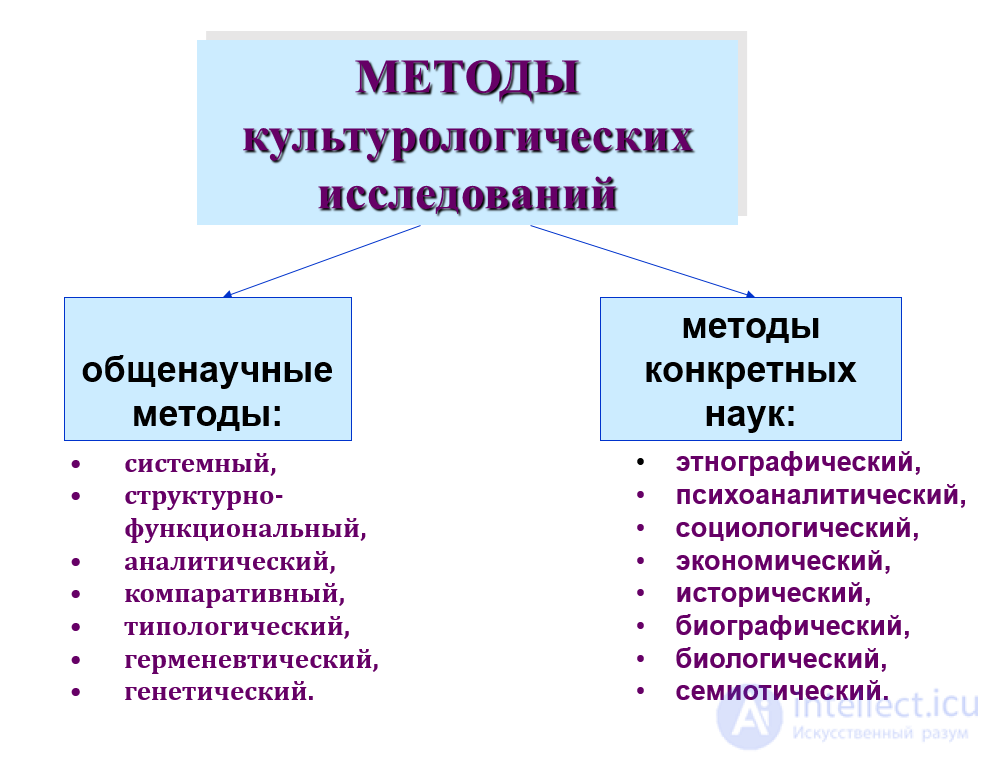
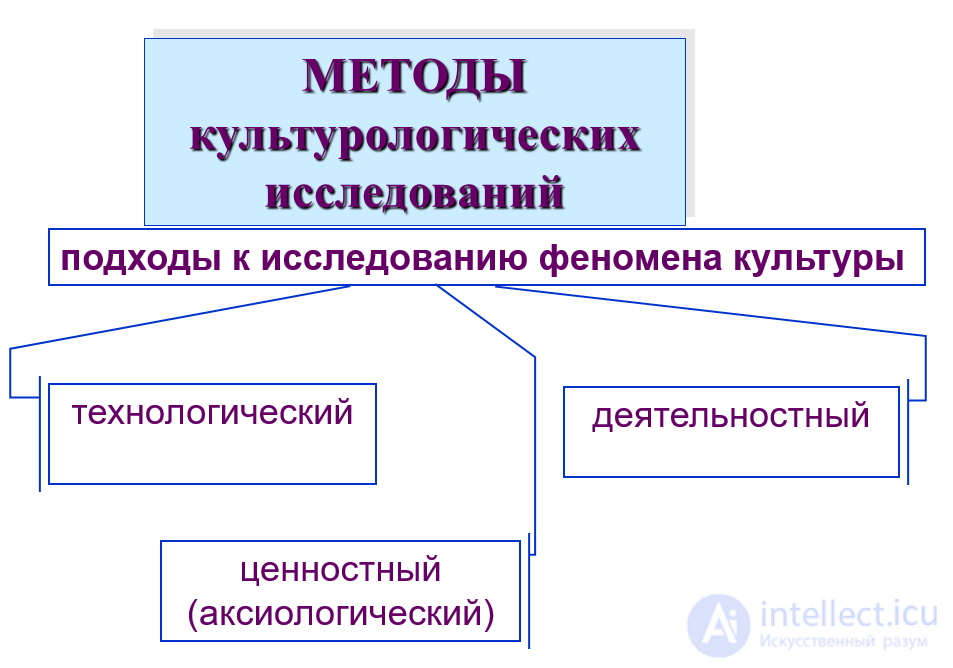
The methods of cultural studies include:
The Oxford English Dictionary records the use of the word "culturology" in the sense of "the science or study of culture" beginning in 1920. American anthropologist Leslie White (1900-1975) popularized the term "culturology" among modern English-speaking social scientists. White defined culturology as a field of science devoted to the study of culture and cultural systems. He notes that "culturology" was previously known as "the science of culture," as defined by English anthropologist Edward Burnett Tylor in his 1872 book "Primitive Culture." White also notes that he introduced the term in 1939, and that the term first appeared in English dictionaries in 1954. He also notes that the corresponding German term, Kulturwissenschaft, was introduced by Wilhelm Ostwald in 1909.
Following White, philosopher of science Mario Bunge (1919-2020) defined culturology as the sociological, economic, political, and historical study of specific cultural systems. "Synchronic culturology" is considered to coincide with anthropology, sociology, economics, and the political ideology of cultures. In contrast, "diachronic culturology" is a component of history. According to Bunge, "scientific culturology" also differs from traditional culturological studies, since the latter are often the work of idealistically minded literary critics or pseudo-philosophers who are ignorant of the scientific method and incompetent in the study of social facts and specific social systems.
Bunge's systemic and materialist approach to the study of culture gave rise to numerous new areas of research in the social sciences. Fabrice Rivault, for example, was the first scholar to formalize and propose international political culturology as a subfield of international relations in order to understand the global cultural system, as well as its numerous subsystems, and to explain how cultural variables interact with politics and economics, influencing world affairs. This scientific approach differs radically from culturalism, constructivism, and cultural postmodernism, since it is based on logic, empiricism, systemism, and emergent materialism. International political culturology is studied by scholars around the world.



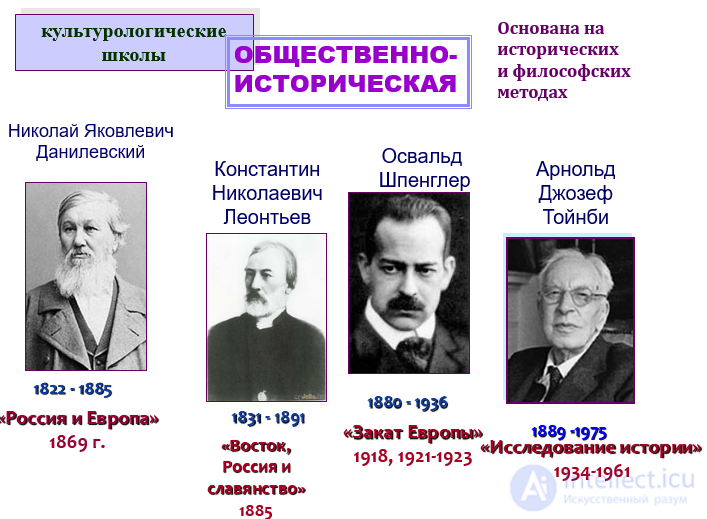
The socio-historical school has the longest-standing, "classical" traditions and traces back to Kant, Hegel, and Humboldt, grouping around itself mainly historians and philosophers, including religious ones. Its representatives include Spengler and Toynbee in Western Europe, and N. Y. Danilevsky in Russia.
The main features of the socio-historical school are the organicism of cultures (every culture has periods of birth, growth, flourishing, decline, and death), division into typologies, locality, and the absence of a single line of cultures.
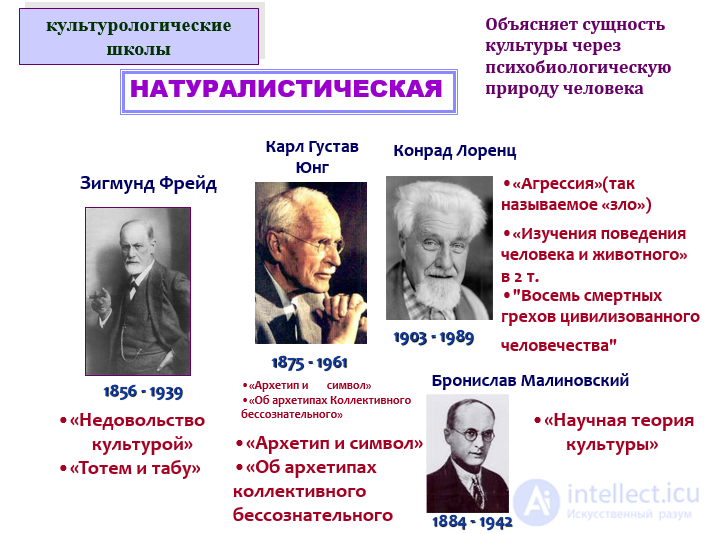
The main feature of this school is the desire to emphasize the biological conditioning of culture. This trend unites mainly physicians, psychologists, and biologists, who attempt to explain culture based on the psychobiological nature of man. Its main representatives are Sigmund Freud, Carl Jung, Konrad Lorenz, and Bronisław Malinowski.
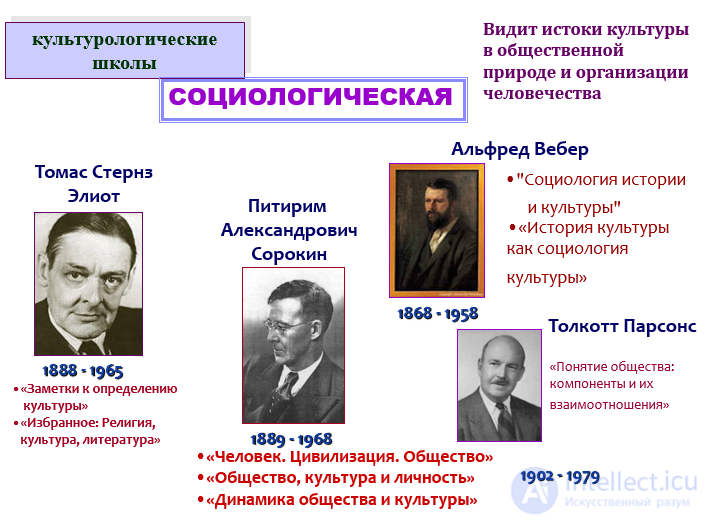
At the center of culturological attention for representatives of this school is society itself, its structure and social institutions. The defining idea of this school is that culture is a product of society. Its main representatives are Thomas Eliot, P. A. Sorokin, and Alfred Weber.
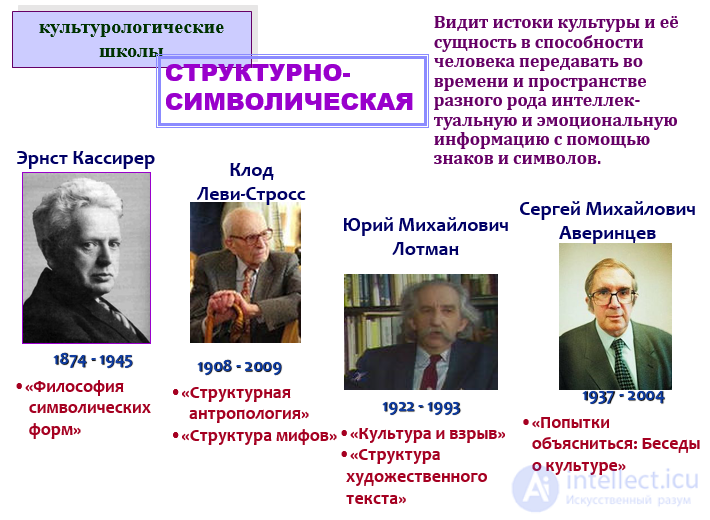
The youngest and one of the most influential modern schools. All processes occurring in culture are regarded by representatives of this school as purely communicative. Culture is understood as a kind of sign system created by man by virtue of his uniquely inherent capacity for symbolization, and through it, for mutual exchange of information. Its main representatives are Ferdinand de Saussure, Ernst Cassirer, and Claude Lévi-Strauss.
The formation of cultural studies as a science in Russia is associated with the work of the Soviet and Armenian scholar Eduard Sarkisovich Markarian (1929—2011) and his first studies in cultural studies in the 1960s—1970s, which opened up a new direction in Soviet science. At the turn of the 1980s—1990s, cultural studies in Russia received official recognition and was legalized as a field of science and higher education.
Over the past decades, the following main schools of cultural studies have taken shape in the Russian Federation — Russia:
Russian authors have developed a number of fundamental theories of the functioning of culture. In particular, these are the theory of culture as activity, according to which the historical development of culture is determined by the development of the entire system of social practice technologies; the theory of culture as an adaptive-adapting system, according to which culture not only passively adapts to the external conditions of its functioning but also actively adapts them; the theory of the balance of social and cultural dynamics, according to which, as the pace of a society's social development accelerates, the level of its local cultural distinctiveness decreases, and vice versa, and others.
In 1992, the Russian Institute for Cultural Research (formerly the Research Institute of Museology and the Protection of Historical and Cultural Monuments) began its work. Later, alongside the central branch located in Moscow, three more branches of the Institute opened: the Siberian branch (opened in 1993 in Omsk), the St. Petersburg branch (opened in 1997), and the Southern branch (opened in 2012 in Krasnodar). In 2014, the Institute for Cultural Research was merged with the D. S. Likhachev Russian Research Institute for Cultural and Natural Heritage.
In 2006, the Scientific and Educational Society of Cultural Studies (SESCS) was established, bringing together a significant number of Russian culturologists.
Russian universities have been training specialists in cultural studies since the early 1980s, and dissertation councils award academic degrees in the fields of history, theory and philosophy of culture, and philosophical anthropology. As a field of scientific research, cultural studies is on the rise due to the growing significance of such sociocultural processes as the "culture-centric" trend in the development of the modern world (globalization, multiculturalism, etc.)
Cultivation - to make cultured; to transform from a wild state into a cultured one, to introduce to culture
Decultivation - the partial loss by a society of the culturedness it previously possessed; a transition to a lower degree of culturedness. It is often used by unfriendly countries to destroy the culture of an adversary.
The main objectives of cultural studies:
Two orientations are distinguished in cultural studies:


Until the first half of the 19th century, the phenomenon of culture was examined through rational reflection on moral-legal and aesthetic norms of life and philosophical-theoretical consciousness. In the second half of the 19th century, with the development of various human sciences, culture began to be studied within a number of scientific-conceptual approaches of these disciplines (evolutionist, axiological, anthropological, formational, cyclical, sociological, and others), which became the foundation of the future field of cultural studies.
The term "cultural studies" was proposed in 1909 by the German philosopher Wilhelm Ostwald, who distinguished cultural studies from sociology. He used the term "cultural studies" to describe phenomena that constitute culture as a specifically human activity.
Cultural studies took shape as part of philosophy or within other sciences under its influence. At the same time, the methods and results of cultural studies research were used by philosophy. A significant contribution to the development of cultural studies was made by Oswald Spengler with his book "The Decline of the West" (1918), and by the theory of cultural supersystems of Pitirim Sorokin, set out in "Social and Cultural Dynamics" (1937-1941).
In 1939, the American philosopher Leslie White, independently of Wilhelm Ostwald, introduced the term "culturology" in relation to anthropological studies of culture. His work "The Science of Culture" (1949) contributed to the further separation of cultural studies into a distinct field of research and laid the foundation for a holistic approach to the study of cultural phenomena, contributing to the establishment of cultural studies as an independent science. According to White, cultural studies is a separate science that investigates the interrelations of cultural phenomena and represents a qualitatively higher level of understanding of both humanity and the world as a whole.
Ernst Cassirer developed a symbolic concept of culture based on humans' capacity for mass, systematic, and continuous symbolization. The Dutch culturologist Johan Huizinga, in his book "Homo Ludens - Man the Player" (1938), introduced into the study of culture the idea that play precedes culture and creates it, thereby laying the foundation for the play concept. In parallel, the biospheric concept of culture developed, according to which culture is a natural stage in the development of the Earth's and the universe's biosphere. The founder of this approach is considered to be the cosmist philosopher Vladimir Vernadsky. The English historian and philosopher Arnold Toynbee became one of the developers of civilizational theory in cultural studies, viewing world history as a collection of histories of independent civilizations.
In the second half of the 20th century, an ethological direction developed, absorbing psychoanalytic and play theories of culture, as well as anthropological research. The creators of this direction - Konrad Lorenz, Nikolaas Tinbergen, and others - founded the science of animal behavior in the 1930s, later extending their research to humans and human culture. In the 1960s in France, Claude Levi-Strauss, Michel Foucault, Roland Barthes, Jacques Derrida, and others formed the structuralist movement in cultural studies, extending structural analysis from linguistics and literary studies to sociocultural phenomena.
The Canadian culturologist, philosopher, and sociologist Herbert Marshall McLuhan began examining types of culture depending on the means of communication within them. His principal work was the book "The Gutenberg Galaxy" (1962). From the 1970s-1980s, poststructuralism developed in cultural studies - a set of directions oriented toward reconsidering the structuralist paradigm and seeking to revise many classical concepts of structuralism.
In the second half of the 20th century, considerable attention began to be paid to the phenomena of mass culture, the interrelations of culture and politics, and advertising. With the development of technology, cultural studies examines their influence on culture. Thus, in the 1980s-90s, research developed on internet culture, video art, and video games.
The term "cultural studies" became widespread in Eastern European countries, while in English-speaking countries the corresponding discipline is called Cultural Studies, and in German-speaking countries - Kulturwissenschaft. In these countries, the phenomenon of culture is understood predominantly in a socio-ethnographic sense, so the primary science is considered to be cultural anthropology. In addition to it, the leading sciences of culture became social anthropology, sociology, structural anthropology, historical cultural studies, semiotics, and post-cultural linguistics. In the Soviet Union, cultural studies, although not officially declared a bourgeois pseudoscience as genetics or cybernetics once were, was nevertheless significantly restricted due to inevitable philosophical objections.
In Ukraine, cultural studies was established as a compulsory academic discipline in 2003. The Higher Attestation Commission does not designate a separate "cultural studies" specialty, but culturologists have the opportunity to obtain an academic degree in specialty 26.00.01 — "history and theory of culture," which has three areas — art history, philosophy, and historical sciences (the corresponding academic degree is accordingly conferred in art history).

Comments