
Lecture
In Japan, as in most other countries, propaganda was a significant phenomenon throughout the 20th century.
Propaganda activity in Japan had been discussed since the Russo-Japanese War of the first decade of the 20th century. Propaganda activity peaked during the Second Sino-Japanese War and the Second World War. The scholar Koyama Eizō is credited with developing much of the Japanese propaganda apparatus of that time.
After the war, some actions of the democratic Japanese government were also discussed as a form of propaganda, for example instances of cooperation between anime producers and the Japan Self-Defense Forces.
The Russo-Japanese War (1904–1905) was a major war that ended in Japan's victory over the world power of the Russian Empire. It was a major victory for Japan, as it demonstrated to the world an eastern country's ability to defeat a Western power in a full-scale war. This war also became one of the first instances in which the Japanese nation presented to the world an image of the Japanese people as a unified, patriotic body whose people were capable of the greatest sacrifices for the good of their country. This led the Japanese propaganda machine, the Ministry of Foreign Affairs, to try to take control of the narrative about Japan and to gain a better understanding of world perceptions of the Japanese nation by collecting foreign newspapers that mentioned Japan. One such example is the Japanese attempt to misrepresent the words of the Turkologist Arminius Vámbéry, claiming that they had persuaded him to retract an article concerning his earlier anti-Japanese writings and the theme of the “yellow peril”.
Domestically, the Japanese propaganda machine displayed images of the war using various forms of visual media. The Ueno Panorama Hall and the Nippon Panorama Hall displayed images of the war to shape the image of the war in the minds of the Japanese people. This can be seen in Goseda Hōryū II's panorama of the Battle of the Sea of Japan.
With the advent of the first motion-picture camera, the use of cinema allowed ordinary residents of Japan's major cities to gain a visual sense of the course of the war. War films gave Japanese audiences their first opportunity to see thrilling and up-to-date visual news of the war as it unfolded. Moreover, the profits earned from filming war movies encouraged international film companies to take part in the enterprise and allowed Japanese audiences to see an international perspective on the war, in contrast to the one promoted by the Ministry of Foreign Affairs. This era also gave Japanese audiences the chance to feel like active participants in the war rather than passive spectators, as had been the case with the Japanese prints used during the First Sino-Japanese War.
Another type of media displaying propaganda about Japan in connection with the Russo-Japanese War was postcards distributed domestically after the war. Japan's victory filled it with enormous energy and pride at having defeated a great Western power. As a result, Japan began to be welcomed into the broader European world community and was finally recognized as a genuine world power. This new image of Japan can be seen on postcards distributed within the country. On one postcard titled “Japan at the Center of International Communications”, Japan is shown on a map alongside European countries. Although it is not placed directly at the center, the postcard depicts Japan at the edge of Europe. This reflects Japan's growing sense of itself as a significant player on the world stage and a dominant nation in Asia, while also sowing nationalist sentiment. A second postcard from 1911, titled “Map of Japan” and commemorating the crown prince's visit, vividly demonstrates the beginnings of Japanese colonial ambitions by adding countries acquired by Japan, such as Korea, annexed in 1910.
To secure support for its invasion of northeastern China, Japan waged a propaganda campaign in the 1930s whose themes were repeated for months in newspaper headlines.
After the invasion of Manchuria, the Japanese army increasingly regarded Mongolia as a target. From the early 1930s, cultural works were published, sometimes backed by Western authors, to emphasize a special relationship between Japan and the Mongols as a precursor to military incursions into the region. Mongolia's importance to Japan declined after it shifted its strategy to focus on southern China and Southeast Asia.
Japanese propaganda in the period immediately before and during the Second World War was intended to support the ruling regime. Many of its elements echoed prewar themes of Shōwa Statism, including the principles of kokutai (self-government), hakkō ichiu (self-government), and bushido (self-government). New forms of propaganda were devised to convince occupied countries of the benefits of the Greater East Asia Co-Prosperity Sphere, to undermine the morale of American troops, to refute claims of Japanese atrocities, and to present the war to the Japanese people as a victorious one. It began with the Second Sino-Japanese War, which grew into the Second World War. A wide variety of media were used to spread its messages.
Japanese propaganda during the Second World War portrayed the war as a defense against Western influence and hostility. It portrayed the Japanese as victims who would have to fight for their independence and freedom. Japanese propaganda generally worked to demoralize Allied troops and often used racial themes to highlight Japan's oppression by Western culture. Common Japanese propaganda depicted Roosevelt and the American people as “sexually depraved” and as demons. Japanese propaganda material (see image) aimed at Australian soldiers described in detail an Australian soldier far from home and fighting, while an American took his wife. This material was intended to weaken American-Australian relations.
Part of Japanese propaganda was aimed at African-American soldiers and exploited the racist atmosphere in America to stoke “anti-war sentiment”. Propaganda was circulated to highlight Japanese morality in comparison with American racism, typically noting that a Japanese victory would secure freedom from discriminatory white American oppression; it drew on the brutal history of African Americans to heighten the propaganda's effect. The propaganda provoked varied responses; in some cases it “resonated strongly” with African-American soldiers, and a 1944 survey found that 70% harbored “doubts about the importance of the war to them personally”.
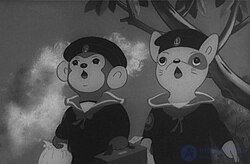
A screenshot from the film “Momotaro, Sacred Sailors”, in which Monkey and Puppy say goodbye.
The Film Law of 1939 mandated the “healthy development of the industry”, banning films of a sexual nature and films dealing with social problems. These films often fostered the formation of national consciousness, adequately reflected the national and international situation, and generally contributed to “public welfare”.
The use of propaganda during the Second World War was widespread, and film became an effective form employed by the Japanese government. Japanese films were made for a far broader audience than American films of the same period. Beginning in the 1920s, Japanese film studios released films legitimizing the colonial project, set in their colonies in Taiwan, Korea, and mainland China. By 1945, the production of Japanese-led propaganda films had spread across much of their empire, including Manchuria, Shanghai, Korea, Taiwan, Singapore, Malaya, the Philippines, and Indonesia.
In China, Japan made extensive use of propaganda films. After the Japanese invasion of China, cinemas were among the first institutions to reopen. Mostly newsreels, Japanese feature films, or propaganda shorts were shown, paired with traditional Chinese films. Films were also used in other conquered Asian countries, typically with the theme of Japan as the savior of Asia from Western tyrants, or recounting the history of friendly relations between the countries, such as the film “The Japan You Don't Know”.
China's rich history and exotic locations made it a favorite subject for Japanese filmmakers for more than a decade before the outbreak of the Second Sino-Japanese War (1937–1945). Of particular note is the popular trio of “continental goodwill films” (大陸親善映画), set on the Chinese mainland, starring Hasegawa Kazuo as the Japanese romantic hero and Ri Kōran (Yoshiko Yamaguchi) as his Chinese love interest. Among these films, “Song of the White Orchid” (1939, 白蘭の歌), “China Nights” (1940, 支那の夜), and “Vow in the Desert” (1940, 熱砂の誓い) blended romantic melodrama with propaganda to present a figurative and literal blending of the two cultures on screen.
“National policy films”, or propaganda images used in the Second World War, included combat films such as “Mud and Soldiers” (1939, 土と兵隊) and “Five Scouts” (1938, 五人の斥候兵), spy films such as “The Spy Isn't Dead Yet” (1942, 間諜未だ死せず) and “You Are Targeted” (1942, あなたは狙われている), and lavish historical pictures such as “Son Goku” (1940, 孫悟空) and “Genghis Khan” (1943, 成吉斯汗). In the early stages of the war with China, so-called “humanist war films”, such as “Five Scouts”, tried to portray the war without nationalism. But in the case of “Pearl Harbor”, the Home Ministry demanded more patriotism and “national policy themes” — that is, themes of war. Japanese directors of war films set in China had to refrain from overt anti-Chinese rhetoric, since the risk of alienating the very cultures the Japanese claimed to be “liberating” from the yoke of Western colonial oppression was a powerful deterrent, beyond pressure from the government. Nevertheless, as the war in China grew harsher for Japan, action films such as “Tiger of Malaya” (1943, マライの虎) and spy dramas such as “The Man from Chongqing” (1943, 重慶から来た男) more openly criminalized China, portraying it as an enemy of the Empire. In contrast to depictions of China as backward and inflexible, Western countries were often portrayed as excessively pampered and decadent. Such negative stereotypes had to be adjusted when Japanese filmmakers were asked to cooperate with Nazi film crews on a number of joint Axis projects following the conclusion of the Tripartite Pact.
As Western countries increasingly fought in the Pacific theater of war, the Japanese likewise directed their prejudices against them. In the film “Fire on That Flag!” (1944, あの旗を撃て!), the cowardice of fleeing American troops is contrasted with the moral superiority of the Imperial Japanese Army during the occupation of the Philippines. The first full-length Japanese animated film, “Momotaro, Sacred Sailors” (1945, 桃太郎海の神兵), similarly portrays Americans and British in Singapore as morally corrupt and physically weak “devils”. A subcategory of costume films is the samurai film. Themes used in these films include self-sacrifice and honor to the emperor. Japanese films often did not shy away from showing suffering, frequently portraying their soldiers as underdogs. This caused Japan to appear as a victim, evoking still more sympathy from audiences. Propaganda materials also often portrayed the Japanese people as pure and virtuous, presenting them as racially and morally superior. The war is depicted as continuous and generally receives no proper explanation.
Other examples of propaganda films include “Momotarō no Umiwashi” and “The Most Beautiful”.
Magazines had supported the war from its very beginning, as with the Second Sino-Japanese War, by publishing stories of heroism, accounts of war widows, and advice on how to survive.
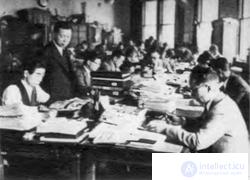
Government censorship in action
After the attack on Pearl Harbor, controls tightened, aided by the patriotism of many reporters. Magazines were told that the cause of the war was the enemy's selfish desire to rule the world, and were ordered, under the guise of requests, to stoke anti-American and anti-British sentiment. When Jun'ichirō Tanizaki began serializing his novel “The Makioka Sisters”, a nostalgic account of prewar family life, the editors of “Chūō Kōron” were warned that it did not foster the necessary wartime spirit. Even though Tanizaki had in the past treated Westernization and modernization as corrupting influences, a “sentimental” story about “bourgeois family life” was unacceptable. Fearing the loss of its paper stock, the magazine halted the serialization. A year later, “Chūō Kōron” and “Kaizō” were forced to disband “voluntarily” after police beat confessions out of “communist” staff members.
Newspapers hired columnists to stoke martial fervor. Magazines were ordered to print militarist slogans. An article titled “Americanism as the Enemy” argued that the Japanese should study the American dynamism arising from its social structure, which was received as praise, even though the editor had added “as the enemy” to the title, resulting in the issue being pulled from publication.
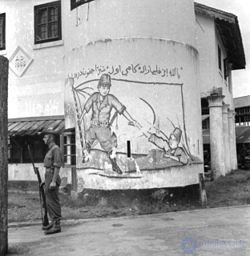
Japanese propaganda literature in Jawi script, found in the city of Kuching, Sarawak, after the city's capture by Australian forces.
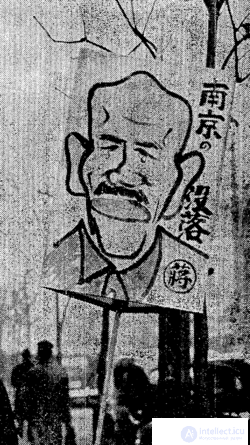
A caricature of Chiang Kai-shek erected in Ginza, Tokyo, after the fall of Nanjing.
Cartoonists formed a patriotic association to promote fighting spirit, stoke hatred of the enemy, and encourage people toward thrift. A notable example is the manga “Norakuro”, which before the war began as humorous episodes about anthropomorphic dogs in the army, but eventually turned into propagandistic tales of military exploits against the “army of pigs” on the “continent” — a veiled reference to the Second Sino-Japanese War.
Cartoons were also used to create informational documents, to educate occupied populations, as well as soldiers, about the countries they occupied.
Kamishibai (paper theater), originally a popular form of street entertainment for children, was appropriated by the Japanese state as an effective propaganda tool. Recognizing kamishibai's broad popularity and its accessibility to all classes and regions, government and military institutions used it to spread military ideology and mobilize public support for the war effort. The simplicity and emotional immediacy of kamishibai, combined with visual storytelling, made it a particularly powerful form of soft propaganda.
By the late 1930s, organizations such as the Nippon Kyōiku Kamishibai Kyōkai (the Japan Educational Kamishibai Association), originally founded by progressive educators, began producing story cards that increasingly reflected state-sanctioned messages. While early educational kamishibai often emphasized moral tales about the hardships of rural life and the virtues of the working class, these narratives were soon repurposed to promote ideals of loyalty, duty, and self-sacrifice for the nation. Although some narratives subtly conveyed the hardships and futility of war, they did so in a way that encouraged further endurance and solidarity. Wartime kamishibai plays were often aimed at a mixed-age audience, including adults.
As the war intensified, kamishibai was actively used both within Japan and across its expanding empire, including colonized Korea, Taiwan, and occupied regions of China. Plays such as “Kawaii Mago Musume” (“My Dear Granddaughter”, 1942) served as a means of cultural assimilation, encouraging colonial subjects to adopt the Japanese language and identity. These stories not only reinforced nationalist ideology but also promoted the image of a benevolent empire uniting its diverse population under imperial rule.
Unlike the lively, improvisational performances of traditional street kamishibai, wartime kamishibai performances were strictly regulated. Performers — often schoolteachers, conscripted women, or local community leaders — were instructed to read scripts verbatim, avoid humor, and suppress their personal presence, so as to ensure that the state's message remained the focus. The mobility and performative nature of the medium were emphasized by slogans such as “anytime, anywhere, by anyone”, reflecting the regime's emphasis on the widest possible dissemination of ideology.
“The Way of the Subject” (Shinmin no Michi) describes what the Japanese should strive for and portrays Western culture as corrupt.
The pamphlet “Read This Alone—And the War Can Be Won”, printed for distribution among the troops, discussed not only the tropical conditions of combat but also the reasons the army was fighting. Colonialism was portrayed as a tiny group of colonists living in luxury by placing the burden on Asians; since blood ties bound them to the Japanese, and Asians had been weakened by colonialism, it fell to Japan to “make men of them again”.
The Ministry of Education, headed by a general, distributed propaganda textbooks. Military oversight of education was intense: officers would arrive at any time to inspect classes and sometimes reprimand a teacher before the lesson began.
Similarly, in occupied China textbooks were revised to teach Chinese children about heroic Japanese figures.
Even before the war, military education treated science as a way of demonstrating that the Japanese were a morally superior race, and history as a way of fostering pride in Japan — not merely as the most magnificent nation, but as the only magnificent one.
After the attack on Pearl Harbor, elementary schools were renamed “National Schools” and tasked with producing “children of the emperor” who would sacrifice themselves for the nation. Children were brought to school, where half their time was devoted to indoctrination, instilling in them loyalty to the emperor, frugality, obedience, honesty, and diligence. Teachers were assigned to teach “Japanese science”, grounded in the “Imperial Way”, which excluded evolution on account of their claims to divine origin. Students received greater attention to physical education and were required to perform public labor. Compositions, drawings, calligraphy, and theatrical performances were based on military themes. Those who left school after six years of study had to attend evening school, where they studied Japanese history and ethics, military training for boys, and home economics for girls.
As the war continued, teachers paid ever more attention to children's destiny as warriors; when one child became nauseated on a swing, the teacher told him that he would not make a good fighter pilot. Students were shown caricatures of Americans and the British to teach them about their enemy.
Girls finishing their schooling in Okinawa heard a speech from the school principal about how hard they must work so as not to disgrace the school, before being accepted into the student corps to serve as nurses.
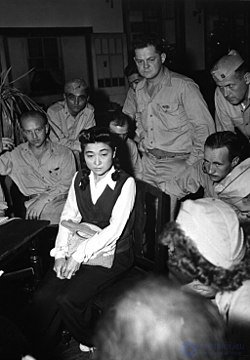
Correspondents interview Iva Toguri, a Japanese-American woman known as “Tokyo Rose”, September 1945.
News reports were required to be official state statements read verbatim, and as the war in China continued, even entertainment programs touched on wartime conditions.
The declaration of war was made over the radio, soon followed by an address from Tojo, who told the nation that a long war should be expected in order to destroy the enemy and secure stability in Asia.
To take advantage of radio’s ability to adapt to events, “Morning Talks” were broadcast to schools twice a month.
Shortwave radio receivers had been used to broadcast anti-European propaganda into Southeast Asia even before the war. Japan, fearing foreign propaganda, banned such receivers for its own people, but built radio stations in all the occupied countries to extol the benefits of Japanese rule and attack the Europeans. Loudspeakers were mounted on “singing towers” or “singing trees” to spread the broadcasts.
Broadcasts to India called for revolt.
Tokyo Rose broadcasts were aimed at American troops.
In an attempt to heighten racial tension in the United States, the Japanese carried out what were called “Negro propaganda operations.” This plan, devised by Yasuichi Hikida, the director of Japanese propaganda aimed at black Americans, consisted of three strands. The first was gathering information about black Americans and their struggles in America; the second was using black prisoners of war in propaganda; and the third was the use of shortwave radio broadcasts. Through shortwave broadcasts, the Japanese used their own announcers together with African-American prisoners of war to spread propaganda in the United States. The broadcasts focused on U.S. news related to racial tension, such as race riots and lynchings in Detroit. One broadcast, for instance, declared: “the notorious lynchings are a rare practice even among the wildest representatives of the human race.” In an attempt to attract more listeners, prisoners of war were allowed to address messages to their families back home. The Japanese believed that the propaganda would be most effective if they used African-American prisoners of war to communicate with African Americans at home. Using programs titled “Real Experiences of Black Prisoners of War” and “Humanity Calls,” the prisoners spoke about wartime conditions and their treatment in the army. Prisoners with artistic ability were used in plays and/or songs that were broadcast back home. The success of this propaganda is much debated, since shortwave radios were owned by only a small minority of people in America. Nevertheless, some scholars believe that the Negro propaganda operations “prompted a variety of reactions within the black community, and the sum of these reactions pushed the American government to improve conditions for black people in the army and in society.” Even the National Association for the Advancement of Colored People (NAACP) viewed the propaganda as “…a tool of the media in the fight against racial discrimination.” Despite this debate, both sides agree that these programs were especially dangerous because they were grounded in truth.
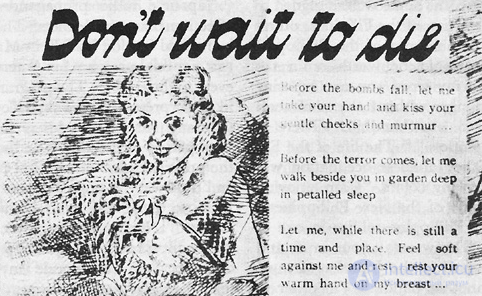
A Japanese propaganda leaflet distributed during the Battle of the Philippines.
In China, leaflets were distributed asking why they had not been better defended after all the money that had been spent.
Leaflets were dropped from aircraft over the Philippines, Malaya, and Indonesia urging surrender, since the Japanese would be better than the Europeans. They were also dropped over India to incite revolt against British rule, since Britain was distracted.
Slogans were used throughout Japan for propaganda purposes. They were used as patriotic appeals — “National Unity”, “A Hundred Million, One Mind” — and as calls for thrift — “Down with frivolous amusements!”
Kokutai , meaning the uniqueness of the Japanese people in having a leader with spiritual roots, was officially endorsed by the government, including in a textbook circulated by the Ministry of Education. The purpose of this instruction was to ensure that every child thought of himself as Japanese above all else and was grateful for the “family-state” structure of government, headed by the emperor. Indeed, during the war almost no effort was made to explain to the Japanese people what it was being fought for; instead, it was presented as an opportunity to rally around the emperor.
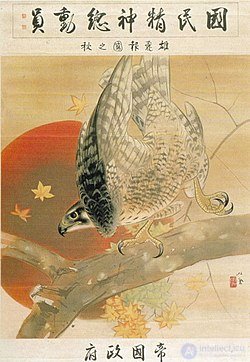
Patriotic fervor: propagandizing patriotism
In 1937 the pamphlet “Kokutai no Hongi” was written to explain this principle. It clearly set out its purpose: overcoming social unrest and developing a new Japan. This pamphlet taught pupils that they must place the interests of the nation above their personal interests and that they were part of the state, not separate from it. The Ministry of Education distributed it throughout the school system.
In 1939 the prime minister founded the “Taisei Yokusankai” (Imperial Rule Assistance Association) to “restore the spirit and virtues of old Japan.” When the number of patriotic associations during the war worried the government, they were absorbed into the IRAA, which used them to mobilize the nation and promote unity.
In 1941 “Shinmin no Michi” was written to teach the Japanese what they should strive for. Ancient texts set out the basic principles of loyalty and filial piety, which were meant to cast aside selfishness and allow them to carry out their “sacred task.” It contained the call to become “a hundred million hearts beating as one” — a call that resurfaced in American anti-Japanese propaganda, although “Shinmin no Michi” itself stated plainly that many Japanese “had failed” to act in this way. The obedience demanded was to be blind and absolute. The war was meant to be a purifying experience that would return them to the “pure and cloudless heart” of their innate character, from which they had strayed. Their natural racial purity was to be reflected in their unity. Patriotic war songs rarely mentioned the enemy, and then only in general terms; the tone was elegiac, and the theme was purity and transcendence, often likened to cherry blossoms.
In their last letters, kamikaze pilots expressed, above all, gratitude to Japan and its emperor as the embodiment of kokutai . In one letter, praising Japanese history and the way of life handed down by their ancestors, and the imperial family as the embodiment of Japan’s splendor, a pilot wrote: “It is a great honor for me to give my life defending these beautiful and lofty things.”
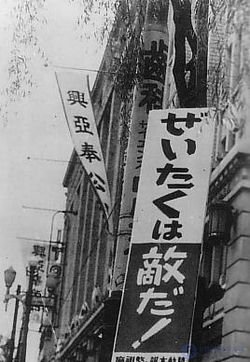
“Luxury is the enemy” — a slogan of the National Spiritual Mobilization Movement.
Intellectuals at the “Overcoming Modernity” conference declared that before the Meiji Restoration Japan had been a classless society under a benevolent emperor, but that the Restoration had plunged the nation into Western materialism (an argument that ignored the commercialism and dissolute culture of the Tokugawa era ), causing people to forget their true nature, which the war would allow them to recover.
In government propaganda, baseball, jazz, and other wasteful Western customs were singled out as things to be abandoned in favor of a pure spirit of self-sacrifice.
This Yamato spirit would allow them to overcome the huge disparity in fighting resources. This belief was so deeply rooted that even when Allied victories outstripped the Japanese government’s ability to conceal them with lies, many Japanese refused to believe that the “Land of the Gods” could be defeated. The military government also fought on in the hope that casualty lists would sap the Allies’ will to fight. General Ushijima, addressing his troops on Okinawa, told them that their greatest strength lay in moral superiority. Even as American forces won victory after victory, Japanese propaganda continued to claim military superiority. The attack on Iwo Jima was announced on the air on the program “Home and Empire” with extraordinary praise for the American commanders, but also with a confident assertion that they would not leave the island alive. President Roosevelt’s dying words were changed to “I have made a terrible mistake,” and some editorials proclaimed this to be Heaven’s punishment. American interrogators questioning prisoners found them unshaken in their conviction of Japan’s sacred mission. After the war, one Japanese doctor explained to American interrogators that the people of Japan had foolishly believed that the gods would actually help them out of their predicament.
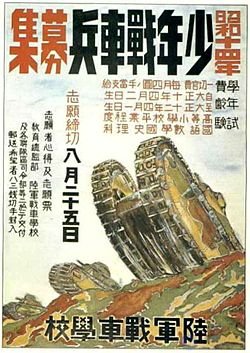
A 1939 conscription poster for the Imperial Japanese Army Tank School.
This also gave them a sense of racial superiority over the Asian peoples they claimed to have liberated, which greatly undermined Japanese propaganda of racial unity. Their “bright and strong” souls made them a superior race, and so their rightful place was in leadership of the Greater East Asia Co-Prosperity Sphere . Anyone who was not Japanese was an enemy – demonic, bestial – including other Asian peoples such as the Chinese. Strict racial segregation was maintained in the conquered regions, and their inhabitants were encouraged to think of themselves as the “leading people of the world.”
This race was, in fact, to be further improved through physical training and welfare programs, as well as demographic policies aimed at increasing their numbers. The campaign to raise the birth rate in order to produce future citizens continued until 1942, and for this reason no effort was made to bring women into war work. The campaigns used the slogan “Be fruitful and multiply.”
Although the regime’s military strength depended on industrialization, it extolled rural life. Traditional rural and agricultural life was set against the modern city; it was proposed to counter the atomizing effect of the cities by placing schools and factories in the countryside to sustain the rural population. Agrarian rhetoric celebrated harmony in the village, even though tenants and landlords were pitted against each other by wartime needs.
The National Spiritual Mobilization Movement was formed from 74 organizations to rally the nation for total war. It carried out such tasks as teaching schoolchildren about the “holy war in China” and enlisting women to make bandages for the war effort.
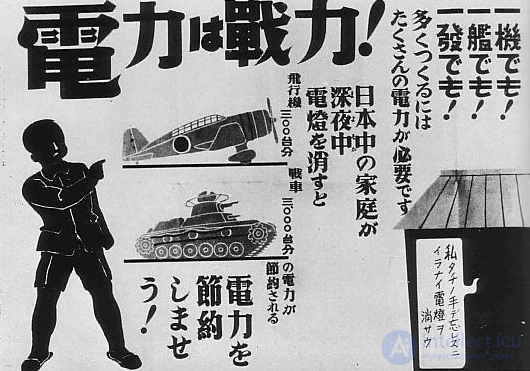
Electric power is military power!
Even before the war there existed an organization called “Sanpō” , which explained the necessity of meeting production quotas, even if this required sacrifice; it did so by means of rallies, lectures, and panel discussions, and it also set up assistance programs for workers to attract new members.
Among the early victories was one that secured Japan an oil field, giving it its own source of oil for the first time; propaganda rejoiced that Japan was no longer a “have-not” country.
In 1943, as American industrial might gave the American armed forces a material advantage, part of the population called for a more militant regime, in particular for increased supplies of war material. The emphasis on training soldiers rather than arming them led to a dangerous shortage of supplies for the armed forces after heavy losses. At morning assemblies in factories, officers addressed the workers and urged them to meet their quotas. Production levels were maintained, though at the cost of extraordinary sacrifice.
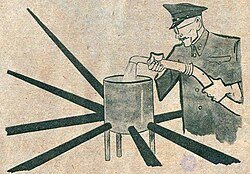
A caricature of Hideki Tojo calling for the rationing of oil consumption.
The government urged the Japanese to do without necessities ( deprivation ). For example, magazines gave advice on economizing on food and clothing as soon as the war with China began.
After the outbreak of war with the United States, early suggestions that people had rejoiced too much over the victories and were unprepared for the long war ahead went unheeded, so early propaganda contained no warnings.
In 1944 propaganda tried to warn the Japanese people of the disasters to come and to instill in them a spirit like that seen on Saipan — a spirit of accepting new hardships during the war. Articles were written claiming that the Americans could not carry out air raids from Saipan, although, since they were able to do so from China, they could obviously do so from Saipan as well; the aim was to give a subtle warning of dangers to come. The bombings themselves gave new meaning to the slogan “We are all equal”. Early songs proclaiming that the cities had an iron defense and that defending the homeland was an honor quickly lost their shine. Nevertheless, calls for self-sacrifice continued to be made; neighborhood associations helped, since no one wanted to be seen as the first to give up.
The press frequently carried stories of self-sacrifice amid deprivation: for instance, a teacher dressed in rags who refused to wear a new shirt because all his friends were in rags too, as well as officials and civil servants who did without heating. This reflected the real level of deprivation in society, where clothing was scarce, the working week ran seven days, and schooling was cut to a minimum so that children could work.
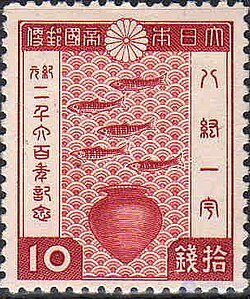
A prewar Japanese postage stamp with a face value of 10 sen, depicting Hakkō ichiu and the 2,600th anniversary of the Empire.
Like Nazi Germany’s claims to “Lebensraum”, Japanese propaganda complained of being trapped within its own home waters. “Hakkō ichiu” , “to gather the eight corners of the world under one roof”, added a religious undertone to the theme. It was based on the legend of Emperor Jimmu , the founder of Japan, who, upon finding five races there, made them all “brothers of one family.” In 1940 the Japan Times and Mail retold the story of Jimmu for the 2,600th anniversary.
News of Hitler’s successes in Europe, followed by Mussolini’s entry into the conflict, gave rise to the slogan “Don’t miss the bus!”, since the European war gave them an opportunity to conquer Southeast Asia for its resources.
With the outbreak of war, Tojo declared that as long as the spirit of loyalty and patriotism was maintained within this policy, there was nothing to fear.
A study of global policy with the Yamato race at its core openly called for such expansion; although it was a secret document intended for use by policymakers, it plainly set out what was only hinted at in other sources. It stated explicitly that Japan’s supremacy within the Greater East Asia Co-Prosperity Sphere, entailing the subjugation of other nations, had not been brought about by the war but was part of an explicit policy.
This was also justified on the grounds that the resource-poor Japanese could not rely on any sources of raw materials they did not themselves control. Propaganda claimed that Japan was being strangled by “ ABCD ” — America, Britain, China, and the Dutch East Indies — through trade embargoes and boycotts. Even on the eve of the war, newspapers reported that if negotiations did not improve, Japan would be forced to resort to measures of self-defense.
The samurai code of bushido was used for ideological indoctrination in militarism. It was used to present war as a purifying act and death as a duty. It helped prevent surrender both by those who held to it and by those who feared the shame of not dying. It was presented as a revival of traditional values and as “overcoming modernity”. War was presented as a purifying experience, though only for the Japanese. Bushido was meant to provide a spiritual shield allowing soldiers to fight to the end. All soldiers were expected to adhere to it, although historically it had been the duty of samurai of higher rank , not of ordinary soldiers.
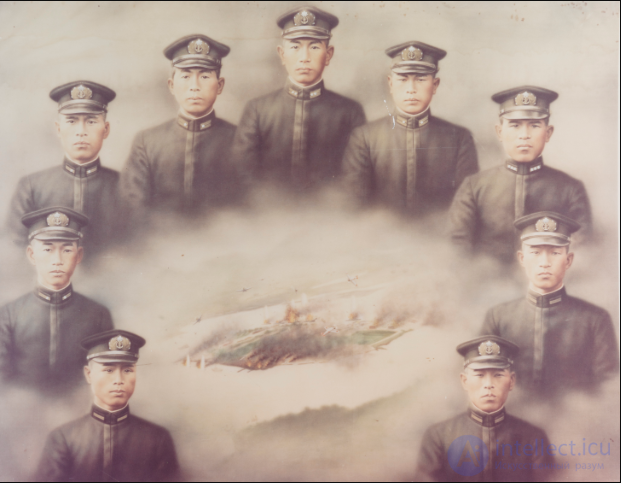
Submariners killed in the attack on Pearl Harbor.
As it was taught, this philosophy bred a reckless indifference to the technological side of war. Japanese production was only a small fraction of America’s, which made it difficult to properly equip combatants. Officers declared their indifference to radar, either because they had perfectly healthy eyes, or because blue-eyed Americans would inevitably be inferior to dark-eyed Japanese in night attacks. At Imphal, the commander told his troops that it was a battle between their spiritual strength and the material strength of the British, an order that became known as a symbol of the Japanese spirit.
Soldiers were told that the bayonet was their primary weapon, and many carried it with them at all times. The weapon was seen as a symbol of martial spirit and loyalty, so any negligence toward it was severely punished.
Already during the Shanghai Incident the principles of victory or death were put into practice, and much attention was paid to a captured Japanese soldier who returned to the site of his capture to commit seppuku . Three soldiers who blew themselves up at a barbed-wire entanglement were dubbed the “Three Human Bombs” and appeared in no fewer than six films, although they may have died only because their fuses were too short. Tojo himself, in a 1940 pamphlet, urged soldiers toward a spirit of self-sacrifice so that they would not think of death. This undoubtedly contributed to the harsh treatment of prisoners of war who had committed the shameful act of surrender. Another consequence was that nothing was done to prepare soldiers for captivity, with the result that it was far easier for the Americans to obtain information from Japanese prisoners than for the Japanese to obtain it from American prisoners.
In 1932, poems by Akiko Yosano urged Japanese soldiers to endure hardship in China and compared fallen soldiers to blooming cherry blossoms — a traditional image that would be widely used throughout the war.
The emphasis on this tradition, and the absence of a comparable military tradition in the United States, led to an underestimation of American fighting spirit, which surprised Japanese forces in the battles of Midway , Bataan , and other engagements in the Pacific. It also placed emphasis on attack at the expense of defense. Bushido called for bold offensives against common sense, which was imposed on the troops.
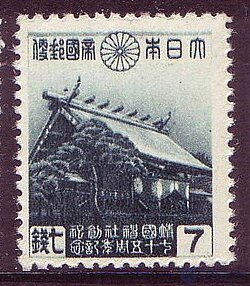
Yasukuni Shrine, dedicated to the war dead.
The dead were venerated as “war gods,” beginning with the nine submariners killed at Pearl Harbor (the tenth, taken prisoner, was never mentioned in the Japanese press). Funerals and memorials for the “hero-gods” who fell in battle gave the Japanese public news of engagements that had not otherwise been made public, as when a submarine attack on Sydney was revealed through the burial of four of the dead; this propaganda often clashed with propaganda of victory. Even years before the war, schoolchildren were taught that dying for the emperor turned a man into a deity. As the war progressed, the spirit of bushido was invoked to stress that everything depended on the nation's firm and united soul. The media were full of stories of samurai, old and new. Newspapers printed bidan — touching stories of fallen soldiers with their photographs and accounts from members of their families; before Pearl Harbor and the crushing losses of the Pacific War, they sought to gather such a story for every fallen soldier. During the fighting in China, casualties were so few that individual cases were extolled. Letters from “fallen heroes” had become a fixture of Japanese newspapers by 1944.
Defeats were treated chiefly as demonstrations of resistance to death. A Time magazine article on Saipan and the mass suicides of civilians received wide coverage in the media, and the enemy's “awed” reports were taken as evidence of the glory of self-sacrifice and the pride of Japanese women. After the defeat at the Battle of Attu, attempts were made to turn the deaths of more than two thousand Japanese into an inspiring epic demonstrating the nation's fighting spirit. Suicidal charges were glorified as expressions of the Japanese spirit. Arguments that the plans for the Battle of Leyte Gulf, which committed every Japanese ship, would expose Japan to grave danger in the event of failure were countered by the call to let the fleet “bloom as flowers of death.” The last message from the troops on Peleliu was “Sakura, sakura” — cherry blossoms.
The first proposals for organized suicide attacks met with resistance, since although bushido called on a warrior to keep death constantly in mind, he was not supposed to regard it as the only end. The Imperial Japanese Navy did not order attacks from which there could be no return; even the midget submarines used in the attack on Pearl Harbor were provided with plans to rejoin the mother ship if at all possible. Desperate circumstances led to their adoption. Propagandists set immediately to glorifying such deaths. Such attacks were proclaimed the true spirit of bushido, and became an integral part of strategy on Okinawa.
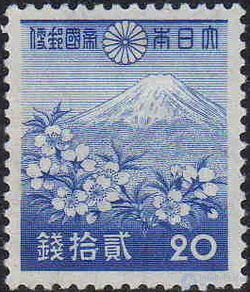
Cherry blossoms in bloom before Mount Fuji: symbols of heroic death.
Vice Admiral Takijirō Ōnishi addressed the first kamikaze (suicide) unit, telling them that their nobility of spirit would keep the homeland from ruin even in defeat. The names of the four sub-units making up the Kamikaze Special Attack Force were: the Shikishima unit, the Yamato unit, the Asahi unit, and the Yamazakura unit. These names were taken from a patriotic poem (waka, or tanka) by the classical Japanese scholar Motoori Norinaga: “Shikishima no Yamato-gokoro wo hito towaba, asahi ni niou yamazakura bana.”
If one should ask about the Yamato spirit [the spirit of ancient, true Japan] of Shikishima [a poetic name for Japan], it is the flowers of yamazakura [mountain cherry] fragrant in the Asahi [the rising sun].
This also drew on the popular Japanese symbolism of falling cherry blossoms as an emblem of mortality. These and other kamikaze were proclaimed national heroes. Divers trained for such work in the event of an invasion of Japan were given individual flags signifying that they could replace an entire ship, and were carefully assigned so that they would die by their own hand rather than another's.
Propaganda calling for such deaths and for resistance to death was spread in the hope that fierce resistance would induce the Americans to offer terms. When Tōgō approached the Soviet Union, this was interpreted as a bid for peace, which the newspapers immediately denied — they would not seek peace, but win the war — a view upheld by the Kempeitai, who arrested anyone for the slightest hint of “defeatism.” The army's charter for the defense of the homeland called for the extermination of any Japanese who obstructed the defense.
Japanese propaganda of “fighting to the last” and of a “hundred years' war” did indeed lead many Americans, quite apart from questions of hatred and racism, to conclude that a war of extermination might be the only path to victory, the only question being whether the Japanese would surrender before such extermination was completed.
Even after the atomic attacks and the emperor's insistent demand for surrender, Inaba Masao issued a statement calling on the army to fight to the last; when other colonels informed him of a proclamation hinting at the prospect of surrender to the public, they hastened to have Inaba's statement broadcast as well, so as to create conflicting messages. This caused consternation within the government over fears of the American reaction, and to prevent any delay, the surrender was sent out as a news bulletin in English and in Morse code, to keep it from being blocked by the military censors.
Early training of intelligence agents tried to imbue the service with Japan's traditional mystique of espionage, invoking the spirit of the ninja.
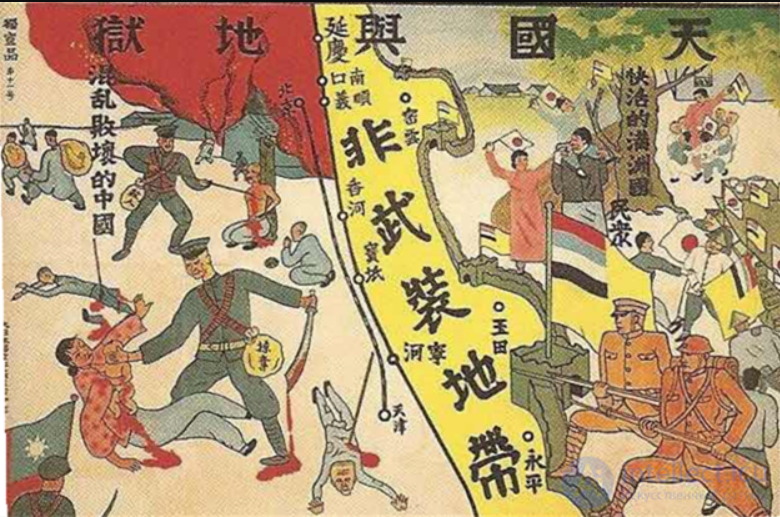
A Japanese propaganda poster, “Heaven and Hell,” demonizing China under the Nationalist government.
In occupied China, textbooks were revised to exclude accounts of Japanese atrocities and to focus instead on heroic Japanese figures, including one officer who divorced his wife before leaving for China so that he could devote himself to the war, and so that she would be freed from the burden of filial duty to his parents, since he was certain to die.
Strict government censorship kept the Japanese public from hearing about the atrocities in China.
When news of the atrocities reached the Western nations, Japan launched propaganda to counter it, both denying it and interviewing prisoners to refute it. It was claimed that they were being well treated owing to the generosity of bushido. The interviews were also described not as propaganda but as an expression of sympathy for the enemy, a sympathy that only bushido could inspire. Their effect on Americans was blunted by subtle messages the prisoners had planted, including remarks such as noting that they had been allowed to go on wearing the clothes they had been captured in.
As early as the Bataan Death March, the Japanese forced the Manila Times to declare that the prisoners were being treated humanely, and that the death toll was due to the intransigence of the American commanders, who had not surrendered until their men were on the verge of death. After several of the Doolittle Raid airmen were tortured and executed, the Nippon Times proclaimed the humane treatment of American and British prisoners of war, in order to claim that British troops had treated German prisoners inhumanely.
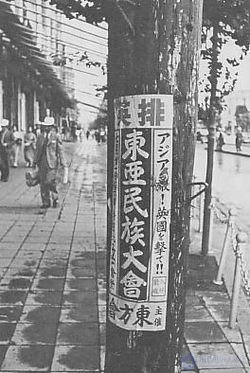
A Tōhōkai poster urging Asians to shoot the British.
The United States and Britain came under attack for years before the war, with any Western idea that conflicted with Japanese practice denounced as a “dangerous thought.” They were accused of materialism and soullessness both within Japan and in shortwave broadcasts to Southeast Asia. Such thinking was not only censored through strict control of publications, but the government also used various popular organizations to stir up hostility toward them. Britain was criticized with particular vehemence over its many colonies and was blamed for the continuing stalemate in China. Chiang Kai-shek was denounced as a Western puppet, sustained by British and American exploitation of the colonies of Southeast Asia. Militarists who resented the arms-control treaties that allowed Japan only 3 ships for every 5 British and American ones used “5-5-3” as a nationalist slogan. They also wanted to break free of an international capitalist system dominated by British and American interests.
In the days leading up to the attack on Pearl Harbor, the newspapers went on ominously reiterating the intransigence of the United States.
Word of the attack on Pearl Harbor led the newspapers to organize a “Rally to Crush the United States and Britain.” When the government judged the war songs too abstract and elegiac, it held a nationwide competition for a marching song titled “Down with Britain and America.”
After atrocities such as the “Bataan Death March,” the harsh treatment of prisoners of war was justified on the grounds that they had sacrificed the lives of others but had surrendered to save their own, and had acted with utter selfishness throughout their campaign.
A pamphlet titled “The Psychology of the Individual American,” addressed to soldiers, claimed that Americans gave no thought to the glory of their ancestors, their descendants, or their family name; that they were braggarts craving publicity; that they feared death and cared nothing about what happened after it; that they were liars, easily swayed by flattery and propaganda; and that, being materialists, they relied on material superiority rather than spiritual motivation in battle.
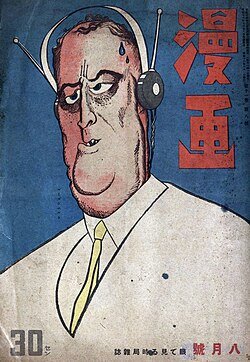
A caricature of Franklin Delano Roosevelt on the cover of Manga magazine, August 1943.
Praising the enemy was considered treasonous, and no newspaper could print anything that spoke well of the enemy, no matter how much the Japanese troops themselves regarded the enemy's fighting spirit and effectiveness as praiseworthy.
Intellectuals were especially zealous in spreading anti-Western views. A conference on “overcoming modernity” declared that the “world-historical significance” of the war lay in resisting the Western cultural ideas imposed on Japan. The Meiji Restoration had plunged the nation into Western materialism (an argument that ignored the commercialism and dissolute culture of the Tokugawa era), causing people to forget that they were a classless society under a benevolent emperor, but the war was meant to dispel these notions. The government also urged the abandonment of Western customs — such as baseball and jazz — in favor of a pure spirit of self-sacrifice.
Officially, Japan did not present itself as wholly anti-Western, both because of its alliance with Italy and Germany, and, for some politicians, because such a stance would have been incompatible with Japan's lofty moral aims. But since the alliance was both reliable and purely a matter of expediency, a broad anti-white rhetoric was nonetheless propagated. In propaganda depictions of Germans in Java, they were shown as grateful now to be under Japanese protection. In the United States, Elmer Davis of the Office of War Information argued that this propaganda could be countered by actions working against it, but he failed to win support.
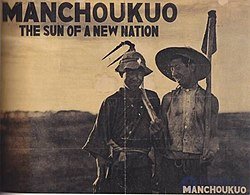
A Japanese propaganda poster depicting Japanese agricultural immigrants in Manchuria, aimed at English speakers.
The Allies were also criticized as weak and effete, incapable of sustaining a long war, an opinion that was at first borne out by a string of victories. The lack of a warrior tradition such as bushido reinforced this belief. The armed forces were told that American troops would not come to fight them, that Americans could not fight in the jungle, and that they would not be able to endure the war at all. Accounts of prisoners of war depicted Americans as cowardly and willing to do anything to curry favor. Subordinates were actively encouraged to treat prisoners with contempt, so as to stoke a sense of superiority in them.
Both Americans and British were portrayed as objects of ridicule, which produced a serious weakness whenever the complacency bred by this propaganda collided with the enemy's actual strength.
Shortly before the Doolittle Raid, Radio Tokyo ridiculed a foreign report of the bombing on the grounds that it was impossible. The Doolittle Raid itself was played down, with only minor damage reported, and the conclusion drawn, quite correctly, that it had been carried out to raise American morale.
Many Japanese pilots believed that their own strength and the softness of the Americans would bring victory. The ferocity and self-sacrificing attacks of American pilots at the Battle of Midway undermined this propaganda, as did the fighting at the Battle of Bataan and on other Pacific battlefields.
The surrender terms proposed by the United States were ridiculed by the newspapers as absurd, and they called on the government to remain silent on the matter, which the government did, using the traditional Japanese method of dealing with unacceptable questions.
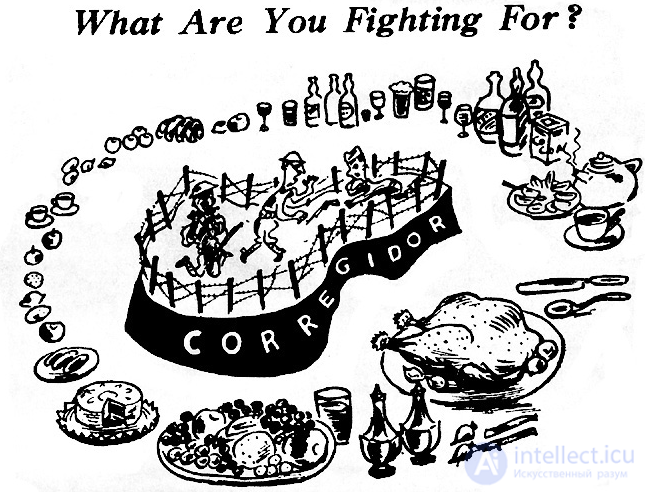
What are you fighting for?: to endure the madness of a starving existence on Corregidor.
Most of the propaganda attacks against American troops were aimed at undermining morale. Tokyo Rose broadcast sentimental programs designed to stir up homesickness. She also taunted the soldiers, calling them saps, hinting that their wives and sweethearts would take new men while they were off fighting. There were also radio broadcasts featuring prisoners of war, meant to reassure listeners of their good treatment; these broadcasts were inserted between news reports of varying length, so that to hear the prisoner one had to listen to the entire broadcast.
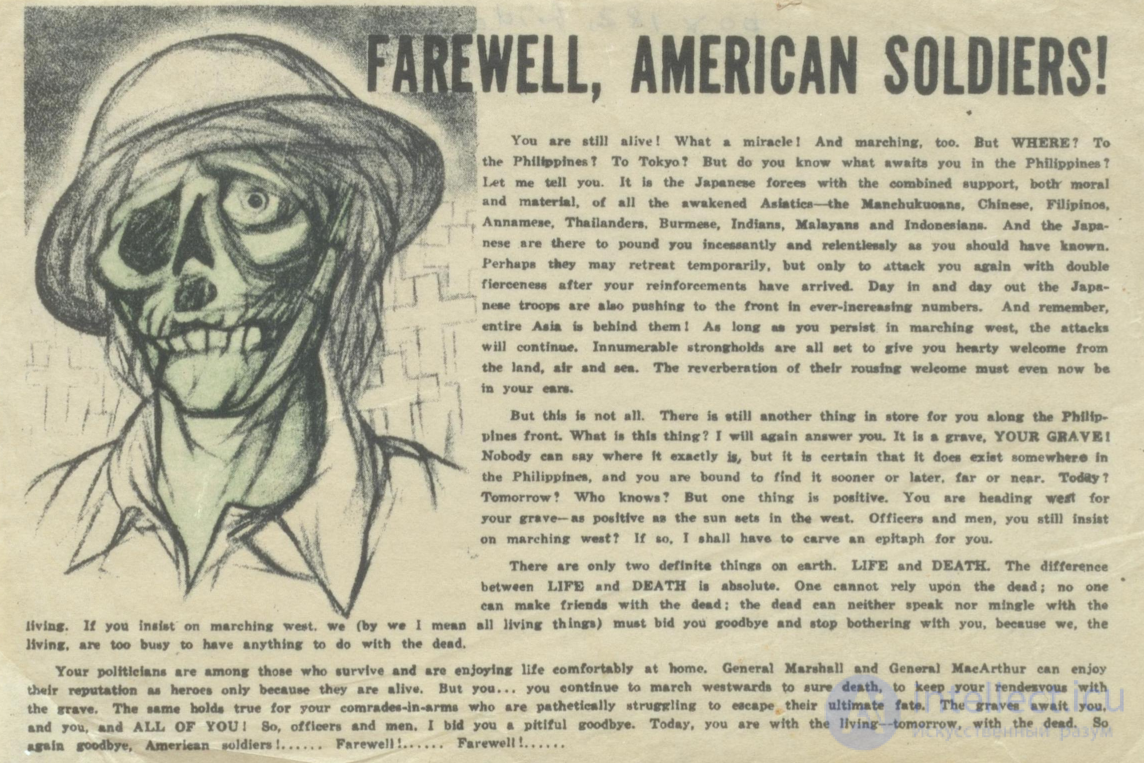
A leaflet warning American soldiers who had gone ashore of their imminent death.
These programs were poorly conceived, since they assumed that Americans did not want to fight, underestimating the psychological impact of Pearl Harbor, and assumed that hostility toward Roosevelt's domestic policy carried over into hostility toward his foreign policy. Indeed, they believed that the attack on Pearl Harbor would be seen as a defensive act forced on them by “Roosevelt and his clique.” American troops were less committed to the idea of a “decisive battle” than the Japanese were, so the first string of victories had less effect on them than expected.
In addition, prisoners who did speak often wove veiled messages into their remarks that undermined the propaganda, stating that they had been “allowed” to keep the clothes they were wearing when captured, so as to signal that they had not been issued any new clothing.
A pamphlet dropped on the troops on Okinawa claimed that President Roosevelt's death had been caused by the heavy damage the Japanese had inflicted on American ships, which would continue until every ship had been sunk, leaving the American troops with no means of support. One soldier reading the pamphlet during a naval bombardment of the shore asked where they thought the shelling was coming from.
Communism was included among the dangerous Western ideas. During the invasion of China, however, Japanese propaganda in the United States played on American anti-communism to win support. It was likewise presented to the Japanese people as a way of building a barrier against communism. Propaganda was also used to demonize the Communist Party of China.
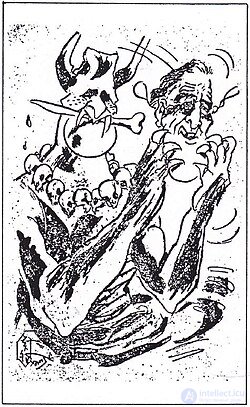
A drawing depicting an ogre wearing a necklace of skulls removing a mask bearing Roosevelt's face, October 1944.
Shinmin no Michi, The Way of the Subject, discussed historical American atrocities and portrayed Western
продолжение следует...
Часть 1 War Propaganda in Japan in the 20th Century
Часть 2 Peace - War Propaganda in Japan in the 20th Century

Comments