
Lecture
Это окончание невероятной информации про пропаганда японии.
...
history as one of brutal wars, exploitation, and destructive values. Its colonialism, it argued, rested on a destructive individualism, materialism, utilitarianism, and liberalism that allowed the strong to prey on the weak.
Although propaganda played down the consequences of the Doolittle Raid, it also depicted the raid's airmen as inhuman fiends attacking civilians. Shortly after the captured airmen were tortured and some of them executed, the Nippon Times condemned the British treatment of German prisoners of war, claiming that American and British prisoners held in Japan were treated in accordance with international law.
The Allies' war aims were portrayed as extermination. Japanese civilians were told that the Americans would rape, torture, and kill, and that they should therefore kill themselves rather than surrender; on Saipan and Okinawa, the overwhelming majority of the civilian population committed suicide or killed one another before the Americans' victory. Those captured on Saipan often feared their captors, especially black soldiers, though this was not only due to propaganda but also because many had never seen a black person before. The demand for unconditional surrender was heavily exploited. Interrogated prisoners reported that this propaganda was widely believed, and that people would therefore resist to the death.
Accounts were also circulated of American soldiers killing German prisoners of war, regardless of their veracity.
Much was made of American soldiers desecrating the bodies of the dead, while it went unmentioned that such acts were condemned both by the military authorities and from American church pulpits. It was reported that President Roosevelt had been given the forearm bone of a Japanese soldier as a gift, but not reported that he had refused it and insisted on a proper burial.
American propaganda made much of the Japanese calls for devotion unto death. Some soldiers attacked civilians on the grounds that they refused to surrender, which in turn provided grist for Japanese propaganda about American atrocities.
Even before American pamphlets warning of the great power of atomic explosions appeared, newspapers commenting on the atomic attacks reported that the bombs could not be treated lightly; the “Nippon Times” wrote that they were clearly intended to kill many innocent people in order to end the war quickly, while others denounced them as a moral outrage.
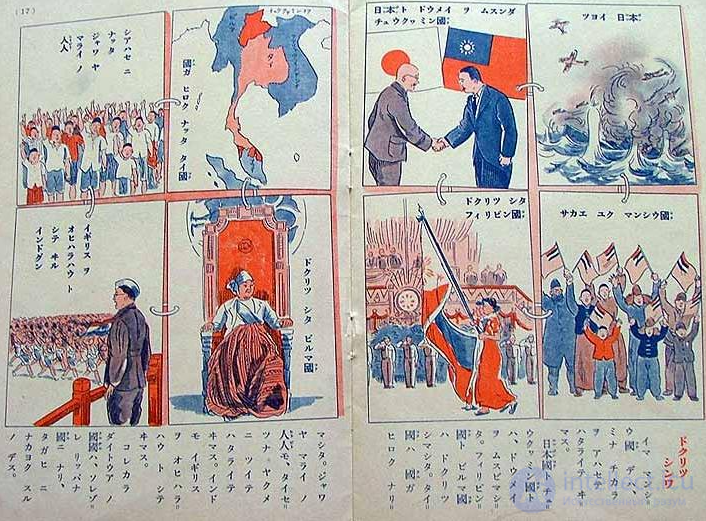
Fragment of a Japanese propaganda pamphlet issued at the Tokyo Conference (1943), depicting scenes of everyday life in East Asia.
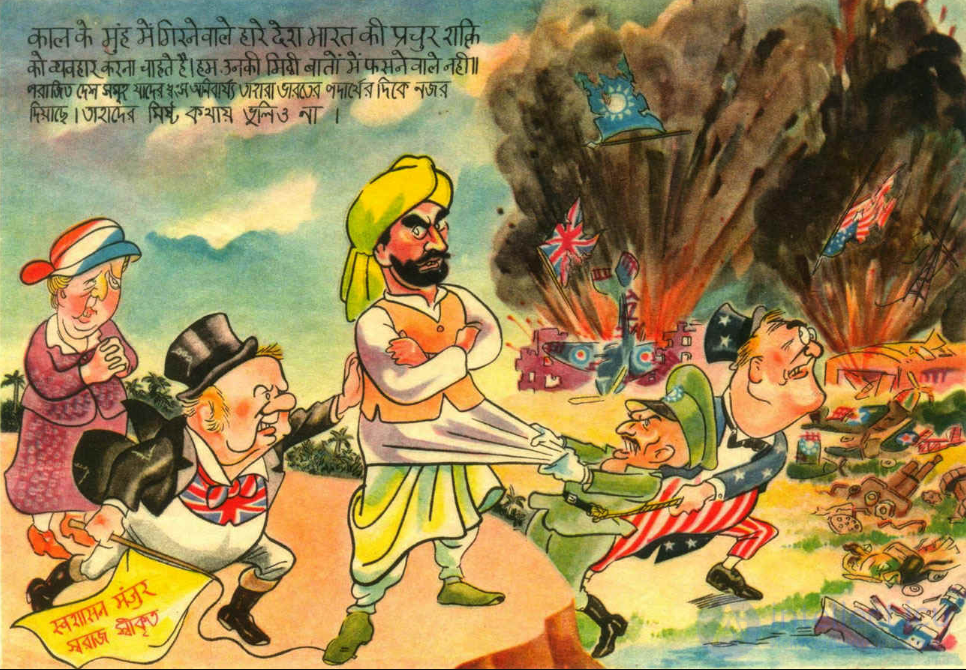
A Japanese propaganda leaflet depicting Allied leaders such as Roosevelt, Churchill and Chiang Kai-shek trying to push or drag an Indian into the fight against the Japanese, 1943.
In China, posters were widely used to convince the Chinese that Europeans were the enemy, especially the Americans and British. Much attention was given to the opium trade.
Similarly, the Philippines were fed propaganda about “American exploitation,” “American imperialism,” and “American tyranny,” and the United States was blamed for starting the war. They were assured that they were not enemies of Japan and that American troops would not return. This effect was substantially undermined by the actions of the Japanese army, and Filipinos soon wanted the Americans to return and liberate them from the Japanese. Black propaganda was presented as American instructions to avoid venereal disease by having sexual relations with wives or other respectable Filipino women rather than with prostitutes.
After the fall of Singapore, Americans and British were sent to Korea as prisoners in order to stamp out Korean admiration for them. Exhausted prisoners of war brought to Korea as forced labourers were also paraded through the streets to show how the European forces had fallen.
In the occupied countries, shortwave radio stations attacked Europeans, especially “White Australia,” which, radio broadcasts claimed, could feed 100 million people instead of its current 7 million if hard-working Asians were allowed to flourish.
Radio broadcasts and leaflets called on India to rise up against British rule while Britain was distracted. Other leaflets and posters aimed at Allied forces of different nationalities tried to drive a wedge between them by attacking other Allied countries.
This Western hegemony was sometimes portrayed as the result of the actions of Jews. Especially in the early years of the war, a surge of anti-Jewish propaganda was generated, apparently a consequence of the alliance with the Nazis.
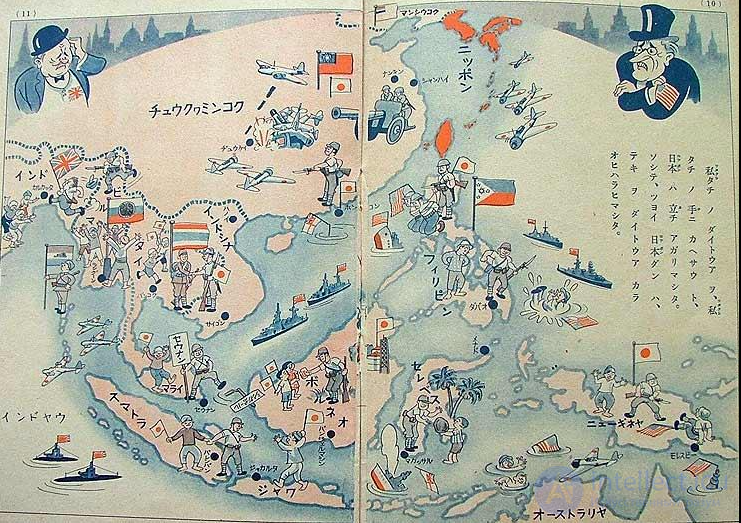
Fragment of a Japanese propaganda pamphlet issued by the Tokyo Conference, depicting East Asia liberated from the Anglo-American presence.
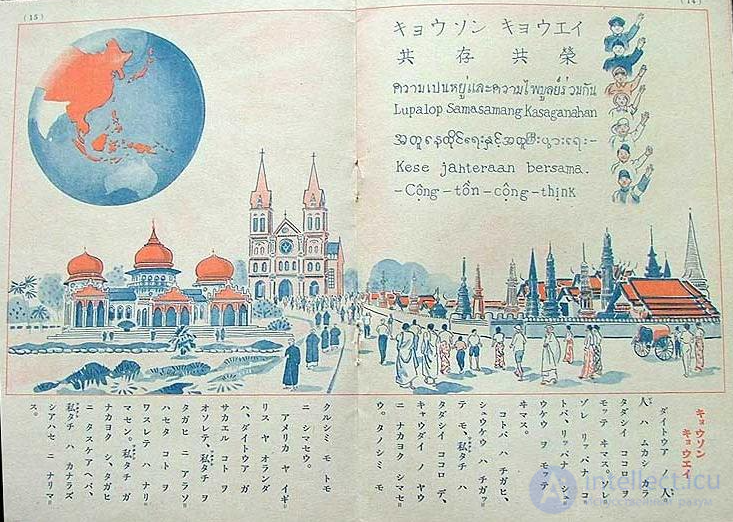
Fragment of a Japanese propaganda pamphlet issued by the Tokyo Conference, depicting the various peoples of East Asia.
During the war the slogan “Asia for Asians” was widely spread, though undermined by Japan's harsh treatment of the occupied countries. This served the purpose of creating the Greater East Asia Co-Prosperity Sphere, in which the new Japanese empire was presented as the Asian equivalent of the Monroe Doctrine. It was claimed that the regions of Asia were as important to Japan as Latin America was to the United States.
Initially, though plausible, this enjoyed great popularity among the occupied countries. Japan's victories were initially welcomed in support of this goal. Many Japanese remained convinced throughout the war that the Sphere was an idealistic idea, submitting slogans to a newspaper competition praising the Sphere for its constructive efforts and for peace.
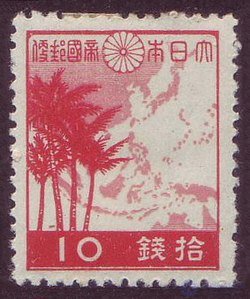
Map of the Greater East Asia Co-Prosperity Sphere
During the war with China, the prime minister declared over the radio that they sought only a new order to secure the stability of East Asia, which unfortunately could not be achieved because Chiang Kai-shek was a puppet of the West. The failure of the Second Sino-Japanese War was blamed on British and American exploitation of the Southeast Asian colonies to supply China, although China received far greater assistance from the Soviet Union.
Leaflets were later dropped by aircraft over the Philippines, Malaya and Indonesia, calling on them to join this movement. Societies of mutual culture were established in all the conquered countries to win over the local population and to try to replace English with Japanese as the common language. Multilingual leaflets depicted numerous Asians marching or working together in happy unity, with the flags of every country and a map showing the supposed sphere of influence. Others proclaimed that they had granted the occupied countries independent governments — a claim undermined by the lack of real power held by these puppet governments. A street was built in Thailand to demonstrate this, which was planned to be lined with modern buildings and shops, but nine-tenths of it consisted of fake fronts.
The Greater East Asia Conference received wide media coverage. Tojo welcomed the delegates with a speech praising the “spiritual essence” of Asia as opposed to the West's “materialistic civilization.” At the conference Ba Maw declared that his Asian blood had always called out to other Asians, and that the time had come to think not with the mind but with the blood, and many other Asian leaders backed Japan in the context of an East-West conflict based on blood. Japanese repression and racial claims gradually undermined this dream.
The pamphlet “Read This Alone—And the War Can Be Won” was intended for the Japanese army. It portrayed colonialism as a tiny group of colonists living in luxury while burdening Asians; since blood ties bound them to the Japanese, and Asians had been weakened by colonialism, Japan's task was to “make men of them again.”
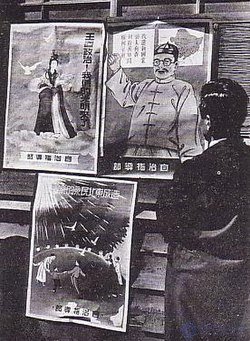
Propaganda posters of the Concordia Association in Manchuria.
Leaflets were distributed in China claiming that the “Mandate of Heaven” had clearly been lost, and so power had passed to new leaders. Propaganda also spoke of the advantages of the “Kingly Way” (王道 wangdao, or in Japanese, ōdo) as a solution to both nationalism and radicalism.
The Philippines became their first target after Pearl Harbor, and instructions to propagandists called for awakening the “spirit of the Far East” and inspiring them with militarism to fight on the Japanese side. “Surrender cards” were issued, allowing soldiers to surrender safely by handing over the card. Jorge B. Vargas, Chairman of the Philippine Executive Commission, signed one of the issued leaflets calling for surrender.
Korea was annexed in 1910. The Governor-General of Korea stated that the colony's economic progress over the following 30 years was due to the fact that Japanese administrators had devoted themselves to its welfare.
The Japanese tried to subjugate the Koreans by urging them to see themselves as part of a single “imperial race” with Japan, and even presented themselves as saviours of a nation that had spent too long in the shadow of China.
However, native Koreans lost their estates, society, and status, which spurred resistance.
The Battle of Imphal was fought, in part, to show the Indian National Army to Indians in the hope of provoking an uprising against British rule.
Propaganda claimed that the war had been forced upon them for the sake of self-defence. As early as the Manchurian Incident, the media unquestioningly spread the message that the Chinese had provoked the explosion by infringing on Japan's rights and interests, and that the Japanese therefore had to defend their rights, even at great cost. This argument was even put forward before the League of Nations: they were merely trying to prevent the anti-Japanese activities of the Kuomintang.
Before the attack on Pearl Harbor, newspapers reported that if negotiations did not improve, Japan would be forced to resort to measures of self-defence. Indeed, after the attack, propaganda aimed at American troops proceeded from the assumption that Americans would come to see Pearl Harbor as a defensive act forced upon them by “Roosevelt and his clique.”
For propaganda purposes, defeats were presented to the public at home as great victories. Much was said about Japan's 2,600-year history without defeat. Historians presented the wars of 1895 and 1904 as crushing triumphs rather than as hard-won victories. For a long time the armed forces held the view that a string of victories would sufficiently demoralize the Americans to bring about a peace settlement.
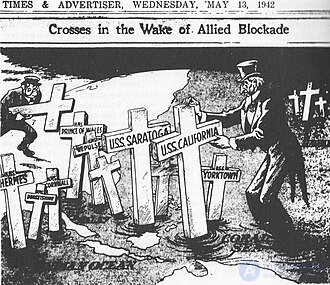
The English-language newspaper the Japan Times & Advertiser depicted John Bull and Uncle Sam erecting gravestones for ships that the Imperial Japanese Navy claimed to have sunk.
This began with statements about the war in China. It was followed by jubilation in the newspapers over the attack on Pearl Harbor. And it continued with a string of early Japanese successes. This produced euphoria in the public that did not prepare them for a long war, but proposals to temper it were not accepted. Even in the early stages, exaggerated claims were made, for example that Hawaii was threatened with famine, although Japanese submarines were not raiding merchant shipping as would have been necessary to achieve that goal. The capture of Singapore was triumphantly announced as the decisive event of the war. The Doolittle Raid caused considerable shock, and efforts were made to counter its effects. After several victories, the army evidently began to believe its own propaganda. Very few statements even hinted that more was needed for victory.
The prolonged resistance at Bataan was made possible in part by orders demanding an impressive victory for propaganda purposes, as a result of which Japanese forces took Manila while American forces dug in. Stubborn American resistance at Corregidor led to periodic announcements of imminent defeat, followed by weeks of silence. The Battle of the Coral Sea was presented as a victory rather than an inconclusive engagement, exaggerating American losses and understating Japanese ones. Moreover, it was presented as a crushing triumph rather than the minor tactical victory that could reasonably have been claimed. Claims were made that the battle had thrown the Americans into panic, although in fact they too proclaimed it a victory.
The attack on Midway became decisive because of the Doolittle Raid, which had breached the defensive perimeter and, although it caused no serious damage, brought humiliation and created problems for propaganda. The clear defeat at the Battle of Midway continued this trend. Newspapers were informed only of American losses, while Japanese losses were omitted entirely. Survivors from the sunken ships were required to keep silent and were sent to remote fronts to prevent the truth from spreading. Even Tojo did not learn the truth until a month after the battle.
The word “retreat” was never used, even in reference to the troops. In 1943 the army coined a new verb, “tenshin,” meaning “to march to another place,” to avoid describing its troops as retreating. Japanese who used the term “strategic retreat” were warned against it. One of the reasons for executing captured American airmen was to conceal their presence as evidence that Japanese forces were retreating.
By the time of the Guadalcanal campaign, newspapers no longer filled their front pages with victories alone, adding accounts of the battles in Europe and the Co-Prosperity Sphere as well, but some engagements still had to be presented as victories. Reporters wrote their stories as though they were winning. Japanese authorities published reports boasting of the losses inflicted before withdrawing. Reports of the Battle of the Eastern Solomons not only exaggerated American losses but also claimed that the carrier “Hornet” had been sunk, thereby avenging its part in the Doolittle Raid, although in fact the “Hornet” had not taken part in the battle. The Battle of the Santa Cruz Islands, although a tactical victory for Japan, bought the Americans time on Guadalcanal and inflicted heavy losses on Japanese aviation; it was considered so important that it was praised in an imperial rescript.
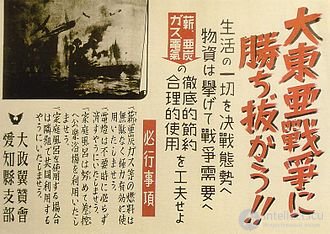
Let us win the Greater East Asia War!
By 1943, however, the Japanese public had become aware of the stark gap between crude propaganda and the facts. The death of Isoroku Yamamoto struck a serious blow. This was followed by the defeat at the Battle of Attu, which propaganda failed to make inspiring.
Reports on the Battle of Saipan focused on fighting spirit and heavy American losses, but a knowledge of geography would have shown that the fighting was slowly moving northward as American forces advanced, and reporting ceased after the final engagement, which went unreported. Reports of “annihilation” did not stop American forces from continuing to fight. Moreover, newspapers were permitted to speculate about the future of the war, so long as they did not predict defeat or otherwise show disloyalty; the truth could be inferred from their speculation.
After the events on Saipan led to Tojo's resignation as prime minister, the army and navy published an accurate account of the fall of Saipan, including the near-total death of all Japanese soldiers and civilians on the island and the use of “human bullets,” which led many to conclude that the war was lost. This was the first uncensored war news they had published since 1938, during the war with China. The simultaneous and catastrophic Battle of the Philippine Sea was still shrouded in the old manner. The Battle off Formosa was announced as a victory, and a holiday was declared, although in fact the Americans had inflicted serious damage and diverted aircraft needed to defend the Philippines. Inexperienced pilots reported devastating attacks on ships of the US Third Fleet shortly before the Battle of Leyte, and these reports were taken at face value, although the pilots had not actually sunk a single ship. The first kamikaze attacks were likewise presented as having successfully caused damage, contrary to the facts.
A downed B-29 was put on display, accompanied by boasts that it was one of hundreds of such aircraft.
When the offer of surrender was made, Kōichi Kido showed the emperor American pamphlets that spoke of the offer, and warned that uninformed soldiers might rise in revolt if the pamphlets fell into their hands. The cabinet agreed that the proclamation should come from the emperor himself, though out of deference to his position it was decided to make it a recording rather than a live broadcast. The Kyūjō incident, an attempt to prevent the broadcast, failed.
Часть 1 War Propaganda in Japan in the 20th Century
Часть 2 Peace - War Propaganda in Japan in the 20th Century

Comments