
Lecture
Lubok literature — pre-revolutionary cheap and primitive mass-produced publications, often furnished with a brightly coloured picture; primitive literature aimed at undiscriminating taste.
It should not be confused with works specially compiled or published for popular reading with educational aims (popular-national literature).
Lubok literature includes images and texts telling of various historical, religious, moral or everyday subjects. These works of art were widely used in various countries from the seventeenth to the nineteenth centuries as an accessible means of information and entertainment for the population, often becoming a kind of chapbook. They were accessible to most strata of society thanks to their relative cheapness and ease of production.
Lubki could tell of important historical events, warn against harmful habits, convey religious and moral lessons, and also serve as decorative ornament in homes. The combination of images and brief texts made lubok works accessible to those who could not read.
Over time interest in lubok literature as a mass phenomenon declined, but it remained an important part of the world's cultural heritage. Today lubok publications, including reproductions and modern interpretations, may be regarded as objects of art and collecting, and also used in educational and cultural projects.
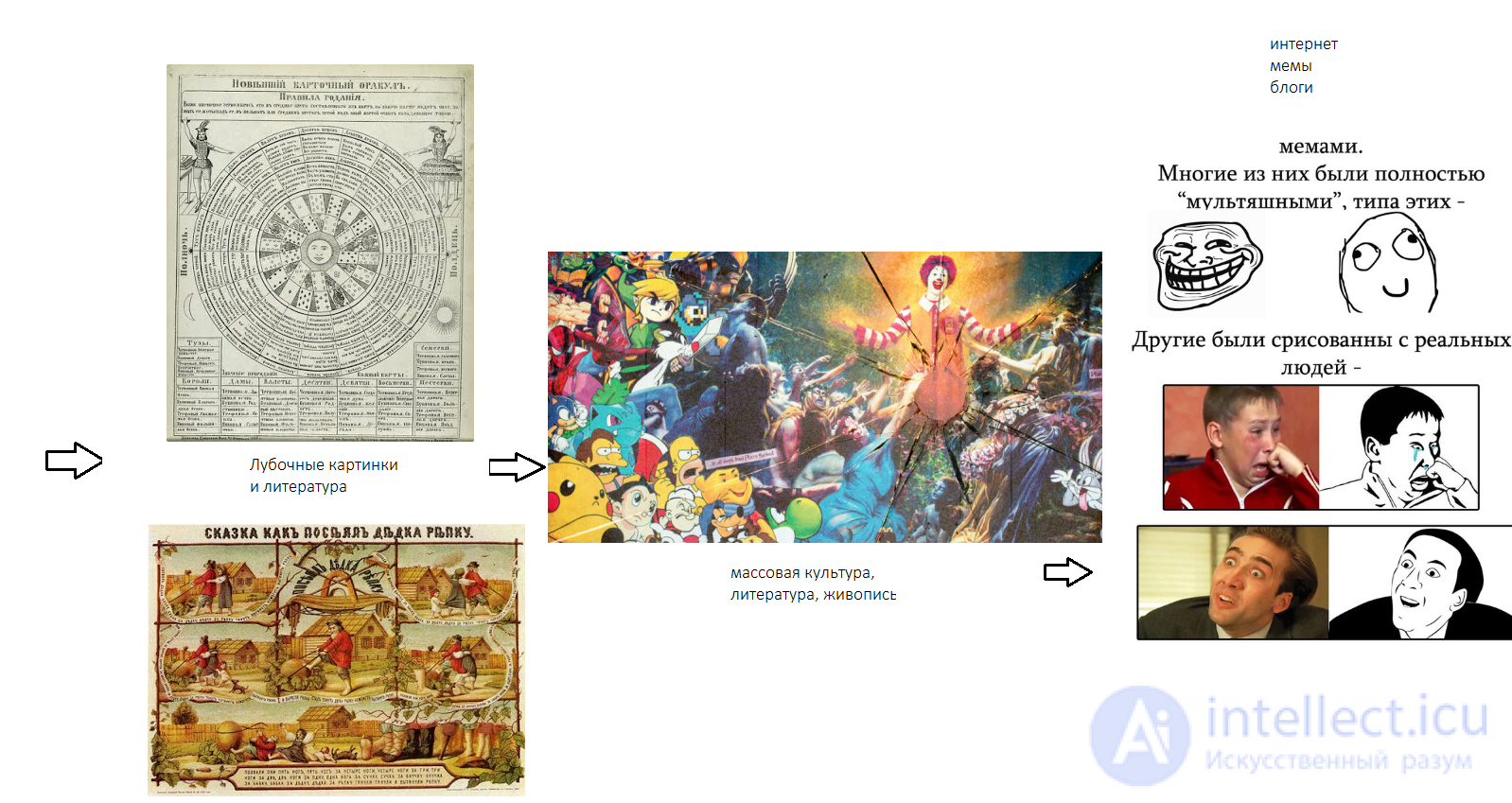
The history of lubok literature begins in Western Europe in the sixteenth—seventeenth centuries, and in Russia — from the second half of the eighteenth century. Before that there was no distinction between strata of readers: the level of concepts in the sphere of literate people was the same; some were more, others less well-read, but the character of that reading was similar, and consequently literature was universal, equally accessible to all.
With the development of scientific thought and aesthetic forms, the lower strata of the population fell behind the general movement and continued to make do with those works that literature had contained at the end of the era of its universality. These works underwent countless reworkings, always tasteless. Works of lubok literature were furnished with a brightly coloured picture, often having no relation to the text at all, and sometimes were limited to such a picture, with an explanatory text.
In France the first place among lubok literature was occupied by:
The tale of the misadventures of Genevieve of Brabant, at least in its German reworking made from a Dutch source, represents perhaps the latest in time work of narrative lubok literature.
In Western Europe, especially in Germany (unlike in Russia), the lubok tale was not enriched by works composed in more recent times: it is a tale, partly frozen, partly distorted, from the fifteenth—sixteenth centuries. This explains the weak manifestation of folk creativity in lubok literature, the utterly negligible influence of folk epic on the lubok tale.
From the heroic epic only individual, and moreover secondary, episodes passed into German lubok literature (“Heldenbuch”, 1491 and later editions; “Kleiner Rosegarten”, “König Laurin”, 1509; the legends of Dietrich von Bern), whereas the most significant poems, such as the “Nibelungenlied”, remained almost untouched by it; from the “Nibelungenlied” only the episode of Siegfried’s youth was borrowed (the prose tale “Hörnern Seyfried”, around 1640). The poem “Reineke Fuchs” immediately became a folk book in the version it acquired at the end of the fifteenth century.
To collections of facetiae compiled by the humanists were joined numerous collections of amusing anecdotes, which by the sixteenth century constituted an entire literature and continued to live on in lubok editions.
The history of lubok literature in Russia began in the second half of the eighteenth century, where it was composed of the same elements as in France. Its main part, alongside cheap calendars, consisted of religious publications and works of fiction.
Among religious lubok literature a significant part consisted of saints’ lives. More than 100 lubok editions of saints’ lives are known in all. It also included prayer books, psalters, calendars of saints, and the works of the holy fathers (Saints Tikhon of Zadonsk, Ephraim the Syrian, Basil the Great, Gregory the Theologian, John Chrysostom). In addition, about two dozen editions of spiritual-moral content may be assigned to religious lubok literature: “Strasti Khristovy”, “Kako podobaet stoyati v tserkvi Bozhiey”, “Ob antikhriste i konchine mira”, “Smert zakorenelogo greshnika i pravednogo”, “Serdtse chelovecheskoe pri zhizni pravednoy i grekhovnoy”, “Zagrobnaya zhizn”, “Vodka, kak dukh satany” and others.
Among lubok booklets of secular content were found letter-writing manuals, fortune-telling books, oracles and dream-books, with references in their titles to Albertus Magnus, Bryus, Swedenborg and “the famous soothsayer Lenormand”, numerous guides to choosing a wife, keys to a woman’s heart, songbooks.
In addition, a large number of tales and novels written in the lubok style were issued, numbering more than 500 editions. In lubok literature, above all, works well known in Russia in the seventeenth and the first half of the eighteenth centuries retained their popularity. Among them stand out the tales of Shemyaka’s Judgement, Yeruslan Lazarevich and Bova Korolevich. In addition, printed lubok literature preserved a significant part of those medieval European tales which, before the beginning of the eighteenth century, came to Russia chiefly through Poland. They were comic everyday tales in the fabliau genre or chivalric romances, whose main motif (the idealization of woman) remained misunderstood in Russia and grew ever more blurred in lubok reworkings. Among translated novels the greatest popularity at the end of the eighteenth — beginning of the nineteenth century was enjoyed by the tale of Peter of the Golden Keys, a reworking of the romance of Maguelonne (in our tradition — Magilena), the novels “Yevdon i Berae”, “Arzas i Razmira”, which retained their popularity throughout the entire nineteenth century “Frantsel Ventsian”, “Egipetsky Tsarevich Politsion”, “Guak, ili Nepreoborimaya Vernost”. Also enjoying success in lubok literature was “Istoriya ob Adolfe, printse Laplandiyskom i ob ostrove vechnogo veselya”, which represented a reworked episode of the sentimental-moral novel translated in the first half of the eighteenth century, “Istoriya Ippolita i Zhulii” , as well as “Povest ob Oktaviane”, which was a novel translated from Polish into Russian in 1677, “Povest o preslavnom rimskom kesare Ottone”.
Widely used in lubok literature also were collections of facetiae which had come to Russia from Europe through Polish sources as far back as pre-Petrine times. Thus, from the collection “Smekhotvornye Povesti” subjects were borrowed for the booklets “Starichok-Veselchak”, “Pokhozhdeniya Ivana Gostinnogo Syna”, in which the old tale of Frol Skobeev was reworked. The tale of Yorsh Shchetinnikov likewise became part of the lubok literature’s heritage. The motif of selling one’s soul to the devil was developed in the lubok reworking of the Polish novel about Pan Twardowski. Many similar stories passed into eighteenth-century lubok prints from the Velikoye Zertsalo.
Soon, in addition to works borrowed from Russian narrative literature of the first half of the eighteenth century, new subjects began to appear in lubok literature, composed partly on the basis of folk legends (illustrated eighteenth-century editions of the tales of Ilya Muromets, Dobrynya and Alyosha Popovich), partly on the basis of foreign sources, and subsequently — also of native literature. In the second half of the eighteenth century the first lubok writer appeared in Moscow — Matvei Komarov, who compiled “Obstoyatelnye i vernye istorii dvukh moshennikov: pervogo rossiyskogo slavnogo vora… Vanki Kaina; …vtorogo frantsuzskogo moshennika Kartusha” and the famous “Povest o priklyucheniyakh angliyskogo milorda Georga i brandenburgskoy markgrafini Frederiki-Luizy”.
At the same time as Komarov, in Moscow there also began to work the first lubok publisher, the clerk D. Fyodorov. Before that, lubok works were copied out by clerks and sold by pedlars at the Spassky Gate, in Kholshchovy Ryad, at the Mytny Dvor by the Moskvoretsky Bridge, by the Sukharev Tower. Fyodorov began publishing them, at first on large sheets with pictures, and later also in booklets of lubok format, likewise with pictures. In the first half of the nineteenth century, among lubok writers the most popular were Nikolai Zryakhov, A. Churovsky, V. F. Potapov, Alexei Moskvichin, and among publishers — I. N. Loginov, Pyotr Sharapov, Yerofeyev. Later, popular writers were — V. Suvorov, N. Mironov, publishers — A. Abramov, A. V. Morozov, Luzina, Ivan Sytin, Ye. A. Gubanov, at the end of the nineteenth century — the well-known writers Vasily Savikhin, Ivan Kondratyev, I. G. Zhuravov, A. Zhuravlev . But the greatest popularity at the end of the nineteenth century was enjoyed by Mikhail Yevstigneyev, Valentin Volgin,[15] whose tales (“Charodey i Rytsar”, “Noch u Satany”, “Utoplennitsa” and others), abounding in every kind of devilry, stood out among lubok works for their literacy and a certain coherence of exposition, and I. Kassirov
In the works of lubok writers at the end of the nineteenth century every kind of devilry, national exceptionalism and other similar tendencies predominated, giving an understanding of the reasons for the close connection between lubok literature and the cheap street press. Moreover, the works of the latter sometimes passed directly into lubok literature. Thus, for example, the story by Pastukhov about “Razboynik Churkin”, so widespread in lubok editions at the end of the nineteenth century and provoking a mass of imitations and forgeries, first appeared in “Moskovsky Listok”. The works of lubok writers at the end of the nineteenth century, who received extremely low pay (2—4 roubles per broadsheet, that is, for a composition of 36 printed pages), consisted of reworkings of bylinas and folk tales (“Koshchey Bessmertny”, “Istoriya o slavnom i khrabrom Ilye Muromtse i Solovye razboynike”), forgeries in the guise of folk tales (“Volshebny Klad pod Kupalov Den”, “O zloy vedme Nepogode”, “O soldate Yashke”), tales of contemporary life (“Ay da Yaroslavtsy!”, “Nuzhda na pogoste i dusha v russkoy bane”), historical novels and sketches (“Rokovaya Klyatva, ili Chernoye Domino”, “Tsygan-mstitel” from the time of Alexander Nevsky, “Strashny Klad, ili Tatarskaya Plennitsa”, “Vechevoy Kolokol”, “Gromoboy, ili Novgorodsky Voevoda”, “Putyata krestil mechom, a Dobrynya ognyom”, “Izbraniye na tsarstvo Mikhaila Fyodorovicha i podvig krestyanina Ivana Susanina”, “Kars, turetskaya krepost, i vzyatiye eyo shturmom russkimi voyskami”, “Mikhail Dmitrievich Skobelev 2-y”), various inscriptions and rhymes for lubok prints, always furnished with an explanatory text, just as lubok booklets always have a picture.
At the same time, in moments of historical upheaval lubok literature also used contemporary events as its subject matter. Such were the caricatures of French setbacks in 1812, and the numerous “flying leaflets” that appeared in Moscow during the Russo-Turkish War of 1877—78 in the form of booklets full of caricatured mockery of the Turks. The best of these were the editions by Yakovlev: “Nashi Zhernova Vse Smelyut”, “Posle Uzhina Gorchitsa”, “Pishchat”. In other leaflets of 1878 (“Krovavy Son”, “Ogarok”, “Zanoza”), alongside poems and short stories about the war, verses and anecdotes having no relation to the war at all were placed; there also appeared such “flying leaflets” (“Bulavka — Listok bez Podpischikov”, “Kurier”) in which there was no talk of the war at all.
Lubok writers were remarkable for their extraordinary fecundity, which is explained, in part, by their indulgent attitude to copyright: their “works” often amounted to reprints, in distorted form, of other people’s writings. “Taras Bulba”, for example, existed in several reprints under the most varied titles: “Razboynik Taras Chernomor”, “Taras Chernomorsky”, “Priklyucheniya kazatskogo atamana Urvana”; “Viy” was transformed into “Strashnaya Krasavitsa, ili Tri Nochi u Groba”; “Strashnaya Mest” — into “Strashny Koldun, ili Krovavoye Mshcheniye”. Zhukovsky’s fairy tales appeared in lubok literature under the titles: “Dedushka Vodyanoy”, “Chort v Duple”. Of Lermontov’s works, “Pesnya o kuptse Kalashnikove” found its way into lubok literature in several reworkings. Turgenev’s “Bezhin Lug” was reworked by Kassirov into the story “Domovoy Prokazit”, and he likewise reworked several of Nikolai Wagner’s “Skazki Kota Murlyki”, giving them the striking titles usual in lubok literature: “Proklyaty Gorshok”, “Zakoldovanny Zamok”. Numerous reworkings existed in lubok literature of “Knyaz Serebryany” by Alexei Tolstoy, “Yuri Miloslavsky” by Mikhail Zagoskin, “Konyok-Gorbunok” by Pyotr Yershov. There is a lubok reworking of Mikhail Saltykov-Shchedrin’s tale “Propala Sovest” and of Gleb Uspensky’s story “Nuzhda plyashet, nuzhda skachet, nuzhda pesenki poyot”. The tale by P. Kuvshinov “Peshchera v Lesu, ili Trup Mertvetsa” is an excerpt from Melnikov-Pechersky’s novel “V Lesakh”. There are lubok reworkings of “The Wandering Jew” by Eugène Sue, “The Martyrs” by François-René de Chateaubriand, and several works by Paul de Kock.
A characteristic feature of lubok literature was the enormous multitude of variants of one and the same work. Every lubok publisher wrote his own reworking of the most popular booklets: each had his own “Knyaz Serebryany”, his own “Razboynik Churkin”, his own “Bitva Russkikh s Kabardintsami”.
| Publisher | Books | Total print run |
|---|---|---|
| I. Sytin i K° | 116 | 1 236 700 |
| Ye. Gubanov | 86 | 729 000 |
| Ye. Abramova | 44 | 522 600 |
| I. Morozov | 58 | 423 600 |
| A. Kholmushin | 50 | 386 500 |
| G. Brilliantov | 24 | 330 000 |
| T. Kuzin | 24 | 172 000 |
| S. Zhivarev | 9 | 66 000 |
| T. Gubanov | 8 | 35 000 |
| Barkov | 2 | 24 000 |
| P. Kamenev | 5 | 20 000 |
The publishing of lubok books was concentrated almost entirely in Moscow; the St Petersburg entrepreneurs (Kuzin) and the Kiev ones (T. Gubanov) engaged little in publishing, preferring to trade in Moscow editions. Pedlars sold the broadsheet at 1 rouble per hundred, but there were also more expensive lubok editions. All lubok novels and tales, especially the historical ones, usually ran to 6 to 12, and sometimes as many as 18, printer’s sheets, and were sold by pedlars at 10—25 kopecks.
Lubok publishers traded in Moscow on Nikolskaya Street and, intending their editions for the rural population, called themselves “popular”. According to the Encyclopedic Dictionary of Brockhaus and Efron, they should not be confused with those “publishers of Nikolskaya Street” (Zemsky, Presnov, formerly Leukhin and Manukhin), who put out booklets for the lower strata of the urban population (guides to choosing a wife, keys to a woman’s heart, collections of “spicy stories”, various recipes and the like). In terms of content, however, it is difficult to draw a line between the works of this “lackey” literature and many lubok books, into which, in the last third of the nineteenth century, an element of pornography also crept.
In the early 1880s a turning point emerged in lubok literature under the influence of the struggle for existence with popular-educational literature, characterized by an improvement in proofreading, and the correction (on the initiative of I. Kassirov) of outdated language, historical or geographical references, and obscure or immoral passages.
In 1893 the number of copies of lubok editions increased, compared with 1892, by 500,000, reaching a total figure of 4,491,300. The increase occurred chiefly at the expense of religious-moral editions (from 1,401,400 to 1,692,400) and literary editions (from 1,785,200 to 2,169,600), while the number of dream-books decreased (from 266,600 to 168,300), as did letter-writing manuals (from 38,400 to 31,200).

Comments