
Lecture 6 min.
Euler's identity is a special case of Euler's formula at  [⇨], a well-known identity linking five fundamental mathematical constants - the equation of the five constants:

where
 — the number e, or the base of the natural logarithm,
 — the imaginary unit,
 — pi, the ratio of a circle's circumference to its diameter,
 — one, the identity element under multiplication,
 — zero, the identity element under addition.
Euler's identity is named after the Swiss, German and Russian mathematician Leonhard Euler[⇨]. The identity is considered a model of mathematical beauty[⇨], since it shows a deep connection between the most fundamental numbers in mathematics.
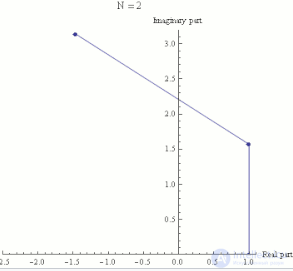
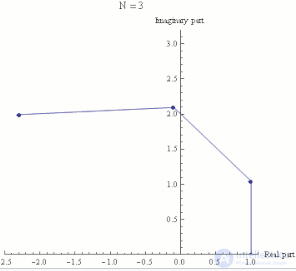
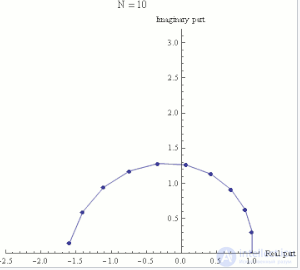
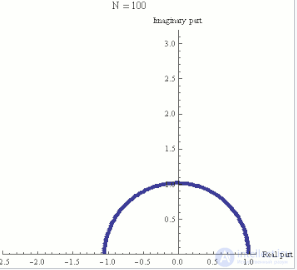
The exponential function ez can be defined as the limit of the sequence (1 + z/N)N as N tends to infinity, and therefore eiπ is the limit of (1 + iπ/N)N. Each frame of this animation shows the numbers (1 + iπ/N)k, where k runs from 0 to N, and N takes various increasing values from 1 to 100.
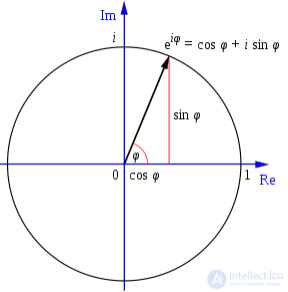
Euler's identity is a special case of Euler's formula from complex analysis:

for any real {\displaystyle x} . (Note that the arguments of the trigonometric functions
  and
and  are taken in radians.) In particular

And from the fact that

and

it follows that

which gives the identity:

Euler's identity is also a special case of a more general identity: the sum of the  -th roots of unity for
  equals :
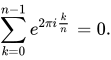
Euler's identity is the case when  .
.
In another area of mathematics, using quaternion exponentiation, it can be shown that a similar identity also applies to quaternions. Let {i, j, k} be the basis elements; then
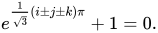
In general, given real a1, a2, and a3 such that a12 + a22 + a32 = 1, then

For octonions, with real an such that a12 + a22 + ... + a72 = 1, and with the octonion basis elements {i1, i2, ..., i7},

Euler's identity, which combines three basic mathematical operations (addition, multiplication and exponentiation) and five fundamental mathematical constants belonging to four classical areas of mathematics (the numbers and belong to arithmetic, the imaginary unit to algebra, the number to geometry, and the number to mathematical analysis), made a deep impression on the scientific world, was interpreted mystically as a symbol of the unity of mathematics, and is often cited as an example of deep mathematical beauty.
Euler's identity has drawn many enthusiastic reactions.
A reader poll conducted by the mathematics journal The Mathematical Intelligencer in 1990 named Euler's identity "the most beautiful theorem in mathematics". In another reader poll, conducted by the physics journal PhysicsWorld in 2004, Euler's identity (together with Maxwell's equations) was named the "greatest equation ever".
A study of the brains of sixteen mathematicians showed that the "emotional brain" (in particular, the medial orbitofrontal cortex, which responds to beautiful music, poetry, paintings, etc.) was activated more consistently for Euler's identity than for any other formula[9].
Euler's formula, from which Euler's identity follows immediately, was first given in a paper by the English mathematician Roger Cotes (Newton's assistant), "Logometria" (Latin: Logometria), published in the journal Philosophical Transactions of the Royal Society in 1714 (when Euler was 7 years old), and reprinted in the book "Harmonia mensurarum" (Latin: Harmonia mensurarum) in 1722.
Euler published Euler's formula in its familiar form in a 1740 paper and in the book "Introductio in analysin infinitorum" (Latin: Introductio in analysin infinitorum) (1748).
However, Euler's identity itself (in its current classical form) does not appear in Euler's works of 1740 and 1748, and it is possible that he never derived it. It is possible that Euler may have learned of Euler's formula through his Swiss compatriot Johann Bernoulli.
According to Robin Wilson (English):
We have seen how it [Euler's identity] can easily be deduced from results of Johann Bernoulli and Roger Cotes, but that neither of them seem to have done so. Even Euler does not seem to have written it down explicitly — and certainly it does not appear in any of his publications — though he must surely have realized that it follows immediately from his identity [in this case, Euler's formula], eix = cos x + i sin x. Moreover, it seems that it is not known who first stated the result explicitly…

Comments