
Lecture 4 min.
A plurisubharmonic function is a real-valued function  of
of  complex variables
  on a domain
  of complex space
  ,
,  , satisfying the following conditions:
 is upper semicontinuous everywhere in ;
 is a subharmonic function of the variable
  in each connected component of the open set
  for any fixed points
  ,
,  .
.Plurisubharmonic functions were defined in 1942 by Kiyoshi Oka and Pierre Lelong .
A function  is called a plurisuperharmonic function if
  is a plurisubharmonic function.
Plurisubharmonic functions are subharmonic, but for  the converse is not true.
In addition to the general properties of subharmonic functions, plurisubharmonic functions have the following properties:
is a plurisubharmonic function in a domain if and only if is a plurisubharmonic function in a neighborhood of each point  ; the mean value
over the sphere of radius  is an increasing function of , convex with respect to
  on the interval
  , if the ball
  lies in ;
is a continuous plurisubharmonic function in a domain ,  is a closed connected analytic subset of , and the restriction
  attains a maximum on , then
 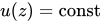 on .
on . ,
,  for
for  , where
  is a holomorphic function in .
Relation to Kähler manifolds: on n-dimensional complex Euclidean space ,  is plurisubharmonic. In fact,
 is equal to the standard Kähler form onup to constant multiples. More generally, if
 satisfies
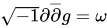
for some Kähler form  , then is plurisubharmonic, and is called a Kähler potential.
Relation to the Dirac delta: on one-dimensional complex Euclidean space ,
, 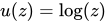 is plurisubharmonic. If
 is a C ∞ function with compact support , then the Cauchy integral formula says
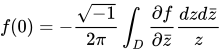
which can be rewritten as
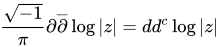 .
.
This is nothing other than the Dirac measure at the origin 0.
More examples
is an analytic function on an open set, then  is plurisubharmonic on that open set.
 is a domain of holomorphy, then
  is plurisubharmonic
In complex analysis, plurisubharmonic functions are used to describe pseudoconvex domains , domains of holomorphy and Stein manifolds .
Although the notion of a plurisubharmonic function can be hard to grasp, it has found applications in various areas of mathematics and physics. Here are a few examples:
Potential theory: Plurisubharmonic functions are used to study potential fields arising in various physical problems, such as electrostatics, gravitation and heat conduction.
Complex analysis: Plurisubharmonic functions are important in the study of analytic functions, especially in the theory of harmonic functions. They help to study the characteristics of the boundaries and integrals of analytic functions.
Probability theory: Plurisubharmonic functions have found application in the study of stochastic processes and probability theory. They are related to certain classes of martingales and can be used to model various random phenomena.
Geometry: Plurisubharmonic functions are used to study the properties of various classes of geometric objects, such as conformal maps, harmonic measures and harmonic functions at different levels of the complex plane.
These are only a few examples of applications of plurisubharmonic functions. In general, they are important tools in various areas of mathematics, physics, probabilistic modeling and geometry, making it possible to study and analyze various mathematical structures and physical phenomena.
The main geometric application of the theory of plurisubharmonic functions is a famous theorem proved by Kiyoshi Oka in 1942 .
A continuous function  is called exhaustive, if the preimage
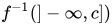 is compact for all
  . A plurisubharmonic function f is called strongly plurisubharmonic, if the form
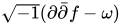 is positive for some Kähler form on M .
Oka's theorem: Let M be a complex manifold admitting a smooth, exhaustive, strongly plurisubharmonic function. Then M is Stein . Conversely, every Stein manifold admits such a function.

Comments