
Lecture 9 min.
An elliptic function is, in complex analysis, a function defined on the complex plane that is periodic in two directions. Elliptic functions can be regarded as analogues of trigonometric functions (which have only one period). Historically, elliptic functions were discovered as the inverse functions of elliptic integrals.
An elliptic function is a meromorphic function f defined on a domain  , for which there exist two nonzero complex numbers a and b such that

and also the quotient  is not a real number.
It follows that for any integers m and n
and n
 .
.
Any complex number ω such that

is called a period of the function f . If the periods a
 and b
and b are such that any ω can be written as

then a and b are called fundamental periods. Every elliptic function has a pair of fundamental periods.
The parallelogram  with vertices at 0, a, b, a+b is called the fundamental parallelogram.
 has no poles on the boundary of the parallelogram α+Π, then the sum of the residues of f(z) at all poles lying inside α+Π is zero (Liouville's second theorem).
where h, g are rational functions, and  is the Weierstrass function with the same periods as f(z). If, in addition, f(z) is an even function, it can be represented in the form
 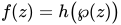 , where h is rational.
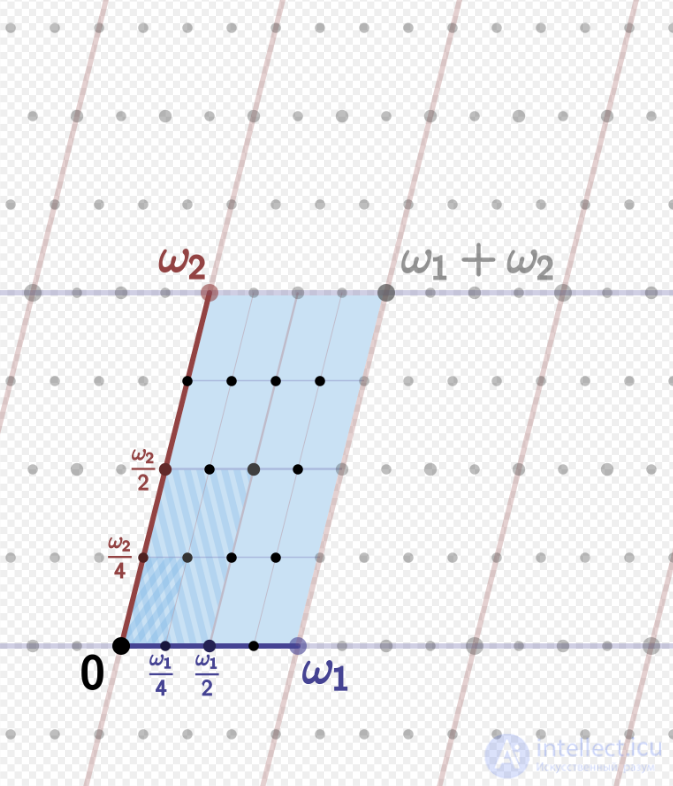
The fundamental domain of an elliptic function as the unit cell of its period lattice.
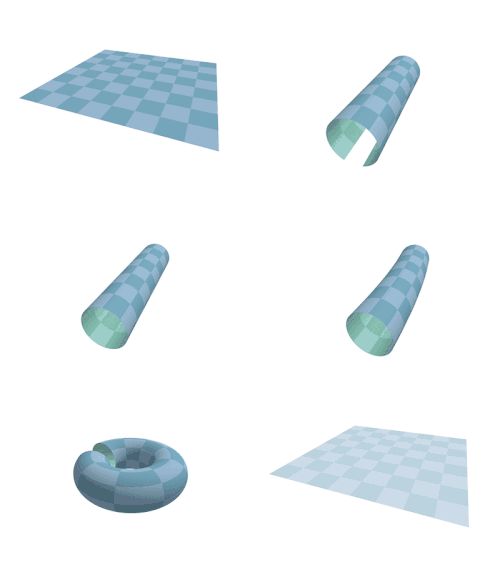
A parallelogram in which opposite sides are identified
If is an elliptic function with periodsω1,ω2 it also holds that

for every linear combination  withm,n∈Z
 .
.
The abelian group

is called the period lattice.
The parallelogram generated by  and
and 

is a fundamental domain ofΛ acting onC.
Geometrically, the complex plane is tiled by parallelograms. Everything that happens in one fundamental domain is repeated in all the others. Therefore we can regard elliptic functions as functions on the quotient group. C/Λ as their domain of definition. This quotient group, called an elliptic curve, can be represented as a parallelogram in which opposite sides are identified, which is topologically a torus.
The following three theorems are known as Liouville's theorems (1847).
A holomorphic elliptic function is constant.
This is the original form of Liouville's theorem, and it can be derived from it. A holomorphic elliptic function is bounded, since it takes all its values on the fundamental domain, which is compact. Therefore it is constant by Liouville's theorem.
Every elliptic function has a finite number of poles in and the sum of its residues is zero.
It follows from this theorem that there is no nonzero elliptic function with exactly one pole of order one, or exactly one zero of order one, in the fundamental domain.
A nonconstant elliptic function takes every value the same number of times in counted with multiplicity.
One of the most important elliptic functions is the Weierstrass  -function. For a given period lattice it is defined by

It is constructed so that there is a pole of order two at each lattice point. The term  is a way of making the series converge.
℘is an even elliptic function; that is, 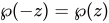 .
.
Its derivative
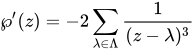
is an odd function, i.e.℘′(−z)=−℘′(z).
One of the main results of the theory of elliptic functions is the following: every elliptic function with respect to a given period latticeΛcan be expressed as a rational function in terms of and ′ .
.
The℘-function satisfies the differential equation

where  and
and  are constants that depend onΛ. More precisely,
  and
and  , where
  and
and  are the so-called Eisenstein series.
In algebraic language, the field of elliptic functions is isomorphic to the field
 ,
,
where the isomorphism maps to  and to
  .
.
 -function with period lattice
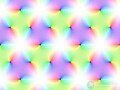 -function
The relation to elliptic integrals is mainly of historical background. Elliptic integrals were studied by Legendre, whose work was continued by Niels Henrik Abel and Carl Gustav Jacobi.
Abel discovered elliptic functions by taking the inverse functionφ of the elliptic integral function

 .
.
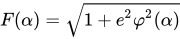
He also defined the functions
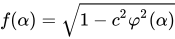
and
 .
.
After being extended to the complex plane, they turned out to be doubly periodic and are known as Abel's elliptic functions.
The Jacobi elliptic functions are obtained in a similar way as inverse functions of elliptic integrals.
Jacobi considered the integral function
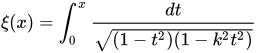
and inverted it:x=sn(ξ) .sn
.sn stands for sinus amplitudinis and is the name of the new function. [ 11 ] He then introduced the functions cosinus amplitudinis and delta amplitudinis , which are defined as follows:

 .
.
Only by taking this step was Jacobi able to prove his general formula for the transformation of elliptic integrals in 1827.
Soon after the development of the infinitesimal calculus, the Italian mathematician Giulio di Fagnano and the Swiss mathematician Leonhard Euler began to develop the theory of elliptic functions . In trying to compute the arc length of a lemniscate, they encountered problems involving integrals that contain the square root of polynomials of degree 3 and 4. It was clear that these so-called elliptic integrals could not be solved with elementary functions. Fagnano discovered an algebraic relation between elliptic integrals, which he published in 1750. Euler immediately generalized Fagnano's results and formulated his algebraic addition theorem for elliptic integrals.
Apart from a remark by Landen his ideas were not developed until 1786, when Legendre published his work Mémoires sur les intégrations par arcs d'ellipse . Legendre subsequently studied elliptic integrals and called them elliptic functions . Legendre introduced a triple classification – three kinds – which was a substantial simplification of the rather complicated theory of the time. Other important works by Legendre are: Mémoire sur les transcendantes elliptiques (1792), Exercices de calcul intégral (1811–1817), Traité des fonctions elliptiques (1825–1832). Legendre's work remained largely untouched by mathematicians until 1826.
Subsequently, Niels Henrik Abel and Carl Gustav Jacobi resumed the investigation and quickly obtained new results. First they inverted the elliptic integral function. On Jacobi's suggestion in 1829, these inverse functions are now called elliptic functions . One of Jacobi's most important works is Fundamenta nova theoriae functionum ellipticarum , published in 1829. The addition theorem found by Euler was formulated and proved in general form by Abel in 1829. In those days, the theory of elliptic functions and the theory of doubly periodic functions were considered different theories. They were unified by Briot and Bouquet in 1856. Gauss had discovered many properties of elliptic functions 30 years earlier, but never published anything on the subject.
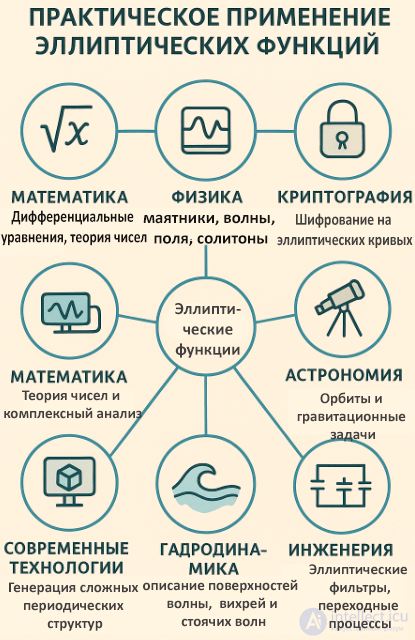
Elliptic functions are an important branch of analysis that has wide practical applications in science and engineering. Below is an overview of the main areas where they are actually used.
a) Oscillations and pendulums
The real motion of a simple pendulum is described not by a sine but by an elliptic function.
For large amplitudes, the equation of motion is integrated in terms of an elliptic integral of the first kind.
b) Electricity and magnetism
Current fields in ring-shaped and toroidal systems (coils, current loops) are expressed through elliptic integrals.
Calculation of the inductance of rings, of the magnetic fields of current loops, and of currents on the surface of conductors.
c) Optics and waves
The propagation of light in nonlinear media and solitons (stationary wave packets) are described through Jacobi functions, a kind of elliptic function.
In optical gratings and crystals, elliptic functions describe the modulation of intensity and phase.
a) Solving nonlinear differential equations
Many nonlinear equations (Korteweg–de Vries, Duffing, Schrödinger) admit solutions in the form of Jacobi or Weierstrass elliptic functions.
b) Number theory and complex analysis
Elliptic functions underlie modular forms, elliptic curves and Fermat's theorem (via Wiles's proof).
They are used in constructing distribution functions and in cryptography.
Elliptic curves are geometric objects defined by equations of the form
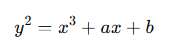
Their properties are directly related to elliptic functions.
Applications:
Elliptic curve cryptography (ECC) is the modern encryption standard (in TLS, Bitcoin, Ethereum and others).
Digital signatures, key exchange (ECDH), authentication.
The motion of a body in a central field (for example, a planet) with a deviation from a circular orbit is often expressed through elliptic integrals.
Calculation of orbits under perturbations, of spacecraft trajectories, and of precessions.
Elliptic functions make it possible to describe orbital parameters analytically where the usual trigonometric approximations are not suitable.
Chebyshev filters and elliptic filters (in analog and digital signal processing) use elliptic functions to shape the required frequency responses.
Calculation of transient processes in circuits with nonlinear elements.
In describing wave surfaces, vortices and standing waves, solutions in terms of elliptic functions often appear (for example, superfluidity, surface waves).
In graphics and modeling, for generating periodic patterns with controlled shapes (unlike the sine).
In quantum computing and superstring theory, elliptic functions describe the behavior of wave functions on a torus.
| Field | Application |
|---|---|
| Physics | Pendulums, waves, fields, solitons |
| Mathematics | Differential equations, number theory |
| Cryptography | Encryption on elliptic curves |
| Astronomy | Orbits and gravitational problems |
| Electronics | Elliptic filters |
| Hydrodynamics | Surface waves |
| Computer graphics | Generation of complex periodic structures |

Comments