
Lecture 15 min.
In mathematics , complex geometry is the study of complex manifolds , complex algebraic varieties and functions of several complex variables . The application of transcendental methods to algebraic geometry falls into this category, together with the more geometric aspects of complex analysis .
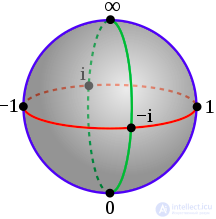
Broadly speaking, complex geometry is concerned with spaces and geometric objects that are modeled, in some sense, on the complex plane . The features of the complex plane and of complex analysis of a single variable, such as the intrinsic notion of orientability (that is, the ability to rotate consistently by 90 degrees counterclockwise at every point of the complex plane) and the rigidity of holomorphic functions (that is, the existence of a single complex derivative implies complex differentiability of all orders), are seen to manifest themselves in all forms of the study of complex geometry. For example, every complex manifold is canonically orientable, and a form of Liouville's theorem holds on compact complex manifolds or projective complex algebraic varieties.
Complex geometry differs from what might be called real geometry, the study of spaces based on the geometric and analytic properties of the real number line . For example, while smooth manifolds admit partitions of unity , collections of smooth functions that can be identically equal to one on some open set and identically zero elsewhere, complex manifolds do not admit such collections of holomorphic functions. Indeed, this is a manifestation of the identity theorem , a typical result of complex analysis of a single variable. In some sense, the novelty of complex geometry goes back to this fundamental observation.
It is true that every complex manifold is, in particular, a smooth real manifold. This is because the complex plane , after forgetting its complex structure, is isomorphic to the real plane
  . However, complex geometry is not usually regarded as a separate branch of differential geometry , the study of smooth manifolds. In particular, Serre's GAGA theorem states that every projective analytic variety is in fact an algebraic variety, and the study of holomorphic data on an analytic variety is equivalent to the study of algebraic data.
This equivalence indicates that complex geometry is, in some sense, closer to algebraic geometry than to differential geometry . Another example of this, which is related to the nature of the complex plane, is that in complex analysis of a single variable the singularities of meromorphic functions are easy to describe. In contrast, the possible singular behavior of a continuous real function is much harder to characterize. As a result, one can easily study singular spaces in complex geometry, such as singular complex analytic varieties or singular complex algebraic varieties, whereas in differential geometry the study of singular spaces is often avoided.
In practice, complex geometry sits at the intersection of differential geometry, algebraic geometry and analysis in several complex variables , and the complex geometer uses tools from all three fields to study complex spaces. Typical areas of interest in complex geometry include the classification of complex spaces, the study of the holomorphic objects attached to them (such as holomorphic vector bundles and coherent sheaves ), and the close relations between complex geometric objects and other areas of mathematics and physics.
Complex geometry is concerned with the study of complex manifolds , as well as complex algebraic and complex analytic varieties . This section defines these types of spaces and presents the relations between them.
A complex manifold is a topological space  such that:
is Hausdorff and second countable .is locally homeomorphic to an open subset of for some
  . That is, for every point
 , there is an open neighborhood
  of
of  and a homeomorphism
  to an open subset
  . Such open sets are called charts .
 and
and  are any two intersecting charts that map onto open sets
  of respectively, then the transition function
  is a biholomorphism .
Note that, since every biholomorphism is a diffeomorphism , andis isomorphic as a real vector space to , every complex manifold of dimension is, in particular, a smooth manifold of dimension
  , which is always an even number.
In contrast to complex manifolds, which are always smooth, complex geometry is also concerned with possibly singular spaces. An affine complex analytic variety is a subset such that at each point , there is an open neighborhood of and a collection of finitely many holomorphic functions
  such that
  . By convention we will also require the setto be irreducible . A pointis singular if the Jacobian matrix of the vector of holomorphic functions
 does not have full rank at , and nonsingular otherwise. A projective complex analytic variety is a subset
 of complex projective space , which is, in the same way, locally given by the zeros of a finite set of holomorphic functions on open subsets of
 .
.
In a similar way, one can define an affine complex algebraic variety as a subset which is locally given as the zero set of finitely many polynomials in complex variables. To define a projective complex algebraic variety , one requires a subsetto be locally given by the zero set of finitely many homogeneous polynomials .
To define a general complex algebraic or complex analytic variety, the notion of a locally ringed space is needed. A complex algebraic / analytic variety is a locally ringed space which is locally isomorphic, as a locally ringed space, to an affine complex algebraic / analytic variety. In the analytic case one usually allows to have a topology locally equivalent to the subspace topology, due to the identification with open subsets of , whereas in the algebraic caseoften uses the Zariski topology . Again, by convention, we also require this locally ringed space to be irreducible.
Since the definition of a singular point is local, the definition given for an affine analytic / algebraic variety applies to the points of any complex analytic or algebraic variety. The set of points of a varietywhich are singular is called the singular set and is denoted , and the complement is the nonsingular or smooth set , denoted
 . We say that a complex variety is smooth or nonsingular if its singular set is empty. That is, if it is equal to its nonsingular locus.
By the implicit function theorem for holomorphic functions, every complex manifold is, in particular, a nonsingular complex analytic variety, but in general is not affine or projective. By Serre's GAGA theorem, every projective complex analytic variety is in fact a projective complex algebraic variety. When a complex variety is nonsingular, it is a complex manifold. More generally, the nonsingular set of any complex variety is a complex manifold.
Complex manifolds can be studied from the point of view of differential geometry, whereby they are equipped with additional geometric structures such as a Riemannian metric or a symplectic form . For this additional structure to be relevant to complex geometry, one must ask that it be compatible with the complex structure in a suitable sense. A Kähler manifold is a complex manifold with a Riemannian metric and a symplectic structure compatible with the complex structure. Every complex submanifold of a Kähler manifold is Kähler, and so, in particular, every nonsingular affine or projective complex variety is Kähler, after restricting the standard Hermitian metric onor the Fubini-Study metric on respectively.
Other important examples of Kähler manifolds include Riemann surfaces, K3 surfaces and Calabi-Yau manifolds .
Serre's GAGA theorem states that projective complex analytic varieties are in fact algebraic. Although this is not quite true for affine varieties, there is a class of complex manifolds that behave very much like affine complex algebraic varieties, called Stein manifolds . A manifoldis Stein if it is holomorphically convex and holomorphically separable (see the article on Stein manifolds for the technical definitions). However, it can be shown that this is equivalent to being a complex submanifold of for some . Another way in which Stein manifolds are similar to affine complex algebraic varieties is that Cartan's Theorems A and B hold for Stein manifolds.
Examples of Stein manifolds include noncompact Riemann surfaces and nonsingular affine complex algebraic varieties.
A special class of complex manifolds is the hyperkähler manifolds , which are Riemannian manifolds admitting three distinct compatible integrable almost complex structures  which satisfy the quaternionic relations
  . Thus, hyperkähler manifolds are Kähler manifolds in three different ways and consequently have a rich geometric structure.
Examples of hyperkähler manifolds include ALE spaces , K3 surfaces, Higgs bundle moduli spaces, quiver varieties and many other moduli spaces arising from gauge theory and representation theory .
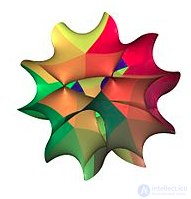
As already mentioned, a special class of Kähler manifolds is given by the Calabi-Yau manifolds. They are given by Kähler manifolds with trivial canonical bundle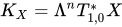 . Usually the definition of a Calabi-Yau manifold also requiresto be compact. In this case, the proof of the Calabi conjecture by Yau implies thatadmits a Kähler metric with zero Ricci curvature , and this can be regarded as an equivalent definition of Calabi-Yau.
Calabi-Yau manifolds have found application in string theory and mirror symmetry , where they are used to model the extra 6 dimensions of spacetime in 10-dimensional string theory models. Examples of Calabi-Yau manifolds are elliptic curves , K3 surfaces and complex abelian varieties .
A complex Fano variety is a complex algebraic variety with an ample anticanonical line bundle (that is, is ample). Fano varieties are of significant interest in complex algebraic geometry and, in particular, in birational geometry , where they often arise in the minimal model program . Fundamental examples of Fano varieties are given by projective space where
  , and smooth hypersurfaces in of degree less than
  .
.
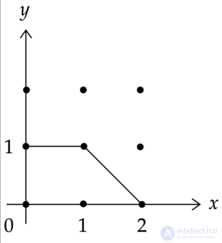
Toric varieties are complex algebraic varieties of dimensioncontaining an open dense subset biholomorphic to , equipped with an action of which extends the action on the open dense subset. A toric variety can be described combinatorially by its toric fan and, at least when it is nonsingular, by its moment polytope . This is a polygon in
 with the property that any vertex can be transformed into the standard form of the vertex of the positive orthant by the action of
 . A toric variety can be obtained as a suitable space fibered over the polytope.
Many constructions carried out on toric varieties admit an alternative description in terms of the combinatorics and geometry of the moment polytope or the associated toric fan. This makes toric varieties particularly attractive test cases for many constructions in complex geometry. Examples of toric varieties include complex projective spaces and bundles over them.
Because of the rigidity of holomorphic functions and complex manifolds, the techniques typically used to study complex manifolds and complex varieties differ from those used in regular differential geometry, and are closer to those used in algebraic geometry. For example, in differential geometry many problems are solved by taking local constructions and patching them together globally using partitions of unity. Partitions of unity do not exist in complex geometry, so the question of when local data can be glued into global data is more subtle. When local data can be joined together, this is measured by sheaf cohomology , and sheaves and their cohomology groups are the main tools.
For example, well-known problems in the analysis of several complex variables that preceded the introduction of the modern definitions are the Cousin problems , which ask precisely when local meromorphic data can be glued together to obtain a global meromorphic function. These old problems can be solved simply after the introduction of sheaves and cohomology groups.
Special examples of sheaves used in complex geometry include holomorphic line bundles (and the associated divisors ), holomorphic vector bundles, and coherent sheaves . Since sheaf cohomology measures obstructions in complex geometry, one of the techniques used is to prove vanishing theorems. Examples of vanishing theorems in complex geometry include the Kodaira vanishing theorem for the cohomology of line bundles on compact Kähler manifolds, and Cartan's theorems A and B for the cohomology of coherent sheaves on affine complex varieties.
complex geometry also uses techniques arising from differential geometry and analysis. For example, the Hirzebruch-Riemann-Roch theorem , a special case of the Atiyah-Singer index theorem , computes the holomorphic Euler characteristic of a holomorphic vector bundle in terms of characteristic classes of the underlying smooth complex vector bundle.
One of the main themes of complex geometry is classification . Because of the rigidity of complex manifolds and varieties, the classification problem for these spaces is often tractable. Classification in complex and algebraic geometry often proceeds by studying moduli spaces , which are themselves complex manifolds or varieties whose points classify other geometric objects arising in complex geometry.
The term moduli was introduced by Bernhard Riemann during his original work on Riemann surfaces. The classification theory is best known for compact Riemann surfaces. By the classification of closed oriented surfaces, compact Riemann surfaces come in countably many discrete types, measured by their genus.  , which is a non-negative integer counting the number of holes in a given compact Riemann surface.
The classification follows essentially from the uniformization theorem and is as follows:

 where
where  is a complex number with strictly positive imaginary part. The moduli space is given by the quotient by the group
 acting on the upper half-plane by Möbius transformations .
 of compact Riemann surfaces of genus g, of dimension
  . Similarly to the case of elliptic curves, this space can be obtained as a suitable quotient of the Siegel upper half-space by the action of the group
 .
.Complex geometry is concerned not only with complex spaces, but also with other holomorphic objects attached to them. The classification of holomorphic line bundles on a complex manifoldis given by the Picard variety  of .
of .
The Picard variety is easily described in the case where is a compact Riemann surface of genus g. Namely, in this case the Picard variety is a disjoint union of complex abelian varieties , each of which is isomorphic to the Jacobian variety of the curve, classifying divisors of degree zero up to linear equivalence. In differential-geometric terminology, these abelian varieties are complex tori, complex manifolds diffeomorphic to , possibly with one of many different complex structures.
By Torelli's theorem, a compact Riemann surface is determined by its Jacobian variety, and this demonstrates one reason why studying structures on complex spaces can be useful, since it can allow the classification of the spaces themselves to be solved.
Enriques–Kodaira classification
GAGA (Algebraic geometry and analytic geometry)

Comments