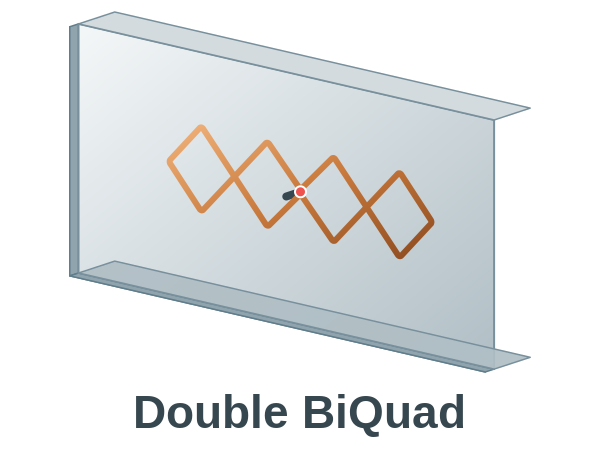
The calculator designs a double triangle loop antenna from its operating frequency: the size of the 2A × B wire blank, the triangle side, the wire diameter with its AWG gauge, the total wire length, the SWR < 2 bandwidth and the gain. The dimensions of the bent antenna are shown as well. The calculation runs on the server, and the result comes with a scale drawing.
Double triangle antenna
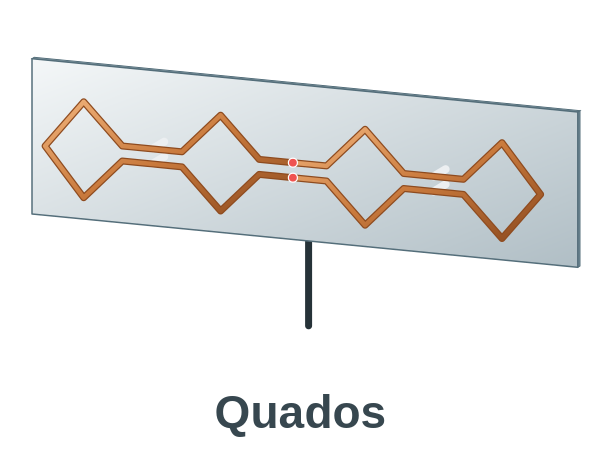
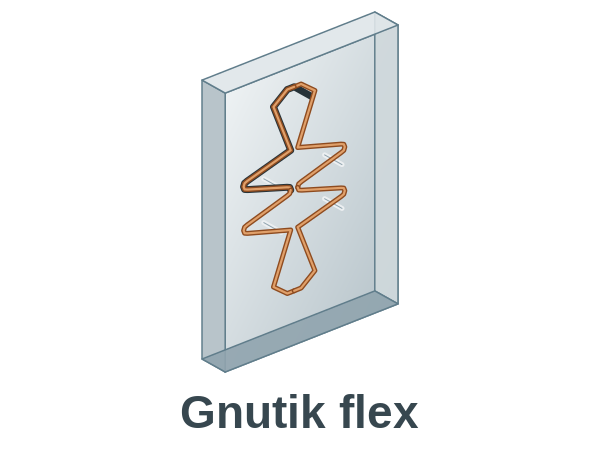
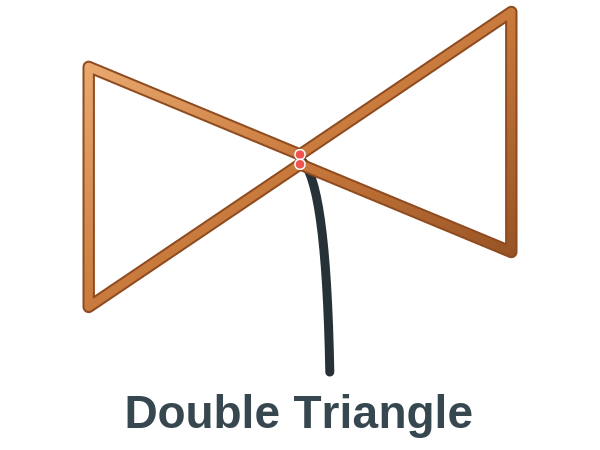
The double triangle is a simple wire loop antenna made of two triangular loops joined at their apexes in a common feed point. Each triangle is a little longer than a wavelength around, and together they work as an in-phase pair of loops. As a result the antenna gives noticeably more than a single loop or a dipole: about 6 dBi, while staying flat, light and free of matching devices - its input impedance is close to 50 Ω, so the cable is connected directly.
Without a reflector the antenna radiates on both sides, perpendicular to its plane. It is made of copper wire or rod for LPD/PMR, GSM, LTE and Wi-Fi, placed at a window or on a mast, and a flat reflector may be added when needed (this calculator does not design the reflector). Construction and building
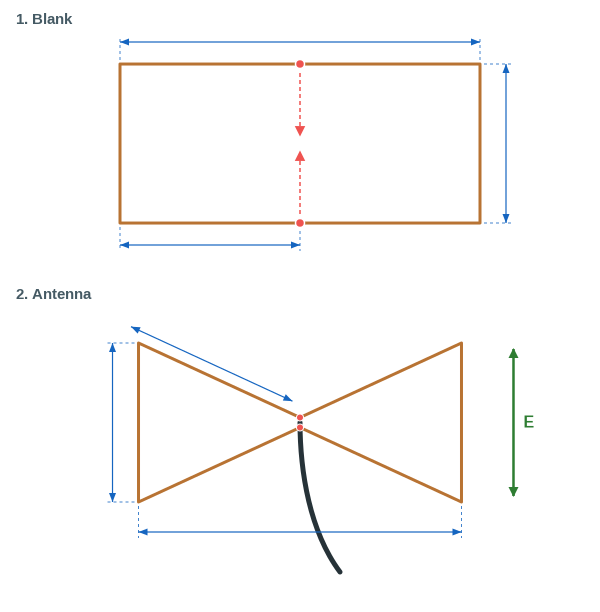
First, a rectangle with sides 2A and B is bent from wire of diameter dw. Then the middles of the long sides are brought towards each other, to the centre of the rectangle: this gives two triangles with bases B and sides A whose apexes meet in the middle. The wire ends are soldered together on one of the bases. The two middles are not shorted: a small gap is left between them, and the cable is soldered there - the centre conductor to one point, the shield to the other.
The polarisation runs along the bases B and along the feed gap: with the triangles on the left and right and the bases vertical, the polarisation is vertical; turning the antenna by 90° makes it horizontal. Calculation method
The wavelength λ = 299792 / f (f in MHz, λ in mm), and the other dimensions are proportional to it:
Blank width
2A = 0.789218 · λ
Blank height (triangle base)
B = 0.348572 · λ
Triangle side
A = 0.394609 · λ
Wire diameter
dw = 0.0049 · λ
Total wire length
L = 2 · 2A + 2 · B + 2.5π · dw
The SWR < 2 bandwidth is about 12.6 % of the operating frequency, the gain about 6.3 dBi. The wire diameter grows with the wavelength, so the calculator works while the wire fits the AWG table (no thicker than 12 mm and no thinner than 50 AWG): roughly from 122.42 MHz to 62 GHz. The higher the frequency, the more decimal places in the dimensions. How to use the calculator
Enter the frequency or pick a band. Example for Wi-Fi 2450 MHz: λ = 122.4 mm, wire dw = 0.6 mm (23 AWG), blank 2A = 96.6 mm by B = 42.7 mm, triangle side A = 48.3 mm, total wire length 283 mm, bandwidth about 308 MHz.
Comments