Cantenna (tin can antenna) calculator online on Intellect

Used 520 times
Cantenna (tin can antenna) calculator online
The calculator checks whether a can of the chosen diameter suits the operating frequency and designs a cantenna: the passband of the can as a circular waveguide, the can length, the probe length and its distance from the bottom, and the pattern of a conical horn. The calculation runs on the server, and the result comes with a drawing.
The operating frequency in MHz (or a band from the list) and the inner can diameter in mm. Leave the diameter empty to have it picked automatically.
MHz
mm

Reset Complain Share result

Share:


Was this answer useful?
Choose a quick rating so we can improve the next answer for you.
How satisfied are you?


Your answer option for this service or noticed an error:

Cantenna
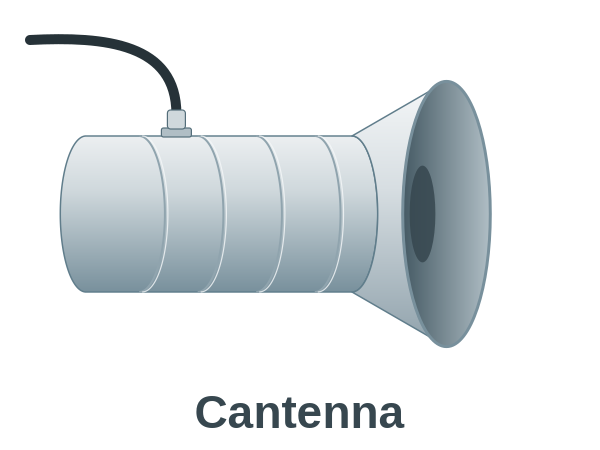
A tin can antenna, or cantenna (can + antenna), is a short section of circular waveguide closed at one end. The waveguide is an ordinary metal can from coffee, juice or canned food, and a probe soldered to a coaxial connector goes into it through the wall. The result is a directional antenna that receives the wave entering the open end of the can.
The antenna is popular with those who build their first home-made antenna for Wi-Fi and 3G/4G: all it takes is a can, a connector and a piece of copper wire, and the build accuracy is not critical. In practice it gives 4-8 dBi depending on the can and the tuning, and a conical horn adds up to 3 dB more. Below 1 GHz the can gets too large, so such antennas are not made for those bands.
How the can works
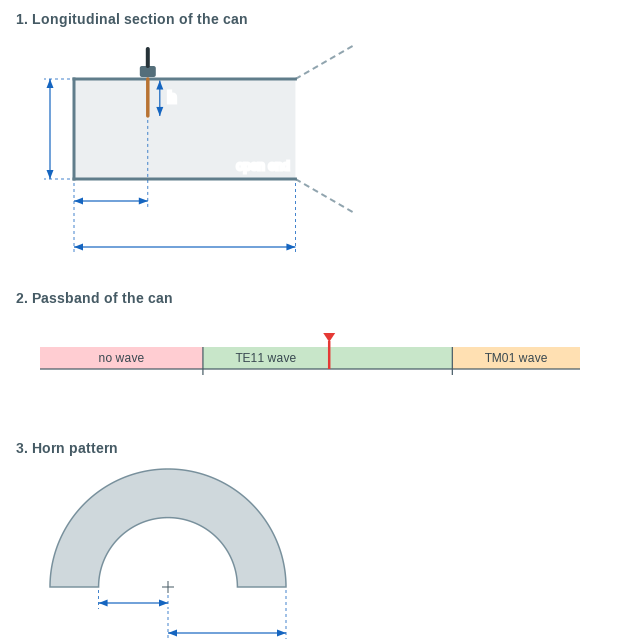
A circular waveguide has a cutoff frequency: below it, the fundamental TE11 (H11) wave does not propagate. It depends only on the inner diameter: f = 1.8412·c / (π·D). From above, the operating band is limited by the next wave type, TM01 (E01), with a cutoff of 2.4048·c / (π·D): above it, spurious waves appear in the can and the radiation pattern is distorted. The operating frequency must lie between these limits; their ratio is constant at 1.306, so each frequency suits cans within a fairly narrow range of diameters.
The wavelength inside the waveguide λg is longer than in free space: λg = λ / √(1 - (λ/λc)²), where λc = π·D / 1.8412 ≈ 1.706·D is the cutoff wavelength. Near the cutoff frequency λg grows sharply: the can gets very long and its dimensions become sensitive to the frequency. So it is better to pick a diameter in the middle or upper part of the allowed range.
The wave entering the can reflects from the bottom and forms a standing wave inside. The electric field peaks λg/4 from the bottom, and that is where the probe goes, λ/4 long (a quarter of the free-space wavelength). The wave also reflects from the open end, so the can length matters too: the probe signal peaks at a length of 3λg/4, 5λg/4 and so on, and dips at λg/2, λg and so on. A small deviation from 3λg/4 is acceptable, but this length is worth aiming for.
Construction
Cantenna: a can of length L and diameter D, a probe of length h at a distance d from the bottom, and a horn pattern with radii R1 and R2
The probe is perpendicular to the can wall, and the polarisation follows its direction: with a vertical probe the antenna receives a vertically polarised wave. Turning the can about its axis matches the polarisation to the base station or access point.
Horn
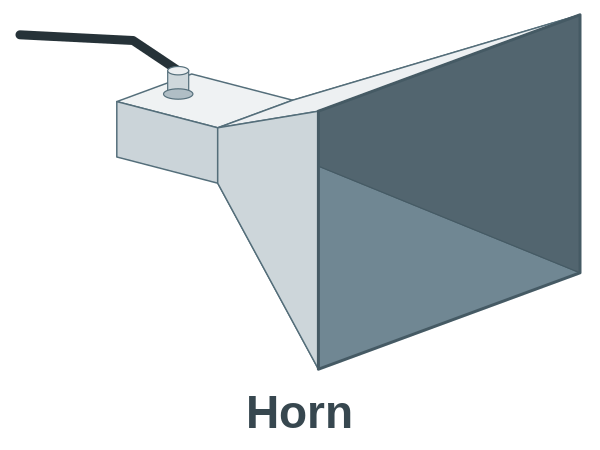
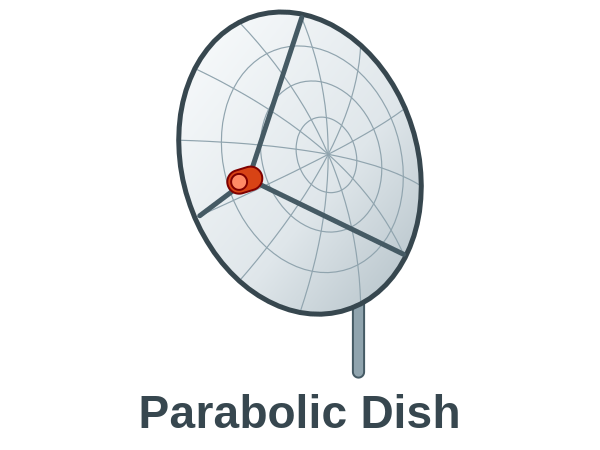
A conical horn fitted over the open end turns the can into a simple conical horn antenna with up to 3 dB more gain than the can alone. The horn pattern is a half-ring with an inner radius R1 = D and an outer radius R2 = 1.7·D. Rolled into a cone, it gives an apex angle of 60°: the narrow end of the cone equals the can diameter and the aperture is 1.7·D. The horn is cut from galvanised steel sheet with an allowance for the seam. Making the horn larger is not worth it: in a large conical horn the polarisation plane can rotate, and the gain may even drop. For more gain a pyramidal horn antenna is a better choice.
Building and tuning
The can should be as close to a straight cylinder as possible; coffee tins work well. The inner diameter is what counts. The can is cut slightly longer than L and the edge is rolled, because some cans split along the seam after cutting. A hole for a coaxial connector, preferably one with a nut (N or SMA), is drilled at a distance d from the inner surface of the bottom. Cans are often lacquered inside, so the connector body must make good contact with the metal. A copper wire probe of length h is soldered to the centre pin. Some fine tuning is possible: tilting the probe changes the match with the 50 Ω cable.
For outdoor use the open end is closed with a plastic lid. The plastic is worth testing in a microwave oven next to a glass of water: if the lid stays cool, it does not absorb radio waves. A 2 mm hole next to the connector lets condensation drain. Tinplate rusts over time and the signal weakens, so a cantenna suits portable use better than a permanent mast. A USB modem can be inserted right into the can through a slot λg/4 from the bottom, provided its internal antenna sits at the end of the modem rather than near the USB plug.
Calculation method
The calculation uses the formulas for a circular waveguide (S. N. Shabunin, I. P. Solovyanova, "Waveguides and Cavity Resonators", 1998). The cutoff frequencies in MHz for a diameter D in mm: TE11 - 175698.4 / D, TM01 - 229485.2 / D. The wavelength λ = 299792.458 / f (f in MHz, λ in mm), and λg follows the formula above. The can length L = 0.75·λg, the probe length h = 0.25·λ, the bottom-to-probe distance d = 0.25·λg, and the horn pattern radii R1 = D and R2 = 1.7·D.
If the can is narrower than the TE11 cutoff allows, or wider than the TM01 wave permits, the calculator says so and suggests a range of suitable diameters. If the diameter is left empty, the bands from the list use a typical diameter (83 mm for Wi-Fi 2.4 GHz, 99 mm for LTE 2100 and so on), and other frequencies use the middle of the allowed range. The higher the frequency, the more decimal places in the dimensions.
How to use the calculator
Enter the frequency or pick a band, and measure the inner diameter of the can. Example for Wi-Fi 2445 MHz and a can 83 mm in diameter: the can passband is 2117-2764 MHz, the can length L = 183.8 mm, the probe h = 30.7 mm at a distance d = 61.3 mm from the bottom, and the horn pattern R1 = 83 mm and R2 = 141.1 mm.

Comments

To leave a comment

If you have any suggestion, idea, thanks or comment, feel free to write. We really value feedback and are glad to hear your opinion.
To reply