The calculator designs a circularly polarised cloverleaf antenna with three or four wire leaves from its centre frequency: the leaf sides and arc, the wire diameter and AWG gauge, the gap at the feed point, the leaf opening and tilt angles, the wire length. The calculation runs on the server, and the result comes with drawings.
Cloverleaf antenna
The cloverleaf is a small omnidirectional antenna with circular polarisation, especially popular in FPV: on drones, model aircraft and ground video stations. It also suits GPS and GLONASS receivers, whose signals are circularly polarised too. The cloverleaf pattern resembles that of a vertical dipole - a doughnut with no nulls to the sides - but its polarisation is rotating rather than linear.
Why this matters for moving objects. With linear polarisation the signal drops sharply when the receiver and transmitter antennas end up at an angle to each other, and a drone in flight keeps turning and banking. A circularly polarised wave hardly notices this. Besides, a reflection off the ground or walls reverses the sense of rotation, so a right-hand antenna receives reflected signals noticeably worse - less multipath interference. Both ends of the link must use antennas with the same sense: RHCP with RHCP or LHCP with LHCP. For linearly polarised networks such as Wi-Fi the cloverleaf brings no advantage: a plain whip or a collinear antenna is better there. Construction
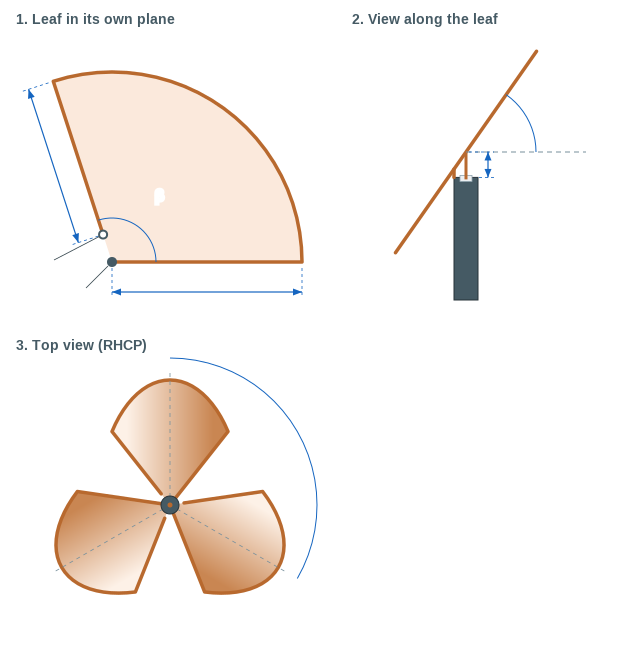
The antenna consists of three or four identical wire loops - leaves - connected in parallel at the end of the cable. Each leaf starts from the braid with a straight section a, continues with an arc c - part of a circle of radius a centred at the feed point - and returns with a straight section b to the centre conductor. The angle between sides a and b is the leaf opening β: 108° for the three-leaf cloverleaf and 90° for the four-leaf one. Side b is shorter than a because the centre conductor sticks out above the braid by the gap d. The plane of each leaf is tilted from horizontal by the angle δ, all leaves are tilted the same way and turned by 360°/N relative to each other. This tilt is what twists the field and produces circular polarisation.
The sense of rotation is checked with the hand rule: take the cable in your right hand with the thumb up, towards the leaves. If the leaves twist from bottom to top the way your fingers curl, the polarisation is right-hand (RHCP), otherwise left-hand (LHCP). The calculator drawings show RHCP.
The input impedance of both the three- and four-leaf cloverleaf is close to 50 Ω. Strictly speaking, a loop antenna with a balanced input needs a balun, but with a short pigtail in FPV gear it is usually left out. Then the pigtail and the equipment body radiate too, the pattern and polarisation are slightly distorted, and the tuning depends on the pigtail length. The wide bandwidth of the antenna saves the day. Building
The leaves are bent from copper wire of diameter dw, preferably on a jig so that they are all identical. It is convenient to bend the arc of radius a through the angle β first and then bend out sides a and b. The a ends of all leaves are soldered around the braid, the b ends to the centre conductor, keeping the gap d. After soldering, the leaves are tilted by the angle δ, all the same way. The gap d and identical leaves need the most care; the three- and four-leaf versions hardly differ in performance. Calculation method
The wavelength λ = 299792.458 / f (f in MHz, λ in mm). Wire diameter dw = 0.0065·λ. Three leaves: a = 0.2527·λ, vertical gap h = 0.02795·λ, δ = 55°, β = 108°, arc c = 0.3·2π·a; four leaves: a = 0.2834·λ, h = 0.01915·λ, δ = 50°, β = 90°, c = π·a/2. Side b = a / cos(h/a) − h·tan δ, gap d = h / cos δ (minus dw for the three-leaf version). The wire length of a leaf is a + b + c. The higher the frequency, the more decimal places in the dimensions. How to use the calculator
Enter the frequency or pick a band and give the number of leaves. Example for FPV 2.4 GHz (2445 MHz), three leaves: a = 31 mm, b = 26.3 mm, arc c = 58.4 mm, wire 0.797 mm (20 AWG), gap d = 5.18 mm, 115.7 mm of wire per leaf, β = 108°, δ = 55°.



Comments