Corner reflector antenna calculator online on Intellect

Used 524 times
Corner reflector antenna calculator online
The calculator designs a sheet-metal corner reflector antenna from its centre frequency: the length and width of the strip dipole, the planar slot balun, the dipole height above the reflector bottom, the bottom and side sizes of the reflector and its flat blank. The calculation runs on the server, and the result comes with drawings.
The centre frequency of the operating band in MHz: type a number or pick a band from the list.
MHz

Reset Complain Share result

Share:


Was this answer useful?
Choose a quick rating so we can improve the next answer for you.
How satisfied are you?


Your answer option for this service or noticed an error:

Corner reflector antenna
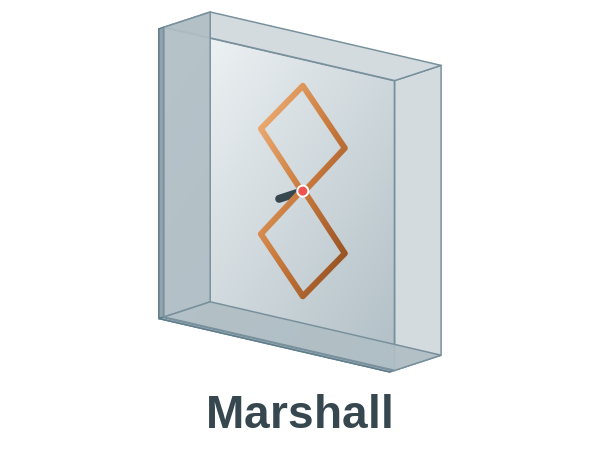
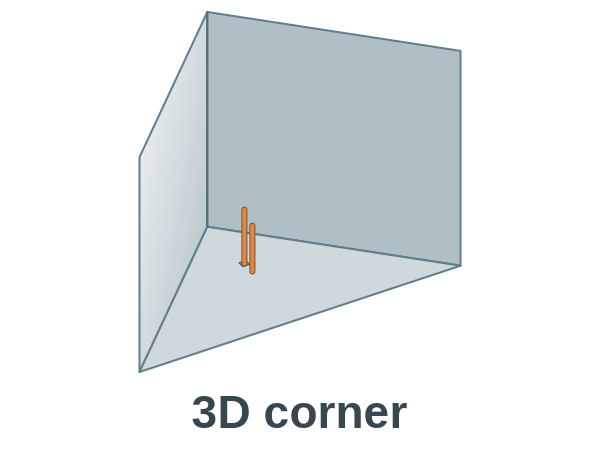
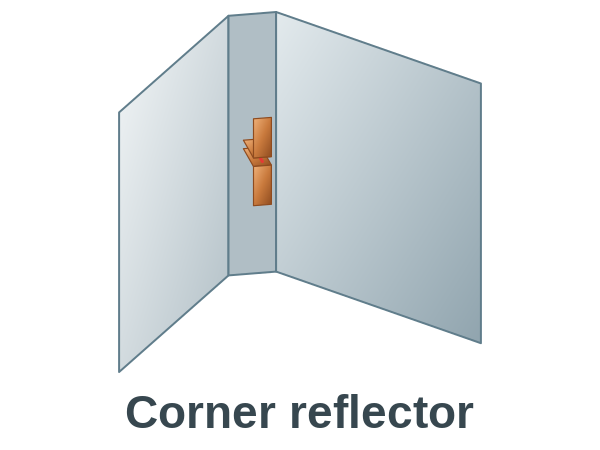
The corner reflector antenna was invented by the American radio engineer and radio amateur John Kraus (W8JK) in 1938 and patented in 1940; he also invented the helical antenna. The design is as simple as it gets: a half-wave dipole stands on the bisector of the angle formed by two conducting planes. The walls reflect the wave so that the radiation adds up in one direction - along the bisector, out of the corner. For its modest size the antenna gives noticeable gain and good back-lobe suppression, which makes it a good "balcony" antenna for 4G and Wi-Fi.
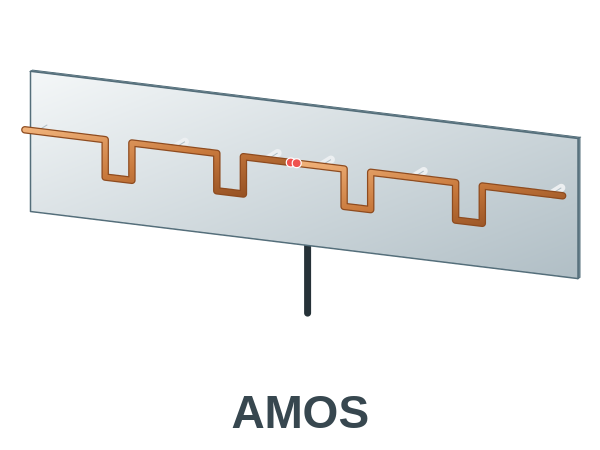
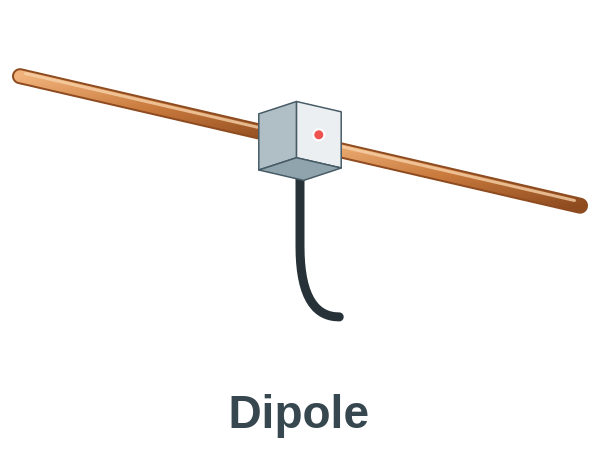
In this version the corner is truncated: the reflector has a flat bottom from which two walls spread out, so in cross-section it looks like a trough. The walls are 70° apart. The dipole is not a wire but a strip: it is bent together with the balun from a single strip of sheet metal, and the antenna is fed through a planar slot balun. The dipole together with this balun widens the bandwidth noticeably, and the antenna covers any of the 4G bands completely.
The calculator coefficients come from a computer model of the antenna in an electromagnetic simulator. The calculated gain is about 13 dBi, the input impedance 50 Ω, the VSWR within the operating band no higher than 2, and the back lobe of the pattern is suppressed by at least 30 dB.
Construction
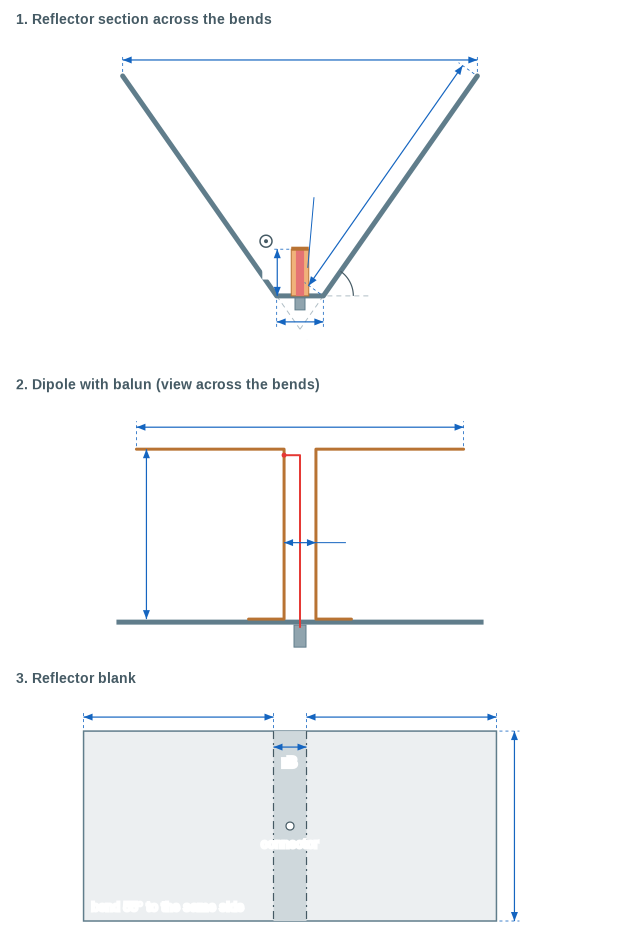
Corner reflector antenna: reflector cross-section, dipole with balun and the reflector blank
The reflector is a bottom of width rB and two walls rH bent 55° from the plane of the bottom; along the bend lines the reflector is rW long, and the distance between the wall edges is the opening rA. The strip dipole of length c and width W sits at a height h above the bottom, parallel to the bend lines. Two cold balun strips of the same width W run from its halves down to the bottom with a slot d between them; at the bottom the strips are bent into tabs clamped to the bottom by the connector nut. The hot strip of width hotW runs up the slot from the connector centre pin and joins one of the dipole halves at the top.
The polarisation is parallel to the dipole, that is, to the bend lines of the reflector: with vertical bends the polarisation is vertical.
Building
The whole antenna is made of sheet metal, for example 0.2-0.5 mm galvanised steel. The reflector is cut in one piece rW × (rB + 2·rH) and bent along two lines by 55°. The dipole with the balun is bent from a single strip of width W: one dipole half, a cold strip down, a tab, the second tab, a cold strip up, the other dipole half. The assembly is fixed to the reflector bottom with the connector nut. The hot strip is conveniently made of copper or brass tape, soldered to the connector centre pin and riveted to the dipole.
Calculation method
The wavelength λ = 299792.458 / f (f in MHz, λ in mm). Dipole: c = 0.5265·λ, width W = 0.1026·λ, height above the bottom h = 0.2735·λ. Balun: slot d = 0.0513·λ, hot strip hotW = 0.0479·λ. Reflector: bottom rB = 0.2735·λ, length along the bends rW = 1.5728·λ, wall rH = 1.5728·λ, opening rA = rB + 2·rH·cos 55°. The higher the frequency, the more decimal places in the dimensions.
How to use the calculator
Enter the centre frequency or pick a band. Example for LTE 2100 (2045 MHz): a 77.2 mm dipole from 15 mm strip at 40.1 mm above the bottom, balun slot 7.52 mm, hot strip 7.02 mm; a reflector with a 40.1 mm bottom, 230.6 mm walls and 230.6 mm length, opening 304.6 mm.

Comments

To leave a comment

If you have any suggestion, idea, thanks or comment, feel free to write. We really value feedback and are glad to hear your opinion.
To reply