The calculator estimates a 5/8 λ vertical whip, or a whip of any other length, over perfect ground: the input impedance with the whip diameter taken into account, the coil inductance or capacitor value that cancels the reactance, the SWR after compensation, the directivity and the vertical radiation pattern compared with a λ/4 whip. The calculation runs on the server using the induced EMF method.
The 5/8 wave whip and where its fame comes from
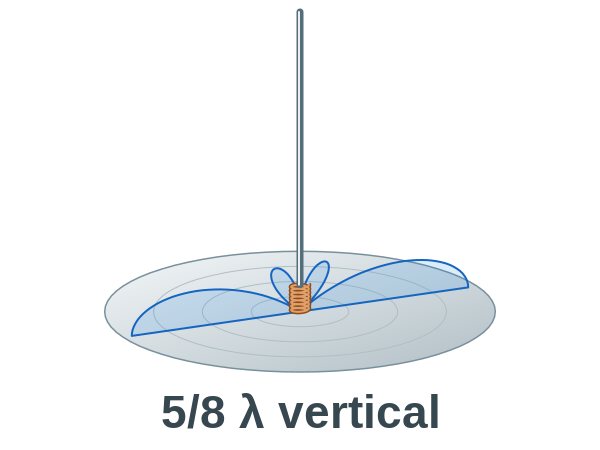
A 5/8 λ vertical whip is often called the "longest-reaching" vertical antenna. This reputation goes back to S. Ballantine's 1924 work on medium-wave broadcast masts. He showed that for a vertical radiator standing on perfectly conducting ground and fed at its surface, with a sinusoidal current distribution, the radiation along the ground is greatest when the electrical length is near 225°, that is 5/8 λ. The advantage over a quarter-wave whip is about 3 dB, and on medium waves, where the mast stands right on the ground, it does matter.
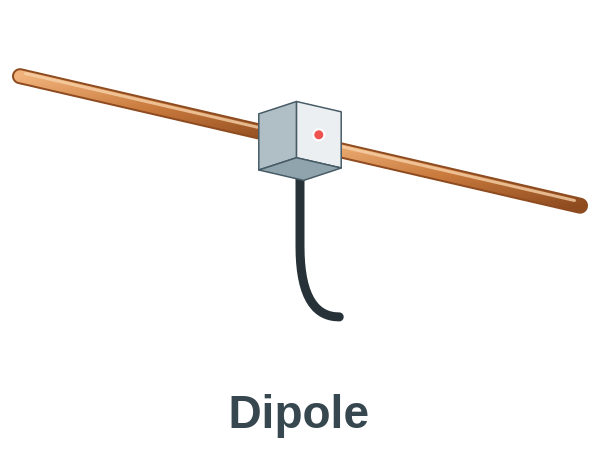
On VHF the conditions are different. The feed point is usually raised above the ground, real ground is far from a perfect mirror, and there are good alternatives: a half-wave vertical dipole or a collinear antenna at the same height performs no worse and is easier to match. A 5/8 λ whip makes sense where the antenna base is fixed and the length is limited: on a car, where the roof serves as the "ground", or on a handheld radio. Even then it is worth checking that a shortened 1/8 λ whip with a coil is not being sold as a "five-eighths". Construction and matching
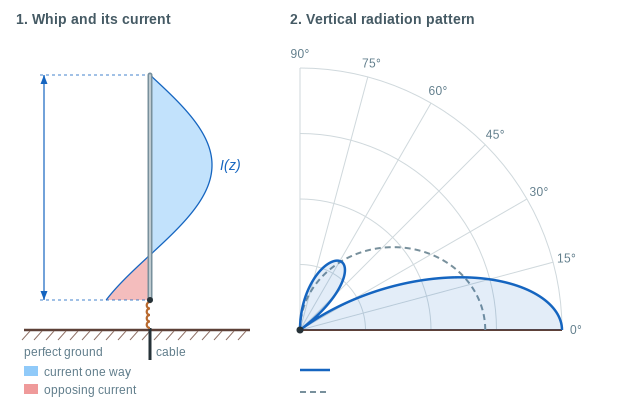
The current along the whip is close to sinusoidal and falls to zero at the top end. In a whip longer than λ/2 the current near the base flows against the current in the upper part - this section has a different colour in the drawing. The input impedance of such a whip has a large capacitive component, and it is cancelled with a coil in series at the base. Short whips (below λ/4) are capacitive too, whips from λ/4 to λ/2 are inductive and need a capacitor instead of a coil. Near λ/2 and λ the input impedance tends to infinity: such a whip cannot be fed at the base through a series element.
After compensation the resistive part R remains. For a 5/8 λ whip it is about 100 Ω, so a coil alone is not enough for 50-ohm cable: in practice the coil is tapped or a transformer is added. The calculator shows the SWR left after compensation alone - it tells you whether extra transformation is needed. Why this is only an estimate
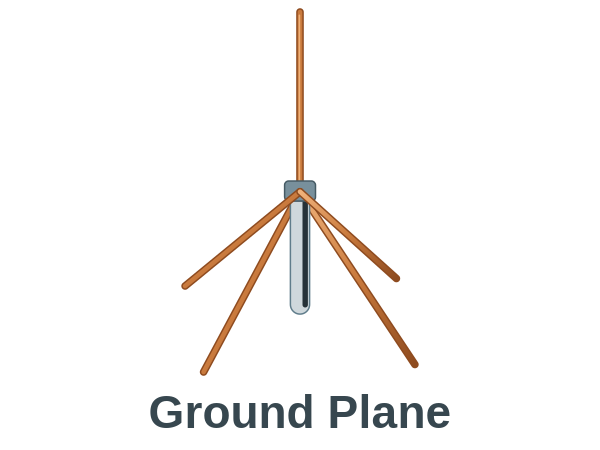
The calculator models an ideal monopole over perfect infinite ground and takes into account only one real-world factor - the whip diameter, on which the reactance depends noticeably. It ignores the number, length and slope of the radials, the properties of real ground and of the car body, and the size of the coil itself: at high frequencies the coil is no longer a lumped element and must be part of the antenna model. Use the result as input for a model in an antenna simulator (MMANA, 4NEC2 and the like), and do the final tuning with an analyser. Calculation method
The wavelength λ = 299792.458 / f (f in MHz, λ in mm), the whip length h = n·λ, where n is the length in wavelengths, k = 2π/λ. A whip over perfect ground is equivalent to half of a dipole of length l = 2h. The radiation resistance referred to the current maximum and the dipole reactance are found with the induced EMF formulas using the sine and cosine integrals Si and Ci; the whip diameter dw enters the reactance through the term Ci(2k·a²/l), a = dw/2. The input values are divided by sin²(kh), and halved for the monopole. The compensating coil L = |X| / (2πf), the capacitor C = 1 / (2πf·X). The directivity is obtained by integrating the pattern F(θ) = [cos(kh·cos θ) − cos kh] / sin θ over the ground; it is twice the directivity of the dipole. How to use the calculator
Enter the frequency, the whip diameter and the length in wavelengths. Example for CB 27 MHz, a 5/8 λ whip 25.4 mm in diameter: λ = 11.1 m, whip length 6.94 m, input impedance about 106.5 − j233.7 Ω, compensating coil 1.38 µH, directivity 8.2 dBi against 5.2 dBi for a quarter-wave whip.


Comments