
Lecture
In the course of providing care, doctors and medical staff often deal with elderly patients. Compared with other categories of patients, it is older people who need additional care and special attention.
As we grow older, our mind and body change slowly but surely. Some of these changes can creep up on us so gradually that we may not even notice them.
These changes include the typical physical problems that accompany aging, such as wrinkles, hair loss, various illnesses and loss of muscle mass. Psychological problems also become more common with age. Many older people experience some kind of mental and emotional disorder. Some of these problems may be caused by physical changes, such as the mood swings that accompany menopause or the depression caused by a chronic illness. Other psychological problems may be caused by life experiences, such as grief over the loss of close friends and relatives.
Deontological tactics when communicating with elderly patients are: maintaining the patient's sense of self-worth; a markedly respectful, tactful and delicate attitude, without familiarity, a commanding tone or moralizing; an orientation toward physical activity;
motivation for recovery.
Patients of elderly and senile age are characterized by the following:
The whole complex of changes associated with reaching advanced age is studied by the science of gerontology.
Gerontology is the study of the aging process and the problems faced by older people. Society conventionally classes men and women over 60 as elderly.
Social gerontology and biogerontology are the two most common branches of gerontology.
Social gerontology is the part of gerontology that deals with the social aspects of aging, while biogerontology deals with the biological aspects of aging.
a feeling of being unneeded by loved ones
a sense of betrayal by one's own body
inability to maintain the accustomed way of life (especially physically)
dependence on others (family, those around them, society) and
a narrowing circle of social contacts
fear of death
Today gerontology is growing and developing as scientists devise new drugs and conduct new research, which leads to greater life expectancy. This means that we need to move forward in step with this new pace of life.
Arterial hypertension (hypertensive disease) is a common disease of older people, characterized by an elevated blood pressure of >140/80 mmHg, recorded at least twice in a row on two separate measurements.
Atherosclerosis is another vascular disease typical of older people. Atherosclerosis is caused by a disturbance of lipid metabolism in the body, as a result of which accumulations of cholesterol (plaques) form in the vessel walls. This ailment often becomes a harbinger of myocardial infarction. Atherosclerosis of the cerebral vessels, in turn, leads to stroke. Senile dementia, or dementia, is a decline in brain function associated with the loss of practical and mental skills, difficulty absorbing new information and other mental impairments. Sclerosis of the cerebral vessels is often the cause of dementia.
Alzheimer's disease is one form of dementia, a degenerative disease that progresses with age. It is almost impossible to diagnose in its early stage, and it appears in people over 65. It is expressed as an irreversible deterioration of memory. Parkinson's disease, or shaking palsy, manifests most intensely in people over 70. The disorder can be detected at an early stage, and timely therapy makes it possible to minimize its symptoms. The disease is caused by a lack of a chemical substance, dopamine, in the central nervous system, which leads to a partial loss of control over motor activity. In affected people the limbs tremble and the steadiness of their gait is lost.
Osteoporosis is a disease of bone tissue in which it becomes thinner, leading to skeletal deformation and bone fractures. The disease is caused in part by the fact that after age 40 the absorption of calcium in the body decreases markedly, and this trace element is intensively leached from the skeleton. Osteoporosis most often affects women over 60, but it also occurs in men.
Bladder atony occurs in many people in old age. It may be related both to kidney dysfunction and to tumors in the genitourinary system that press on the bladder and cause an urge to urinate, often uncontrollable. In elderly women there is often
prolapse of the female genital organs, which leads to urinary incontinence during sudden movements, for example laughing or sneezing.
Many elderly people are troubled by anxiety states. Without apparent grounds they feel fear, sense a hidden threat and experience stress for no particular reason. In part this may be
associated with age-related abnormalities of the psyche.
One of the constants of life is that people never stop changing, no matter how hard they try. Aging brings a cascade of physical and emotional changes, which can lead to various behavioral changes that may puzzle or worry
loved ones. But which behavioral changes are typical, and which are not? Sometimes it is hard to tell the difference. Although it can be difficult to care for a loved one whose behavior has changed and is no longer what you are used to, patience, along with proper medical care and attention, often pays off. Below are the main examples of behavioral changes common among older people,
along with a detailed description of what may signal a problem and how to respond:
• Memory
About 10% of the population over 65 is affected by dementia, and more than half of those aged 85 and older. Symptoms of dementia include memory lapses or loss, difficulty speaking, problems with concentration and impaired vision. Do not lose time if you notice any type of impairment that affects the daily functioning of an older person.
The precursors of this disease are usually considered to be not only problems with remembering but also problems with speech and reasoning.
What to do: if, while communicating with an elderly patient, you see signs of dementia or its precursors, it is important to bring your observations to the attending physician. This may help the doctor complete the picture of the illness.
• Mood
One often hears that aging is associated with death. Unfortunately, it is older people who suffer the greatest frequency of losses among relatives, friends and acquaintances. Understandably, with each loss the suffering worsens their well-being.
However, one should pay attention to exactly what a particular display of sadness or anxiety is connected with, because such factors are often not perceived by loved ones as a serious symptom, are ignored and are treated too late. Most elderly people experience depression, a persistent feeling of sadness that may include changes in sleep, appetite, energy level and other areas. Mood changes, apathy or anger may also signal early dementia.
It is important not to let a person's low mood continue indefinitely without the intervention of outsiders. If you suspect that a problem lies behind such a mood, it is better to be safe and tell the attending physician. Also explain to the patient's family that uncontrolled use of medication or incompetent advice on improving mood ("Cheer up! Don't grieve! Find something to do!") can only do harm, giving the illusion that the situation is under control while the underlying processes only worsen over time.
Competence is the ability to apply knowledge and skills and to act successfully on the basis of practical experience when solving problems of a general kind, as well as in a certain broad field. Professional competence is the ability to act successfully on the basis of practical experience, skills and knowledge when solving professional tasks.
Fundamentals of competence in gerontology
1. Knowledge and skills. To provide highly professional care in gerontology, one must have additional knowledge and skills. These include gerontological, geriatric and geropsychiatric knowledge and skills, which can be acquired through education or other professional development programs and activities.
2. Personal and professional recognition of how to deal with age discrimination. The ability to recognize and manage the effects of age differences between the medical professional and older people, especially in the delivery of medical care.
3. The ability to encourage and support older people and their relatives in order to increase their independence and psychological well-being. Being able to provide help effectively so as to increase their motivation for a speedier recovery.
4. The ability to recognize and minimize psychological barriers to the independence of older people. The ability to communicate effectively with elderly patients. Overcoming cognitive and sensory impairments in order to provide effective care. The ability to provide written information in the right format for the individual elderly patient.
5. The ability to develop psychological formulations for elderly patients with complex, multiple problems. For example: patients with dementia, depression, social isolation, substance abuse and poverty.
6. The ability to intervene effectively, directly or indirectly, to improve the lives of older people and of those who help to provide their care, using psychological understanding and methods based on the scientist-practitioner and reflective practitioner models.
7. The ability to recognize and manage boundary issues when helping older people in different settings.
The modern medical model of care for people of elderly (55-74 years) and senile (75-90 years) age focuses only on one-sided nosological diagnosis. However, a simple statement of the state of health says nothing about how it affects the life of an older person. It does not take into account the influence of socioeconomic status, quality of life, functional activity, premorbid personality characteristics, mental health and compensatory resources on the objective and subjective indicators of physical health. It also does not take into account the availability of coping strategies (emotion-focused or problem-focused) for dealing with health problems in later life [28]. For this reason, comprehensive geriatric assessment of the condition of elderly and senile people has become widespread in foreign geriatric practice (and, recently, in Russia). Comprehensive geriatric assessment is a multidimensional, multidisciplinary diagnostic evaluation of elderly and senile people [15; 24].
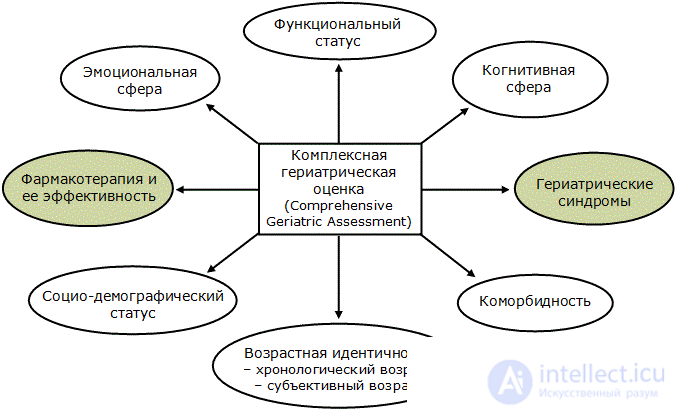
Unlike a standard (symptomatic) medical examination, comprehensive geriatric assessment includes a comprehensive and interdisciplinary evaluation of the older person and an approach to his or her treatment [20]. Such an assessment is carried out in order to prolong autonomy [15] and to increase the subjective well-being of elderly and senile people [25].
Let us outline the features of comprehensive geriatric assessment:
|
• |
Comprehensive geriatric assessment is not a replacement for syndromic and nosological diagnosis, but supplements and extends it [15]. |
|
• |
The assessment is oriented toward the long-term improvement of the older person's physical condition and quality of life [31]. |
|
• |
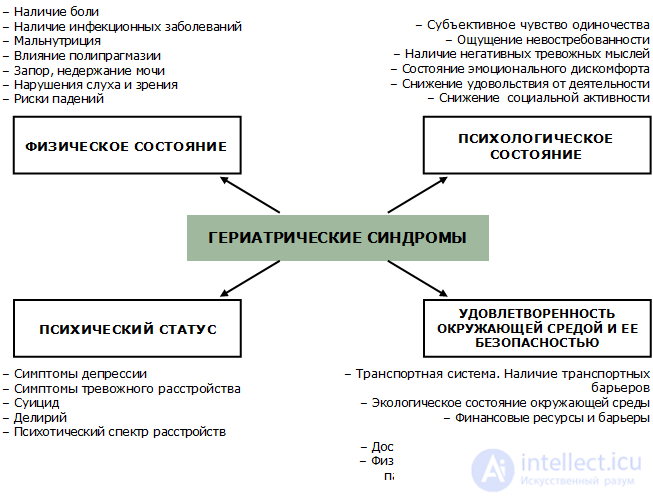
It is aimed at the early detection of frailty, which is accompanied by various geriatric syndromes (Fig. 2). |
|
• |
The emphasis is on determining the degree of impairment of functioning in everyday life, and on the presence of mobility problems, incontinence, symptoms of depression, cognitive impairment, falls, and reduced vision and hearing [28]. |
|
• |
Special attention is paid to those geriatric problems that the elderly patient may not report. For example, older men may not mention urinary problems or sexual dysfunction out of shame. Finally, an older person may assume that these symptoms, like the decline in hearing, memory and working capacity, are normal aspects of aging and that no appropriate help can be given for them with the aim of prolonging active longevity [24]. |
|
• |
Specially selected tests and scales are used for the assessment, but they do not replace a clinical examination by a geriatrician, a general practitioner and other specialists. |
|
• |
The emphasis is placed on examining cognitive functions, in view of the prevalence of Alzheimer's disease, vascular and mixed forms of dementia and other neurodegenerative disorders [16]. |
|
• |
Increased attention is paid to examining the presence and severity of symptoms of depression in later life. Depression in older people may take an atypical course and may be masked by somatic disorders with cognitive impairment or by neurological diseases [17; 20]. A simple question to an elderly patient, "Do you feel sad or depressed?", can be used as a screening tool to detect changes in mental state [17]. This question is sensitive to changes in an older person's mood, but it is better used together with the Geriatric Depression Scale (GDS-30) [6; 7]. |
|
• |
The characteristics of social activity, the availability of social support, and the resources and limitations of the older person are taken into account [15]. |
|
• |
The assessment is aimed at developing, together with the older person and his or her relatives, a treatment plan and an algorithm for maintaining the person's state of health [25]. |
|
• |
During the assessment, the emphasis is placed on adherence to treatment (compliance) and on monitoring of treatment [31]. |
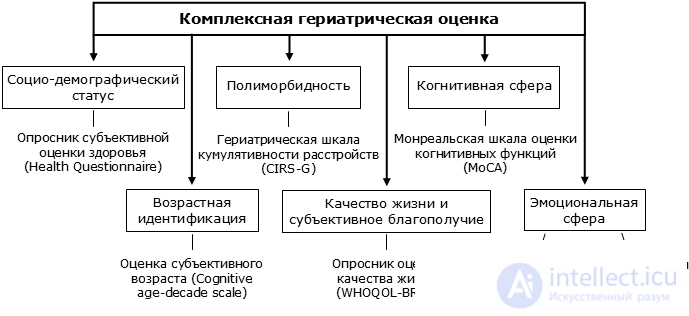
A geriatrician, cardiologist, neurologist and clinical psychologist take part in comprehensive geriatric assessment [25]. We have identified diagnostic methods that allow the clinical psychologist to examine the main components of the status of an elderly or senile geriatric patient (Fig. 3).
Let us describe the stages of carrying out a comprehensive geriatric assessment.
At the first stage of the geriatric assessment, the elderly patient's medical history is studied. The following information must be taken into account: the diagnosis, the stage of the disease, whether there is treatment, and whether the patient adheres to it. In geriatric practice the Health Questionnaire for subjective assessment of health is often used to identify complaints about somatic and mental health. The questionnaire was developed by B. Levin to study the features of depression in old age and allows the specialist to collect information about chronological (passport) age, sex, ethnicity, education, social employment and marital status [22]. The elderly patient's subjective complaints are assessed:
• Do you have any health problems?
• Do you have any problems with your vision?
• Do you have any problems with your hearing?
• Have you had any changes in your mood?
• Have you had health problems in the past?
The older person's preferences regarding his or her own condition are also assessed.
The second stage. Alongside chronological age, the concept of subjective age is distinguished. Subjective age integrates biological and social factors (in our case, those underlying the aging process [11]). It can be regarded as an integrative indicator of changes in cognitive, mental and physical functioning [12]. Differences in the assessment of subjective age can affect the maintenance of health and social activity in later life. Thus, it can be assumed that subjective age can be regarded as one of the factors of psychological and physical well-being in later life [10].
From a clinical point of view, subjective age can be an effective means of identifying individuals at increased risk of adverse reactions to the onset of maturity and aging, and of providing timely therapeutic help and influencing the somatic, cognitive and psychological components of health [11]. To study subjective age, the cognitive age-decade scale, or "Age-of-Me" questionnaire (Cognitive age-decade scale, B. Barak) is used [18].
The scale makes it possible to analyze a person's ideas about how old he or she looks, feels and acts, and to which age his or her interests correspond. In general, in order to assess what ideas a person has about his or her resources, capabilities and interests [10], R. Kastenbaum proposed a multidimensional model of age identity, "Age-of-Me," consisting of subjective and ideal ages. This model includes the following components of subjective age:
|
• |
cognitive-emotional (feel-age); |
|
• |
subjective biological (look-age); |
|
• |
social (do-age); |
|
• |
intellectual (interest-age) age. |
Emotional age is possibly the most closely related to physical, mental and social changes [19]. On the basis of this model, a scale was developed that consists of four questions assessing subjective age (Table 1).
Table 1
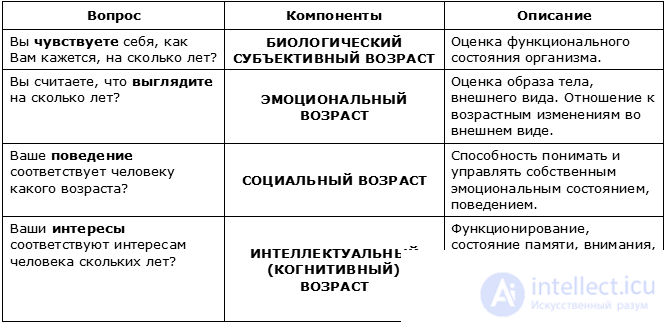
The assessment looks for a tendency to rate one's subjective age relative to one's chronological age: to overestimate it (that is, a negative cognitive illusion of age) or to underestimate it (that is, a positive cognitive illusion of age, subjective youth (cognitively younger) [10; 26]).
The third stage. A characteristic feature of elderly and senile people is the presence of polymorbidity, predominantly chronic in course, atypical clinical manifestations, and the presence of various geriatric syndromes. Syndromic analysis is carried out using the Cumulative Illness Rating Scale for Geriatrics (abbreviated CIRS-G). The scale is a system for screening for chronic diseases (morbidity); it takes into account the degree of chronic disease in individual body systems, for example diseases of the heart, vessels, blood, kidneys and others. Somatic diseases are assessed by organ system and by severity (from mild to extremely severe), with the aim of addressing a specific set of the older person's problems. It also includes an assessment of the presence and degree of mental disorders [Ibid.].
The fourth stage. One of the criteria for evaluating the effectiveness of medical care and subjective well-being in old age is the assessment of quality of life. This integrative indicator of physical, psychological and social well-being evaluates components associated and not associated with disease, and makes it possible to determine in a differentiated way the influence of somatic and psychosocial problems on the older person's psychological and emotional state and social status.
The quality of life of older people can be assessed using the World Health Organization Quality of Life questionnaire (WHOQOL-BREF). The questionnaire makes it possible to assess the following components of quality of life:
|
• |
physical health; |
|
• |
psychological health (self-perception); |
|
• |
the sphere of social relationships (microsocial support); |
|
• |
the sphere of the environment and its safety (social well-being). |
The use of this questionnaire is dictated by the age-related and nosological characteristics of elderly and senile people, since some patients could not cope with completing the full version of the questionnaire.
The fifth stage. A number of neurodegenerative disorders and depression are the most common diseases in people over 65 [16; 27]. Most forms of dementia are accompanied by symptoms of depression, while depression in elderly and senile people, as a rule, is accompanied by symptoms of cognitive deficit. The signs and symptoms of depression in elderly and senile people are often atypical and blurred [17]. For this reason, in the differential diagnosis of depression and dementia in old age, one should first assess cognitive functions and only then the severity of affective symptoms.
According to various authors, the prevalence of dementia among older people (those over 60) varies from 5 to 12% [14; 16]. Recall that dementia is a psychopathological syndrome consisting of cognitive, affective and behavioral syndromes [14]. Because cognitive impairment is regarded as the core of the clinical picture of dementia, it is recommended, following the recommendations of N.N. Yakhno, to assess cognitive status using the Montreal Cognitive Assessment (abbreviated MoCA) [16]. The scale is used to screen for mild cognitive impairment (abbreviated MCI) and early symptoms of dementia.
The MoCA is more sensitive than the Mini-Mental State Examination (MMSE) to manifestations of vascular dementia, Parkinson's disease and mild forms of cognitive deficit [8; 27; 29]. The test is not a clinical tool for diagnosing cognitive impairment. The decision on the presence of cognitive disorders should be based on a careful assessment of complaints, a clinical examination and the results of a neuropsychological assessment [13]. According to Z. Nasreddine, mild cognitive deficit is a MoCA score of <26 (a more detailed clinical and neuropsychological examination is required) [29]. C. Luis recommends assessing mild cognitive deficit starting from a score of 23 [23].
To study the presence, degree and structure of depressive symptoms, it is recommended to use the full Geriatric Depression Scale (GDS-30). The test is used to screen for the presence and severity of dysthymia and depression in elderly and senile people. The test was based on studies of depression in late life, which showed a high risk of suicide associated with worsening depression. This test can be used to assess depressive symptoms in patients with mild or moderate cognitive deficit. Scores on the Geriatric Depression Scale correlate with scales for rating the severity of depression such as the Beck Depression Inventory (BDI), the Hamilton Depression Rating Scale (HDRS) and the Zung Self-Rating Depression Scale (Zung SDS) [Ibid.].
It should be borne in mind that an assessment with the GDS-30 by itself indicates only the presence of depressive symptoms and is by no means a basis for diagnosing late-life depression. High GDS-30 scores and an analysis of the completed protocol allow the specialist to identify only targets for further analysis of the mental status. This is merely a reason to question the elderly patient carefully about his or her inner state, to observe his or her behavior, and to conduct a thorough interview with relatives about the patient's condition.
It is recommended to pay attention to the first question, which assesses life satisfaction, since it has high prognostic value in diagnosing depressive symptoms in late life [30]. Versions of the Geriatric Depression Scale with 15, 5 and 4 questions can also be used to screen and assess the mental state of an elderly patient.
To assess the subjective feeling of loneliness, the Revised UCLA Loneliness Scale (R-UCLA-LS) is used, which evaluates the emotional and social components of loneliness. The results obtained on this scale make it possible to predict the development of a wide range of mental disorders (depressive episodes, anxiety disorder) and psychosocial problems affecting health in old age.
Many elderly people believe that at their age there is no longer any point in taking an active stance toward anything. However, most elderly people want to remain independent and enjoy life. To motivate elderly people means to encourage them to maintain an active lifestyle and to exercise, which will positively affect the length, quality and health of their lives and give them many more
joyful, valuable and fulfilling days. Caring for elderly people and building successful relationships with them often require unique skills and strategies of
interpersonal communication.
1. Goals.
Young people and adults are often reminded that they need to achieve this or that goal. But it is important to remember that the older generation can have such goals too. By focusing on a goal, you can engage both motivation and pride in achievement. With elderly people, set achievable goals every day, whether it is doing ten squats, finishing a small project, or doing something very simple for you but not simple for them, such as finishing a bowl of soup. Make the path easier and help them along it. Offer a reward for reaching each stage. A positive experience of achieving a goal will restore their self-belief and the feeling that even at this age and in this condition they are worth something and capable of something.
2. Values.
Sometimes it is hard to imagine that our grandmothers and grandfathers were once as young as we are. If you ask them what they did in their youth, you will find that their lives were full of adventures, decisions and events. When an elderly person is away from home, in a place such as a medical facility, try to surround them with pleasant memories of the period of their active life, such as photographs, postcards, music and scents. Let these items serve as topics of conversation and prompts for reminiscence. Ask questions tactfully and listen. Encourage elderly people when they tell you stories; this is a wonderful form of psychological release, as well as a way for them to feel that their life has been lived, and
continues to be lived, not in vain.
3. Technology.
The internet and social networks are a wonderful opportunity to stay in touch with relatives. In addition to social benefits, online connections also give family and friends regular chances to monitor the physical, mental and emotional well-being of elderly people. For elderly people it is also an excellent motivation to learn new technologies and discover the opportunities they offer. Some will want to chat with friends, others to gain access to works of art or other things of value to them that they are deprived of because of their limited mobility. Some will be interested in sharing with the world the story and achievements of their long life. It will also help elderly people feel that they are not on the sidelines of modern life but at its active center.
Help elderly people gain access to modern technology and be patient as they master it, and you will gain grateful listeners who are eagerly getting to grips with the realities of the modern world.
4. Usefulness.
Many elderly people want to feel useful, even if their physical functions are limited. Identify and find out about topics or tasks in which the older person can feel needed and necessary.
For example:
• Ask them for advice on practical as well as important matters of life. Treat them as if they were your mentors.
• Ask their opinion on making certain decisions.
Treatment in gerontology mainly specializes in providing competent care. The main function of medical staff in this field is communicating with patients and providing the most comfortable conditions for their stay in the medical facility. This field requires a certain set of professional and personal characteristics.
1. Patience.
All patients, regardless of age, and elderly patients especially, need medical staff to have a reserve of patience. Geriatric patients are particularly difficult for those who are quick to become irritated. Medical staff must be able to listen attentively to patients,
who often speak slowly.
2. Compassion.
It is sad, but a fact, that most geriatric patients are in the final stage of their lives. It may not yet be palliative care, but problems can accumulate over the last years of their lives. It is important for medical staff to be able to show compassion. Unfortunately, it also happens that elderly people cannot manage their own hygiene independently or perform the simplest manipulations with familiar objects. At the moment when you help them with such things, all their shyness, embarrassment and wounded pride come to the surface. Compassion is the best way to help them cope with both the difficulties and the emotions evoked in patients by their own helplessness or weakness.
3. Attention to detail.
An important component of gerontological care is preventive care. Every member of medical staff needs to know that elderly patients are at greater risk than young ones. It is therefore very important that you pay close attention to the condition of those in your care, vigilantly
note changes in their condition, and also tell them about various diseases and situations related to their health and well-being that they could have coped with a few years ago but cannot cope with at their present age.
4. Creativity.
Elderly people are a rewarding audience for medical staff to show a creative approach. For example, some patients with dementia respond well to art therapy. Others are significantly limited by their age and condition, and the caregiver has to
find original ways of caring for them. The ability to think creatively about each person's physical and emotional needs in order to carry out a successful treatment plan is the key to being successful medical staff in geriatrics.
5. Consistency.
Many elderly people become confused easily and feel bewildered even in a mildly stressful situation. If both you and they stick to an established sequence in their usual activities, your patients begin to feel more comfortable and secure. This makes life easier for them in the medical facility.
6. Simplicity.
As with children, it is better to avoid medical terminology when talking to elderly people. Medical terminology is, in fact, not a very good way to talk to any patient. The best option is to use simple, clear language.
You should also strive to be as honest as possible. Some elderly patients need to write down what you tell them: this helps them remember it better. Be ready to repeat a phrase twice and to put your thought in different ways so that your patient can understand what you want to say. It can be said that an average member of medical staff is the main link between patient and doctor: you can be a kind of interpreter for the doctor. Try to be at hand when
the doctor talks to the patient, so that you can later explain what the doctor meant. Elderly people are often overloaded with various information from the doctor, and may not even have the opportunity to ask questions. They will wait and ask you for help in understanding better.
1. They are not children!
Most of the elderly people we meet in our lives are quite independent, and they will certainly dislike it if you are condescending or treat them like children. You should be close enough to help prevent an unwanted fall or injury, to point out in time that the patient has misunderstood the words of the doctor or nurse, and to remind them of what they have forgotten or missed. But at the same time it is important not to seem too intrusive. You should act when you really see that they need help, but let them be independent under safe conditions.
2. Knowledge.
This is an excellent way to build relationships with elderly patients. If they see that you are a doctor and you know what you are talking about, they are more likely to reach out to you and begin to trust you and your advice. They like learning new things, and they are glad that you can spare the time to tell them something new (for example, your knowledge of anatomy, physiology and much else that you learned within the walls of your medical institution or gained from your
medical practice).
3. Be yourself.
Being genuine is an excellent way to build trust, and elderly people truly value authentic conversations. Medical staff should try to build a connection with each of their patients. This is their key to success in assisting treatment and in promoting health and well-being. Usually,
in building a connection, you need to show that you genuinely care about them. If they see how seriously you take them, they are more likely to listen to you as medical staff who want to help. Of course, in this case it is important not to forget to maintain
a certain distance in order to avoid possible professional burnout.
4. More than help.
Many elderly people, especially in advanced age, do not have enough friends because of their deaths. And relatives rarely visit them. Unconsciously, by your very presence,
the doctor provides the social interaction that many elderly people lack. By talking with an elderly patient, you brighten his or her day. Many patients will be glad to see you and will gladly share their news and thoughts with you. They also enjoy listening to what is going on in your life.
5. Stories.
The older generation loves to tell stories from their lives. Make sure you switch on active listening and pay attention to the details. It is appropriate, at the end of your conversation, to ask the patient to repeat the details of the story or to ask questions;
this is sure to bring a smile. Sometimes they tell you the same stories more than once, and it is better to react as if you were hearing it for the first time. This avoids unnecessary embarrassment and prevents awkward situations between you and your patients.
6. Sensitivity.
Always try to sense what patients think and how they perceive what is happening. Try to understand what barriers they face in their lives. You must be adaptable and offer alternative solutions or ways of doing things that take their condition into account, in case the available options are not comfortable.
7. Dementia.
In old age many people develop disorders of thinking, memory, intellect and speech, provoked by changes in the molecular exchange between cells in the cerebral cortex, caused by various factors. And the more pronounced these changes are, the more severe the senile dementia. The elderly person loses not only existing knowledge, experience and the ability to learn, but also his or her own personality. It happens that for a time patients with dementia feel happier, and then suddenly become irritable and may start shouting at you. It is important to understand that what you are facing is precisely the illness and the result of its effect on the person's personality. The most useful thing is to give the patient time to calm down. Do not draw attention to the situation. Stay calm no matter what, and do not take what is happening too
much to heart. Instead, think about how you could, while keeping to your original position, make the dialogue more comfortable for the patient, taking into account his or her pathological reactions.
8. Punctuality.
You may be the only person outside the medical staff who comes to visit this elderly patient. In that case, believe me, he or she begins to wait for your arrival. Your being late may be perceived as a lack of care and respect. They may feel that you are embarrassed to help patients like them. Conversely, punctuality demonstrates professionalism and helps strengthen mutual respect.
9. Sweets and souvenirs.
Note that many elderly people like to treat others to something tasty. Some of them also make crafts or souvenirs for the staff of the medical facility whom they like best. At first it may seem unethical to accept treats or
gifts from patients. However, believe me, they do it from the heart. We advise you to politely accept this token of attention and say thank you.
10. Time.
One of the most important factors when talking to elderly people is time. If you show impatience or signs of stress, you will most likely frighten them off from further communication with you. It is hard to find the time needed to communicate properly with an elderly person, but it is a way to open a channel of communication. There are elderly patients who are afraid to speak up because they do not want to bother you or do not want to seem like patients who only complain about their lives. Some patients have difficulty expressing their thoughts, which
slows down the process of communication. Sometimes this even leads them to prefer to stay silent, knowing that it will be awkward and difficult for them to put their thoughts into words, and that you might laugh at them or brush aside their attempts to express themselves. Therefore, only sufficient time set aside for listening will give you a full picture of what is going on with a given patient. If you show that you have the time and the desire to talk, elderly patients will gladly share with you what is troubling them. You can learn something vital to the care and comfort of this patient simply by spending a few minutes with them. Yes, medical staff are busy too, but elderly people need time to express their pain, fear and questions, and you
need to take this into account.
Other recommendations
At any given moment an elderly person is ready to talk only about a particular topic. Other topics do not interest them at that moment so much that even if they begin to talk about them, they still return to the one that troubles them and is relevant to them. Therefore, in order to establish good contact and help the elderly person develop their story, you need to be interested in what worries them most right now, what they are thinking about, and what interests them
Social interest counteracts the aging process (as opposed to self-concentration). The ability to establish and maintain social contacts eases the process of adapting to old age. The degree of loneliness depends on the level of social expectations and the level of satisfaction with the present. Because many social contacts are broken, family relationships become the most important.
With successful adaptation to old age: a desire arises to communicate with young people (not to lecture them!), to learn more about modern life, to learn new things. A feeling of special closeness arises even to strangers, along with a deep understanding of the value of human life. With unsuccessful adaptation to old age: a hostile attitude arises toward those around them, primarily toward the young (a result of fear of the future).
Conflicts between generations often appear in those elderly people who have always been in the parental (dominant) position and for whom roles have now changed. Elderly people react emotionally to conflicts, so lengthy arguments should be avoided. In the past, elderly people preserved the experience of generations and passed it on to the young, but today this role has been lost. The inability to keep up with social changes provokes their rejection of them and conflict.
Choose one correct answer:
1. Aging is characterized by the following features:
2. Vitauct is a process that:
3. List the components of aging:
4. Features of age-related changes in the spinal motion segment (SMS):
5. Characteristics of osteopathic techniques for correcting somatic dysfunctions of joints that are recommended for use in an elderly patient:
6. Effective restoration of walking function is achieved by the following techniques:
7. Conditions for optimal functioning of the musculoskeletal system:
8. Conditions that tooth loss may lead to:
9. Features of diseases in elderly people that require special attention during osteopathic examination and treatment:
10. Elderly age is considered to be:
11. Indicators that progressively decline in old and senile age:
12. Indicators that do not change with age:
13. What is the species-specific lifespan of a human being:
14. Aging is:
15. Osteoporosis is:
16. Exclude the incorrect use of osteopathic techniques in the treatment of an elderly patient:
17. From the standpoint of osteopathy, the absence of pain in an elderly patient indicates that the patient is:
18. Normalization of the musculoskeletal system improves:
19. Relative immobility of patients and the absence of exposure to UV radiation can lead to:
20. Effects of osteopathic treatment in elderly and senile people:
21. Conditions whose risk is reduced by improved proprioception:
22. Osteopathic treatment of an elderly person:
23. A condition that predisposes to the development of pneumonia in elderly and senile people:
24. The main focus of osteopathic correction in peptic ulcer disease in old age:
25. The goal of osteopathic correction of somatic dysfunction of the gallbladder in elderly people:
26. The most characteristic heart rhythm found in elderly people:
27. Presbyopia (age-related farsightedness) in elderly people:
28. Features of degenerative-dystrophic changes of the spinal column in elderly people:
29. Diseases of elderly and senile people are studied by
30. Wearing removable dentures in elderly people can lead to:
31. The age-related decrease in the number of proprioceptors of the feet leads to:
32. The communication tactics of a nurse with elderly patients involve...
[[b6944]]

Comments