
Lecture
Social-psychological training (SPT) is an active method of group work aimed at personal development, improving communication skills, and interpersonal interaction. It is used in psychology, education, business, medicine, and social work.
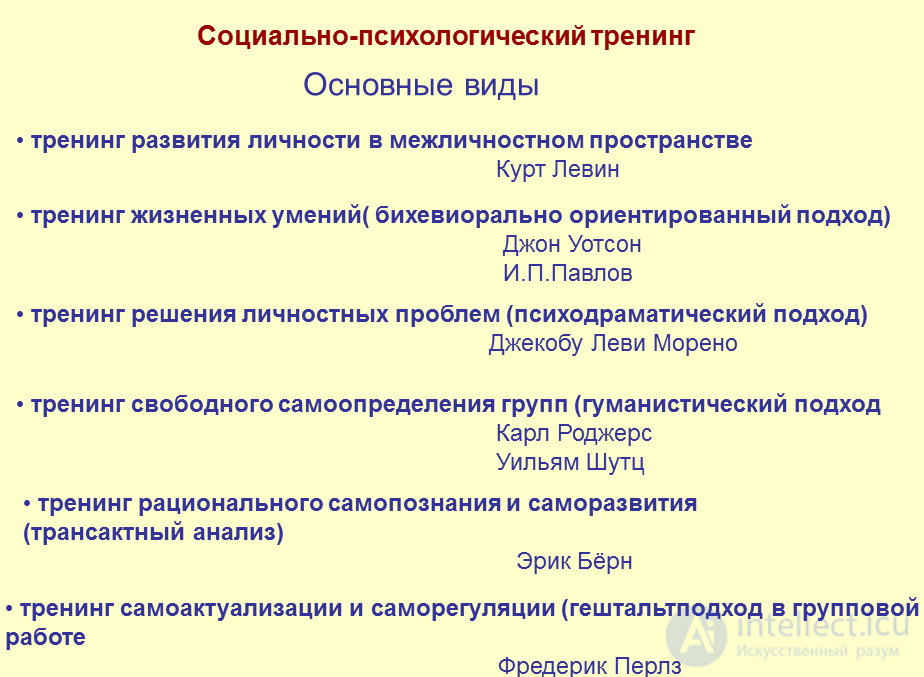
Psychological trainings are aimed at changing negative attitudes and behavioral habits that hinder a person, and at forming new ones. In terms of its type of impact, psychological training lies between psychotherapeutic and skills-based approaches. Most often
psychological trainings are used to increase communicative competence.
Invented psychodrama, a method of acting out role situations in a group.
Developed the ideas of spontaneity, role play, and self-expression.
Created the foundations of sociometry, a method for assessing interpersonal relationships in a group.
His work began as early as the 1920s in Vienna and then continued in the United States.
In the 1940s he developed the T-group (training group) method, a predecessor of SPT.
Founded the Research Center for Group Dynamics in the United States.
Put forward the principle of feedback and participation that underlies all trainings.
Michael Vorwerg is known as the author of fundamental works on training methods for personal and communication development.
SPT as structured learning through experience
Vorwerg emphasizes that a training is neither a lecture nor psychotherapy, but a system of exercises and interactions leading to personal change.
The role of feedback
He considers feedback the central tool for developing self-awareness, correcting behavior, and forming new social skills.
Training is a learning situation in action
Participants "learn from themselves," in the "here and now" mode, through emotions, mistakes, clashes, and support.
The trainer is not a teacher but a facilitator
Vorwerg stressed that the leader does not give ready-made solutions but creates a space for the participants' personal experience and growth.
Heterogeneity of participants in age, gender, and social status is permitted, but the main criterion is similarity of psychosocial problems and level of development.
The optimal size is 6 to 14 people, which ensures:
sufficient variety of opinions and experience
safety and trust
the opportunity for everyone to participate actively
Stability of the group's composition throughout the course, which promotes the formation of group dynamics and effective interaction.
Total volume: 25-40 hours, divided into sessions of 2-4 hours
Minimum for effectiveness: at least 18-25 hours
The structure may include:
Introductory session: goals, getting acquainted, setting norms
Main block: thematic sessions, exercises, feedback
Concluding part: reflection, recording of changes, farewell
Commonly encountered training goals:
Developing empathy: the ability to understand others' feelings without judgment
Acceptance of oneself and others: working with self-esteem and tolerance
Unlocking potential: stimulating personal growth and awareness of one's resources
Learning to interact: developing skills of communication, empathy, and support
Developing communicative competence: the ability to listen, express thoughts, and understand others
Forming self-knowledge skills: awareness of one's emotions, attitudes, and behavior
Correcting interpersonal relationships: overcoming conflicts, developing empathy
Personal growth: increasing confidence, self-acceptance, and motivation
Developing communication skills (the ability to listen, speak, and understand others);
Building self-confidence and raising self-esteem;
Developing empathy and tolerance toward other points of view;
Overcoming interpersonal barriers and improving group dynamics;
Skills of constructive conflict resolution;
Personal growth and self-knowledge;
Increasing stress resistance and adaptability.
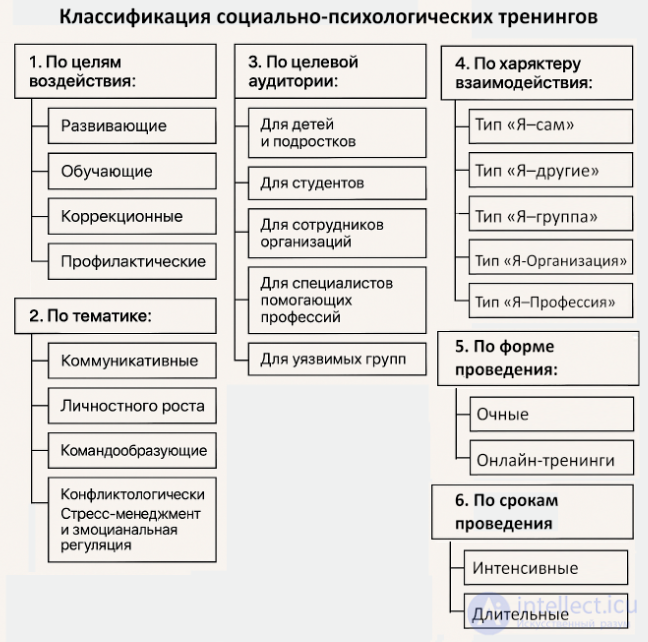
Social-psychological trainings can be classified by various criteria:
Developmental (aimed at personal growth and self-knowledge);
Educational (forming specific skills such as communication, leadership, and time management);
Corrective (changing undesirable behavioral stereotypes, raising self-esteem);
Preventive (preventing professional burnout, conflicts, and deviant behavior).
Communicative (improving communication, active listening, feedback);
Personal growth (self-esteem, self-acceptance, self-realization);
Team-building;
Conflictological (conflict resolution);
Stress management and emotional regulation.
For children and adolescents;
For students;
For employees of organizations (corporate SPT);
For specialists in helping professions (psychologists, teachers, doctors);
For vulnerable groups (people with disabilities, displaced persons, etc.).
In-person (group meetings);
Online trainings (webinars, Zoom sessions);
Intensive (1-3 consecutive days);
Long-term (several weeks).
6. By the nature of interaction
The "Me-myself" type is oriented toward individual changes related to self-knowledge, self-esteem, and personal development.
The "Me-others" type is aimed at improving interpersonal interaction, building relationships, and developing empathy and communication skills.
The "Me-group" type places the emphasis on the transformation of the personality through group dynamics, awareness of oneself as part of a social system, and work with collective processes.
The "Me-Organization" type places the emphasis on the individual as part of a large structure. It explores how the person interacts with other people in conditions of rivalry, conflict, or joint work between groups.
The "Me-Profession" type focuses on a person performing a specific professional activity. It analyzes their emotions, motivation, and the life values that are formed and manifested within the professional context.
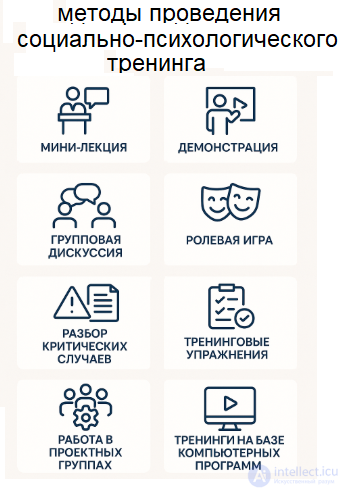
The methods of conducting a training are diverse and include the following types of activity:
mini-lecture,
demonstration,
group discussion,
role play,
analysis of critical incidents,
training exercises,
work in project groups,
trainings based on computer programs, interactive video programs,
trainings using artificial intelligence systems
A social-psychological training (SPT) is built on a definite structure:
Preparation: defining goals, selecting participants, choosing methods
Group formation: creating an atmosphere of trust, establishing rules
Warm-up exercises (icebreakers) — build trust;
Conducting the sessions. Main stage (training sessions):
Role-playing games
Group discussions
Psychotechniques and exercises
Analysis of situations and feedback
Interaction exercises — work in pairs and subgroups;
Role-playing and situation modeling — acting out real situations;
Discussion and reflection — participants share impressions and insights;
Feedback — the trainer and participants give constructive comments.
Reflection: discussing the experience, becoming aware of changes
Analysis of achievements and difficulties;
Evaluation of the effectiveness of the training;
Completion: summing up, recommendations
Summing up;
Recommendations for further development.
Voluntary participation;
Confidentiality;
Active participation of all group members;
Non-judgmentalism and respect for the opinions of others;
The "here and now" principle — a focus on current experiences and reactions.
The difference between social-psychological training and other kinds of training lies in its orientation toward developing the personality through group interaction and the emotional living-through of experience, rather than only through transferring knowledge or forming specific skills.
Let us consider the key points of this difference:
Reliance on group dynamics
Social-psychological training uses the small group as a means of development — interaction between participants becomes a tool of self-knowledge and behavior change.
Emphasis on the "here and now"
Instead of analyzing past experience or theoretical models, attention is focused on current emotions, reactions, and communication patterns within the group.
Developing the personality, not only skills
Whereas classical trainings aim at teaching (for example, public speaking or sales), social-psychological training aims at developing empathy, self-reflection, confidence, and the ability to build relationships.
Emotional involvement
Participants actively live through situations and explore feelings, boundaries, and attitudes — unlike more rational, information-based trainings.
Informal structure
Such trainings are often run without a rigid program — the topics may be determined by the participants themselves and by the processes currently unfolding in the group.
Discussion is an integral part of social-psychological training and plays a key role in its effectiveness
Participants try on different social roles (boss–subordinate, parent–child, conflicting parties, etc.) and act out real or simulated situations.
Goal: to learn new behavior, become aware of one's own reactions, and receive feedback.
| Characteristic | Social-psychological training (SPT) | Ordinary instructional trainings |
|---|---|---|
| Goal | Personal and interpersonal change | Mastery of specific knowledge or skills |
| Method | Emotionally rich interaction, group dynamics | Instruction, exercises, business games |
| Focus | The individual in the group, development of self-awareness and empathy | Improving professional effectiveness |
| Impact | Deep, affecting attitudes, values, and feelings | Superficial, related to behavior and actions |
| Examples | Confidence training, empathy training | Sales training, time management |
| Training method | Main emphasis | Depth of work |
|---|---|---|
| Social-psychological | Inner processes and communication | Deep, emotional |
| Skills training | Specific abilities (for example, speech) | Superficial, technical |
| Motivational training | Energy and inspiration | Emotional, but brief |
| Business training | Results and strategies | Rational |
A person who has completed a social-psychological training acquires not just knowledge — he or she is transformed as a personality and as a member of a social group. This shows itself as follows:
Deep self-knowledge. The person becomes aware of habitual patterns of behavior, inner attitudes, and reactions to stress, conflict, and closeness.
Improved communication skills. The person listens better, expresses thoughts more precisely, makes contact more easily, and manages tense situations.
Heightened empathy. The ability to understand the emotions and motivations of other people develops, making communication more conscious.
A clear understanding of one's roles in the group. The person can track his or her position in the collective, consciously choose a style of behavior, and accept or change roles.
Growth of resilience and confidence. Thanks to feedback and the support of the group, a more stable self-esteem and readiness for change are formed.
Flexibility of thinking. Openness to different points of view and the ability to work with contradictions are an important part of the inner transformation.
The personality of the facilitator is one of the key factors determining the success of a social-psychological training. He or she is not just a moderator, but a person capable of creating a safe space, stimulating deep work, and serving as a mirror for the group.
Psychological maturity. The facilitator understands his or her own attitudes, emotions, and boundaries — and can manage them consciously.
The ability to listen and to hear. Genuine engagement with each participant, the ability to catch hidden meanings, and sensitivity to nonverbal signals.
Communicative flexibility. The facilitator can adapt the style of communication to the group — being gentle and supportive, or provocatively stimulating when necessary.
Ethics and honesty. The facilitator follows professional standards and builds trust through transparency and respect for participants.
Spontaneity and a creative approach. The facilitator knows how to bring in games, metaphors, and unexpected forms of interaction to energize the group and avoid formulaic work.
The ability to hold boundaries. The facilitator does not dissolve into the group and does not impose his or her own point of view, yet still knows how to steer the process.
Such a personality becomes the center of group interaction, and the depth and outcome of the training depend to a large extent on his or her state.
Social-psychological training is not just a methodology but a path on which a person confronts themselves, the group, and the many facets of human communication. During their joint work, participants go through discussions, conflicts, insights, and support, discovering new sides of themselves — sometimes unexpected, but always genuine.
The result is not only the development of social skills but also a strengthening of inner stability, openness to life, and understanding of others. What matters here is not a result in the form of a report, but the process, the experience, the connection.
The facilitator becomes a guide, the group a mirror, and each participant the author of his or her own renewal. And although the training ends, its effect continues — in new decisions, in deeper relationships, in the ability to be oneself.

Comments