
Lecture
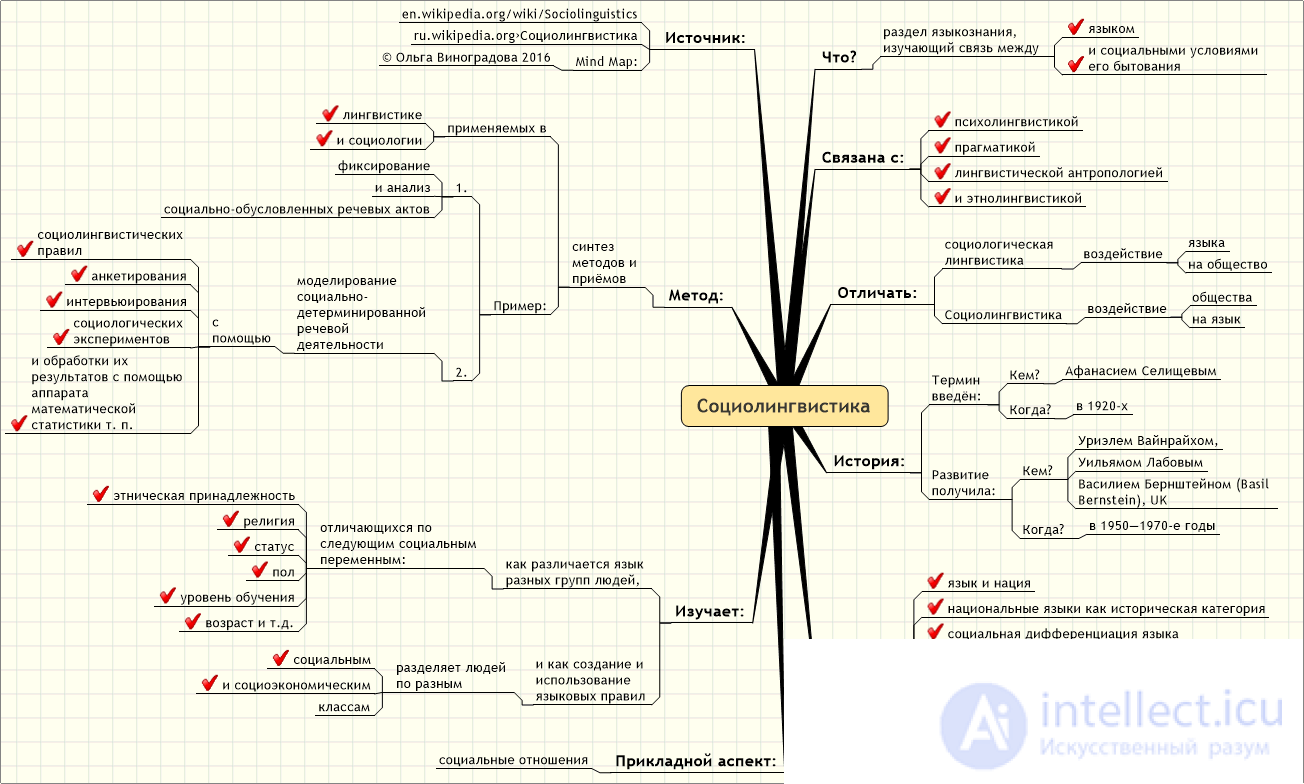
Sociolinguistics (sociological linguistics) — a branch of linguistics that studies the connection between language and the social conditions of its existence. Sociolinguistics is closely related to such linguistic disciplines as psycholinguistics and ethnolinguistics. At the intersection of sociolinguistics and economic theory, a field of research known as the economics of language is developing.
Sociolinguistics arose in the 1920s (Afanasy Selishchev) and developed further in the 1950—1970s (Uriel Weinreich, William Labov).
The subject matter of sociological linguistics is a broad range of questions: language and nation, national languages as a historical category, the social differentiation of language, the relationships between linguistic and social structures, the typology of language situations determined by social factors, the social aspects of multilingualism, and so on.
The method of sociolinguistics is a synthesis of the methods and techniques used in linguistics and sociology, such as recording and analyzing socially conditioned speech acts, modeling socially determined speech activity by means of sociolinguistic rules, questionnaires, interviews, sociological experiments, and processing their results using the apparatus of mathematical statistics, and so on.
For example, by studying social attitudes a sociolinguist may determine that a particular native language will not be considered suitable for use in a business or professional setting. Sociolinguists may also study the grammar, phonetics, vocabulary, and other aspects of this sociolect in much the same way as dialectologists study the same things for a regional dialect. .
The study of language variation is linked to the social constraints that define language in its contextual setting . Code-switching is a term denoting the use of different varieties of a language in different social situations.
William Labov is often considered the founder of sociolinguistics. He is especially known for introducing quantitative analysis of language variation and change , turning the sociology of language into a scientific discipline.
The sociolinguistic interview is the fundamental data-collection method for sociolinguistic research, allowing the researcher to gather large volumes of speech from speakers of the language or dialect being studied. The interview takes the form of a long, loosely structured conversation between the researcher and the interview subject; the researcher's main task is to elicit the vernacular style, that is, the register associated with everyday, casual conversation. This goal is complicated by the observer's paradox: the researcher tries to elicit the style of speech that would be used if the interviewer were not present. To this end, various techniques can be used to reduce the subject's attention to the formality and artificiality of the interview setting. For example, the researcher may try to prompt stories about memorable events in the subject's life, such as fights or near-death experiences; it is believed that the subject's emotional involvement in telling the story distracts their attention from the formality of the context. Some researchers interview several subjects together to allow them to talk to each other more freely than with a single interviewer. The researcher can then study the effect of style-shifting on language by comparing the subject's speech style in a more conversational context, such as personal-experience narratives or conversation between subjects, with the more careful style produced when the subject pays more attention to the formal setting of the interview. Correlations of demographic characteristics such as age, gender, and ethnicity with speech behaviour can be studied by comparing the speech of different interview subjects.
Although the study of sociolinguistics is very broad, there are several fundamental concepts on which many sociolinguistic studies depend.
A speech community is a concept in sociolinguistics that describes a particular group of people who use language in a unique and mutually acceptable way among themselves. This is sometimes called a Sprechbund. .
To be considered part of a speech community, one must possess communicative competence . That is, the speaker has the ability to use language in a way that is appropriate to a given situation. A speaker may be communicatively competent in more than one language.
Speech communities may be members of a profession with a special jargon, distinct social groups such as high schoolers or hip-hop fans, or even close-knit groups such as families and friends. Members of speech communities often use slang or jargon to serve the special purposes and priorities of the group.
The community of practice allows sociolinguistics to explore the relationship between socialization, competence, and identity. Since identity is a very complex structure, the study of language socialization is a means of studying the micro-interactional level of practical activity (everyday activity). Language learning is strongly influenced by the family, but it is also supported by a larger local environment, such as school, sports teams, or religion. Speech communities can exist within a broader community of practice.
The concept of prestige is of decisive importance for sociolinguistic analysis; a positive or negative value is assigned to certain speech habits, which is then applied to the speaker. This can operate on many levels. It can be realized at the level of an individual sound/phoneme, as Labov found in his study of the pronunciation of postvocalic /r/ in the Northeastern United States, or at the macro-level of language choice, as is realized in the various diglossias that exist throughout the world, among which Swiss German/Standard German are perhaps the best known. An important consequence of sociolinguistic theory is that speakers "choose" a variety by performing a speech act, consciously or subconsciously.
The terms acrolectal (high) and basilectal (low) are also used to distinguish a more standard dialect from a less prestigious dialect.
Understanding language in society means that one must also understand the social networks in which language is embedded. A social network is another way of describing a particular speech community in terms of the relationships between individual members of the community. A network can be loose or close-knit, depending on how the members interact with one another. [11] For example, an office or a factory can be considered a close-knit community because all members interact with one another. A large course with more than 100 students would be a looser community, because students may only interact with the instructor and, perhaps, with 1–2 other students. Multiplex is a community in which members have several relationships with one another.[11] For example, in some neighborhoods members may live on the same street, work for the same employer, and even intermarry.
The looseness or restrictedness of a social network can influence a speaker's speech patterns. For example, Sylvie Dubois and Barbara Horvath found that speakers in one Cajun Louisiana community were more likely to pronounce the English "th" [θ] as [t] (or [ð] as [d]) if they participated in relatively dense social networks (i.e., had strong local ties and interacted with many other speakers in the community), and less likely to do so if their networks were weaker (i.e., had fewer local ties). [12]
A social network can refer to the macro-level of a country or a city, but also to the interpersonal level of neighborhoods or an individual family. In recent times, social networks have been shaped by the Internet through chat rooms, Facebook groups, organizations, and online dating services.
Sociolinguistics as a field distinct from dialectology arose from the study of language variation in urban areas. Whereas dialectology studies the geographic distribution of language variation, sociolinguistics focuses on other sources of variation, including class. Class and occupation are among the most important linguistic markers in society. One fundamental finding of sociolinguistics, which is hard to refute, is that class and linguistic variety are interrelated. Members of the working class tend to speak the standard language less, while the lower, middle, and upper-middle classes, in turn, will speak closer to the standard. However, the upper class, even members of the upper-middle class, can often speak "lesser" standards than the middle class. This is because not only class matters, but also class aspirations.
Studies, for example those conducted by William Labov in the 1960s, have shown that social aspirations influence speech patterns. This is also true with regard to class aspirations. Wishing to associate themselves with a particular class (usually the upper class and the upper-middle class), people who are moving in that socioeconomic direction may adjust their speech patterns to sound like that class. However, not being native speakers of upper-class speech, they often hypercorrect, which involves over-adjusting their speech to the point of introducing new errors. The same is true of people moving down in socioeconomic status.
In any contact situation there is a power dynamic, whether it is a teacher-student situation or an employee-customer situation; this power dynamic leads to hierarchical differentiation of languages.
Basil Bernstein, a well-known British sociolinguist, developed in his book "Elaborated and Restricted Codes: Their Social Origins and Some Consequences" a method for categorizing linguistic codes according to a variable emphasis on verbal and extraverbal communication. He argued that factors such as family orientation, social control, verbal feedback, and possibly social class contributed to the development of two codes: elaborated and restricted.
According to Basil Bernstein, restricted code is an example of the predominance of extraverbal communication, with an emphasis on interpersonal connection over individual expression. His theory places this code within an environment that operates according to established social structures which predetermine the roles of their members, in which a commonality of interests and intentions, conditioned by a shared local identity, creates predictability of discrete intentions and, consequently, a simplification of verbal utterances. Such an environment may include military, religious, and legal settings, criminal and prison subcultures, long-term marital relationships, and friendships between children. Because of the strong bond between speakers, explicit verbal communication often turns out to be unnecessary, and individual expression is of little importance. However, this simplification is not a sign of a lack of intelligence or of the code's complexity; rather, communication is carried out by extraverbal means (facial expressions, touch, etc.) in order to strengthen the bond between speakers. Bernstein notes the example of a young man asking a stranger to dance: there is an established manner of asking, and yet communication is carried out through physical grace and an exchange of glances. Thus, implied meaning plays a greater role in this code than in the elaborated code. Restricted code also fosters the unity of speakers and strengthens solidarity. there is an established manner of asking, and yet communication is carried out through physical graces and an exchange of glances. Thus, implied meaning plays a greater role in this code than in the elaborated code. Restricted code also fosters the unity of speakers and strengthens solidarity. there is an established manner of asking, and yet communication is carried out through physical graces and an exchange of glances. Thus, implied meaning plays a greater role in this code than in the elaborated code. Restricted code also fosters the unity of speakers and strengthens solidarity.[14]
Basil Bernstein defined "elaborated code" in accordance with its emphasis on verbal communication over extraverbal communication. This code is typical of environments in which a person has access to various social roles, to be chosen depending on character and temperament. In most cases, speakers of the elaborated code use a broader lexicon and display less syntactic predictability than speakers of the restricted code. The absence of a predetermined structure and solidarity requires the explicit verbal communication of an individual's discrete intentions in order to succeed in education and career. Bernstein cautiously notes the association of this code with the upper classes (whereas the restricted code is associated with the lower classes), where an abundance of available resources allows people to choose their social roles, but he warns that studies linking the codes to particular social classes have used small samples and have been subject to considerable variation. He also argues that the elaborated code arose because of differences in social context rather than intellectual advantages; as such, the elaborated code differs from the restricted code in the contextual emphasis on individual advancement as opposed to the affirmation of social bonds.[14]
Bernstein explains the development of language in relation to the two codes in light of their fundamentally different values. For example, a child familiar only with the restricted code learns extraverbal rather than verbal communication, and may therefore have a less extensive vocabulary than a child raised using both codes. Although the restricted code has no inherent lesser value, a child unfamiliar with the elaborated code may encounter difficulties upon entering formal education, in which standard, clear oral communication and comprehension are necessary for learning and for effective interaction with both instructors and other students from different backgrounds. As such,
Furthermore, Bernstein notes several studies on language development in relation to social class. In 1963, the Committee on Higher Education conducted a study of verbal IQ, which showed a decline among individuals from the lower working classes aged 8–11 and 11–15, compared with members of the middle class (who had been exposed to both restricted and elaborated codes). [15] In addition, studies by Bernstein, [16] [17] Venables, [18] and Ravenette, [19], as well as a 1958 report by the Council for Education [20] show a relative underperformance in verbal tasks compared with extraverbal tasks among children from the lower working classes (exposed exclusively to the restricted code). [14]
The following table shows the differences in language associated with social position:
| Nonstandard dialect (associated with the lower classes) |
Standard dialect (associated with the upper classes) |
|---|---|
| It looks like it won't rain today. | It looks like it won't rain today. [21] |
| You gave it to me yesterday. | You gave it to me yesterday. [22] |
| You've got to do it right. | You must do it correctly. [23] |
It is commonly assumed that nonstandard language is language of low prestige. However, in certain groups, such as traditional working-class neighborhoods, standard language may be considered undesirable in many contexts. This is because working-class dialect is often regarded as a powerful in-group marker, and especially for non-mobile people, the use of nonstandard varieties (even exaggeratedly) expresses neighborhood pride as well as group and class solidarity. Thus, there will be a considerable difference in the use of nonstandard varieties when visiting a neighborhood pub or barbecue (lower register) versus going to a bank (higher register) for the same individual. [clarification needed]
Sociolinguistic research typically takes a sample of the population and conducts interviews with it, assessing the realization of specific sociolinguistic variables.
A commonly studied source of variation is regional dialects. Dialectology studies language variation based primarily on geographic distribution and its associated features. Sociolinguists who deal with the grammatical and phonological features corresponding to regional areas are often called dialectologists.
There are several different types of age-related variation that can be observed in a population. They speak the local language of a subgroup whose membership is typically characterized by a particular age range, age-related variation, and signs of language change in progress.
Variation may also be related to gender. On average, men and women use somewhat different linguistic styles. These differences are quantitative rather than qualitative. That is, to say that women use a particular speech style more than men is much like saying that men are taller than women (i.e., men are taller than women on average, but some women are taller than some men).
Another method is the matched-guise test. This method has the listener listen to a pair of words and rate them on the basis of personality and dialect. Since certain groups have divided views on attitudes toward language
The fact that language is far from socially uniform has been known for quite some time. One of the first written observations attesting to this dates back to the early 17th century. Gonzalo de Correas, a lecturer at the University of Salamanca in Spain, clearly distinguished social varieties of language: "It should be noted that, besides the dialects found in the provinces, language has certain varieties associated with the age, standing, and wealth of the inhabitants of these provinces: there is the language of country dwellers, commoners, townspeople, noble lords and courtiers, the learned historian, the elder, the preacher, women, men, and even small children."
The term "sociolinguistics" was first used in 1952 by the American sociologist Haver C. Currie. However, this does not mean that the science of the social conditioning of language originated in the early 1950s. The roots of sociolinguistics run deeper, and they should be sought not in American scholarship, but in European, and in particular Russian, scholarship.
Linguistic research taking into account the conditioning of linguistic phenomena by social phenomena was already being conducted, with greater or lesser intensity, at the beginning of the present century in France, Russia, and the Czech lands. Scholarly traditions different from those in the United States meant that, in these countries, the study of the connections between language and social institutions, and the evolution of society, was never fundamentally separated from "pure" linguistics. "Since language is only possible in human society," wrote I. A. Baudouin de Courtenay, "we must always note in it, besides its psychic aspect, its social aspect as well. The foundation of linguistics must be not only individual psychology, but sociology as well."
The ideas most important to modern sociolinguistics belong to such outstanding scholars of the first half of the 20th century as I. A. Baudouin de Courtenay, E. D. Polivanov, L. P. Yakubinsky, V. M. Zhirmunsky, B. A. Larin, A. M. Selishchev, V. V. Vinogradov, and G. O. Vinokur in Russia; F. Brunot, A. Meillet, P. Lafargue, and M. Cohen in France; Ch. Bally and A. Sechehaye in Switzerland; J. Vendryes in Belgium; B. Havránek and A. Mathesius in Czechoslovakia; and others. These include, for example, the idea that all the means of language are distributed across spheres of communication, and that the division of communication into spheres is to a considerable extent socially conditioned (Ch. Bally); the idea of the social differentiation of a unified national language depending on the social status of its speakers (the work of Russian and Czech linguists); the proposition that the pace of language evolution depends on the pace of the development of society, and that, overall, language always lags behind social change in the changes it undergoes (E. D. Polivanov); the extension of the ideas and methods used in the study of rural dialects to the study of urban language (B. A. Larin); the substantiation of the need for a social dialectology alongside territorial dialectology (E. D. Polivanov); and the importance of studying jargons, argots, and other uncodified spheres of language for understanding the internal structure of the national language system (B. A. Larin, V. M. Zhirmunsky, D. S. Likhachev); and others.
A characteristic feature of sociolinguistics in the second half of the 20th century is the shift from works of a general nature to the experimental testing of proposed hypotheses and to a mathematically rigorous description of specific facts. According to J. Fishman, one of the representatives of American sociolinguistics, the study of language from a social perspective at the present stage is characterized by such features as systematicity, a strictly targeted approach to data collection, quantitative-statistical analysis of facts, and a close interweaving of the linguistic and sociological aspects of research.
Sociolinguistics – it is evident that it arose at the intersection of two other sciences, sociology and linguistics. The interdisciplinary nature of sociolinguistics is recognized by many scholars. However, this recognition in itself does not answer the question: which is there more of in this science – sociology or linguistics? Who practices it – professional sociologists or professional linguists (recall that the first scholar to use the term "sociolinguistics" was a sociologist)?
Modern sociolinguistics is a branch of linguistics. While this science was still taking shape and finding its feet, its status could be debated. But by the end of the 20th century, when sociolinguistics had not only defined the object, goals, and tasks of its research but had also obtained tangible results, the "linguistic" nature of this science became entirely obvious. It is another matter that sociolinguists have borrowed many methods from sociologists, for example, methods of mass surveys, questionnaires, oral polls, and interviews. But in borrowing these methods from sociologists, sociolinguists apply them to the tasks of studying language, and, moreover, on their basis they develop their own methodological techniques for working with linguistic facts and with native speakers.
One of the founders of modern sociolinguistics, the American researcher William Labov, defines sociolinguistics as the science that studies "language in its social context." To unpack this terse definition, it must be said that the attention of sociolinguists is directed not at language itself, not at its internal structure, but at how language is used by the people who make up a given society. In doing so, all factors that could influence the use of language are taken into account – from various characteristics of the speakers themselves (their age, sex, level of education and culture, type of occupation, etc.) to the particularities of a specific speech act.
"A thorough and precise scientific description of a given language," noted R. Jakobson, "cannot dispense with grammatical and lexical rules concerning the presence or absence of distinctions between interlocutors in terms of their social standing, sex, or age; determining the place of such rules within the overall description of a language constitutes a complex linguistic problem."
Unlike generative linguistics, represented, for example, in the works of N. Chomsky, sociolinguistics deals not with an ideal native speaker who generates only correct utterances in a given language, but with real people who, in their speech, may violate norms, make mistakes, mix different linguistic styles, and so on. It is important to understand what explains all such features of the real-world use of language.
Thus, in the sociolinguistic approach to language, the object of study is the functioning of language; its internal structure is taken as a given and is not subjected to special investigation. In societies where two, three, or many languages function, the sociolinguist must investigate the mechanisms by which several languages function in their interaction, in order to obtain answers to the following questions. In which spheres of social life are they used? What are the relationships between them in terms of status and function? Which language "dominates," i.e., is the state language or the one officially accepted as the primary means of communication, and which are forced to make do with the role of family and everyday languages? How, under what conditions, and in what forms does bilingualism and multilingualism arise?
Sociolinguistics operates with a certain set of concepts specific to it: speech community, language situation, socio-communicative system, language socialization, communicative competence, language code, code-switching, bilingualism, diglossia, language policy, and a number of others. In addition, some concepts are borrowed from other branches of linguistics: language norm, verbal communication, speech behaviour, speech act, language contact, language mixing, lingua franca, etc., as well as from sociology and social psychology: the social structure of society, social status, social role, social factor, and some others.
Let us consider some of these concepts, the ones most specific to sociolinguistics and most important for understanding the essence of this scientific discipline.
– is a collection of people united by common social, economic, political, and cultural ties, who, in their everyday life, carry out direct and mediated contacts with one another and with various kinds of social institutions by means of one language or several languages current within this collection.
The boundaries of language distribution very often do not coincide with political borders. The most obvious example is present-day Africa, where the same language may be spoken by the inhabitants of different states (such as, for example, Swahili, spoken in Tanzania, Kenya, Uganda, and partly in Zaire and Mozambique), while within a single state several languages coexist (in Nigeria, for example, there are more than 200 of them!). Therefore, in defining the concept of "speech community," it is important to combine linguistic and social criteria: if we retain only the linguistic ones, we will be speaking only of language, without regard to the environment in which it is used; if, on the other hand, we rely only on social criteria (including political-economic and cultural factors), then the languages functioning within a given social community will be left out of consideration.
A language community can be understood as any aggregate of people, varying in the number of individuals it comprises – from an entire country down to what are called small social groups (for example, a family, a sports team): in each case the criterion for identifying it should be the commonality of social life and the presence of regular communicative contacts. One language community may encompass others. Thus present-day Russia is an example of a language community that encompasses, includes within itself, language communities of a smaller scale: republics, regions, cities. In turn, a city as a language community includes within itself language communities of an even smaller scale: enterprises, institutions, educational establishments.
The smaller the language community, the greater its linguistic homogeneity. In Russia dozens of national languages and their dialects exist and interact with one another, while in large Russian cities the main forms of social life are already carried out in a considerably smaller number of languages, often two (Kazan: Tatar and Russian, Ufa: Bashkir and Russian, Maykop: Adyghe and Russian), and where the population is ethnically homogeneous, predominantly in one (Moscow, St. Petersburg, Saratov, Krasnoyarsk).
Within language communities such as a factory, a research institute, or a secondary school, one language of communication predominates. In small language communities, however, such as a family, where communicative contacts take place directly, there may be not one but two languages (or even more: there are known cases of Russian émigré families that use several languages in their everyday family communication).
Every language community makes use of certain means of communication – languages, their dialects, jargons, stylistic varieties of the language. Any such means of communication can be called a code. In the most general sense a code is a means of communication: a natural language (Russian, English, Somali, and so on), an artificial language such as Esperanto or modern machine languages, Morse code, maritime flag signaling, and the like. In linguistics the term code is customarily applied to linguistic formations: a language, a territorial or social dialect, an urban koine, and the like.
Alongside the term "code", the term "subcode" is also used. It denotes a variety, a subsystem of some general code – a communicative means of smaller scope, a narrower sphere of use, and a smaller set of functions than the code itself. For example, such varieties of the modern Russian national language as the standard language, the territorial dialect, urban vernacular, and social jargon are subcodes, or subsystems, of a single code (the Russian national language).
A subcode, or subsystem, may in turn be divided into varieties and thus include within its composition subcodes (subsystems) of a lower level, and so on. For example, the Russian standard language, itself a subcode in relation to the national language, is divided into two varieties – the codified language and the colloquial language – each possessing a certain self-sufficiency and differing in function: the codified language is used in written, book forms of speech, while the colloquial language is used in oral, everyday forms. In turn the codified standard language is differentiated into styles, and the styles are realized in various speech genres; some semblance of this differentiation exists in the colloquial language as well.
– the totality of codes and subcodes used in a given language community and standing in relations of functional complementarity to one another. "Functional complementarity" means that each of the codes and subcodes making up the socio-communicative system has its own functions, without overlapping with the functions of other codes and subcodes (so that they all, as it were, complement one another functionally).
For example, each style of the standard language – scientific, official-business, publicistic, religious-homiletic – has its own specific functions not characteristic of the other styles, yet together they functionally complement one another, forming a system capable of serving all the communicative needs of the given society (which may conventionally be called the society of speakers of the standard language; besides them there are, for example, speakers of dialects and of vernacular) and all spheres of communication.
In a multilingual society the socio-communicative system is formed by different languages, and communicative functions are distributed among them (each of the languages may, of course, in turn be subdivided into subcodes – dialects, jargons, styles).
The components of the socio-communicative system serving a given language community stand in certain relations to one another. At each stage in the existence of a language community these relations are more or less stable. This does not mean, however, that they cannot change. A change in the political situation in a country, a change of political system, economic transformations, new orientations in social and national policy, and so on – all of this can, in one way or another, affect the state of the socio-communicative system, its composition, and the functions of its components – the codes and subcodes.
The functional relations among the components of the socio-communicative system at a given stage in the existence of a particular language community are precisely what form the language situation characteristic of that community.
The concept of "language situation" is usually applied to large language communities – countries, regions, republics. For this concept the factor of time is important: in essence, a language situation is the state of the socio-communicative system during a particular period of its functioning.
For example, in Ukraine, where the socio-communicative system includes Ukrainian and Russian as its main components (besides them there are others: Belarusian, Bulgarian, Hungarian, Czech, and some others), before the collapse of the USSR a relatively dynamic equilibrium was observed between these two languages. There were schools with instruction in both Ukrainian and Russian, both languages were used in science and higher education, dividing the spheres of application to a certain extent (the natural and technical sciences – predominantly in Russian, the humanities – predominantly in Ukrainian), and in the everyday sphere the choice of the language of communication was determined by the intentions of the speaker, the type of addressee, the nature of the communicative situation, and so on. In the 1990s the functions of the Russian language in Ukraine sharply narrowed: it was displaced by Ukrainian from the spheres of secondary and higher education, science, and culture; the areas of use of Russian in everyday communication also shrank.
These changes are undoubted evidence of a change in the language situation, while the composition of the socio-communicative system serving the Ukrainian language society remains the same.
Codes (languages) and subcodes (dialects, styles), which make up the socio-communicative system, are functionally distributed. This means that one and the same body of speakers, who make up a given language society, possessing a common set of communicative means, use them depending on the conditions of communication. For example, if we speak of the subcodes of the standard language, then in scientific activity speakers of the standard language use the means of the scientific style of speech, while in the sphere of record-keeping, jurisprudence, administrative correspondence, and so on, they are obliged to resort to the means of the official-business style, and in the sphere of religious worship – to the words and constructions of the religious-homiletic style, and so on.
In other words, depending on the sphere of communication, the speaker switches from one set of linguistic means to another.
A similar picture is observed in those societies where not one but two languages (or several) are used. Bilinguals, that is, people who command two (or several) languages, usually "distribute" their use depending on the conditions of communication: in an official setting, when dealing with the authorities, predominantly one language is used, while in everyday life, in the family, in contacts with neighbors – the other (or others). In this case too one can speak of switching from one code to another, except that the codes involved are not the styles of a single language, as in the first example, but different languages.
Code-switching, or code switching, is the transition of a speaker, in the course of verbal communication, from one language (dialect, style) to another depending on the conditions of communication. Code-switching may be brought about, for example, by a change of addressee, that is, of the person to whom the speaker is speaking. If the addressee knows only one of the two languages the speaker knows, then the speaker naturally has to use precisely that language familiar to the addressee, even though up to that moment a different language, or both languages, may have been used in communicating with bilingual interlocutors. Switching to a code known to the interlocutor may occur even when the composition of those communicating changes: if a third person, who knows only one of the languages known to all three, joins a conversation between two bilinguals, the communication must proceed in that language. A refusal by the interlocutors to switch to the code familiar to the third participant in the communication may be regarded as an unwillingness to let him in on the subject of the conversation or as disregard for his communicative needs.
A factor conditioning code-switching may be a change in the role of the speaker himself. Say, in the role of father (when communicating within the family) or in the role of a neighbor in the building, he may use his native dialect, whereas in addressing the central authorities he is forced to switch to more or less generally accepted forms of speech. If such switching does not occur, representatives of the authorities will not understand him and he will not achieve his goal (getting a request granted, having a complaint examined, and so on), that is, he will suffer communicative failure.
The topic of communication also influences the choice of code. According to researchers who have studied problems of communication under conditions of linguistic heterogeneity, members of language communities prefer to discuss "production" topics in the language that has the corresponding specialized terminology for designating various technical processes, devices, instruments, and so on. But as soon as the topic changes – from a production topic to an everyday one – a different linguistic code or subcode "switches on": the native language or dialect of the interlocutors. In a monolingual society, a similar change of code involves switching from the professional language to generally used linguistic means.
At what points in the speech chain do speakers switch codes? This depends on the nature of the influence of the factors just discussed. If the speaker can foresee, and even in some sense plan for, the influence of one factor or another, the switch takes place at natural boundaries of the speech flow: at the end of a sentence, of a syntactic period, or, in the calmest mode of communication, upon completion of the discussion of some topic. If, however, the intervention of the factor conditioning the code-switching is unexpected for the speaker, he may switch from code to code in the middle of a sentence, sometimes even without finishing a word. At a high level of command of different codes or subcodes, when their use is largely automatized, the very process of code-switching may not be consciously perceived by the speaker, especially in cases where the other code (subcode) is used not in its entirety but in fragments. For example, speaking in one language, a person may insert into his speech elements of another language – set phrases, modal words, interjections, particles.
The very ability to switch codes attests to a fairly high degree of command of the language (or of its subsystems) and to a certain communicative and general culture on the part of the individual. The mechanisms of code-switching ensure mutual understanding among people and the relative comfort of the process of verbal communication itself. Conversely, an individual's inability to vary his speech depending on the conditions of communication, an adherence to only one code (or subcode), is perceived as an anomaly and can lead to communicative conflicts.
If, in the process of communication, we can switch from one linguistic means to another – for example, when the addressee changes – while continuing to discuss the same topic, this means that we have at our disposal a set of means allowing us to speak of one and the same thing in different ways. This is an extremely important property of language, giving the speaker the ability not only to freely express his thoughts in the given language but also to do so in different ways. A native speaker's ability to express one and the same meaning in different ways is called his capacity for paraphrase. This capacity, together with the ability to extract meaning from what has been said and the ability to distinguish correct sentences from incorrect ones, underlies the complex mental skill called "knowledge of a language".
Variability manifests itself at all levels of verbal communication – from command of the means of different languages (and, consequently, from varying, alternating use of the units of each language depending on the conditions of communication) to the speaker's awareness of the admissibility of different phonetic or accentual variants belonging to one language (in the modern Russian standard language these are variants such as бýло[шн]ая / бýло[чн]ая,  ('bulochnaya', bakery, pronounced with [shn] or with [chn]) and the like).
From a sociolinguistic point of view, the phenomenon of variability deserves attention inasmuch as different linguistic variants can be used depending on social differences among speakers of the language and on differences in the conditions of verbal communication.
This term arose in linguistics comparatively recently – in the second half of the 20th century. It is formed from two parts – the element socio-, indicating a relation to society, and the second component of the word "dialect"; it is, in essence, a contraction into a single word of the phrase "social dialect". A sociolect is the term for the totality of linguistic features characteristic of some social group – professional, estate, age-related, and so on – within one or another subsystem of the national language. Examples of sociolects include the speech features of soldiers (military jargon), schoolchildren (school jargon), criminal jargon (thieves' cant), hippie argot, student slang (on the terms "jargon", "argot", and "slang" see below), the professional "language" of computer workers, and various trade argots (for example, that of "shuttle traders" or of drug dealers), among others.
The term "sociolect" is convenient for designating diverse and mutually dissimilar linguistic formations that nonetheless share a common unifying feature: these formations serve the communicative needs of socially limited groups of people.
Sociolects do not constitute complete, self-contained systems of communication. These are specifically features of speech – in the form of words, word combinations, syntactic constructions, features of stress, and so on; the foundation of sociolects – lexical and grammatical – usually differs little from what is characteristic of the given national language as a whole. Thus, in modern criminal argot there is a fairly large number of specific designations, including metaphorical ones: балда ('head'), кусок ('a thousand rubles'), мент ('policeman'), хаза, малина ('thieves' den'), хрусты ('money'), шмонать ('to search'), этапка ('transit prison'), and the like, but the declension and conjugation of these words, and their combination into sentences, follow the models and rules of the national language as a whole; likewise part of the common language is the vocabulary that does not denote any specific realia of the "professional" and everyday life of criminals (compare: Ударили меня по балде – 'They hit me on the head'; Это он купил за два куска – 'He bought it for two thousand rubles'; На хазу нагрянули менты и обшмонали всех, кто там был – 'The cops raided the den and searched everyone who was there').
The first two terms are French in origin (French argot, jargon), the third is English (English slang). All three terms are often used as synonyms. It is worthwhile, however, to distinguish between the notions concealed behind these names: argot, unlike jargon, is a language that is secret to one degree or another, created specifically to make the speech of a given social group incomprehensible to outsiders. For this reason the phrases "thieves' argot" and "argot of the ofeni" – itinerant peddlers in 19th-century Russia – are preferable to "thieves' jargon" and "jargon of the ofeni".
The term "slang" is more characteristic of the Western linguistic tradition. In content it is close to what is designated by the term "jargon".
Argot, jargon, and slang – these are varieties of sociolect. The specific character of each of these linguistic formations may be due to the professional isolation of particular groups or their social separateness from the rest of society. Computer jargon (slang) – an example of professionally restricted linguistic formations; thieves' argot and student slang – examples of socially restricted subcodes. Sometimes a group may be isolated both professionally and socially; the speech of such a group has the properties of both a professional and a social jargon. An example – military jargon (soldiers' jargon), since soldiering is a profession, and the people engaged in this profession lead a life that is fairly separate from the rest of society.
The term koiné (Greek  'common [language]') was originally applied only to the common Greek language, which took shape in the 4th–3rd centuries BC and served as the single language of business, scholarly, and literary works in Greece until the 2nd–3rd centuries AD.
In modern sociolinguistics, koine is understood as a means of everyday communication that connects people speaking different regional or social variants of a given language. The role of koine may be played by supradialectal forms of a language – distinctive interdialects that combine features of different territorial dialects – or by one of the languages functioning within a given area.
The concept of "koine" is especially relevant to the linguistic life of large cities, where masses of people with different speech habits intermingle. Intergroup communication under urban conditions requires the development of a means of communication that would be understood by everyone. This is how urban koines emerge, serving the needs of everyday, chiefly oral, communication among different groups of the urban population.
Besides urban koines, there is also areal koine, i.e., the koine of a particular territory over which a given language (or languages) is spread. Thus, in the multilingual Republic of Mali (Africa), the Bamana language, which has a supradialectal form, is used as koine. The concept of "koine" is sometimes also applied to written forms of a language – for example, to Latin, which was used as the language of scholarship in medieval Europe.
The terms described above, denoting various kinds of subsystems of a national language, indicate that natural languages are fundamentally heterogeneous: they exist in many varieties, the formation and functioning of which are conditioned by a certain social differentiation of society and by the diversity of its communicative needs.
Some of these varieties have their own native speakers, i.e., groups of speakers who command only that particular subsystem of the national language (a territorial dialect, a vernacular). Other varieties serve not as the sole but as an additional means of communication: for example, a student uses student slang chiefly within "their own" circle, in communication with peers, while in other situations they resort to the resources of the standard language. The same is true of professional jargons: programmers and computer operators use computer jargon in informal communication on professional topics, but when they step outside their professional milieu, they use the words and constructions of the general standard language.
Such command of different subsystems of one national language, and its use depending on the situation or sphere of communication, is called intralingual diglossia (from Greek  'two-' and
  'language'; literally – 'bilingualism').
In addition, the term "diglossia" can also denote the command of different languages and their alternating use depending on the situation of communication; in this case the term is used without the qualifier "intralingual."
The concept of diglossia was introduced into scholarly use by the American researcher C. Ferguson in 1959. Before that, linguistics had used (and continues to use) the term "bilingualism" – as the Russian translation of the international term "bilingvizm." And for situations in which several languages may function, the term "multilingualism" has been adopted (English multilingualism, French plurilinguisme).
Bilingualism and multilingualism, as follows from the literal meaning of these terms, are the presence and functioning within a single society (usually a state) of two or several languages. Many present-day countries are bilingual or multilingual: Russia (cf. the existence on its territory, alongside Russian, of such languages as Bashkir, Tatar, Yakut, Buryat, Ossetian, and many others), the countries of Africa, Southeast Asia, India, and others.
Bilingualism and multilingualism can also be spoken of with regard to a single individual, if he or she commands not one but several languages.
Unlike bilingualism and multilingualism, diglossia denotes such a form of command of two independent languages or subsystems of one language in which these languages and subsystems are functionally distributed: for example, in official situations – lawmaking, record-keeping, correspondence between government institutions, and the like – the official (or state) language is used, if a multilingual society is involved, or the standard form of the national language (in monolingual societies), while in everyday, domestic situations, in family communication – other languages that do not have official or state status, other language subsystems – dialect, vernacular, jargon.
An important condition in diglossia is the fact that speakers make a conscious choice between different communicative means and use whichever of them is best able to ensure the success of communication.
The main goals of sociolinguistics are to study how language is used by the people who make up a given society, and how changes in the society in which a given language exists affect the development of that language. These goals correspond to two cardinal sociolinguistic problems – the problem of the social differentiation of language and the problem of the social conditioning of language development.
The present stage in the study of the first of these problems is characterized by the following features:
1. The rejection of the once widely held straightforward view of language differentiation in connection with the social stratification of society: according to this view, the stratification of society into classes directly leads to the formation of class dialects and languages. This viewpoint was expressed especially clearly in the book by A. M. Ivanov and L. P. Yakubinsky, Essays on Language (1932), as well as in the works of L. P. Yakubinsky, The Language of the Proletariat, The Language of the Peasantry, and others published in the 1930s in the journal "Literaturnaya Ucheba" (Literary Studies).
More convincing, and now shared by most linguists, is the view that the relations between the structure of society and the social structure of language are arranged in a fairly complex way. The social differentiation of language reflects not only, and perhaps not even so much, the current state of society, but rather its preceding states, the characteristic features of its structure, and the changes in that structure in the past, at different stages in the development of the given society. In this connection it is necessary to bear in mind a thesis repeatedly voiced by linguists of the past but which has not lost its relevance: that the pace of linguistic development significantly lags behind the pace of society's development, and that language, by virtue of its purpose – to serve as a connecting link between several successive generations – is far more conservative than any given social structure.
2. Linked to the rejection of a straightforward interpretation of the problem of the social differentiation of language, and to the recognition of the complexity of social-linguistic ties, is another feature of the treatment of this problem in modern linguistics: while there is a general tendency to identify systemic connections between language and society, sociolinguists point to the mechanistic and a priori nature of an approach to this problem that declares a complete isomorphism (i.e., a complete correlation of properties) between the structure of language and the structure of the society it serves.
The exaggerated, and therefore incorrect, notion of an isomorphism between linguistic and social structures is to a certain extent explained by the absence, until the mid-20th century, of concrete sociolinguistic research: a speculative approach predominated in the treatment of social-linguistic ties. With the appearance of works drawing on a substantial body of linguistic and social material, the shakiness of the isomorphism theory became more evident.
As these studies show, the social is transformed in language in a fairly complex way, as a result of which the social structure of language and the structure of people's verbal behaviour in society possess specific features that, although conditioned by the social nature of language, find no direct analogues in the structure of society. Such, for example, are the types of variation in linguistic means, which depend on the social characteristics of speakers and on the conditions of speech.
3. As regards the treatment of the problem of the social differentiation of language, modern sociolinguistics is characterized by a broader view than before of the phenomenon of variation in linguistic means (which may be conditioned by both social and intralinguistic causes) – including means belonging to relatively homogeneous linguistic formations, such as the standard language.
Some researchers regard such social categories as "status" and "social role" as factors influencing the stylistic variation of language. Attention to the figure of the speaker as one of the main factors conditioning the variation of speech, and the identification of different types of speakers depending on social and situational features, is characteristic of a number of contemporary studies in the field of stylistics. One example is the study by W. Labov, innovative for its time, in which the phonetic variability of the modern American variant of English is examined in relation to the social stratification of speakers and to the stylistic conditions of speech.
продолжение следует...
Часть 1 Sociolinguistics (Sociological Linguistics)

Comments