
Lecture
Profiling is the process of analyzing and building a psychological profile of a person based on their behaviour, characteristics, and other information. Profiling is often used in various fields, such as criminalistics, psychology, marketing, recruiting, and even medicine.
In criminalistics, profiling can be used to identify the characteristics and motives of an offender on the basis of their crimes and behaviour at the crime scene. This can help an investigation determine the offender's profile and devise a strategy for apprehending them.
In psychology, profiling can be used to analyze a person's personality and character on the basis of their behaviour, speech, and other data. This can be useful, for example, in psychological counselling or in working with patients.
In marketing, profiling can be used to determine the characteristics and interests of a target audience, which makes it possible to create advertising campaigns and promote products or services more effectively.
In recruiting, profiling can help in selecting candidates for vacancies on the basis of their skills, experience, and personal characteristics.
In the scholarly literature, profiling is most often referred to as a method, a system of methods, a technology, or a scholarly methodology. In addition, there are definitions of profiling as a "new area of psychologists' practical activity" (A. Poteryakhin, 2017) and a "process of identifying the psychological characteristics of an individual" (R. Ressler, 1992). K. and S. Dern, A. and U. Horn, and R. Kocsis, in turn, held that profiling is a "complex and scientifically grounded criminal practice."
What, then, is profiling? Is it a method, a methodology, a system, a process, a psychological field, or a criminal practice? Why is there still no consensus on its definition? And what is its place in the system of sciences at the present stage?
First of all, it should be noted that profiling, as part of human activity, fully meets all the criteria of scientific character. This is a natural consequence of its origin from scientific knowledge, without the use of any pseudoscientific tools.
There is also no doubt that profiling is derived from the psychological and psychophysiological analysis of personality and, in this respect, has the closest ties to psychological science. Practically all researchers place profiling within the field of psychological knowledge. Most authors also agree on its applied character.
It should be noted, however, that profiling activity has long gone beyond the mere applied use of psychological knowledge, having been enriched both by knowledge from the fields of anatomy, physiology, clinical medicine, biochemistry, and psychiatry, and by absorbing criminological, statistical, sociological, legal, and other kinds of knowledge from the social sciences (see fig. 1).
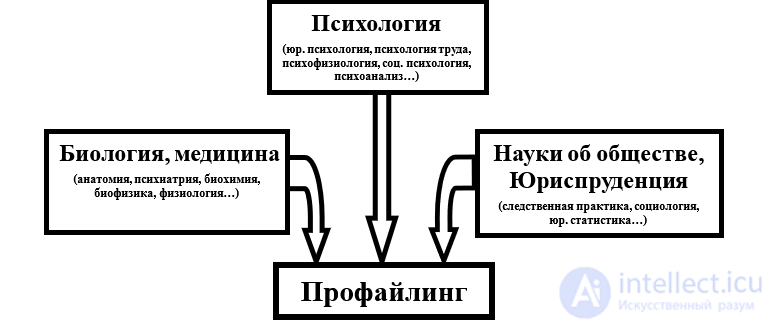
Figure 1. Sources of profiling
Thus, profiling has turned into a kind of social phenomenon which has, at the very least, acquired a systemic character, going beyond the significance of the sum of all its component parts.
In order to bring clarity to the definition of profiling, let us turn to the philosophy of science.
A method, being a path of research or cognition, cannot become a definition of profiling, since the latter itself makes use of an entire series of methods, including: observation, analysis and synthesis, comparison, ascent from the abstract to the concrete, description, analogy, and others.
Nor will we be able to identify profiling as a scholarly approach, since an approach is understood as a set of homogeneous methods, and profiling, as we have seen above, is not such a set.
It is also difficult to call profiling a new area of a psychologist's practical activity, alongside the five existing ones:
Although profiling has a certain connection with psychodiagnostics, this kind of activity, as already mentioned above, long ago went beyond the competence of the classical psychologist proper and cannot be included among the areas of their activity.
In our view, the concepts closest to describing the phenomenon of profiling at present are those of methodology (technique) and technology.
A methodology (technique), as an algorithm and procedure for carrying out targeted actions, differs from a method in the specificity of its techniques and tasks. In this respect, a psychodiagnostic technique, representing a "set of instructions for conducting, diagnosing, processing data, and interpreting results," for the most part most concisely describes the essence of specific profiling actions.
Profiling also meets all the requirements placed on a scholarly methodology:
As for the concept of "technology," being "a set of methods and tools for achieving a desired result; the application of scientific knowledge to practical tasks," it too describes profiling fairly fully, placing emphasis not only on its methodology but also on the tools it employs.
One could confine oneself to classifying profiling as a psychodiagnostic technique that has found practical implementation, by means of available tools, in the form of a corresponding technology. But this would hold only if we were describing the procedure of strictly regulated, specific actions of a profiler on a given object.
Abstracting from the description of a specific manipulation and defining profiling as a phenomenon of the contemporary world, we are forced to state that this phenomenon also extends beyond the aforementioned definitions.
It should be noted that, with the emergence of scholarly research in this field, profiling has gradually begun its shift from a purely technology (a technical sphere) toward a scientific-technical sphere. This is because only theoretical knowledge actually studies the causes of phenomena and discovers the laws by which these phenomena occur. Practical, technological knowledge, in turn, cannot answer the question of the cause of what is happening, but is merely a reflection of the skills that already exist and are used in practice.
It is, of course, still too early to call profiling a field of scholarly knowledge, a scholarly area, or a branch of psychological science. However, it is also evident that, with the emergence of new theoretical developments, including those presented to the scholarly community in the form of dissertation research, with the development of a family of branches of profiling with the specialization of scholarly research within each of them, and with the acquisition, through this, of new knowledge and its systematization, a path is opening toward the transformation of profiling from a strictly regulated investigative technology into a scientifically formalized body of knowledge that finds its application in practice.
In today's world, technology penetrates practically every sphere of human life, exerting the most active influence on them. This gives grounds to speak of the formation of a new, somewhat social-scientific-technological complex (D.V. Kotelevsky, 2015), which is coming to replace the scientific-technical complex. Profiling, in our view, is a vivid reflection and one of the illustrative examples of this process.
It should also be noted, in this connection, the concept developed by P. Stiegnitz (P. Stiegnitz, 1997) of a new branch of scholarly knowledge which he called "mentiology" [11]. Mentiology, from the point of view of its creator, is meant to become a discipline of the social sciences and psychology.
The subject areas of mentiology are presumed to be as follows:
As we can see, lie detection, and profiling in particular, was expected, as assumed, to become the subject area of a new scholarly field.
However, since this question has not yet been studied and has not, to date, received development within scholarly psychology and sociology, the final resolution of the question of the place of profiling in the system of scholarly knowledge remains open to this day and requires further theoretical elaboration.
At present, all profiling activity can be divided into 2 main types: theoretical and applied profiling (see fig. 2). It follows from the name that the branches belonging to the first type are theoretical and exploratory in character, are in constant development, and are continually supplemented with the most up-to-date theories and methods. Theoretical profiling actively promotes the methodological development of applied profiling, and of the methods and technologies that find their application in practice.
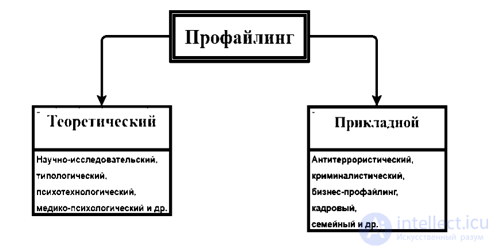
Figure 2. Types of profiling
Depending on the areas of application and the tasks set before profiling specialists, the following branches of profiling are distinguished at present (see fig. 3).
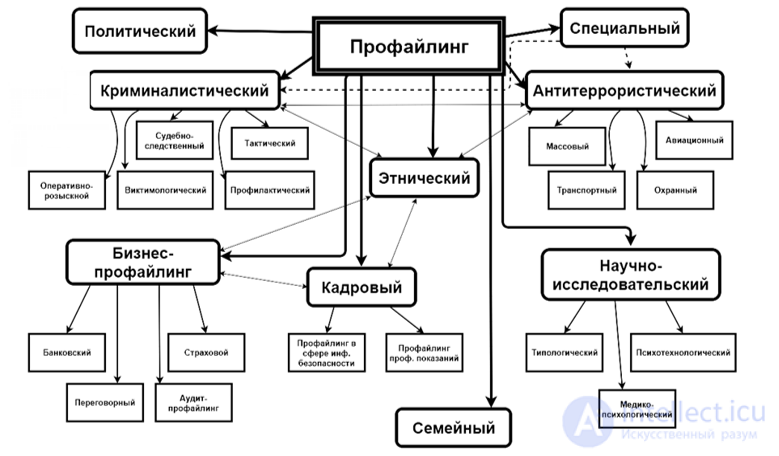
Figure 3. Branches of profiling
The criminalistic branch is one of the oldest and most theoretically developed branches of profiling. It is used by the law enforcement agencies and special services of a number of states, including the Ministry of Internal Affairs and the FSB of Russia, as well as the FBI and CIA (USA).
The specialist's main task in carrying out profiling actions is to compile a psychological portrait (a description of personality type, basic character traits, possible psychological or mental deviations, and distinctive features) of the presumed offender. In most cases, a profiler's activity involves compiling a profile of persons who have committed serial murders or maniacally coloured crimes. It is based on the use of knowledge in the fields of psychology, psychiatry, psychophysiology, criminalistics, sociology, and statistics. It includes preventive, tactical, investigative-operational, forensic-investigative, victimological, and other types of profiling.
Political profiling relies not only on knowledge in the fields of psychology and physiology, but also integrates the developments of PR technologists into the theory of profiling. It studies the verbal and nonverbal behaviour of politicians, evaluates the psycholinguistic features of how their speeches are constructed, their communicative abilities, facial expressions, and body language. Political profiling is the process of analyzing and building a psychological profile of a political figure, candidate, party, or voter on the basis of their political convictions, behaviour, speech, and other characteristics. This type of profiling can be used in political strategy, election campaigns, marketing, and public opinion analysis.
The special branch is connected with the activity of the special services and serves to ensure the security of the state against external threats. Recently, in connection with the increased threat of terrorist incursions, it has partly found its development within counterterrorist and criminalistic profiling.
Counter-terrorism profiling is used to prevent criminal and terrorist threats, primarily in places where large numbers of people gather. This type is based on observing a person's emotional state while they are in public places. Non-verbal behaviour is assessed and analysed for signs of stress, nervousness, and atypical behaviour in order to identify potentially dangerous visitors or passengers who may be preparing to commit an unlawful act.
It is subdivided into: aviation, transport, hotel, mass-event, and security profiling (which, in turn, is further divided depending on the type of facility), among others.
Counter-terrorism profiling is a method of analysing and building psychological profiles of individuals or groups who may pose a threat in the area of terrorism or national security. It can be used by law enforcement agencies and intelligence services to identify potential terrorist threats, identify suspects, and develop strategies for preventing terrorist acts. Counter-terrorism profiling includes the analysis of behaviour, connections, communications, and other characteristics that may indicate a possible security threat.
Aviation profiling is applied at civil aviation facilities and serves the purpose of ensuring flight safety. It is one of the most theoretically developed areas. The use of established algorithms for observing, questioning, and screening individuals before a flight makes it possible to identify potentially dangerous passengers and prevent prohibited cargo from being brought on board.
Transport profiling prevents unlawful acts at transport infrastructure facilities (on railways, on road transport, in railway and bus station buildings, on platforms, and in vehicle parking areas).
Mass-event profiling serves to prevent unlawful acts during major public events. It is based on the simultaneous analysis of the behaviour of a large number of people, as well as on assessing the dynamics of behavioural change when people gather in large crowds.
Security profiling (hotel security, shopping-centre security, special-facility security, cultural-centre security, and place-of-worship security) helps prevent unlawful and terrorist acts on the premises of protected facilities, taking into account the specifics of their operation.
Research profiling is an actively developing branch, continually enriched with modern theories and methods. In recent research, the main emphasis has been on developing emotion-reading capabilities, including remote lie detection. It includes a number of theoretical directions (typological, psychotechnological, medico-psychological, and others).
Typological profiling represents scientific research in the field of studying and creating psychotypologies, used for the rapid diagnosis of a person's psychotype and for determining, on that basis, the key personality traits that make it possible to construct the most probable behavioural models.
The psychotechnological direction describes a person's metaprogram profile, characterises their system of values and beliefs, and identifies the specifics of how they receive, process, analyse, and evaluate information. It is applied to understand a person's key irrational beliefs and their individual characteristics in various areas of activity. It also develops ways of correcting these characteristics.
The medico-technological direction is based on the work of the Russian and Soviet psychiatrist P. B. Gannushkin in the field of the typology of psychopathies, and the German psychiatrist K. Leonhard, who developed the theme of personality accentuation. Research in this area is both theoretical and applied in nature: it is used not only in all the main branches of applied profiling but also in medical practice (in the field of psychotherapy and psychiatry).
Business profiling (commercial profiling) applies profiling methods and technologies to identify current interests and business benefits, assesses the effectiveness of negotiations and business communications, establishes the reliability of information provided by counterparties, and helps reliably determine the sincerity of partners' declared intentions. It includes the analysis of non-verbal components of business contacts and helps ensure correct and timely decisions. In practice, it amounts to a business being accompanied by a professional profiler. It includes banking, negotiation, insurance, audit profiling, and others.
Business profiling, also known as commercial profiling, is a method of analysing and building profiles of organisations, companies, customers, or market segments based on various business parameters and characteristics. This type of profiling is widely used in the world of business and marketing for decision-making, strategy optimisation, and resource management. Here are some of its main aspects:
Market analysis: Creating a market profile allows companies to understand their competitors, identify their target audience, and uncover growth opportunities.
Customer profiling: Analysing customer data helps companies better understand their customers' needs and preferences, which helps in creating more effective marketing strategies and offers.
Assessment of partners and suppliers: Commercial profiling can be used to assess partners and suppliers in order to minimise risks and identify potential opportunities for cooperation.
Competitor analysis: Creating a competitor profile allows companies to understand their strategies, strengths, and weaknesses, which can help develop more effective competitive tactics.
Risk management: Commercial profiling can be used to identify risk factors in the business environment and to develop strategies for reducing them.
Investment decision-making: When analysing potential investments or acquisitions, companies can apply business profiling to assess potential partners and projects.
This type of analysis and profiling helps companies plan and make decisions more effectively, as well as improve their competitiveness in the market.
Personnel (HR) profiling is used during recruitment and subsequent work with employees. It is aimed at establishing whether a candidate's profile matches the requirements of the position, ruling out a criminal past or criminal intent on the part of the candidate, and solving other personnel-related tasks. In addition, within this branch, an assessment is made of employees' individual characteristics in order to achieve their fuller professional realisation. Corporate profiling includes profiling in the field of information security and profiling of professional aptitudes (abilities).
Information security profiling includes the analysis of personnel risks and the risks of important commercial information leaking beyond the company, and studies employee loyalty.
Ethnic profiling studies the features of a person's verbal and non-verbal behaviour, predicts their behavioural stereotypes and readiness for business cooperation from the standpoint of belonging to a particular ethnic group, language, religion, traditions, and culture. It examines the peculiarities of time perception and information-acquisition patterns adopted by various peoples.
Family profiling. Used in modern family psychotherapy to determine the level of trust in a partner, it is aimed at studying the compatibility of a couple and helps build healthy, harmonious relationships within the family.
Family profiling is a method of analysing and creating psychological profiles of family members in order to understand their interaction, the dynamics of their relationships, sources of conflict, and other aspects of family life. This type of profiling can be useful for psychologists, family counsellors, and therapists who work with families to improve their relationships and resolve family problems.
Family profiling includes the following aspects:
Identification of roles and dynamics: Analysing the roles and interaction of family members can help identify which family members perform which functions and how this affects the overall dynamics within the family.
Communication analysis: Family profiling can help identify patterns of communication within the family and reveal problems in communication between family members.
Identification of conflicts: By analysing the profiles of family members, it is possible to identify sources of conflict and attempt to develop strategies for resolving them.
Development of family therapy strategies: Family profiling can be used to develop individual family therapy strategies that will help improve relationships and solve problems within the family.
Assessment of family values and beliefs: Analysing profiles can also include assessing family values and beliefs that may influence the decisions and actions of family members.
Family profiling can be a powerful tool for understanding and improving family relationships and resolving problems within the family.
As can be seen from the diversity of its branches, modern profiling is developing rapidly in its variety. Over the past decade, the phenomenon of profiling has firmly established itself both in the system of theoretical and applied scientific knowledge.
In this regard, profiling is of undoubted interest from the point of view of its further development and application in a wide range of fields, from the highly specialised compilation of a psychological portrait (profile) of a person to broad use in the sphere of interpersonal relations and communication.
Thus, profiling is a tool for analysing and creating profiles of people or situations based on available information, which can be useful in various fields of activity

Comments