
Lecture
The methods specific to sociolinguistics as a linguistic discipline can be divided into methods of collecting material, methods of processing it, and methods of assessing the reliability of the data obtained and their substantive interpretation.
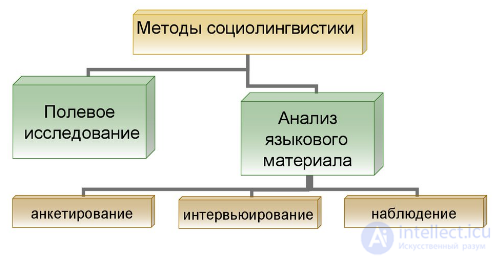
In the first group, methods borrowed from sociology, social psychology, and, in part, dialectology predominate; in the second and third, methods of mathematical statistics occupy a significant place. There is also a specific character to the presentation of sociolinguistic materials. In addition, material that has been collected, processed, and evaluated by statistical criteria requires sociolinguistic interpretation, which makes it possible to reveal regular connections between language and social institutions. In gathering information, sociolinguists most often resort to observation and various kinds of surveys; the general scientific method of analysing written sources is also fairly widely used. Naturally, these methods are often combined: after a preliminary analysis of written sources, the researcher formulates a hypothesis, which is then tested through observation; to verify the data collected, the researcher may resort to surveying a particular part of the social community of interest.
Alongside ordinary observation, sociolinguists often employ the method of participant observation. This way of studying people's behaviour consists in the researcher becoming a member of the group being observed. Naturally, observation can be participant observation only when nothing prevents the researcher from identifying with the members of the social group under observation – in terms of national, linguistic, behavioural, and other characteristics. A European, for example, finds it difficult to conduct participant observation in groups of Chinese people or dark-skinned people; an adult researcher can in no way become fully assimilated into a group of adolescents under study; a town-dwelling dialectologist is always perceived by village inhabitants as someone not from their milieu, and so on.
If, however, no such obstacles exist and the observer is able to infiltrate the group, becoming "just like everyone else," he can successfully conceal his research intentions, and later his actions as well. Being "exposed," on the other hand, leads to failure and, in some situations, is dangerous to the observer's life. Thus, two European ethnographers studied the way of life, behavioural characteristics, and language of dervishes – wandering Muslim monks – and mimicked them so skilfully that the monks took them for their own; they were exposed, however, by their habit of unconsciously tapping out a musical rhythm with their foot, something entirely alien to dervishes. There is a well-known case of a philologist-prisoner who, in a labour camp, tried to secretly keep records of thieves' argot away from the other prisoners. However, his position as an intellectual outsider among criminals fairly quickly led his barrack neighbours to expose him and consider him an informer. With great difficulty he nevertheless managed to prove the scholarly nature of his activities, after which people even began to help him collect material.
Both in external and in participant observation, the researcher must record the speech material being observed. Recording can be done in two main ways: by hand and by instrument.
Handwritten notes are convenient in that no special preparation is needed for them: if you have a pencil and paper, and your ear is "tuned" to perceive certain facts of speech, then, provided the object under observation (a person or a group of people) does not know of your intentions or, knowing them, does not object, the notes can be made relatively easily and successfully. Handwritten notes are especially effective when observing occasional linguistic units that rarely appear in the flow of speech – words, word forms, syntactic constructions. If, however, the task is to study not isolated facts but, for example, connected speech, the nature of people's dialogic interaction in the process of communication, the characteristics of pronunciation, intonation, and verbal behaviour as a whole, then handwritten notes are of little use: the observer manages to record only certain links of the speech chain, and the choice of these links is always subjective.
For this reason, most of the tasks addressed by modern sociolinguistics in the study of spoken speech are characterized by the use of instrumental technology – chiefly tape recorders and dictaphones (video cameras are also used to record gestural and facial behaviour). This use may be either open or covert. When a recording device is used openly, the researcher informs the informants of the purpose (true or false) of the recordings and, while observing their speech, tries to reduce the so-called "microphone effect," which to one degree or another constrains the natural behaviour of the individuals under study. The microphone effect is entirely removed when recording equipment is used covertly, without the informant being informed of its use; in this case, the data obtained characterize the natural, spontaneous verbal behaviour of native speakers.
Written questionnaires, oral interviews, tests, and certain other methodological techniques for data collection are widely used in sociolinguistics, aimed at revealing certain regularities in the command of language and in its use by speakers in various communicative conditions.
The data collected are compiled into tables and processed – by hand, if there is not much of it, or mechanically, which is used in large-scale sociolinguistic surveys. This is followed by the mathematical-statistical evaluation of the material obtained and its substantive interpretation, by means of which the researcher reveals the relationship between the use of language and certain social characteristics of its speakers.

Comments