
Lecture
Signal — the material embodiment of a message, used for transmitting, processing and storing information.
Signal — a code (symbol, sign) generated and transmitted into space (over a communication channel) by one system, or arising in the process of interaction between several systems. The meaning and significance of a signal are revealed after registration and interpretation by the receiving system.
Signal (in information and communication theory) — a carrier of information used to transmit messages within a communication system.
Any signal can be represented as a function that describes changes in its characteristics. This representation is convenient for studying radio engineering devices and systems. Besides the signal, radio engineering also deals with noise, which is its counterpart. Noise carries no useful information and distorts the signal by interacting with it.
There have been quite a few attempts to formulate a sufficiently convenient definition of this term, both in specialized literature and in formal regulatory acts.
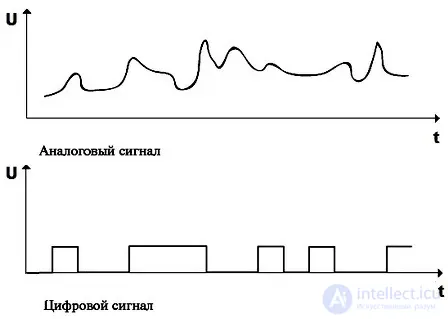
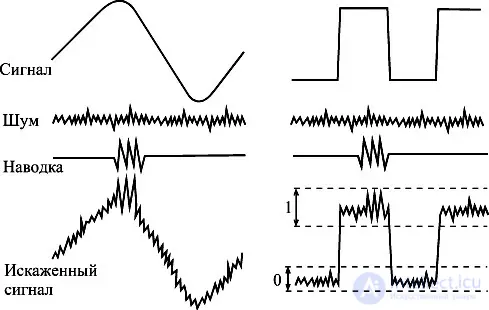
Fig. Ideal and distorted (real) digital and analog signal
Besides the encyclopedic definition given above, classical literature contains many other variants of the definition of the term “signal”.
“A signal is usually understood as a quantity that reflects, in some way, the state of a physical system. In this sense it is natural to regard a signal as the result of certain measurements carried out on a physical system in the course of its observation”.
“A signal can be defined as a function carrying information about the state or behavior of a physical system. (...) Mathematically, signals are represented as functions of one or several independent variables”.
“A signal is a physical quantity that varies over time, described by a function of time. One of the parameters of this function carries information about another physical quantity. Such a parameter of the signal (function) is called informative, and the physical quantity by which the signal is represented is called the signal carrier (the carrier of the signal); the signal has the dimension of that quantity”.
“A signal is usually defined as something that carries some kind of data”.
A signal can be generated without necessarily being received, unlike a message, which is intended to be received by the receiving party — otherwise it is not a message. A signal can be any physical process whose parameters change (or are set) in accordance with the message being transmitted.
A signal, whether deterministic or random, is described by a mathematical model — a function characterizing the variation of the signal's parameters. The mathematical model representing a signal as a function of time is a fundamental concept of theoretical radio engineering, one that has proven fruitful both for the analysis and for the synthesis of radio engineering devices and systems. In radio engineering, the counterpart of a signal carrying useful information is noise — usually a random function of time that interacts with the signal (for example, by addition) and distorts it. The main task of theoretical radio engineering is to extract useful information from a signal while necessarily taking noise into account.
The concept of a signal makes it possible to abstract away from a specific physical quantity, such as current, voltage, or an acoustic wave, and to consider, outside a particular physical context, phenomena related to the encoding of information and its extraction from signals that are usually distorted by noise. In studies, a signal is often represented as a function of time whose parameters may carry the needed information. The way this function is written, together with the way the interfering noise is written, is called the mathematical model of the signal.
In connection with the concept of a signal, such basic principles of cybernetics are formulated as the notion of the channel capacity of a communication channel, developed by Claude Shannon, and of optimal reception, developed by V. A. Kotelnikov.
By the physical nature of the information carrier:
and others;
By the method of specifying the signal:
Depending on the function describing the signal's parameters, the following are distinguished:
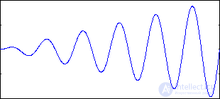
Analog signal
Analog signal — a data signal in which each of the representing parameters is described by a function of time and a continuous set of possible values.
Most signals depend continuously on the independent variable (for example, they vary continuously in time) and can take any value over some interval. “Signals continuous in time and with a continuous range of amplitudes are also called analog signals”. Analog signals (AS) can be described by some continuous mathematical function of time.
An example of an AS is a harmonic signal: s(t) = A·cos(ω·t + φ).
Analog signals are used in telephony, radio broadcasting, and television. Such a signal cannot be entered into a digital system for processing, since over any time interval it may take an infinite number of values, and representing its value exactly (without error) would require numbers of infinite word length. Therefore, it is very often necessary to convert an analog signal so that it can be represented by a sequence of numbers of a given word length.
Among experts there is an opinion that the term “analog signal” should be considered unsuccessful and outdated, and that the term “continuous signal” should be used instead.
Two signal spaces are distinguished — space L (continuous signals), and space l (small L) — the space of sequences.
Space l (small L) is the space of Fourier coefficients (a countable set of numbers defining a continuous function on a finite interval of the domain), while space L is the space of signals continuous over the domain (analog signals).
Under certain conditions, space L is uniquely mapped into space l (for example, the first two Kotelnikov sampling theorems).
Analog signals are described by continuous functions of time, so an analog signal is sometimes called a continual signal. Analog signals are contrasted with discrete signals (quantized, digital). Examples of continuous spaces and the corresponding physical quantities:
The properties of analog signals are, to a large extent, the opposite of the properties of quantized or digital signals.
Analog signals are often used to represent continuously varying physical quantities. For example, an analog electrical signal taken from a thermocouple carries information about temperature change, while a signal from a microphone carries information about rapid pressure changes in a sound wave, and so on.
Analog television is one type of television broadcasting. In some countries, for example in Russia [comm 1], terrestrial analog television is being replaced by digital television.
Discrete signal
“Discrete signals (signals in discrete time) are defined at discrete instants of time and are represented by a sequence of numbers”.
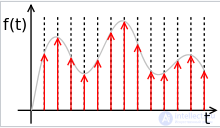
Sampling of an analog signal consists in representing the signal as a sequence of values taken at discrete instants of time ti (where i is an index). Usually the time intervals between successive samples (Δti = ti − ti−1) are constant; in that case Δt is called the sampling interval. The values of the signal x(t) at the instants of measurement, that is xi = x(ti), are called samples.
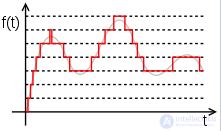
Quantized signal
During quantization, the entire range of the signal's values is divided into levels, the number of which must be representable by numbers of a given word length. The spacing between these levels is called the quantization step Δ. The number of these levels equals N (from 0 to N−1). Each level is assigned a certain number. The signal samples are compared with the quantization levels, and the number corresponding to some quantization level is chosen as the signal. Each quantization level is encoded by a binary number with n bits. The number of quantization levels N and the number of bits n of the binary numbers encoding these levels are related by n ≥ log2(N).
In accordance with GOST 26.013-81 , such signals are denoted by the term “multilevel signal”.
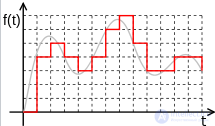
Digital signal
Digital signals are those in which both the independent variable (for example, time) and the level are discrete. Digital signal — a signal that can be represented as a sequence of discrete (digital) values. Nowadays the most common are binary digital signals (bit stream), owing to the simplicity of encoding and their use in binary electronics. To transmit a digital signal over analog channels (for example, electrical or radio channels), various types of keying (modulation).
In order to represent an analog signal by a sequence of numbers of finite word length, it must first be turned into a discrete signal and then subjected to quantization. Quantization is a special case of sampling in which the sampling is performed with a fixed step size, called the quantum. As a result the signal is represented in such a way that at each given time interval an approximate (quantized) value of the signal is known, which can be written as an integer. The sequence of such numbers is precisely the digital signal.
An important property of a digital signal, one that has determined its dominance in modern communication systems, is its ability to undergo complete regeneration at a repeater (up to some threshold signal-to-noise ratio). When a signal with small interference arrives at a repeater, it is converted to digital form, and the repeater re-forms the signal, completely removing the distortion. An analog signal, on the other hand, can only be amplified together with the noise superimposed on it.
On the other hand, if a digital signal arrives with large interference, it cannot be recovered (the cliff effect (Eng.)), whereas some information can be extracted from a distorted analog signal, though with difficulty. Comparing analog-format cellular communication (AMPS, NMT) with digital communication (GSM, CDMA), interference on a digital line sometimes causes whole words to drop out of a conversation, while on an analog line a conversation can still be carried on, albeit with interference.
A way out of this situation is to regenerate the digital signal more often, by inserting regenerators into breaks in the communication line, or to shorten the length of the communication line (for example, by reducing the distance from a cell phone to the base station, which is achieved by placing base stations more densely across the terrain).
The use of verification and recovery algorithms for digital information in digital systems makes it possible to substantially increase the reliability of information transmission.

 defines the time interval during which the signal exists (is nonzero);
 — the frequency band within which the main energy of the signal is concentrated;
 . It should be noted that there is an inversely proportional relationship between spectral width and signal duration: the narrower the spectrum, the longer the signal duration. Thus, the value of the time-bandwidth product remains practically unchanged;
Parameters of a periodic pulse signal:
amplitude Um – the largest of the instantaneous values (over the repetition period T);
repetition period T – the time interval from any instantaneous value of the signal to the next instantaneous value of the signal at the same level (at the same value of the derivative);
repetition frequency f – the number of oscillation periods per 1 s;
pulse duration τ – the time interval at the level 0.5Um;
rise time 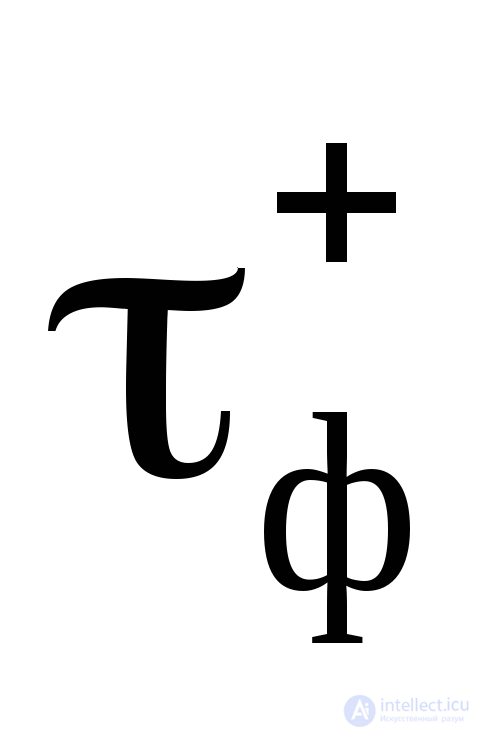 – the time interval during which the signal increases from the level 0.1Um to the level 0.9 Um;
fall time (trailing edge) 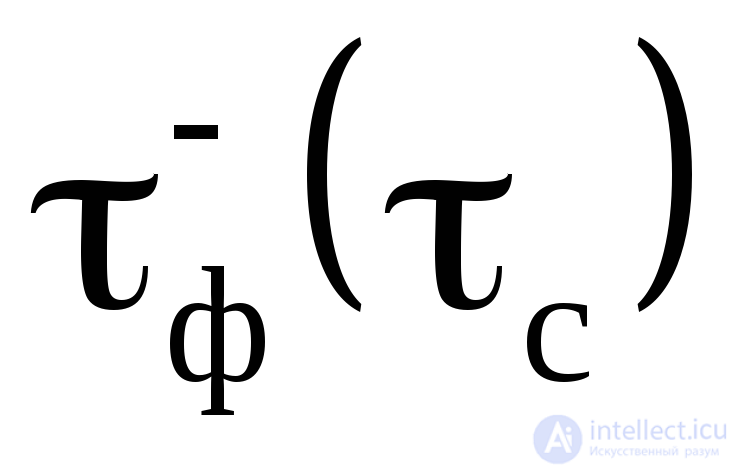 – the time interval during which the signal decreases from the level 0.9Um to the level 0.1 Um;
Sometimes the pulse duration is specified at some given level, for example at the level 0.1Um – 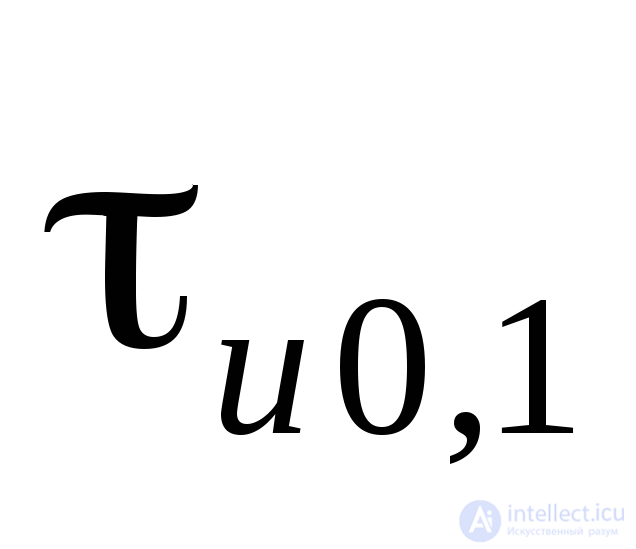 .
.
A pulse signal is considered rectangular if the duration of the flat portion at the level Um exceeds three times the duration 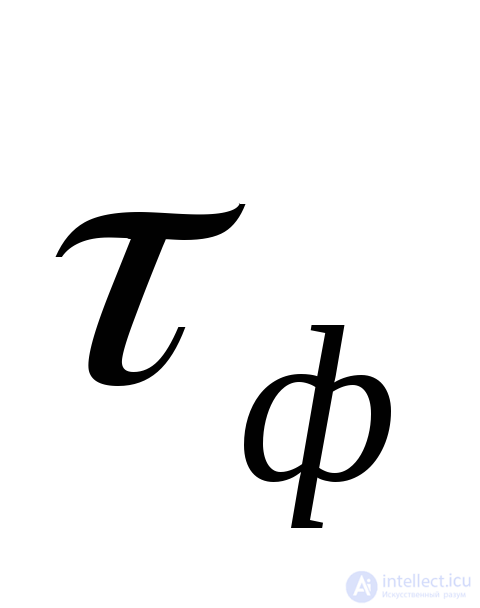 .
.
Figure 1.14 shows a periodically repeating pulse signal of positive polarity.
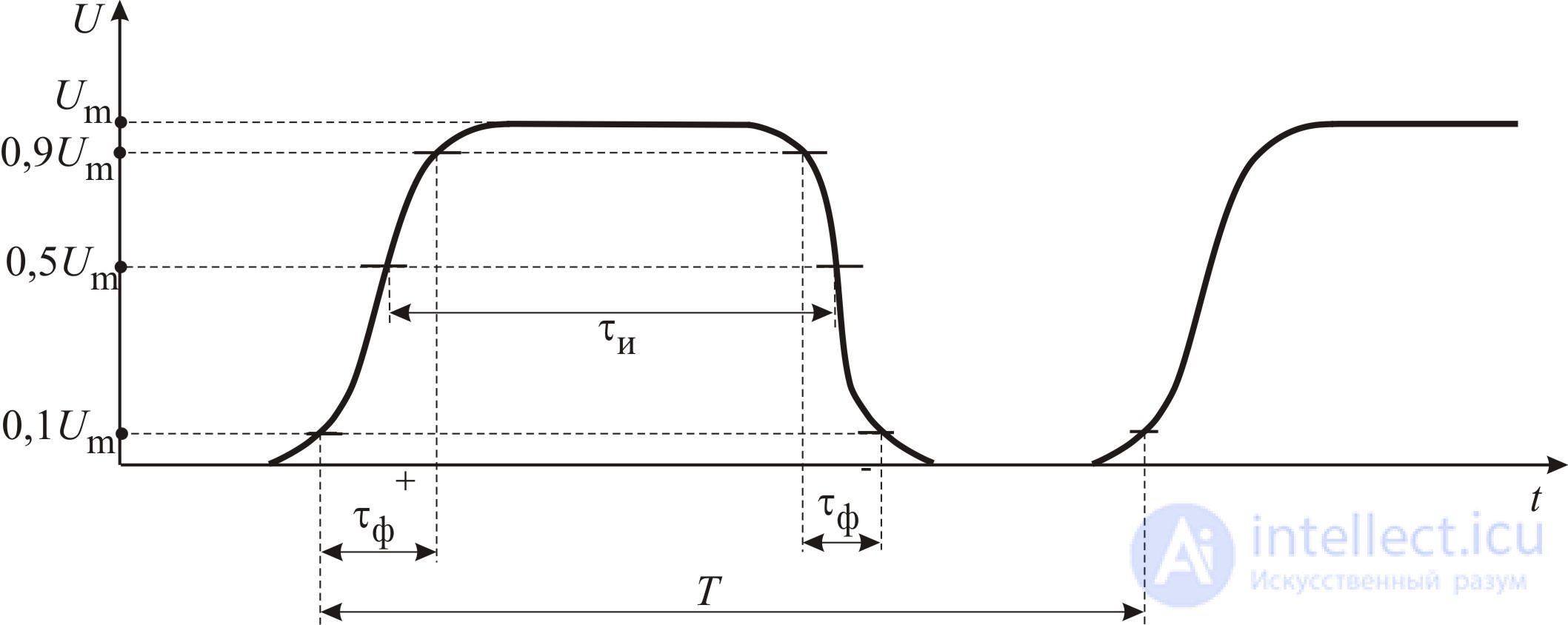
Figure 1.14 – Parameters of a periodic pulse signal
Measuring the period and frequency of a signal
By definition (see Fig. 1), the period T – is the smallest time interval after which a periodic signal repeats its values. The frequency f equals the number of periods per unit time. Frequency is related to the period by the simple reciprocal relationship f = 1/T, so once the period has been measured, it is easy to calculate the reciprocal quantity – the frequency, and vice versa.
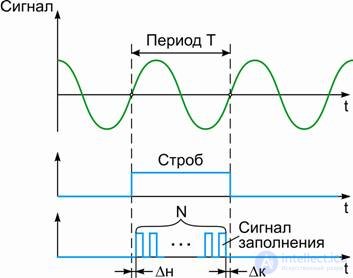
Figure 1 – Gating method for measuring the period of a signal
The characteristics of signals formally specified in the GOST standard are as follows.
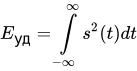
By strength, practical signals can be divided into two categories: energy signals and power signals. [14]
Energy signals: for these signals the energy equals a finite positive value, but their average power equals 0;
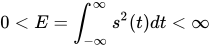
Power signals: the average power of these signals equals a finite positive value, but their energy is infinite.
t}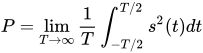
Deterministic signals are those whose values are predictable at any moment and can be computed using a mathematical equation.
Random signals are signals that take on random values at any given moment in time and must be modeled stochastically . [15
An event (receiving a note, observing a signal flare, receiving a character by telegraph) is a signal only within that system of relations in which the message is recognized as significant (for example, in combat conditions a signal flare is an event significant only to the observer to whom it is addressed). Obviously, a signal specified analytically is not an event and carries no information if the signal's function and its parameters are known to the observer.
In engineering, a signal is always an event. In other words, an event — a change in the state of any component of a technical system that is recognized by the system's logic as significant — is a signal. An event that is not recognized as significant by a given system of logical or technical relations is not a signal.
There are two ways of representing a signal, depending on the domain: the time domain and the frequency domain. In the first case the signal is represented by a function of time {\displaystyle s(t)} characterizing the change of its parameter.
Besides the familiar time-domain representation of signals and functions, the description of signals by functions of frequency is widely used in analysis and data processing. Indeed, any signal, however complex its shape, can be represented as a sum of simpler signals, and in particular as a sum of the simplest harmonic oscillations, the totality of which is called the frequency spectrum of the signal.
The Fourier transform is used to move to the frequency-domain representation:
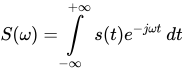 .
.
The function  is called the spectral function or spectral density. Since the spectral function is complex, one can speak of the amplitude spectrum
  and the phase spectrum
  .
.
Physical meaning of the spectral function: the signal is represented as the sum of an infinite series of harmonic components (sinusoids) with amplitudes  , continuously filling the frequency interval from
  to
to  , and with initial phases
  .
.
The dimension of the spectral function is the dimension of the signal multiplied by time.
In radio engineering, the main element of encoding is modulation of the signal. In this case one usually considers a signal close to harmonic of the form s(t) = A sin(2πf·t + φ), where the amplitude A, the frequency f, or the phase φ changes slowly (relative to the rate of change of the sine) depending on the information being transmitted (amplitude, frequency, or phase modulation, respectively).
Stochastic models of a signal assume that either the signal itself or the information it carries is random. A stochastic signal model is often formulated as an equation linking the signal with noise, which in this case simulates the set of possible information messages and is called forming noise, as opposed to interfering observation noise.
A generalization of the scalar signal model is provided, for example, by vector models of signals, representing ordered sets of individual scalar functions with a certain interrelation among the components of the vector. In practice, a vector model corresponds, in particular, to the simultaneous reception of a signal by several receivers with subsequent joint processing. Another extension of the concept of a signal is its generalization to the case of fields.
Signals in nature can be converted into electronic signals using various sensors. Examples include:
Other examples of signals are the output of a thermocouple , which conveys information about temperature, and the output of a pH meter, which conveys information about acidity.

Comments