
Lecture
Electric pulse — a brief surge of electrical voltage or current within a certain, finite time interval. A distinction is made between video pulses — single oscillations of some shape — and radio-frequency pulses — bursts of high-frequency oscillations. Video pulses can be unipolar (deflection in only one direction from zero potential) or bipolar.
An important characteristic of pulses is their shape, which can be visually observed, for example, on an oscilloscope screen. In general, a pulse shape has the following components: the leading edge — the initial rise, a relatively flat top (not present in all shapes), and the trailing edge (fall) — the final drop in voltage. There are several types of pulses with standard shapes that have a relatively simple mathematical description; such pulses are widely used in engineering
Besides pulses of standard, simple shape, in special cases pulses of a special shape described by a complex function are sometimes used; there are also complex pulses whose shape is largely random in nature, for example, the pulses of a video signal.
In general, pulses are characterized by two main parameters — amplitude (peak-to-peak value — the voltage difference between the pedestal and the top of the pulse) and duration (denoted τ or ti). The duration of sawtooth and triangular pulses is determined at the base (from the start of the voltage change to its end); for other types of pulses the duration is conventionally taken at a voltage level of 50% of the amplitude; for bell-shaped pulses a level of 10% is sometimes used; the duration of artificially synthesized bell-shaped pulses (with a clearly defined base) and of sine-wave half-waves is often measured at the base.
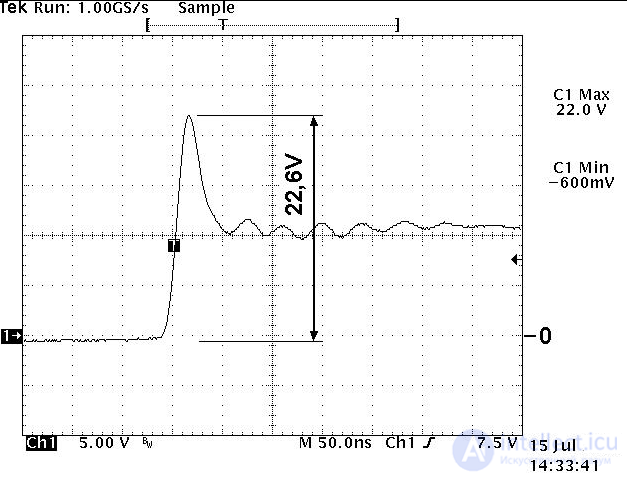
Overshoot at the top of a rectangular pulse
For different types of pulses, additional parameters are also introduced that refine the shape or characterize the degree of its non-ideality — deviation from the ideal. For example, to describe the non-ideality of rectangular pulses, parameters such as rise time and fall time (which are zero for an ideal rectangular pulse), top non-uniformity, and the size of the voltage overshoots after the leading and trailing edges, arising from parasitic transient processes, are used.
Besides the time-domain representation of pulses, observed on an oscilloscope, there is also a spectral representation, expressed as two functions — the amplitude spectrum and the phase spectrum.
The spectrum of a single pulse is continuous and infinite. The amplitude spectrum of a rectangular pulse has clearly defined minima on the frequency scale, occurring at an interval that is the inverse of the pulse duration.
Sometimes pulses are used or occur not singly but in groups, which are called pulse bursts or series of pulses, in the case when they are formed deliberately for transmission somewhere. A pulse burst can carry some information of a single, isolated nature or serve as an identifier. Information-bearing bursts of rectangular pulses, in which the significant quantities are the number of pulses, their timing, or the pulse durations, are called code-pulse bursts or, in some fields of engineering, frames. Information can be encoded in bursts in various ways: a binary digital code, a pulse-time code, Morse code, a set number of pulses (as in a telephone set). In many cases pulse bursts are used not singly but as continuous sequences of bursts.
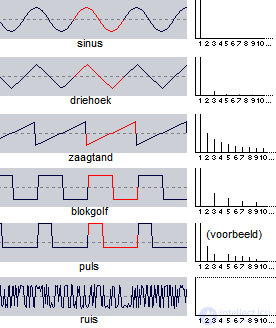
A pulse train is a sufficiently long sequence of pulses used to transmit continuously varying information, for synchronization, or for other purposes, and also generated unintentionally, for example, during sparking in commutator-brush assemblies. Trains are divided into periodic and aperiodic. Periodic trains are a series of identical pulses repeating at strictly equal time intervals. The length of the interval is called the repetition period (denoted T), and the quantity that is the inverse of the period is the pulse repetition frequency (denoted F). For trains of rectangular pulses, two additional, uniquely interrelated parameters are also used: the duty ratio (denoted Q) — the ratio of the period to the pulse duration — and the duty cycle — the quantity that is the inverse of the duty ratio; the duty cycle is sometimes also used to characterize quasi-periodic and random trains, in which case it equals the average ratio of the sum of the pulse durations over a sufficiently long time interval to the duration of that interval. The spectrum of a periodic train is discrete and infinite for a finite train, and finite for an infinite one. Among aperiodic trains, from a technical standpoint the greatest interest is presented by quasi-periodic and random trains (in practice, pseudo-random trains are used). Quasi-periodic trains are sequences of pulses whose period or other characteristics vary around average values. Unlike the spectrum of a periodic train, the spectrum of a quasi-periodic train is, strictly speaking, not discrete but comb-shaped, with a small amount of fill between the teeth; in practice, however, this can sometimes be neglected — for example, in television engineering, to create a complete video signal, a chrominance signal is added to the black-and-white image signal in such a way that the teeth of its spectrum fall between the teeth of the black-and-white video signal's spectrum.
By the nature of the information, pulse signals can be used once (a one-time message about an event) or for continuous transmission of information. Pulse trains can carry time-sampled analog information or digital information; there are also cases where two kinds of information are embedded in a single, physically unified signal, for example, a television signal with teletext.
To represent information, various characteristics of both the pulses themselves and their aggregates are used, both individually and in combination
Thus, several generalized types of pulse signals carrying continuous information can be distinguished

Comments