
Lecture
Below are tests with one or several correct answers
0. Family psychology; the psychology of the family is
1. Fill in the missing word: "The _______ of a family is the composition of its members, together with the totality of their relationships."
2. Fill in the missing word: "_____ is the psychological distance between family members."
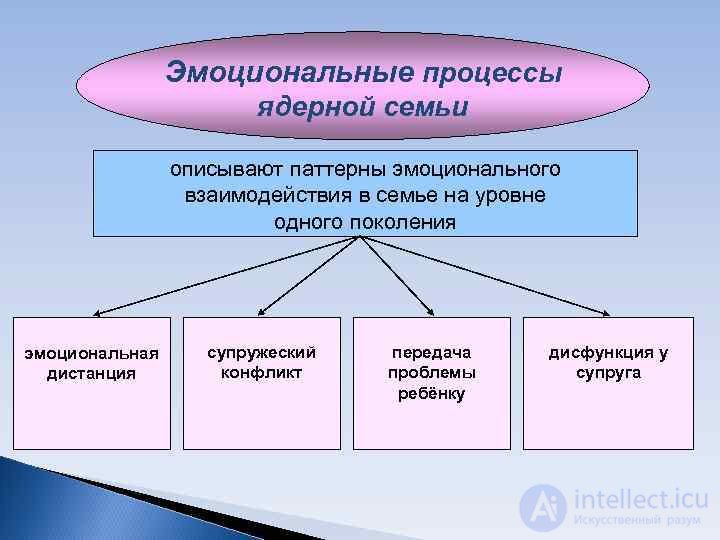
3. Fill in the missing word: "A very close psychological distance between family members that leads to family dysfunction is _______."
4. Fill in the missing word: "A very distant psychological distance between family members that leads to family dysfunction is DISENGAGEMENT, DISTANT RELATIONSHIPS."
5. Fill in the missing word: "_____ characterizes the relationships of dominance and subordination in the family."
6. Fill in the missing word: "The ____ of a family is the change in its structure and functions depending on the stages of its life course."
7. Fill in the missing word: "The ____ of a family is the family's life activity connected with satisfying certain needs of its members."
8. Fill in the missing word: "A family _____ is a form of family pedigree on which information about family members across at least three generations is recorded; it is a subjective tool for generating clinical hypotheses for analyzing the family structure."
9. Fill in the missing word: "The law of ____ is formulated as follows: every family system strives to preserve its position, whatever it may be."
10. Fill in the missing word: "According to the law of ____ , every family system must go through its life cycle."
11. Fill in the missing word: "Family _______ are local, differentiated sets of family roles that allow the family to selectively perform certain functions and to sustain its life activity."
12. Fill in the missing word: "External and internal ______ are the rules that determine who performs family prescriptions, and how, in a particular aspect of family life: marital, parental, or child."
13. Fill in the missing word: "____ boundaries of the family normally contribute to the formation of the family's identity."
14. Fill in the missing word: "_____ boundaries of the family contribute to structuring its psychological space."
15. Fill in the missing word in the appropriate gender, number and case: "_____ is the use of a third person to resolve a conflict between two other family members."
16. Fill in the missing word: "______ of interaction are stable ways of behavior of family members, their actions and messages, which are often repeated."
17. Fill in the missing word: "Family ____ are complex family knowledge, an unconscious mutual agreement between close people."
18. Fill in the missing word: "The ____ of the family is the family's self-awareness as a whole, integrated formation."
19. Fill in the missing word: "An inadequate image of "we" takes the form of a family MYTH."
20. Fill in the missing word: "Family VALUES are an ideal that has been developed, openly approved and cultivated by the family consciousness, containing abstract notions of the attributes of what is proper in various spheres of life."
21. Fill in the missing word: "The formation, fixation and transmission of patterns of emotional and behavioral response from representatives of one generation in dysfunctional families to representatives of another ("pathologizing family inheritance") is regarded as VERTICAL stressors in the family's life activity."
22. Fill in the missing word: "HORIZONTAL stressors are normative stresses, the critical points in passing through the family life cycle."
23. Fill in the missing word: "A DYSFUNCTIONAL family is a family in which the performance of functions is impaired, as a result of which preconditions arise for the emergence of horizontal and vertical stressors."
24. Select the correct statements regarding the definition: "The family is the cell of society, a form of organizing personal life based on a marital union.
25. Select the three models of the family identified by S. I. Golod: patriarchal (traditional), child-centered (modern), spousal (postmodern)
26. What psychological characteristics are identified in the patriarchal model of the family? The father is the head and makes decisions, the wife is subordinate to him, the children to their parents.
27. Select the main psychological characteristics typical of the patriarchal model of the family: the wife's dependence on the husband and the children's on the parents, strict fixing of family roles. Functions: bearing and raising children, running the household.
28. The patriarchal model of the family is characterized by: parental authority and an authoritarian system of upbringing.
29. What psychological characteristics are identified in the child-centered model of the family? Everything is directed to the good of the children, relationships are equal, parenting styles vary, children have more benefits than the parents.
30. What psychological characteristics are identified in the spousal model of the family? Interests extend beyond the family, relationships are based on eroticism, the spouses are autonomous, relationships are egalitarian.
31. The spousal model of the family is characterized by: autonomy of the spouses, egalitarian relationships
32. Select the three types of families by structural composition (A. E. Lichko): complete, incomplete, distorted (deformed) - with a stepfather or stepmother
33. Select the two types of families by functional characteristics (A. E. Lichko): functional and dysfunctional
34. According to A. E. Lichko's classification, the disharmonious families include: disharmonious proper, destructogenic, disintegrating, disintegrated, rigid, pseudo-solidary
35. What psychological characteristics do destructured families have according to A. E. Lichko? Lack of interaction, excessive autonomy, unevenness, lack of attachment
36. What psychological characteristics do rigid pseudo-social families have according to A. E. Lichko? Dominance of one member, a passive dependent position of the others, rigid regulation of life, lack of mutual warmth
37. Select the three correct statements: By form, a family can be
38. Select the correct statements. By form, a family can be:
39. Types of impaired family functioning that lead to traumatization of the family do NOT include:
40. Which state of the family system is described by the following statements: "Our family life is equally bad by day and by night," "I was unlucky with my family," "We were mistaken about each other"
41. Choose the three correct answers regarding the functions of the family:
42. Functions of the family:
43. What functions does the family perform?
44. Name an important feature of family functions based on the interaction of relatives: satisfaction of the needs of each member.
45. Dysfunctional stabilizers of the family are NOT: illnesses, children, alcoholism or drug addiction, mutual infidelity, suicide in the family
The main reasons for losing neutrality when working with a family: the counselor takes the side of one of the family members; the counselor "knows" the necessary outcome; the family comes with a problem the counselor has not worked through.
46. What is NOT among the signs that make up a communication problem in the family:
47. What are NOT the methodological principles of systemic therapy:
The principles are: circularity, neutrality and hypothesizing
48. Which parameters are NOT parameters of the family system:
49. The life of the family system obeys two laws: the law of homeostasis and the law of development. The law of homeostasis states: every system strives for constancy, for stability.
50. At the same time the law of development operates: every family system strives to pass through a full life cycle, which consists of a regular succession of stages and crises
51. Match the schools of family psychology and therapy with their representatives:
52. The family as a system is characterized by the following qualities: dynamism and changeability, structure and dynamics (from lecture notes).
53. The crisis at the triad stage is caused by: the birth of a child and the establishment of distance between people
54. Functional stabilizers of the family are NOT:
55. The predominant type of marriage at present is: monogamy
56. Marriage and family are the same thing.
57. The most common model of the family is:
58. The social structure of the family, inherent to humans, gives children the opportunity for:
59. People who grew up in a two-parent family divorce less often than those who grew up in a single-parent family: Fact
60. A survey of married people shows that when choosing a marriage partner, for both men and women, the first place was taken by the factor of: appearance, resemblance to the father/brother, and for men, to the mother.
61. Men, to a greater extent than women, are guided in choosing a female partner by:
traits directly or indirectly related to women's reproductive potential - youth and attractive appearance.
62. Women, to a greater extent than men, are guided in choosing a marriage partner by:
the man's material resources, his ability to support a family and feed offspring.
63. The functions of the premarital period in the relationship of partners include:
64. The tendency of a person, having seen some positive quality in another (for example, beauty), to attribute other positive qualities to him or her is called the effect of:
65. The structure of the family can be studied through:
66. The family is not a frozen social organization but a dynamic system that is constantly developing.
67. Is it true that the more candid spouses are with each other about their good and bad traits, the greater their marital satisfaction? False
68. For most married couples, the key to lifelong family happiness is lasting romantic love. False
69. A psychological game in which the partner is in the wrong no matter what he or she does (for example, one spouse asks the wife/husband to do a difficult task and then finds all sorts of faults in what was done; the result is "you are to blame for not doing it perfectly, but you are even more to blame if you refuse the request") is called: "Now I've Got You, You SOB"
70. Three players take part in a psychological game, for example a husband, a wife and a psychologist-counselor; one of the spouses complains to the counselor about the other's behavior, the other justifies himself or herself, and the psychologist is given the role of arbiter. What is this game called? "Court"
71. A woman tries to perform ten to twelve different tasks well, taking on a corresponding number of social roles (Wife, Mother, Housewife, Maid, Nanny, etc.); these roles conflict with one another, so the woman feels constantly tired. This psychological game can be called: "HARRIED HOUSEWIFE"
72. A woman marries an authoritarian husband who restricts her activity, thereby protecting her from situations she is actually afraid of. The wife gets the most out of the situation, constantly mentioning the existing restrictions and making her husband feel uncomfortable. He tries to make amends by indulging his wife's wishes. This psychological game is called: the psychological game "If It Weren't for You..."
73. Between spouses with which temperaments is the greatest psychophysical compatibility observed? With opposite temperaments (sanguine–melancholic, phlegmatic–choleric)
74. Which of the types of love listed below did E. Fromm NOT distinguish?
He distinguished:
75. A mother's stress during pregnancy does not affect the development of the fetus. Myth
76. The main factors that negatively affect the embryo and fetus during a mother's stress reactions include:
They may be deception, resentment, information overload, as well as situations that threaten safety, social status, economic well-being, or interpersonal relationships. The most harmful was the stress experienced by a mother whose partner treated her cruelly during pregnancy.
77. Whether a pregnancy is wanted or unwanted by the mother does not affect the development of the fetus.
Serious psychosocial stress during pregnancy and a negative attitude of the mother and those around her toward the unborn child can disrupt its mental and physical development and leave a deep mark in unconscious memory. After birth, as the child grows, the trauma received begins to show itself in the form of psychological and psychosomatic problems that disrupt the normal functioning of the person, and along with it, of his or her close ones and the people around.
78. The development of maternal qualities in a woman depends to a great extent on the conditions of her upbringing in childhood, in particular on: her mother's attitude toward her
79. Of the parenting styles listed below, the optimal one is: democratic
80. Which of the factors listed below plays the most important role in a child's intellectual development?
81. According to E. Erikson, the second psychosocial crisis, corresponding to the child's first learning processes, may be resolved by the development of an anomaly or, on the contrary, by the development of: autonomy, independence
82. Is it true that if a child sees parental love toward himself or herself only on condition of meeting normative requirements, this promotes better adaptation to culture? No
83. Is it true that abilities are entirely determined by teaching and upbringing? No
84. From the point of view of behaviorism, the strongest influence on behavior is exerted by: experience (cultural, social, family and interpersonal influence).
85. The following are NOT among the features of the family as a system:
It is characterized by the following series of features:
• interdependence: mutual influence of the individual elements of the system;
• holism: individual elements of the system, uniting into a whole, acquire new properties that differ from their original individual characteristics;
• structural organization, the main parameters of which are: hierarchy, or subordination of the elements of the structure;
the presence of boundaries describing relationships within the family and relationships between the family and its environment;
cohesion;
the role structure of the family;
• the specificity of intrasystem processes (circular, spiral; discontinuous, continuous);
• dynamism, or the ability to develop;
• the capacity for self-organization: the presence of forces within the family that allow it to remain an integral, balanced system and not fall apart;
• the dialectic of homeostasis and development.
86. In dysfunctional families, the structure of family roles meets the following requirements:
power and responsibility in the same sphere belong to different people.
87. Information in a dysfunctional family is transmitted by means of:
incongruent messages (the verbal part does not match the nonverbal part, or different parts of the verbal message contradict each other)
88. The characteristics of a family crisis do NOT include:
The following characteristics of a family crisis are identified:
89. Choose an adequate motivation for entering marriage:
Inadequate motivation for creating a marriage:
• Marriage as a way to make up for a deficit. This is observed when one or both spouses enter marriage out of a wish to stop feeling a lack of love, communication, care, warmth and attention, and want to avoid feelings of loneliness and being unneeded.
• Marriage as a way to separate from the parental family. The young spouses' desire to distance themselves from their parents is one of the most frequent inadequate motives for entering marriage. In this case, creating a new family becomes a specific communicative message to the parents that their child has grown up and has the right to independent decisions and an independent life.
• Marriage as a way to overcome some crisis: creating a family out of revenge on a former lover, as an attempt to cope with the loss of a significant person, as a way to endure professional failure, and so on.
• Entering marriage in order to conform to the norms of the social environment concerning the age of marriage and other aspects of marital behavior. Such a marriage is a way to avoid pressure from the social environment.
Marriage as compensation for a feeling of inferiority. Entering marriage can be a way to make up for defects in the "Self," usually caused by a pathological self-concept resulting from unresolved inter- and intrapsychic developmental tasks. In this case, attaching oneself to an idealized partner makes it possible to increase one's sense of self-worth and self-esteem.
• Marriage as an achievement. This is observed when one of the partners gains material or social benefit as a result of marriage.
• Forced marriage. In this case, entering marriage is a way to solve life difficulties that have arisen. These include an unplanned pregnancy, housing or financial problems of one of the spouses, and so on.
90. What is not among the markers of the crisis of the young family:
The markers of the first normative crisis (of the young family) are:
91. The following do not belong to destructive motives for pregnancy:
Constructive motives for pregnancy: *The desire to give life to another person with all his or her uniqueness and singularity *Pregnancy as a way of belonging to the family system ("in our family all the women had their first child at 22") - Pregnancy as an expression of the spouses' mutual wish to have a child ("we love each other and want to have a child together") - The desire to be a mother as a result of a woman's psychophysiological readiness for motherhood ("I want to take care of a child," "I want to feel the joy of motherhood," etc.) Destructive motives for pregnancy: - The desire to have a being who will embody the mother's unrealized plans, dreams and aspirations. - A woman's wish to avoid loneliness ("so that I have at least one close person," "to feel needed by someone"). - A way to make up for a lack of love for oneself ("at least someone will love me") - Pregnancy as conformity to social expectations ("to be like everyone else," "my age demands it," "my parents want grandchildren," "all my friends already have children," "my husband wanted a child very much," etc.) - Pregnancy as a way to preserve the relationship and keep the husband in the marriage ("to tie the husband down," "to get the husband back," "to prevent him from leaving the family," etc.) - Pregnancy as a way to achieve pseudo-differentiation from the parental family ("to show the parents that I have become an adult," "I had a baby to spite everyone") Pregnancy as a way to legitimize the marriage ("to force the parents to accept the marriage") - Material motives ("to improve living space," "to acquire the status of a large family and receive benefits," etc.) - Pregnancy for the sake of preserving one's own health ("abortion is harmful to health," "I am afraid I won't be able to have children after an abortion," "pregnancy rejuvenates the body") - Pregnancy as a rejection of the past, as a symbol of a new stage in a woman's life, or as a way to cross out a "stormy" past.
92. Signs that do NOT indicate that a family is experiencing the crisis of including children in external social structures:
Signs indicating that a family is experiencing this normative crisis include the following:
□ disappointment in the marriage partner, a feeling of being tired of the marriage.
93. The areas of conflict in a family with a teenage child are:
94. The crisis caused by a remarriage is associated with: • conflicts arising from the role uncertainty of the members of the new family; • conflicts related to inadequate attitudes, expectations and demands toward the new marriage partner, based on the experience of previous marital relationships; • violation of the external boundaries of the new family, usually expressed in an almost complete absence of contact with the extended families, caused by their non-acceptance of the new marriage, the partner or his or her children; • problems in child-parent relationships (an inverted hierarchy, shown as the child's disobedience toward the non-biological parent; competition between the biological and non-biological parent of the same sex for the right to be the child's "best parent"; a high level of conflict between the parent and the stepchild, etc.); • lack of closeness between the members of the merged families; • disappointment in the new marriage and the marriage partner, based on unfulfilled or unrealistic expectations.
95. What is NOT among the common family myths about remarriage:
The most common family myths about remarriage are: • if my partner loves me, he or she will also love my children; • my spouse must love my children as his or her own; • a stepmother (stepfather) will never love my child as her or his own; • a child can never come to love a stepmother (stepfather), because he or she must love his or her own father (mother); • the child will suffer from the presence of a strange man (woman) in the family; • the stepmother (stepfather) must not interfere in the upbringing of a stepchild; • a remarriage is always more successful than the previous one; • every subsequent marriage is always worse than the previous one, etc.
96. The following do not belong to non-normative family crises:
A non-normative family crisis is a crisis that can potentially arise at any stage of the family life cycle and is associated with experiencing negative life events defined as critical. R. Hill identified three groups of factors that lead to family crises:
1. External difficulties (lack of one's own housing, work, etc.).
2. Unexpected events, stresses (the family or one of its members becomes a victim of a terrorist attack, a car, railway or plane crash, etc.).
3. The family's internal inability to adequately assess and live through some family event that it regards as threatening, conflictual or stressful (a serious illness or the death of a family member, marital infidelity, divorce, etc.).
97. The functions performed by marital infidelity are as follows:
• a way to end the marital relationship and state the fact that the marriage has failed; • a way to attract the marriage partner's attention and convey to him or her a meta-message about the dissatisfaction of certain needs; • a way to preserve the marital relationship by fulfilling needs whose lack of satisfaction in the marriage is felt quite acutely; • the playing out of family scripts; • a way to compensate for a feeling of inferiority and raise self-esteem.
98. Psychological help in divorce is similar to the work done in: experiencing the loss of a loved one.
99. In the case of symbolic incest, the following signs are NOT characteristic of the child's behavior:
+it is characterized by the following signs:
• ambivalent feelings of love and hatred toward the parent: on the one hand, the child feels in a special, privileged position, and on the other, constantly feels insecure because of being unable to live up to expectations. The child may feel rage, anger and despair when he or she senses the inadequacy of the messages addressed to him or her;
• a feeling of guilt, an inability to identify one's own needs and expectations, which causes difficulties in self-identification;
• a chronic feeling of inadequacy, insufficient significance and dependence;
• a tendency to form superficial and short-term relationships with a large number of people. Having become adults, such people later have difficulty building deep, reciprocal relationships, readily enter superficial contacts and, not finding satisfaction, readily break them off, which contributes to the development of addictions, sexual dysfunctions and compulsivity. This is connected with a chronic fear of being abandoned by people who empathize with them and care for them. A constant search for a "perfect" partner and a desire to establish unique relationships based on mutual love are characteristic. After each relationship ends, a feeling of guilt, regret, remorse and dissatisfaction with oneself usually arises.

Comments